If your home has electric heating, heating and hot water usually use the most electricity; in a gas heated home, the biggest users are usually the washing machine, tumble dryer and dishwasher, followed closely by the fridge freezer. Knowing what uses the most electricity in a home comes down to two numbers for each appliance: how much power it draws and how long it runs.
Quick answer: Electric heating and hot water usually use the most electricity where a home has them. Otherwise, laundry and dishwashing appliances lead, at about 14% of a typical energy bill according to the Energy Saving Trust, followed by fridges and freezers at 13%. Cost depends on power multiplied by hours of use, so a small appliance left on all day can cost more than a big one used briefly.
What Uses the Most Electricity in a Home, Appliance by Appliance?
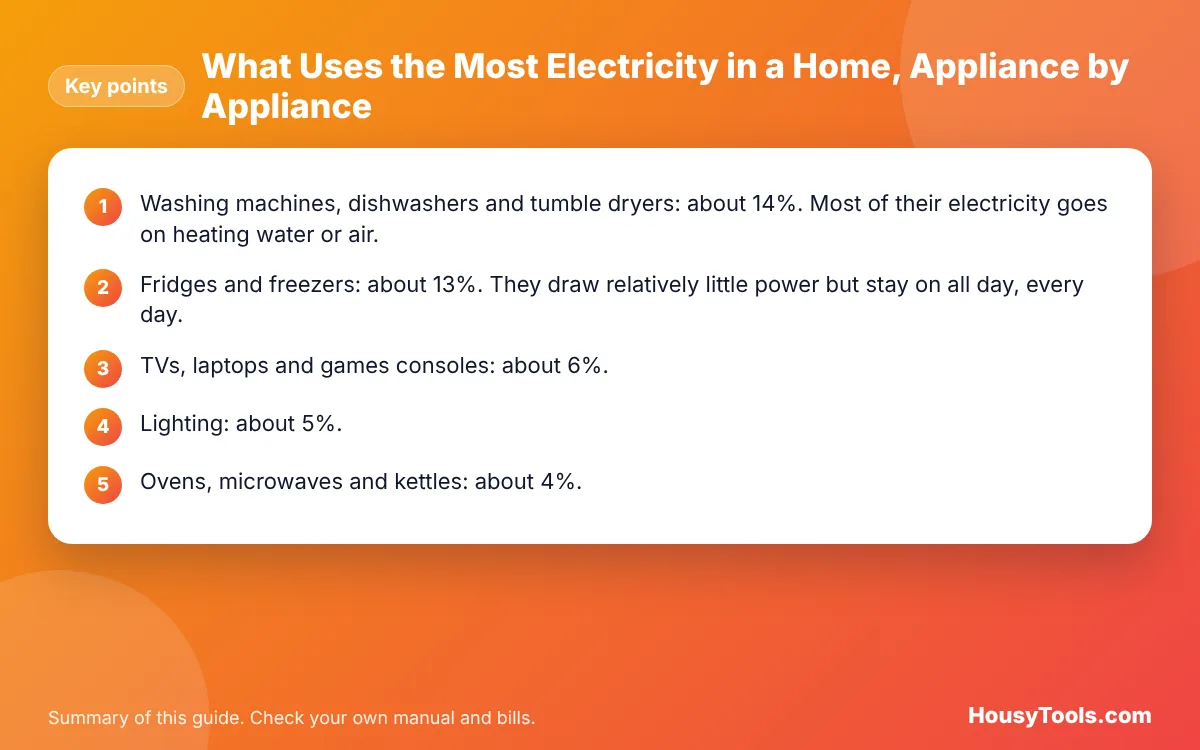
The Energy Saving Trust ranks wet appliances first, at around 14% of a typical household energy bill, in its guide to the appliances that drive up bills most. Its ranking, updated in August 2026, looks like this:
- Washing machines, dishwashers and tumble dryers: about 14%. Most of their electricity goes on heating water or air.
- Fridges and freezers: about 13%. They draw relatively little power but stay on all day, every day.
- TVs, laptops and games consoles: about 6%.
- Lighting: about 5%.
- Ovens, microwaves and kettles: about 4%.
These percentages are shares of a typical home’s whole energy bill, which for most UK households includes gas for heating. That is why heating does not appear in the list: in a gas heated home, it is paid for on the gas bill, not the electricity bill.
Does Electric Heating Use the Most Electricity?
Usually, yes: in a home heated by electric heaters, storage heaters or an electric boiler, heating tends to be the largest use of electricity, because heaters draw kilowatts of power for many hours a day. A 2,000 W heater running for 5 hours uses 10 kWh in a day. At the Ofgem price cap rate of 26.32p per kWh, that is about £2.63 a day from one heater.
The Energy Saving Trust notes that electricity is around four times more expensive than gas per unit of energy, and that heat pumps are about three times more efficient than standard electric heaters. Electric showers and immersion heaters for hot water are also high power appliances, so time spent heating water adds up quickly. Our electric shower cost calculator shows what each shower costs from its power rating and length.
How Do You Work Out What an Appliance Costs to Run?
The rule is simple: power in kilowatts multiplied by hours of use gives kilowatt hours (kWh), and kWh multiplied by your unit rate gives the cost. A kilowatt hour is the energy used by one kilowatt of power for one hour, as the kilowatt-hour definition explains.
- Find the power rating in watts (W) on the appliance’s rating plate or in its manual. Divide by 1,000 to get kilowatts.
- Estimate how many hours a day it actually runs at that power.
- Multiply kW by hours to get kWh per day.
- Multiply kWh by your unit rate from your bill.
Appliances that cycle on and off, such as fridges, washing machines and tumble dryers with sensors, do not draw their full rating all the time, so the rating plate gives an upper limit. A plug-in energy monitor or your smart meter display gives a more accurate figure. Our guide on how to calculate appliance running costs covers this in more depth.
How Much Does Electricity Cost Per kWh Right Now?
From 1 October to 31 December 2026, the Ofgem price cap sets an average electricity unit rate of 26.32p per kWh and a standing charge of 54.83p per day for customers paying by direct debit in England, Scotland and Wales. These are averages: actual rates vary by region, payment method and tariff, so use the figures on your own bill where you can.
Ofgem’s cap rates include no VAT on electricity for this period. HMRC guidance confirms a temporary 0% VAT rate on qualifying domestic electricity in Great Britain from 1 October 2026 to 31 March 2027. Northern Ireland keeps the 5% reduced rate.
Why Do Small Appliances Sometimes Cost More Than Big Ones?
Running time often matters more than wattage: a kettle draws a lot of power but runs for only a few minutes at a time, while a fridge freezer draws far less power but never switches off. The Energy Saving Trust estimates an F rated 424 litre fridge freezer costs around £80 a year to run in Great Britain, more than a 40 inch F rated TV at around £20.
Standby is the other hidden cost. The Energy Saving Trust says switching appliances off standby can save around £45 a year in Great Britain. Games consoles, TV boxes, chargers and older audio equipment are common culprits.
How Much Can You Save on Your Biggest Users?
The table combines the Energy Saving Trust’s share of bill figures with its published example savings for Great Britain. Savings are estimates for a typical home and depend on your appliances and habits.
| Appliance group | Share of typical energy bill | Example saving (GB, per year) |
|---|---|---|
| Washing machine, dishwasher, tumble dryer | About 14% | £50 by drying clothes on a line or rack; £26 by washing at 30°C and one fewer wash a week |
| Fridges and freezers | About 13% | Running cost depends on rating and size (for example £70 to £80 a year for the models EST compares) |
| TVs, laptops, consoles | About 6% | £45 by switching appliances off standby |
| Lighting | About 5% | £7 by turning off lights; about £45 by switching to LEDs |
| Ovens, microwaves, kettles | About 4% | £10 by not overfilling the kettle |
| Showers (hot water) | Not given as a share | £45 by keeping showers to four minutes |
Worked Example: What Does a Tumble Dryer Cost?
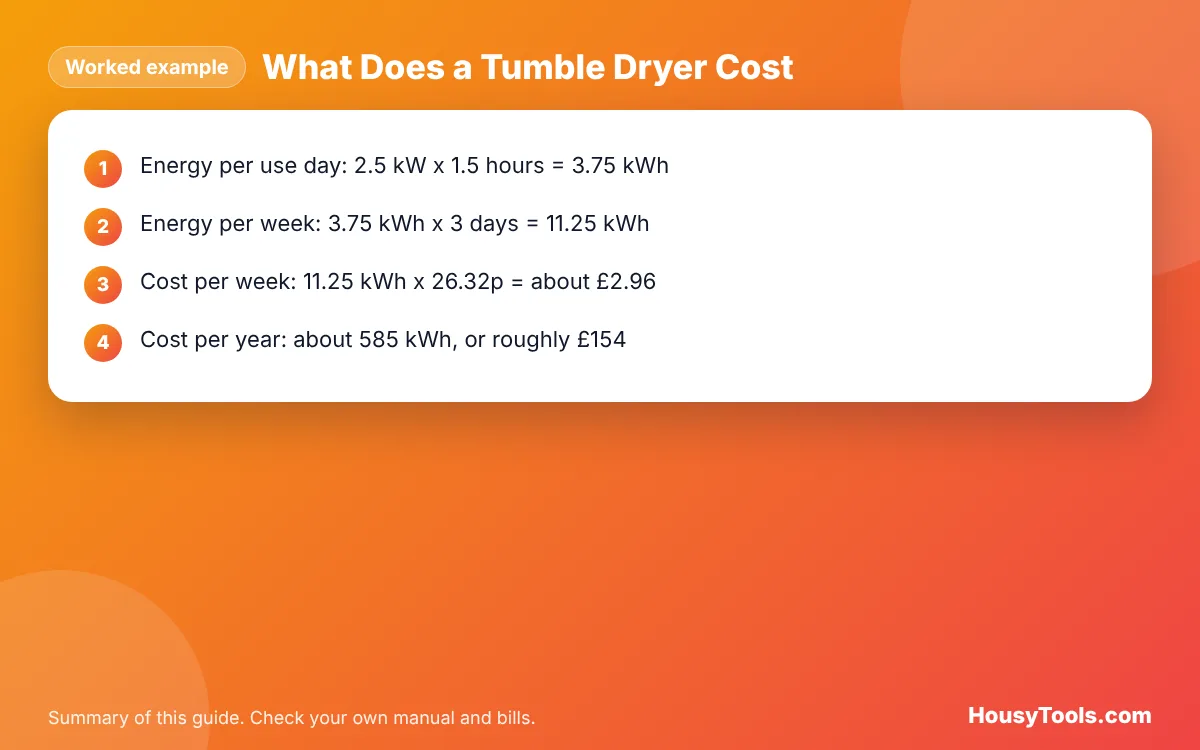
Example: a hypothetical homeowner checks the rating plate on a vented tumble dryer and finds it is rated at 2,500 W. It runs for about 1.5 hours a day, three days a week, at the price cap rate of 26.32p per kWh.
- Energy per use day: 2.5 kW x 1.5 hours = 3.75 kWh
- Energy per week: 3.75 kWh x 3 days = 11.25 kWh
- Cost per week: 11.25 kWh x 26.32p = about £2.96
- Cost per year: about 585 kWh, or roughly £154
Because the dryer cycles its heater, the true figure is likely to be somewhat lower than this maximum, but it is clearly one of the home’s biggest electricity users. You can reproduce this example in the electricity cost calculator by entering 2,500 W, 1.5 hours a day and 3 days a week with the UK price cap preset, then try your own appliances. For more tools, see our energy bill calculators.
Electricity Use at Home FAQs
What uses the most electricity in a house with gas heating?
Laundry and dishwashing appliances usually use the most, at about 14% of a typical energy bill according to the Energy Saving Trust. Fridges and freezers come next at about 13%, because they run continuously. Electric showers can also be a large cost if you have one.
Does leaving things on standby use much electricity?
Each device uses only a little, but together they add up. The Energy Saving Trust estimates that switching appliances off standby can save around £45 a year in Great Britain and £55 in Northern Ireland.
How do I find out how many watts an appliance uses?
Look for the rating plate, usually a sticker on the back, base or inside the door, or check the manual. It shows the maximum power in watts. For a real reading, use a plug-in energy monitor or watch your smart meter display while the appliance runs.
Is it cheaper to use a tumble dryer at night?
Only if you are on a time of use tariff such as Economy 7, which charges less per kWh at night. On a single rate tariff, the cost is the same at any time. Our Economy 7 calculator shows whether shifting use would save you money.
Do fridge freezers use a lot of electricity?
They use a moderate amount of power but run all the time, so they account for about 13% of a typical energy bill. The Energy Saving Trust estimates around £70 to £80 a year for the fridge freezers it compares in Great Britain.
How much does 1 kWh of electricity cost in the UK?
Under the Ofgem price cap from 1 October to 31 December 2026, the average direct debit unit rate is 26.32p per kWh in England, Scotland and Wales, plus a standing charge of 54.83p per day. Your own rate may differ by region and tariff.
Checked October 2026. Sources: Energy Saving Trust: What appliances drive up electricity bills most, Energy Saving Trust: Quick tips to save energy, Energy Saving Trust: Electric heating, Ofgem: Energy price cap unit rates and standing charges, GOV.UK: VAT on fuel and power.