
Show the formula and working
This vinyl flooring calculator works out the length of sheet vinyl to buy from a 2 m, 3 m or 4 m wide roll, for homeowners in the UK and Europe fitting a kitchen, bathroom, hallway or utility room. It adds a trimming allowance to every edge, tests both directions of lay, and picks the one that uses the least vinyl. It also shows seams, offcut waste and an optional cost.
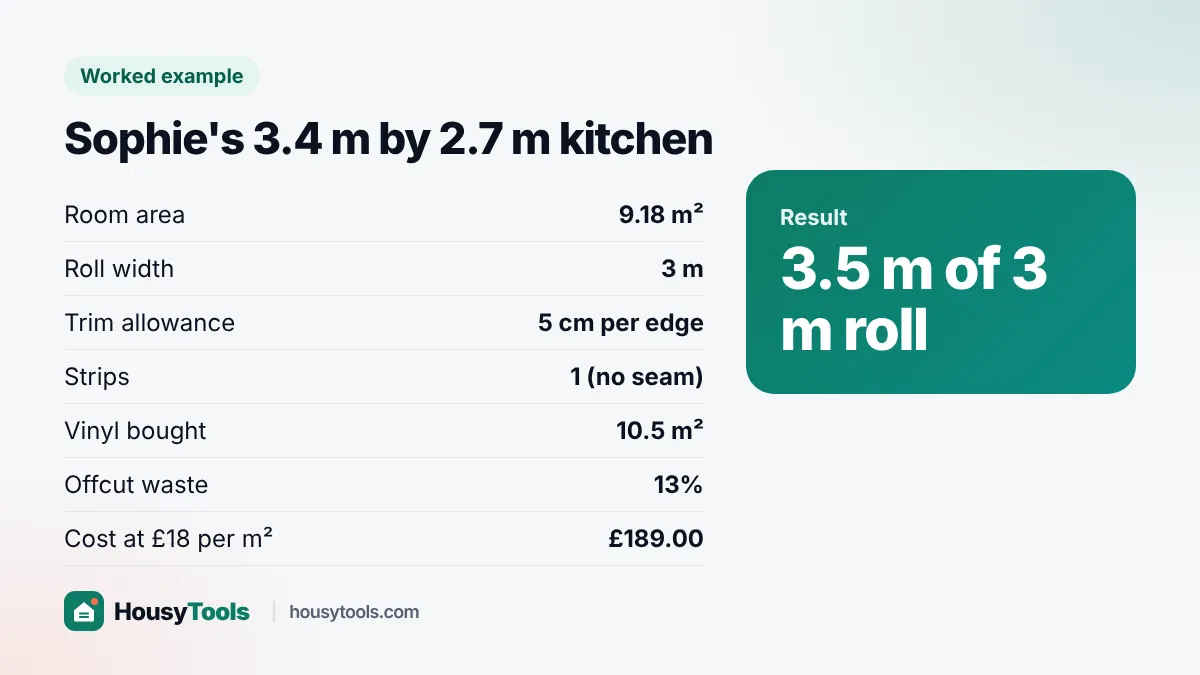
Quick answer: add a trim allowance to each edge, choose a roll width that spans the room in one piece, then buy a length equal to the other side plus trim. The vinyl flooring calculator shows a 3.4 m by 2.7 m kitchen needs 3.5 m of a 3 m roll, which is 10.5 m² with no seam.
What Is a Vinyl Flooring Calculator?
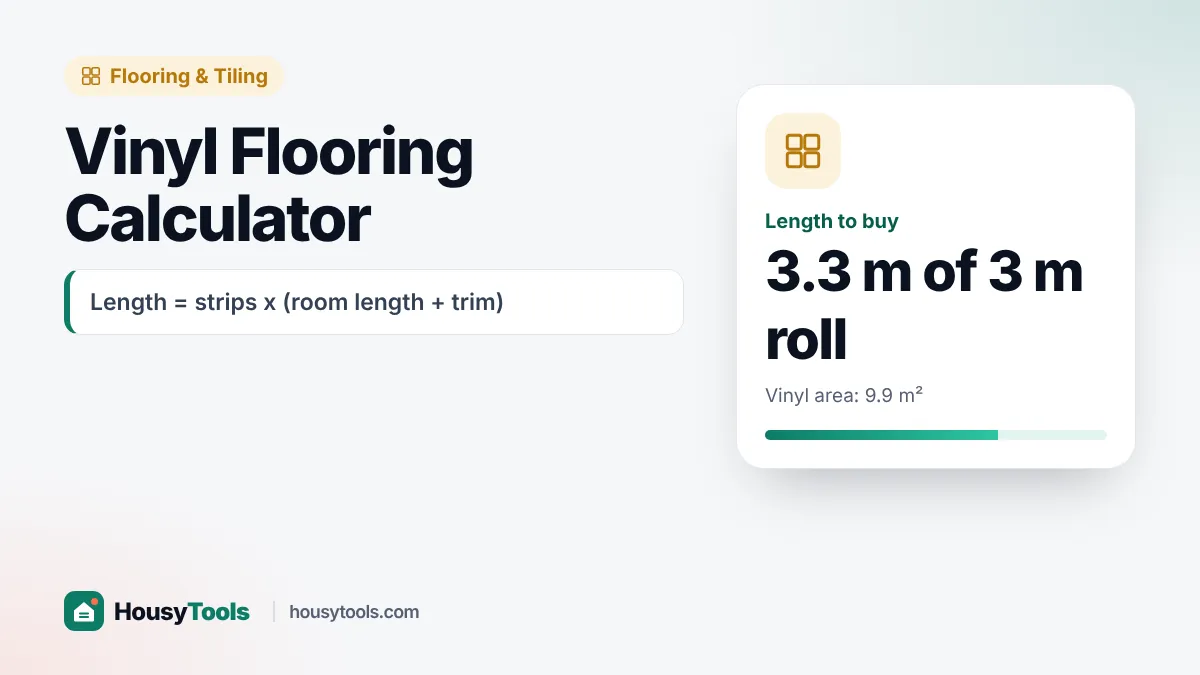
A vinyl flooring calculator is a tool that works out how much sheet vinyl to cut from a roll of fixed width to cover a room, including trimming allowance and any seams.
Sheet vinyl is sold off the roll by the linear metre, so square metres alone do not tell you what to buy. The tool adds the trim allowance to both edges in each direction, works out how many strips of your roll width are needed to cross the room, and multiplies that by the other side plus trim. It does this both ways round and keeps the layout that buys the least vinyl.
The Wikipedia article on sheet vinyl flooring describes it as vinyl supplied in large, continuous, flexible sheets, which is why roll width drives the order more than room area.
How Do You Use the Vinyl Flooring Calculator?
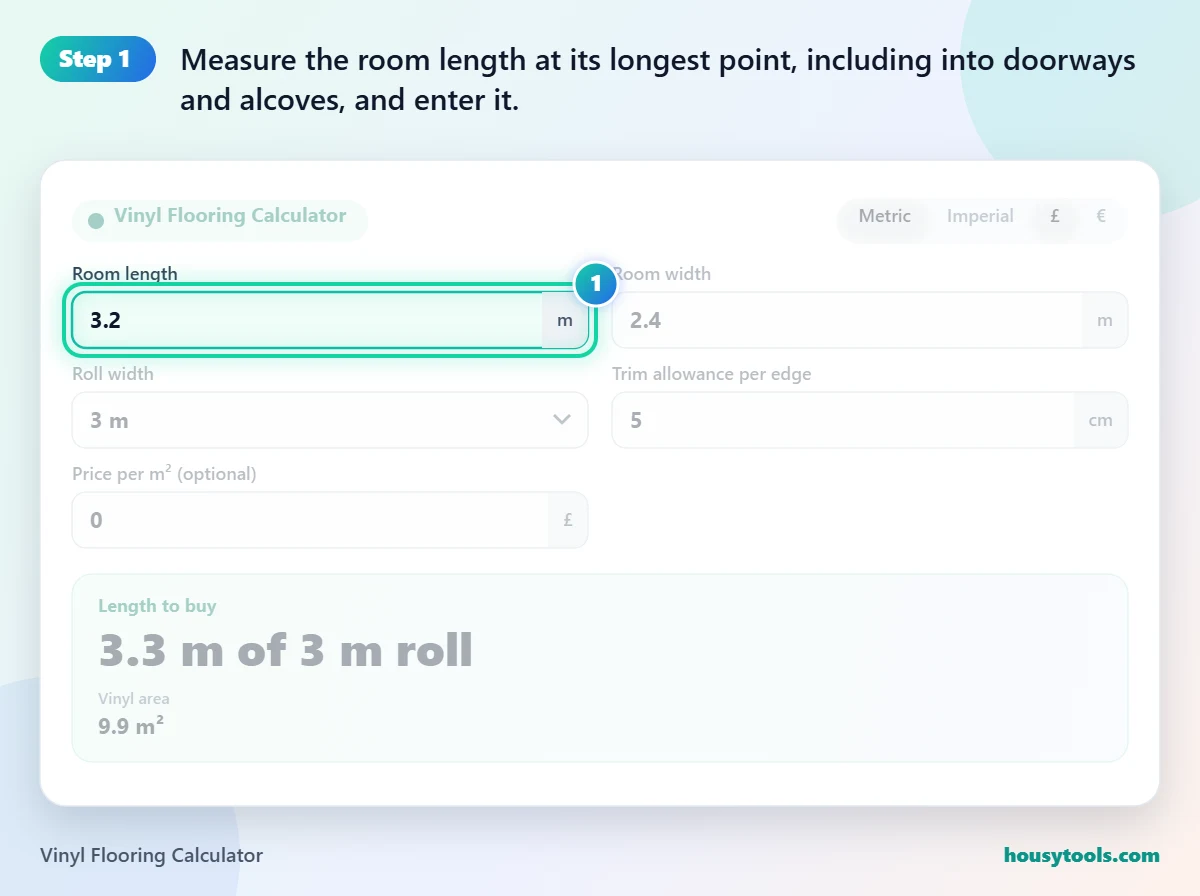
- Measure the room length at its longest point, including into doorways and alcoves, and enter it.
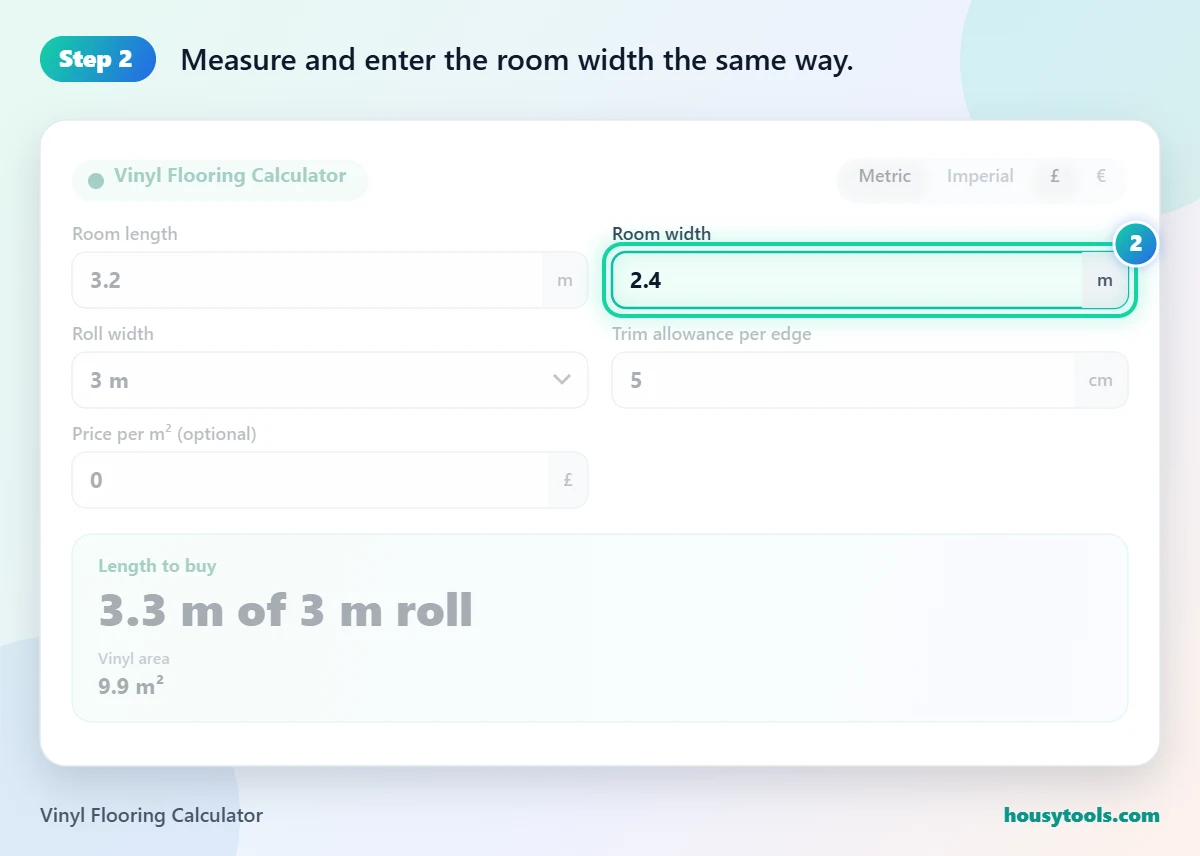
- Measure and enter the room width the same way. Use feet if you prefer imperial.
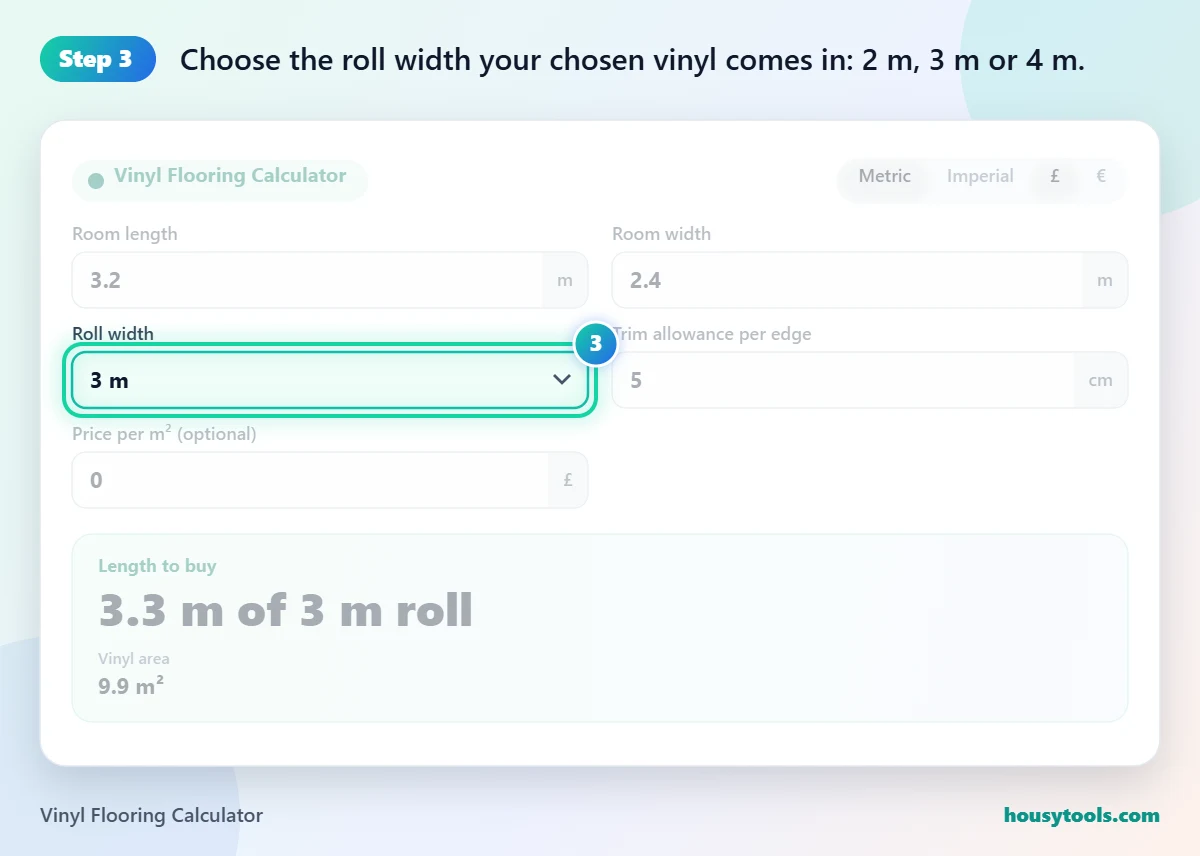
- Choose the roll width your chosen vinyl comes in: 2 m, 3 m or 4 m.
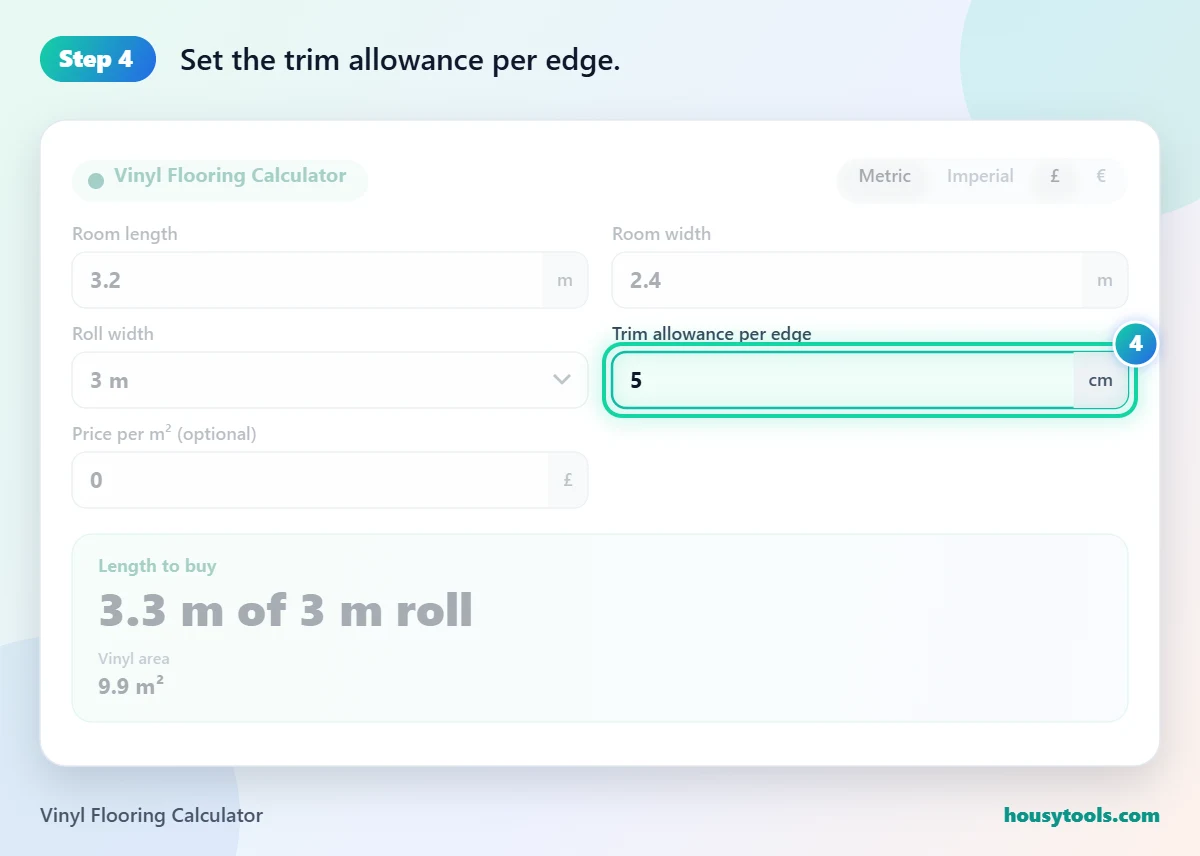
- Set the trim allowance per edge. The vinyl flooring calculator uses 5 cm, which suits most straight walls.
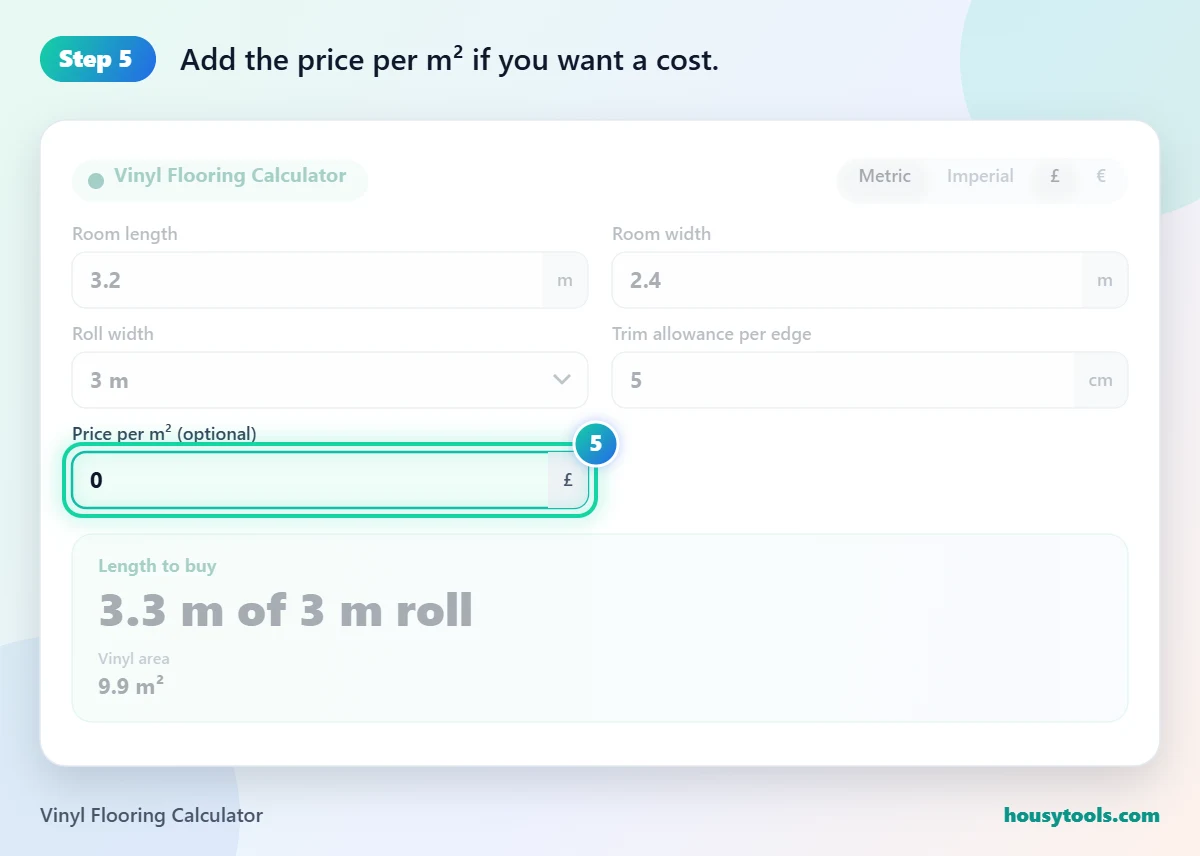
- Add the price per m² if you want a cost.
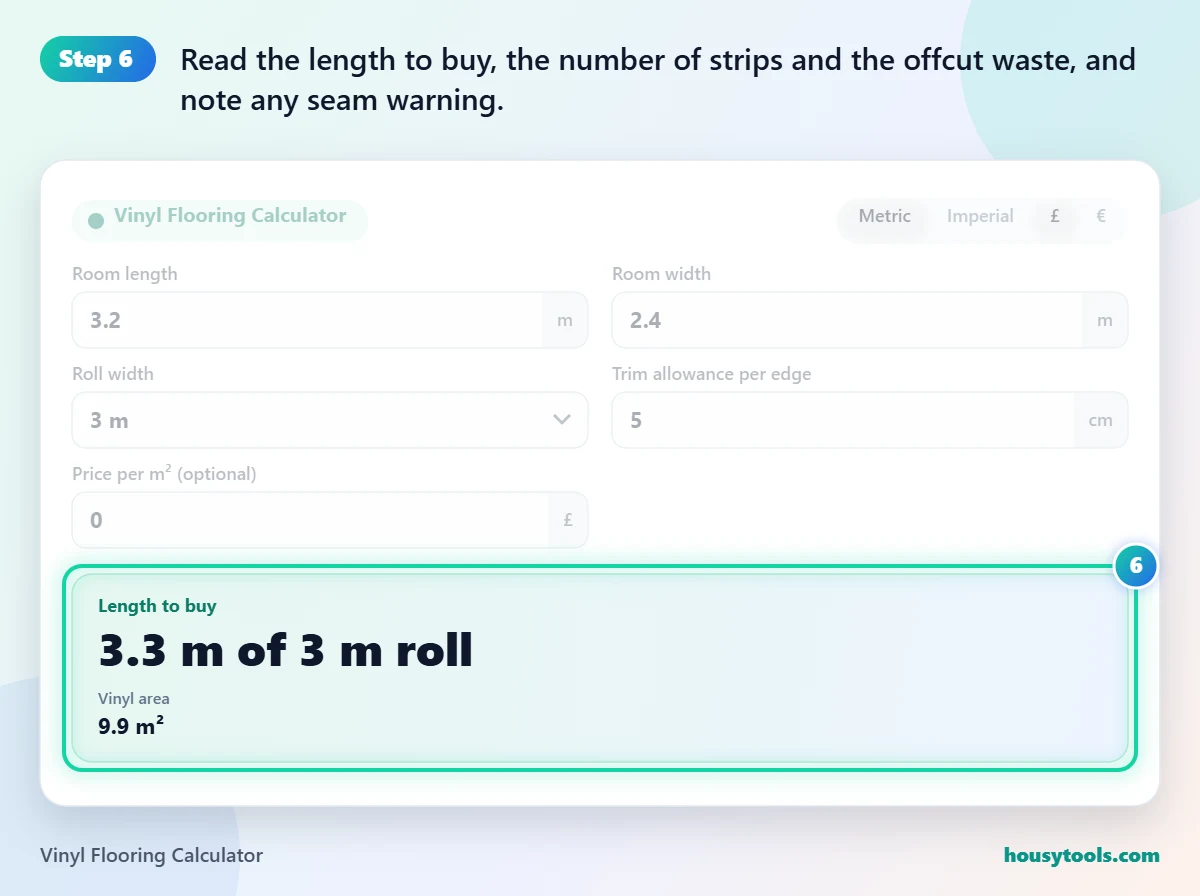
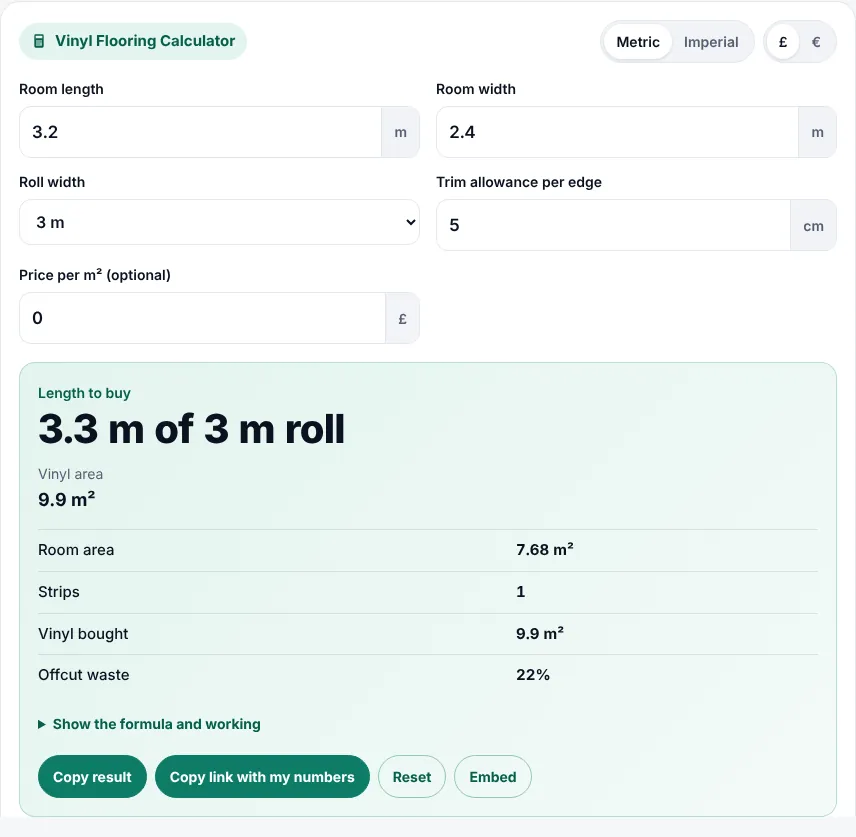
- Read the length to buy, the number of strips and the offcut waste, and note any seam warning.
Which Vinyl Roll Width Should You Choose?
Choose the narrowest roll that still covers one side of the room plus trim in a single piece, because that gives no seam and the least waste.
UK retailers commonly sell sheet vinyl in 2 m, 3 m and 4 m widths, although not every design comes in every width. A 2.7 m wide kitchen fits a 3 m roll with room for trimming. A 3.2 m wide room is too wide for a 3 m roll once trim is added, so a 4 m roll avoids a seam. The vinyl flooring calculator tests both directions, so it may turn the roll the other way if that is cheaper.
A wider roll is not always better. In a small cloakroom a 4 m roll can waste almost half of what you pay for, as the table below shows.
Vinyl Flooring Calculator Results for Common Room Sizes
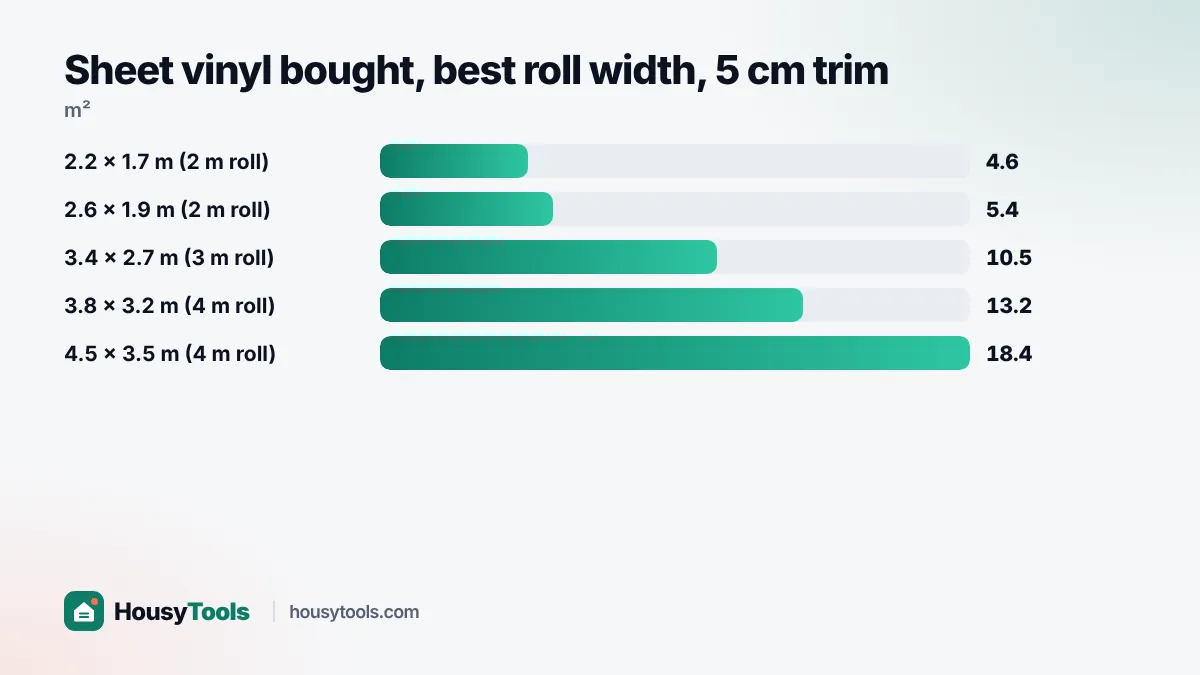
Each row was run through the vinyl flooring calculator with a 5 cm trim allowance. The figures show the length to buy and the vinyl area bought for each roll width.
| Room | Room area | 2 m roll | 3 m roll | 4 m roll |
|---|---|---|---|---|
| Cloakroom, 2.2 m x 1.7 m | 3.74 m² | 2.3 m, 4.6 m² | 1.8 m, 5.4 m² | 1.8 m, 7.2 m² |
| Bathroom, 2.6 m x 1.9 m | 4.94 m² | 2.7 m, 5.4 m² | 2 m, 6 m² | 2 m, 8 m² |
| Kitchen, 3.4 m x 2.7 m | 9.18 m² | 5.6 m, 11.2 m² (seam) | 3.5 m, 10.5 m² | 2.8 m, 11.2 m² |
| Kitchen diner, 3.8 m x 3.2 m | 12.16 m² | 6.6 m, 13.2 m² (seam) | 6.6 m, 19.8 m² (seam) | 3.3 m, 13.2 m² |
| Large kitchen, 4.5 m x 3.5 m | 15.75 m² | 9.2 m, 18.4 m² (seam) | 7.2 m, 21.6 m² (seam) | 4.6 m, 18.4 m² |
How Much Extra Vinyl Should You Allow for Trimming?
Allow about 5 cm at every edge, which adds 10 cm to each dimension, so a 3.4 m wall becomes a 3.5 m cut length.
Walls are rarely perfectly straight or square, and sheet vinyl is trimmed in place against the skirting. The extra lets you scribe the edges neatly. Increase the allowance to 7.5 or 10 cm for old houses with uneven walls, or for patterned vinyl where you may need to shift the sheet to line up tiles or boards with the main wall.
This is why the vinyl flooring calculator uses a trim allowance per edge rather than a flat percentage. A fixed 10% on a small room may be too little for trimming, while on a large room it may be far too much.
When Does Sheet Vinyl Need a Seam?
A seam is needed when both room dimensions, plus trim, are wider than the widest roll available; in practice that means rooms over about 3.9 m in both directions with a 4 m roll.
- Plan the seam away from doorways, the sink and the main walking line, where wear is highest.
- Run the seam along the length of the room, parallel to the main light source if possible.
- Patterned vinyl needs extra length to match the pattern across the join. Ask the retailer for the pattern repeat.
- Use the seam treatment the manufacturer recommends, so the join stays sealed.
If the vinyl flooring calculator shows two strips, check whether a different roll width removes the seam. Sometimes one wider roll costs less than two narrow strips.
Worked Example: Sophie’s 3.4 m by 2.7 m Kitchen
Sophie in Belfast wants a stone effect sheet vinyl in her kitchen, which measures 3.4 m by 2.7 m. The design comes in 3 m and 4 m widths at £18 per m². She enters the room into the vinyl flooring calculator with a 5 cm trim allowance and a 3 m roll.
- Layout: lay the roll along the 3.4 m side; 2.7 m across needs 1 strip of 3 m
- Each strip: 3.4 m + 2 x 0.05 m trim = 3.5 m
- Length to buy: 1 x 3.5 m = 3.5 m of 3 m roll
- Vinyl bought: 10.5 m², with 13% offcut waste
- Cost: 10.5 m² x £18 = £189.00
She also tries the 4 m roll. The tool turns it the other way and suggests 2.8 m, but that is 11.2 m² with 18% waste, so the 3 m roll is cheaper.
What Should You Check Before Laying Sheet Vinyl?
Check that the subfloor is smooth, dry and clean, because every bump and gap shows through sheet vinyl within weeks. No vinyl flooring calculator can allow for a poor base.
- Fill or level uneven concrete, as the vinyl flooring calculator covers only the vinyl itself. Our self levelling compound calculator works out the bags.
- On timber floors, a thin plywood or hardboard overlay is often used to give a flat base. Follow the vinyl maker’s instructions.
- Let the roll settle in the room before fitting, for as long as the fitting instructions say.
- Old floor coverings can be a hazard. The HSE notes that asbestos was added to PVC and thermoplastic floor tiles and some adhesives. In a building from before 2000, do not sand, scrape or break old tiles until they have been checked.
Comparing floors? The laminate flooring calculator and tile calculator give packs and boxes for the same room.
Vinyl Flooring Calculator FAQs
How do I calculate how much sheet vinyl I need?
Add your trim allowance to both edges in each direction. Pick a roll width wider than one side, then buy a length equal to the other side plus trim. The vinyl flooring calculator does this both ways and picks the cheaper layout.
What widths does vinyl flooring come in?
In the UK, sheet vinyl is commonly sold in 2 m, 3 m and 4 m widths, cut to any length. Not every design is made in every width, so check the product page before planning your layout or ordering samples.
How much extra vinyl should I order?
Allow about 5 cm on every edge for trimming, which is the default here. Increase it for uneven walls or patterned vinyl. Avoid adding a flat 10% to the area, because sheet vinyl is bought by length off a fixed width.
Can I join two pieces of sheet vinyl?
Yes, when the room is wider than the roll. Place the seam away from doors and busy areas, match the pattern, and seal it with the product the manufacturer recommends. A wider roll avoids the seam altogether.
Is sheet vinyl priced per m² or per metre?
Shops usually show a price per m² but cut by the linear metre off the roll. Multiply the length you buy by the roll width to get the area you pay for. The vinyl flooring calculator shows both the length and the area.
Do I need underlay for sheet vinyl?
Most cushioned sheet vinyl is laid straight onto a smooth, clean subfloor without underlay, but products differ. Follow the fitting instructions for your vinyl, as the wrong underlay can cause dents and lifting.
Checked October 2026. Sources: Wikipedia: Sheet vinyl flooring, HSE asbestos locations and materials.