
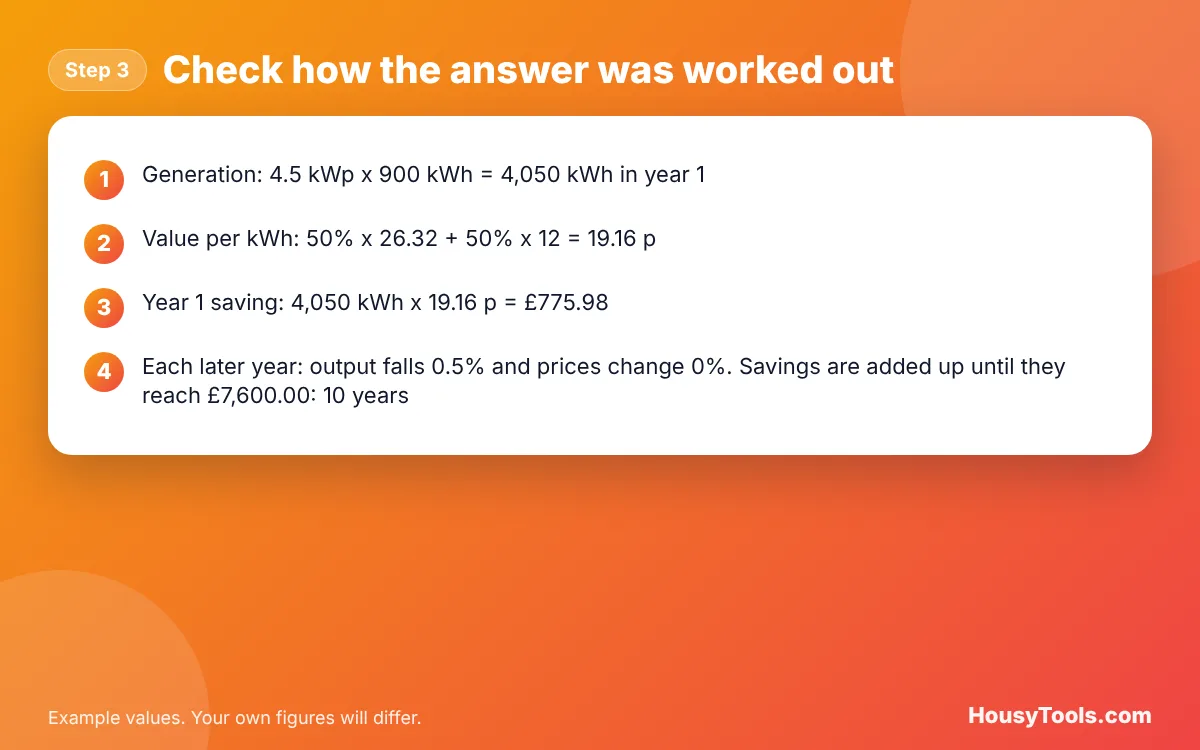
Show the formula and working
This solar panel payback calculator works out how many years a rooftop solar PV system takes to repay its installed cost, for homeowners in the UK, Ireland and the rest of Europe. It values the power you use at home at your unit rate and the power you export at your export rate, then adds up the savings year by year with panel ageing and price changes included.
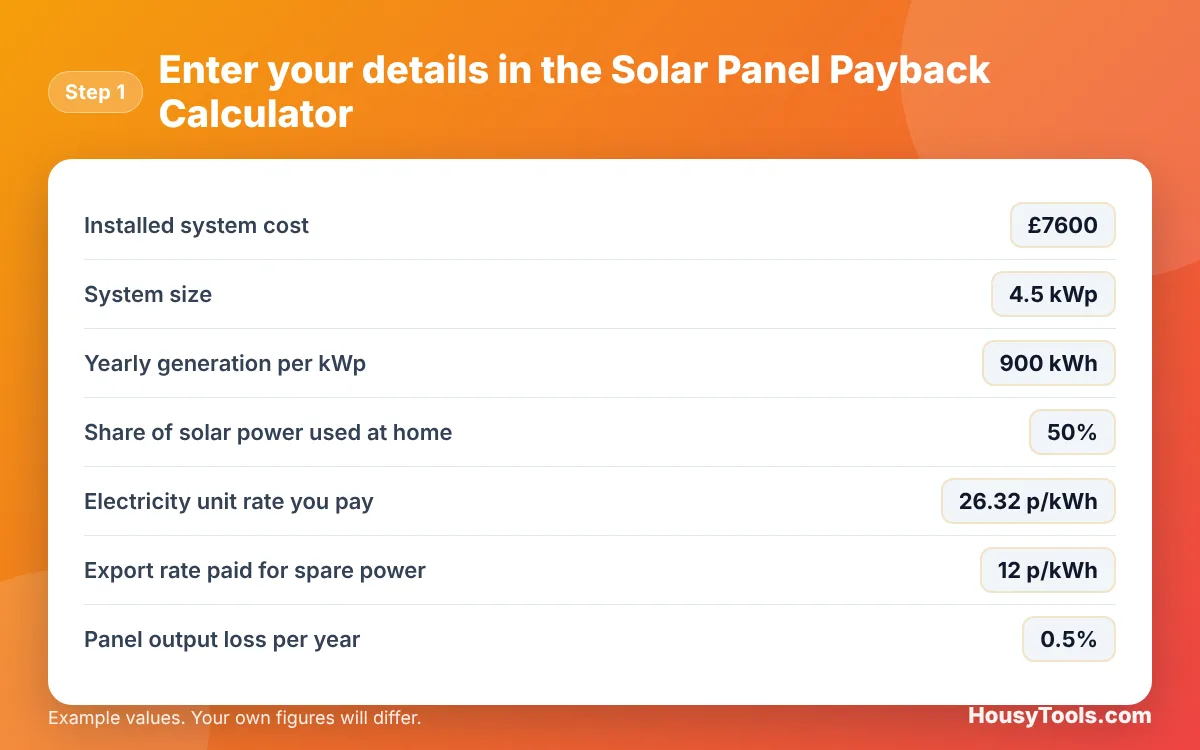
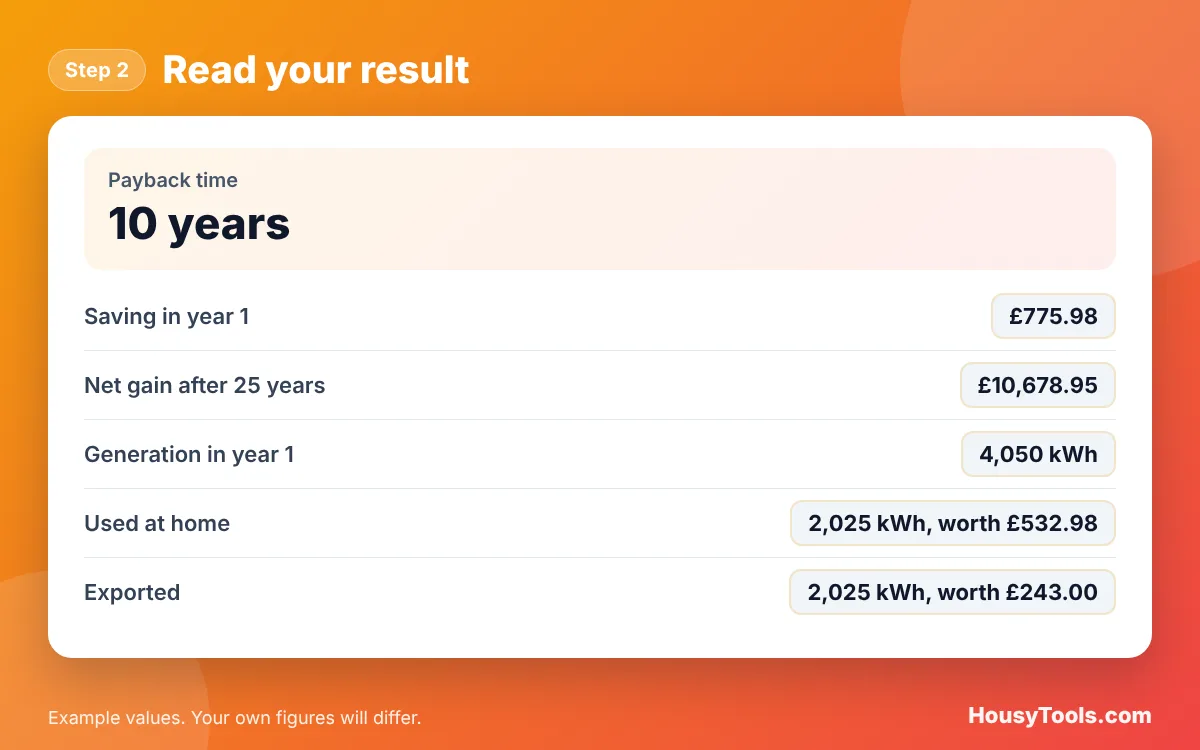
Quick answer: A solar panel payback calculator divides the system cost by the yearly saving. A 4.5 kWp system costing £7,600 that makes 4,050 kWh a year, with half used at home at 26.32p and half exported at 12p, saves about £776 a year and pays back in about 10 years.

What Is a Solar Panel Payback Calculator?
A solar panel payback calculator is a tool that estimates the number of years before the money saved by solar panels equals what you paid for them. In plain words: yearly generation equals system size in kWp multiplied by the kWh each kWp makes in a year. The yearly saving equals the kWh you use yourself multiplied by your unit rate, plus the kWh you export multiplied by the export rate. Payback is the point where the running total of savings reaches the installed cost.
The calculator also lets panel output fall a little each year and lets electricity prices rise or fall, so the result is a year by year total rather than a single division. The simple payback without those changes is shown in the breakdown for comparison.
How Do You Use the Solar Panel Payback Calculator?
- Choose £ or € and enter the Installed system cost from your quote, including scaffolding and the inverter.
- Enter the System size in kWp and the Yearly generation per kWp from the quote or a solar map for your roof.
- Set the Share of solar power used at home. Use a higher figure if someone is home in the day or you have a battery.
- Enter the Electricity unit rate you pay and the Export rate paid for spare power, both in pence or cents per kWh.
- Adjust the Panel output loss per year and the Electricity price change per year if you want a cautious or an optimistic view.
- Read the payback time, the year 1 saving and the 25 year net gain, then open “Show the formula and working” to see each step.
How Long Do Solar Panels Take to Pay Back in the UK?
Most UK home systems pay back in roughly 9 to 12 years, which is the range the Energy Saving Trust gives for solar panels based on July 2026 fuel prices. The same source puts the average system at about 4.5 kWp and about £7,600 installed. Southern England usually generates more than Scotland, and a south facing roof with no shade beats an east or west roof, so the generation figure is the input that moves the answer most after the cost.
Why Does Self-Consumption Matter So Much for Payback?
Each kWh you use yourself saves your full unit rate, while each kWh you export earns only the export rate, so using more of your own power shortens payback. At 26.32p per kWh imported and 12p exported, a kWh used at home is worth more than twice a kWh sent to the grid. Running the washing machine, dishwasher and immersion heater in the middle of the day, or adding a battery, raises the share used at home. Our solar battery size calculator helps you size a battery, which adds cost as well as savings.
How Much Do Solar Panels Generate per kWp?
A well placed system in much of the UK makes very roughly 850 to 1,000 kWh per kWp a year, and far more in southern Europe. The default of 900 kWh is an example, not a promise. The European Commission’s free PVGIS solar tool estimates yearly output for any address in Europe from its roof angle and direction, and an MCS certified installer’s quote should state an expected figure too. To size the system itself, try our solar panel calculator.
Solar Payback by Share of Power Used at Home
The table uses the default system: £7,600, 4.5 kWp, 900 kWh per kWp, 26.32p import, 12p export, no output loss and no price change, so it shows simple payback.
| Used at home | Value per kWh | Year 1 saving | Simple payback |
|---|---|---|---|
| 30% | 16.30p | £660 | 11.5 years |
| 40% | 17.73p | £718 | 10.6 years |
| 50% | 19.16p | £776 | 9.8 years |
| 60% | 20.59p | £834 | 9.1 years |
| 70% | 22.02p | £892 | 8.5 years |
| 80% | 23.46p | £950 | 8.0 years |
Worked Example: A 4.5 kWp System at the 2026 Price Cap
Example: a 4.5 kWp system costs £7,600 and generates 900 kWh per kWp, so it makes 4.5 x 900 = 4,050 kWh in its first year. Half, 2,025 kWh, is used at home at 26.32p, worth £532.98. The other 2,025 kWh is exported at 12p, worth £243.00. The first year saving is £775.98, so the simple payback is £7,600 divided by £775.98, or 9.8 years.
With the default 0.5% output loss per year and no price change, the savings reach £7,600 at about 10 years. After 25 years they total about £18,279, a net gain of £10,678.95 over the cost. These are the figures the calculator shows with its default inputs. Remember that an inverter often needs replacing once during that time, which the Energy Saving Trust puts at around 12 years, so add that cost to the system cost if you want a stricter answer.
To see how solar would change your whole bill, use the electricity bill calculator or browse our energy bill calculators.
Solar Panel Payback Calculator FAQs
Are solar panels worth it in the UK?
For many homes they are, because a typical system pays back in about 9 to 12 years and panels should last 25 years or more. They are less worthwhile on a heavily shaded or north facing roof, or if you plan to move soon. Run your own quote through the calculator before deciding.
What is the Smart Export Guarantee?
The Smart Export Guarantee is a Great Britain scheme that requires larger electricity suppliers to offer a tariff paying you for solar power you export. Each supplier sets its own rate, and the Energy Saving Trust quotes around 12p per kWh. Rates change, so compare suppliers and enter yours.
Does a battery shorten solar payback?
Not always. A battery raises the share of solar power used at home, which raises the yearly saving, but it adds a large cost that the Energy Saving Trust puts at around £5,000 to £8,000. Add the battery price to the system cost and raise the home use share to compare both cases.
How much do solar panels lose each year?
Panels slowly lose output with age, and many manufacturers warrant a loss of well under 1% a year. The calculator uses 0.5% a year as an editable example. Check the performance warranty on your panel data sheet and enter that figure for a more exact answer.
Is there VAT on solar panels?
In Great Britain, solar panels fitted to homes currently have 0% VAT as energy saving materials, under a relief set to run until 31 March 2027. Check the latest gov.uk guidance and make sure your quote shows the VAT treatment clearly. Other countries have their own rules.
Why is my payback different from the installer’s figure?
Installers often assume higher self-consumption, rising electricity prices or a higher export rate. Enter the same assumptions here to compare like with like, then try cautious values, such as 0% price rise and a lower home use share, to see the less favourable case.
Checked October 2026. Sources: Solar panels (Energy Saving Trust), Energy price cap rates (Ofgem), PVGIS (European Commission Joint Research Centre).