
Show the formula and working
This heating oil tank calculator works out how many litres a domestic oil tank holds, how much oil is left from a dip reading, how much to order to top it up and how many days the oil will last. It is built for homes on kerosene in the UK, Ireland and Europe, handles rectangular, horizontal cylinder and upright cylinder tanks, and shows UK gallons when you switch to feet and inches.
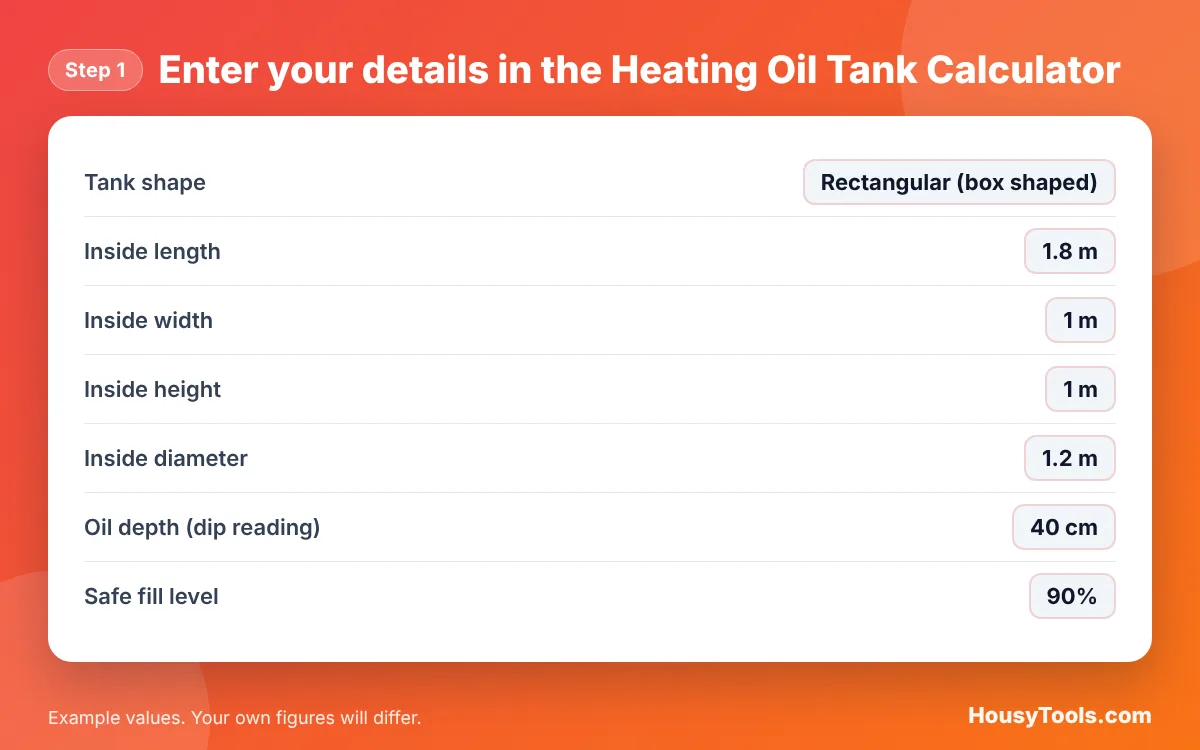
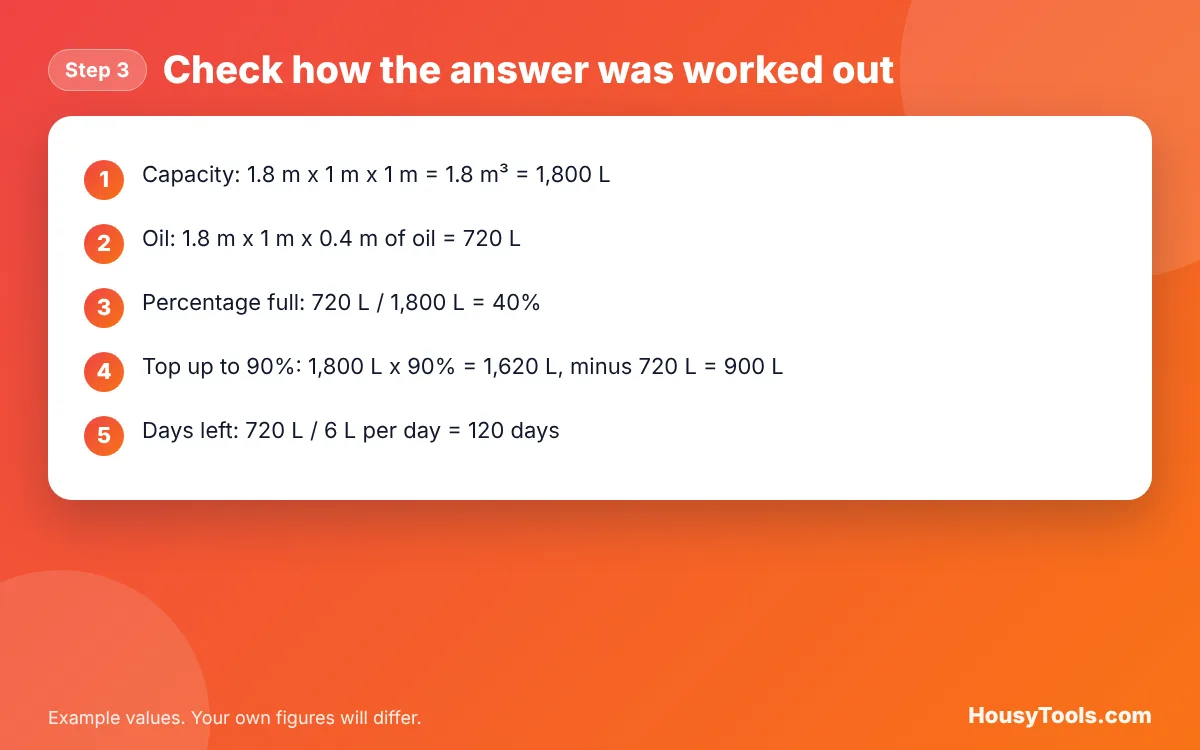
Quick answer: For a box shaped tank, multiply inside length x width x height in metres and then by 1,000 for litres; use the oil depth instead of the height for oil left. A 1.8 m by 1 m tank 1 m high holds 1,800 litres, and 40 cm of oil is 720 litres. This heating oil tank calculator handles cylinders too.
What Is a Heating Oil Tank Calculator?
A heating oil tank calculator is a tool that turns a tank’s inside dimensions and a dip reading into its capacity and the litres of oil it contains. In plain words: capacity = cross section area x length, and oil left = the area of the part filled with oil x length. One cubic metre is 1,000 litres.
For a rectangular tank the filled area is simply width x oil depth. For an upright cylinder it is 3.1416 x radius squared, multiplied by the oil depth. For a cylinder lying on its side the oil forms a segment of a circle, so the calculator uses the circle segment formula. That matters because a horizontal tank a third full by depth is only about 29% full by volume.
How Do You Use the Heating Oil Tank Calculator?
- Choose the Tank shape: rectangular, horizontal cylinder or vertical cylinder.
- Enter the sizes your shape needs: Inside length, Inside width and Inside height for a box tank, Inside length and Inside diameter for a horizontal cylinder, or Inside diameter and Inside height for an upright one.
- Dip the tank and enter the Oil depth (dip reading) in centimetres, measured from the bottom.
- Set the Safe fill level to match your tank’s nominal capacity, which is shown on its label.
- Optionally enter Oil used per day to estimate how long the oil will last.
- Read the litres in the tank, the percentage full and the litres to order, then open “Show the formula and working” to see each step.

How Do You Work Out How Much Oil Is Left in a Tank?
Measure the depth of oil from the bottom of the tank, then multiply the area of the oil’s surface section by the tank’s length; in a 1.8 m by 1 m box tank, every centimetre of depth holds 18 litres. Use a clean dipstick through the filler cap, or read the gauge, and take the reading on level ground after the oil has settled.
Many modern plastic tanks are not true boxes or cylinders. They have rounded corners, ribs and sloped bases, and a bunded tank has an outer skin, so outside measurements overstate what the inner tank holds. Measure the inner tank if you can, and compare the brim full result with the capacity on the tank label. If the label figure is smaller, set the dimensions so the capacity matches, or use the manufacturer’s dipping chart.
How Many Litres Does My Oil Tank Hold?
Multiply the inside length, width and height in metres, then multiply by 1,000, so a 1.8 m x 1 m x 1 m tank holds 1,800 litres brim full. For a cylinder use 3.1416 x radius squared x length; a horizontal tank 1.8 m long and 1.2 m across holds about 2,036 litres.
Domestic oil tanks are commonly sold with a nominal capacity printed on the label, and that figure is less than brim full because space is left at the top for expansion and safe filling. Never ask for more oil than the nominal capacity minus what is already in the tank. In England, Approved Document J covers fixed oil storage tanks of 3,500 litres or less serving homes, including where they can go and when secondary containment (a bund) is needed, so ask an OFTEC registered technician before you install or move a tank.
How Long Will My Heating Oil Last?
Divide the litres left by the litres you burn per day, so 720 litres at 6 litres a day lasts about 120 days. Daily use is much higher in a cold January than in spring, so recalculate as the weather changes.
To find your own daily use, dip the tank on two dates a week or more apart with no delivery in between, work out the litres at each reading with the calculator, and divide the difference by the number of days. Order before the level gets low: running very low risks drawing up sediment from the bottom of the tank, and deliveries can take longer in cold snaps. Our boiler size calculator helps if you suspect an oversized boiler is burning more than it should.
Horizontal Cylinder Tank: Depth Compared With Percentage Full
Because a lying cylinder is narrow at the bottom and top, its depth reading does not match the percentage full. The table gives the true volume for each depth as a share of the diameter, from the circle segment formula. Box shaped and upright tanks are linear, so depth and volume percentages are the same.
| Oil depth as % of diameter | Tank full by volume |
|---|---|
| 10% | 5.2% |
| 20% | 14.2% |
| 25% | 19.6% |
| 30% | 25.2% |
| 40% | 37.4% |
| 50% | 50.0% |
| 60% | 62.6% |
| 70% | 74.8% |
| 75% | 80.4% |
| 80% | 85.8% |
| 90% | 94.8% |
Worked Example: A Horizontal Tank
Example: a steel cylinder tank lies on its side, 1.8 m long inside and 1.2 m in diameter. The dipstick shows 40 cm of oil, the boiler burns about 6 litres a day, and the tank is filled to 90% of brim full.
- Brim full capacity: 3.1416 x 0.6 m x 0.6 m x 1.8 m = 2.036 m³, or 2,036 litres.
- Oil left: the circle segment for 0.4 m depth is 0.33 m², x 1.8 m = 594 litres, so the tank is 29% full.
- Top up: 2,036 x 90% = 1,832 litres, minus 594 = 1,238 litres to order.
- Days left: 594 / 6 = 99 days.
To reproduce this, choose “Horizontal cylinder (lying down)” and leave the other defaults as they are. Once you know how many litres to order, our heating calculators help you plan the cost and size of the rest of your heating system.
Heating Oil Tank Calculator FAQs
How do I convert litres to gallons for an oil tank?
Divide litres by 4.54609 to get UK gallons, the exact definition of the imperial gallon. A 1,000 litre tank holds about 220 UK gallons. US gallons are smaller, at 3.785 litres, so check which gallon an older tank label uses.
How full should I fill my oil tank?
Fill only up to the tank’s nominal capacity on its label, which is less than brim full. That headspace lets the oil expand and stops overfilling during delivery. Subtract the oil already in the tank from the nominal capacity to find the most you can safely order.
Why does my oil gauge not match the dip reading?
Simple sight gauges and float gauges can stick, and many show depth rather than volume, which is misleading on horizontal tanks. Electronic monitors need the correct tank model setting. A dipstick reading combined with the right tank shape is usually the most reliable check.
How much oil is in a tank with 30 cm left?
It depends on the tank. In a 1.8 m by 1 m box tank, 30 cm of oil is 540 litres. In a horizontal cylinder 1.2 m across and 1.8 m long, 30 cm is about 400 litres, because the bottom of a cylinder is narrow.
Can I measure the outside of a bunded tank?
Outside measurements of a bunded tank include the outer skin and the gap around the inner tank, so they overstate the oil it holds. Measure the inner tank through the inspection lid if possible, or use the nominal capacity and dipping chart from the manufacturer.
What is the biggest oil tank a house can have?
Approved Document J guidance in England covers fixed oil tanks of up to 3,500 litres serving a home. Larger stores fall under separate oil storage rules. Whatever the size, an OFTEC registered technician can advise on siting, bunding and fire protection.
Checked October 2026. Sources: GOV.UK: Approved Document J, combustion appliances and fuel storage systems, Wikipedia: Gallon, Wikipedia: Circular segment.