
Show the formula and working
This free TV running cost calculator tells households in the UK, Ireland, Germany, the Netherlands and France what their television costs to run per hour, per day and per year, including the cost of standby. Enter the on mode power from the energy label, your viewing hours and your unit rate in pence or cents.
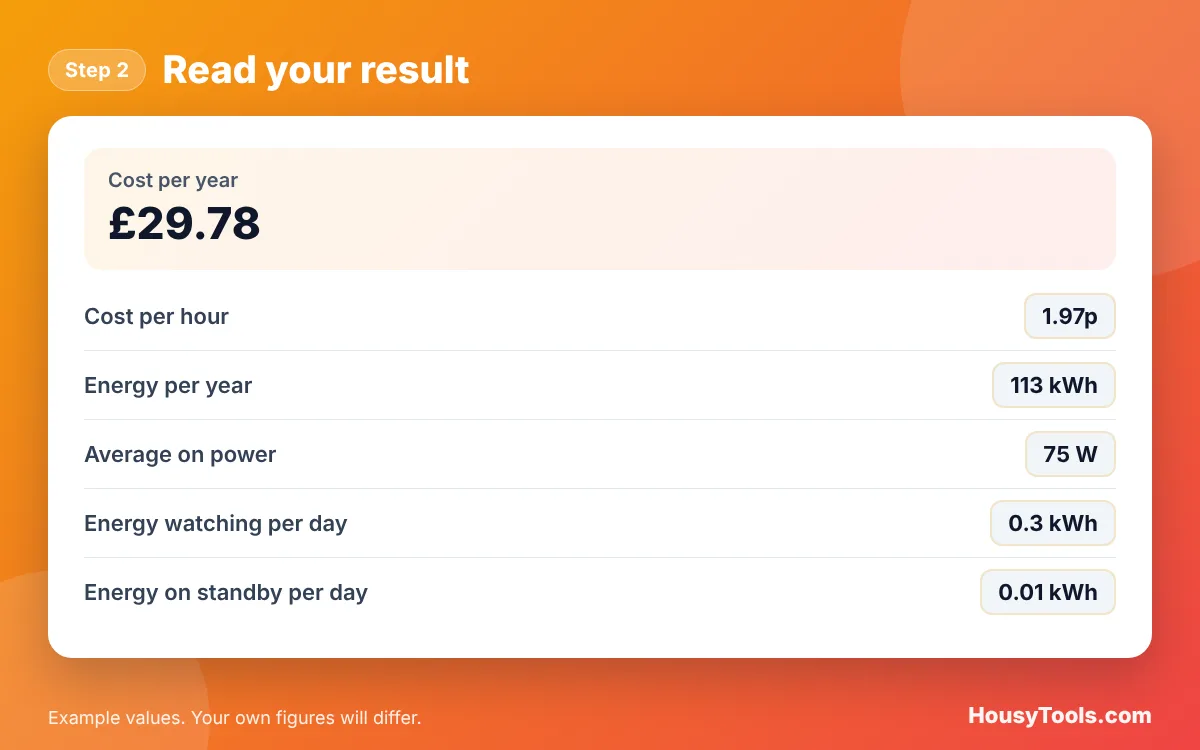
Quick answer: A TV running cost calculator multiplies the TV’s watts by your viewing hours and unit rate. A 55 inch TV using 75 W costs about 2p an hour at 26.32p per kWh. Watched four hours a day with 0.5 W standby, it costs £29.78 a year, using 113 kWh.
What Is a TV Running Cost Calculator?
A TV running cost calculator is a tool that converts a television’s power use while on and on standby into a cost per hour and per year at your electricity price.
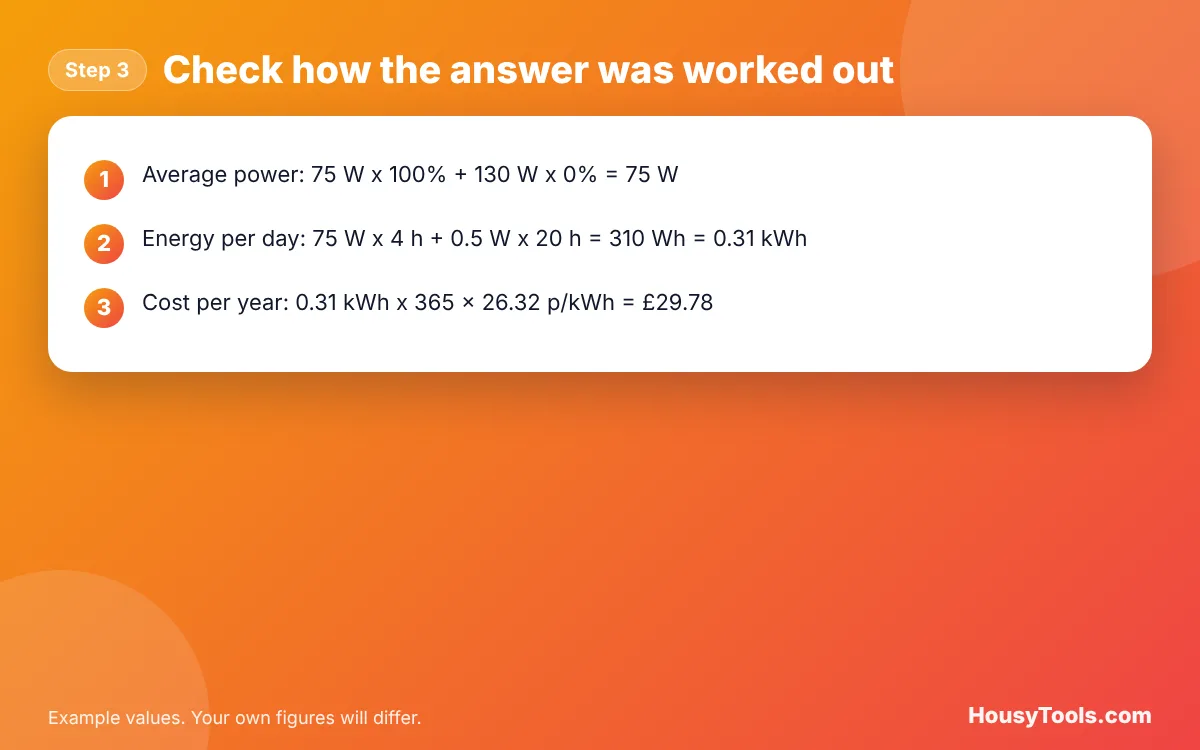
The formula in plain words: energy per day equals the on power in watts times the hours watched, plus the standby power times the rest of the day, divided by 1,000 to give kWh. Cost per year equals the kWh per day times 365 times the unit rate. If you watch some HDR content, the average power is a weighted mix of the SDR and HDR figures.
How Do You Use the TV Running Cost Calculator?
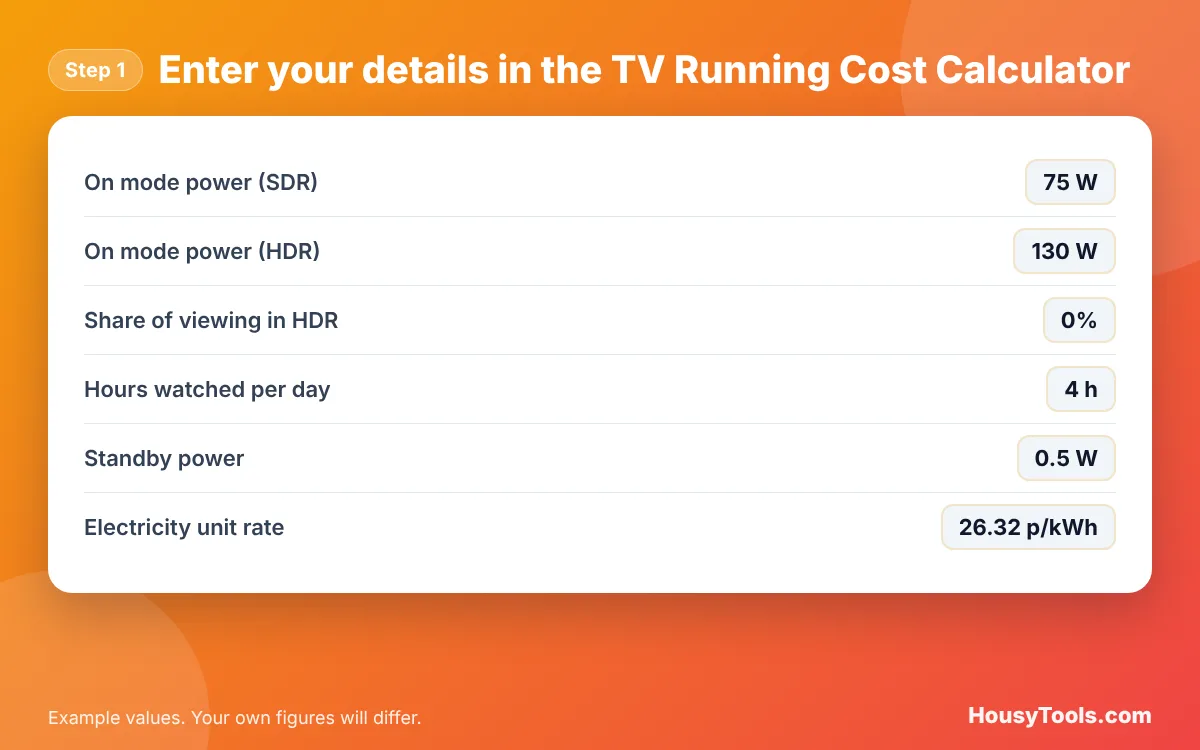
- Enter the On mode power (SDR) from your TV’s energy label or product fiche.
- If you watch HDR films or games, enter the On mode power (HDR) and the Share of viewing in HDR.
- Enter the Hours watched per day and the Standby power.
- Enter the Electricity unit rate from your bill and choose pounds or euros with the currency switch.
- Read the yearly cost and cost per hour in the result, then open “Show the formula and working” to see the sums.
How Much Does It Cost to Run a TV per Hour?
A modern 55 inch TV costs about 2p to 4p an hour at 26.32p per kWh. The Hisense 55S7NQTUK uses 75 W in standard picture mode, which costs 1.97p an hour, and 130 W in HDR, which costs 3.42p. The rate is the Great Britain direct debit average under the Ofgem price cap from 1 October to 31 December 2026. Bigger screens, brighter picture modes and older plasma or LCD sets use more.
How Do You Read the Energy Label on a TV?
The number in kWh/1000h on a TV’s energy label equals the TV’s on mode power in watts. A label showing 75 kWh/1000h means the set draws 75 W, because 75 W for 1,000 hours is 75 kWh. Labels under the current EU scheme show separate figures for SDR and HDR, and the full figures, including standby, are in the product fiche on the EU product database (EPREL).
How Much Does a TV Cost on Standby?
A modern TV on standby at 0.5 W costs under £1 a year, 96p at 26.32p per kWh if it sits on standby 20 hours a day. Networked standby, which keeps the TV ready for voice control or quick start, can use more: 2 W on the example TV, about four times as much. The standby power cost calculator adds up all the devices left on standby around your home.
Does HDR Use More Electricity?
Yes, HDR usually uses much more power, because the screen runs brighter. The example TV uses 130 W in HDR against 75 W in SDR, about 73% more. Watching everything in HDR for four hours a day would raise its yearly cost from £29.78 to £50.92. Set Share of viewing in HDR to match your habits.
TV Running Costs by Power
Four hours a day, 0.5 W standby for the other 20 hours, at 26.32p per kWh and an example 35 cent per kWh.
| TV power | Cost per hour | kWh per year | Cost per year (pounds) | Cost per year (euros at 35c) |
|---|---|---|---|---|
| 40 W | 1.05p | 62 | £16.33 | €21.72 |
| 63 W | 1.66p | 96 | £25.17 | €33.47 |
| 75 W | 1.97p | 113 | £29.78 | €39.60 |
| 100 W | 2.63p | 150 | £39.39 | €52.38 |
| 130 W | 3.42p | 193 | £50.92 | €67.71 |
| 200 W | 5.26p | 296 | £77.82 | €103.48 |
Worked Example: A 55 Inch TV in Pounds and Euros
Example: a 55 inch TV using 75 W in SDR, watched four hours a day, with 0.5 W standby, at 26.32p per kWh. These are the default inputs.
- Watching: 75 W x 4 h = 300 Wh = 0.3 kWh a day.
- Standby: 0.5 W x 20 h = 10 Wh = 0.01 kWh a day.
- Per year: 0.31 kWh x 365 = 113 kWh, x 26.32p = £29.78.
In euros, switch the currency and enter an example rate of 35 in Electricity unit rate: the same TV costs €39.60 a year. If you are choosing a new set, the TV size and viewing distance calculator helps you avoid buying a bigger, hungrier screen than the room needs.
TV Running Cost Calculator FAQs
How many watts does a TV use?
It depends on the screen size and picture mode, so check your own model’s label. As examples, the two Hisense 55 inch models on the EU EPREL database use 63 W and 75 W in SDR, and 160 W and 130 W in HDR.
Is it cheaper to turn a TV off at the wall?
Yes, but only slightly for a modern set. At 0.5 W standby, switching off at the wall saves under £1 a year. Older TVs and sets on networked standby use more, so the saving is bigger for them and for boxes and consoles left on.
Do bigger TVs cost more to run?
Usually, yes. A bigger screen has more area to light, so its on mode power is higher at the same efficiency class. Compare the kWh/1000h figures on the labels of the sizes you are considering to see the real difference.
Does brightness affect TV running costs?
Yes. Vivid or dynamic picture modes and high backlight settings use more power than the standard mode measured for the label. Using the eco or standard mode, or letting the TV adjust to room light, keeps the power close to the label figure.
What does networked standby mean?
Networked standby keeps the TV connected so it can wake quickly, receive casts or answer a voice assistant. It uses more than plain standby, 2 W against 0.5 W on the example TV. Turning off quick start in the settings usually returns it to the lower figure.
How much does a TV add to my electricity bill?
At four hours a day, a TV using 40 to 130 W costs about £16 to £51 a year at October 2026 cap prices, standby included. Enter your own figures above, and add set-top boxes, soundbars and consoles separately.
For other appliances, see the energy bill calculators.
Checked October 2026. Sources: Energy price cap unit rates and standing charges (Ofgem), Hisense 55S7NQTUK product information sheet (EPREL), Hisense 55U7NQTUK product information sheet (EPREL).