
Show the formula and working
This cubic metre calculator works out the volume of a box, room, raised bed, slab, trench or cylinder in cubic metres for homeowners, movers and gardeners in the UK, Ireland and the rest of Europe. Enter the length, width and height in metres, or switch to feet, and you get cubic metres, litres, cubic feet and cubic yards with the working shown.
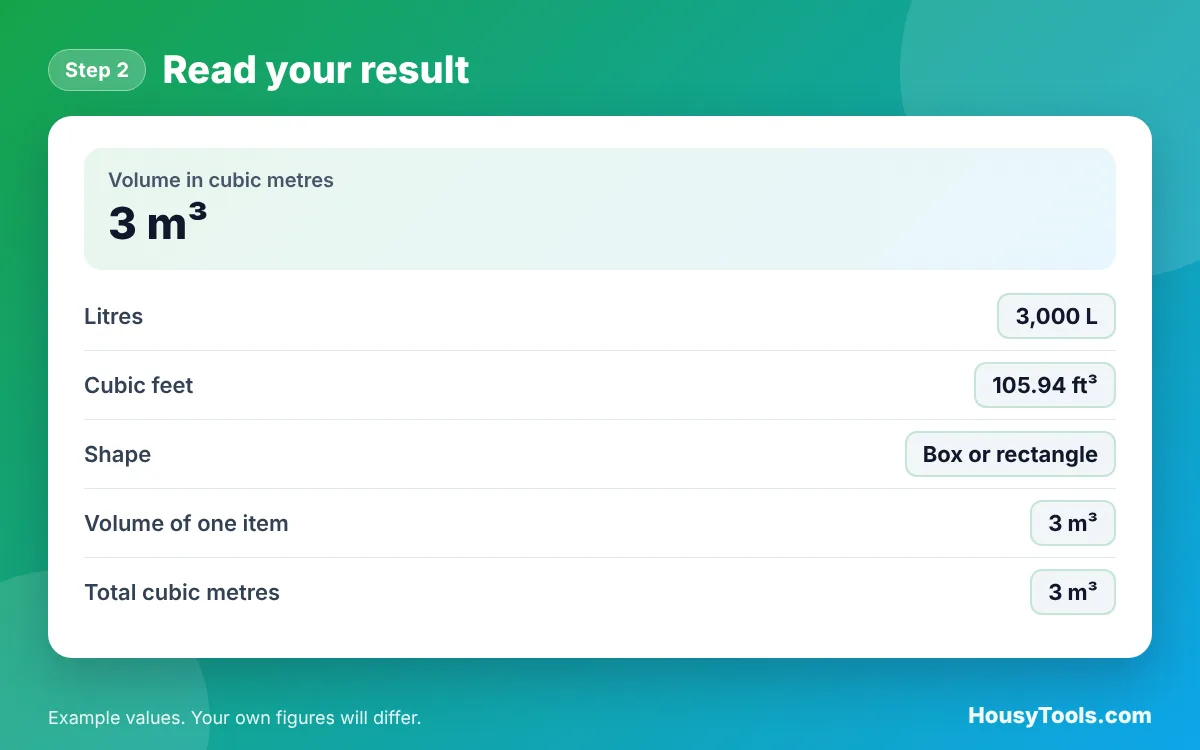
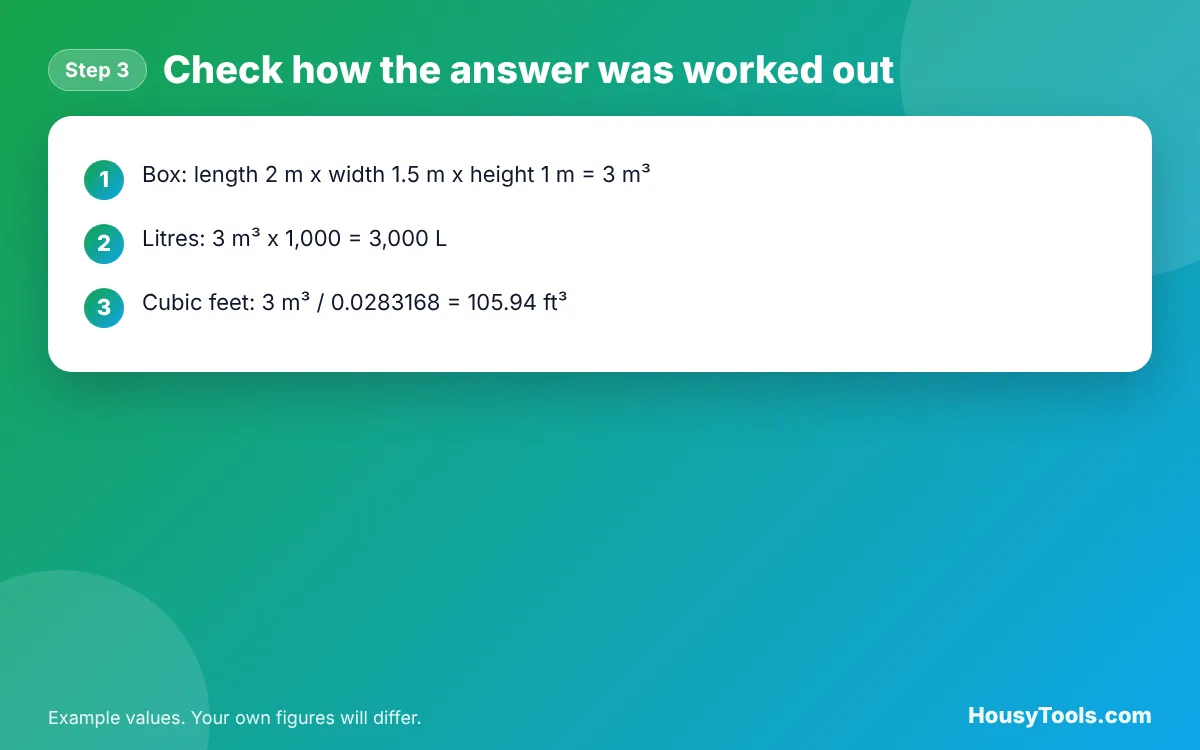
Quick answer: To work out cubic metres, multiply length by width by height, all in metres. A space 2 m long, 1.5 m wide and 1 m high holds 3 cubic metres. For a cylinder, multiply 3.1416 by the radius squared and by the height. One cubic metre equals 1,000 litres or 35.31 cubic feet, as this cubic metre calculator shows.
What Is a Cubic Metre Calculator?
A cubic metre calculator is a tool that turns three measurements into the volume of space they enclose, expressed in cubic metres (m³). For a box shape the formula is length times width times height. For a round shape such as a water butt, tank or post hole it is pi times the radius squared times the height, where the radius is half the diameter.
A cubic metre is the volume of a cube with each edge 1 metre long. The Weights and Measures Act 1985 defines it that way and defines the litre as one cubic decimetre, which is why exactly 1,000 litres fit in one cubic metre. Imperial conversions use the exact foot of 0.3048 m, so one cubic foot is 0.0283168 m³.
How Do You Use the Cubic Metre Calculator?
- Pick the Shape: “Box or rectangle (length x width x height)” for rooms, cartons, beds and slabs, or “Cylinder (diameter x height)” for tanks, tubs and round holes.
- For a box, enter the Length and Width in metres. Convert centimetres by dividing by 100, so 45 cm becomes 0.45.
- For a cylinder, enter the Diameter, the distance straight across the circle.
- Enter the Height or depth. For a concrete slab or gravel layer this is the thickness, for example 0.1 for 10 cm.
- If you have several identical cartons or containers, set the Number of items.
- Read the volume in cubic metres, litres and cubic feet, then open “Show the formula and working” to see each multiplication.
Turn on the imperial switch if you measured in feet. The inputs change to feet and the main result shows cubic feet, with cubic metres alongside.

How Do You Calculate Cubic Metres From Centimetres?
Multiply the three measurements in centimetres and divide the answer by 1,000,000, or convert each one to metres first by dividing by 100. A carton 60 cm by 40 cm by 40 cm is 96,000 cm³, which is 0.096 m³. Converting first gives the same result: 0.6 x 0.4 x 0.4 = 0.096 m³. Dividing by 100 only once at the end is the most common mistake and gives an answer 10,000 times too large.
How Many Litres Are in a Cubic Metre?
One cubic metre holds exactly 1,000 litres. That makes it easy to size tanks and ponds: an oil tank or water tank of 1,200 litres needs 1.2 m³ of space, and a 0.25 m³ water butt holds 250 litres. A litre of water weighs about 1 kg, so one cubic metre of water weighs about 1 tonne. This is useful when you check whether a deck or floor can carry a hot tub.
How Many Cubic Feet Are in a Cubic Metre?
One cubic metre is 35.31 cubic feet. The figure comes from the international foot of exactly 0.3048 m, fixed in 1959 and set out by NIST: 0.3048 cubed is 0.0283168 m³ per cubic foot. Removal firms in the UK often quote van space in cubic feet, so a 3 m³ load is about 106 cubic feet. One cubic metre is also 1.31 cubic yards, the unit many builders’ merchants still use for skips and soil.
How Do You Work Out Cubic Metres for Shipping?
Measure one carton, multiply length by width by height in metres, then multiply by the number of cartons. Shippers call the result CBM, short for cubic metres. Twenty five cartons of 0.6 m by 0.4 m by 0.4 m come to 2.4 m³. Measure the outside of the box including any bulges, because carriers charge on the outer size. Set the Number of items to the carton count and the tool does the multiplication.
Cubic Metre Conversion Table
| Cubic metres | Litres | Cubic feet | Cubic yards | UK gallons |
|---|---|---|---|---|
| 0.1 m³ | 100 L | 3.53 ft³ | 0.13 yd³ | 22.0 |
| 0.25 m³ | 250 L | 8.83 ft³ | 0.33 yd³ | 55.0 |
| 0.5 m³ | 500 L | 17.66 ft³ | 0.65 yd³ | 110.0 |
| 1 m³ | 1,000 L | 35.31 ft³ | 1.31 yd³ | 220.0 |
| 2 m³ | 2,000 L | 70.63 ft³ | 2.62 yd³ | 439.9 |
| 3 m³ | 3,000 L | 105.94 ft³ | 3.92 yd³ | 659.9 |
| 5 m³ | 5,000 L | 176.57 ft³ | 6.54 yd³ | 1,099.8 |
| 10 m³ | 10,000 L | 353.15 ft³ | 13.08 yd³ | 2,199.7 |
Worked Example: Filling a Raised Bed
Example: a raised vegetable bed is 2.4 m long, 1.2 m wide and 30 cm deep, and the supplier sells compost by the cubic metre. Leave the Shape on “Box or rectangle”, enter 2.4 as the Length, 1.2 as the Width and 0.3 as the Height or depth. The calculator multiplies 2.4 x 1.2 x 0.3 and shows 0.864 m³, which is 864 litres or 30.51 cubic feet. Compost settles as it is watered, so round up and order 1 m³.
Volume is often the first step before buying materials. For a floor screed, the self levelling compound calculator turns area and depth into bags, and the loft insulation calculator works out rolls from your loft size. More tools for everyday measuring sit in our home calculators.
Cubic Metre Calculator FAQs
What is the formula for cubic metres?
Cubic metres equal length times width times height, with every measurement in metres. For a cylinder, use 3.1416 times the radius squared times the height. Always convert centimetres or millimetres to metres before you multiply, or the answer will be far too large.
How big is 1 cubic metre?
One cubic metre is a cube 1 m long, 1 m wide and 1 m high. It holds 1,000 litres, about the size of a standard IBC water tank, and would weigh about one tonne if filled with water.
How do you convert square metres to cubic metres?
Multiply the area in square metres by the depth in metres. A 20 m² patio base laid 0.1 m deep needs 2 m³ of material. You cannot convert area to volume without a depth, because a square metre is flat and a cubic metre has thickness.
How many cubic metres is a room?
A typical UK bedroom of 4 m by 3.5 m with a 2.4 m ceiling is 33.6 m³. Multiply the floor length by the width and by the ceiling height. Room volume matters for heating, ventilation and dehumidifier sizing, which all work from cubic metres.
How do you calculate cubic metres for a cylinder?
Halve the diameter to get the radius, square it, multiply by 3.1416 and then by the height. A tub 0.6 m across and 0.9 m tall holds 0.254 m³, or about 254 litres. Choose “Cylinder (diameter x height)” in the Shape field to do this automatically.
Is a cubic metre the same as a tonne?
Only for water. A cubic metre is a volume and a tonne is a mass. One cubic metre of water weighs about 1 tonne, but a cubic metre of dry sand or gravel weighs about 1.5 to 1.6 tonnes, and topsoil about 1.3 tonnes, so check the material’s density before ordering.
Checked October 2026. Sources: Weights and Measures Act 1985, Schedule 1 (legislation.gov.uk), NIST: SI units, length, Cubic metre (Wikipedia).