
Show the formula and working
This exterior paint calculator works out how many litres and tins of masonry paint you need for the outside walls of a house, including gable ends, for homeowners in the UK and Europe. Enter the wall widths and height, take off windows and doors, choose a smooth or textured surface and the number of coats, and it shows the litres, tins and area with the full working. A feet and inches switch is included.
Quick answer: Multiply wall width by height, add any gable triangles, take off windows and doors, then multiply by the coats and divide by the coverage. Smooth masonry paint covers up to 16 m² per litre and textured up to 8. The exterior paint calculator shows 78.4 m² needs 10.8 litres for two coats.
What Is an Exterior Paint Calculator?
An exterior paint calculator is a tool that converts the size of a building’s outside walls into the amount of masonry paint needed to cover them. The formula in plain words: wall area = total wall width x height; gable area = 0.5 x gable width x gable height for each gable; net area = wall area + gables minus windows and doors; litres = net area x coats / coverage per litre, plus an allowance for porous surfaces. Tins = litres divided by the tin size, rounded up.
Coverage depends heavily on the surface. Dulux Trade gives its Weathershield Smooth Masonry Paint a spreading rate of up to 16 m² per litre and its Weathershield Textured Masonry Paint up to 8 m² per litre. Rough surfaces such as pebbledash hold much more paint than smooth render.
How Do You Use the Exterior Paint Calculator?
- Add up the walls you are painting and enter the Total width of walls to paint, then the Wall height from the ground to the eaves.
- If the side walls rise to a point, enter the number of Gable ends, the Gable width and the Gable height above eaves.
- Enter the area of Windows and doors to leave out.
- Choose the Surface, or enter the Own coverage from the tin (optional) if your paint states a different spreading rate.
- Set the Coats and the Extra for porous surfaces and waste.
- Enter the Tin size you plan to buy.
- Read the litres and tins, then open “Show the formula and working” to see each step.


How Much Masonry Paint Do I Need for a House?
About 78 m² of paintable wall, such as the front and back of the two storey house in the worked example below, needs about 11 litres of smooth masonry paint for two coats, or about 22 litres if the walls are pebbledashed. The table shows litres for two coats with a 10% allowance.
| Net wall area | Smooth masonry (16 m² per litre) | Rough or textured (8 m² per litre) |
|---|---|---|
| 25 m² | 3.4 L | 6.9 L |
| 50 m² | 6.9 L | 13.8 L |
| 75 m² | 10.3 L | 20.6 L |
| 100 m² | 13.8 L | 27.5 L |
| 150 m² | 20.6 L | 41.3 L |
Spreading rates on tins are the best case on a sound, smooth surface. Weathered render, new brick and pebbledash can take noticeably more, which is why the calculator adds 10% by default.
How Many Coats of Exterior Paint Do You Need?
Two coats is the usual allowance for masonry paint. Dulux Trade advises a thinned first coat on new or bare surfaces to seal them, and more coats where the colour change is strong, such as white over a dark colour. For a full colour change or very porous walls, set the coats to 3 so you do not run short part way round the house.
How Do You Measure a Gable End?
Measure the width of the gable wall at the eaves and the height from the eaves to the top of the gable, then multiply them and halve the result. A gable 7 m wide and 2.5 m high adds 8.75 m². If you prefer to measure the whole side wall including the gable, the masonry paint calculator works from wall dimensions in the same way, and the render calculator helps if the walls need re rendering first.
Can You Paint the Outside of a House Yourself?
You can paint ground floor walls yourself with ordinary care, but upper walls need safe access such as a scaffold tower or scaffold, because HSE guidance says ladders suit only short, low risk jobs. Paint in dry weather within the temperature range on the tin, and avoid frost or rain while the paint dries. For timber fences and sheds, use the fence paint calculator instead, as wood takes different products.
Worked Example: Painting the Front and Back of a House
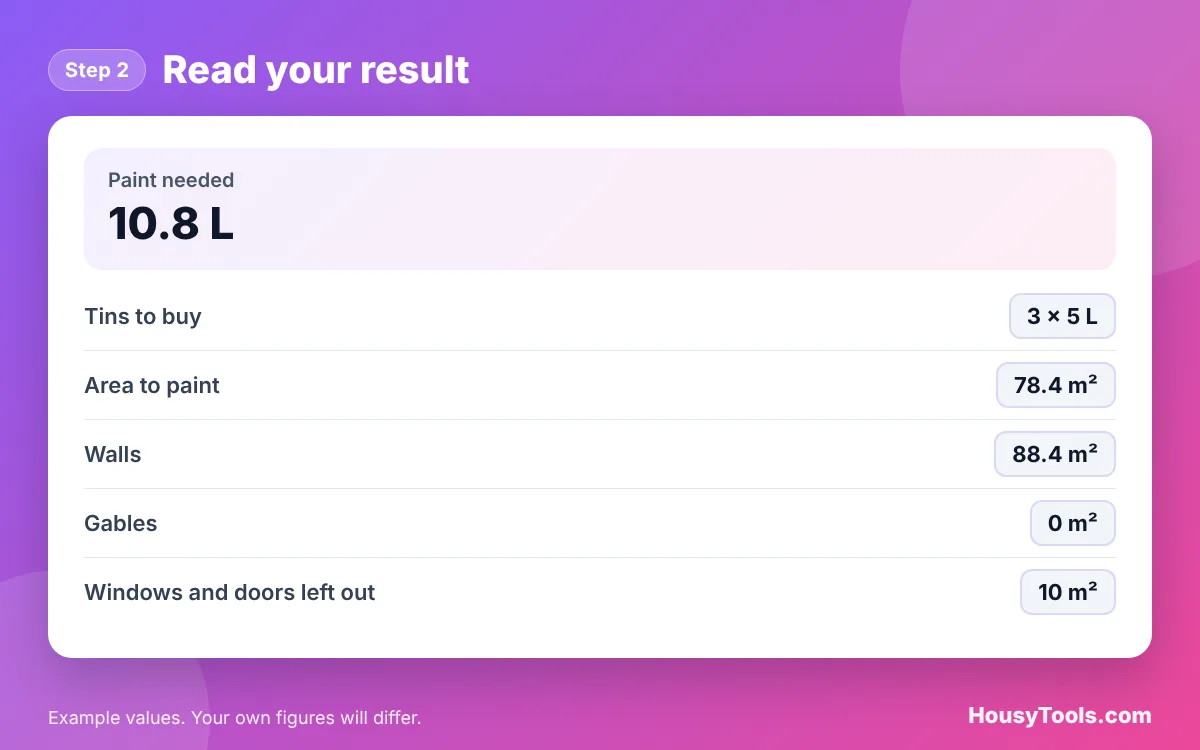
Example: the front and back walls of a two storey house are each 8.5 m wide, so 17 m in total, and 5.2 m high to the eaves. Windows and doors add up to 10 m². The walls are smooth render, and two coats of masonry paint are planned with a 10% allowance, bought in 5 litre tins. These are the calculator’s default inputs.
- Walls: 17 m x 5.2 m = 88.4 m².
- Net area: 88.4 m² minus 10 m² = 78.4 m².
- Paint: 78.4 m² x 2 coats / 16 m² per litre x 1.1 = 10.78 litres.
- Tins: 10.78 / 5 = 2.16, so 3 tins of 5 litres.
If the same walls were pebbledash at 8 m² per litre, the paint would double to 21.56 litres, or 5 tins.
Exterior Paint Calculator FAQs
How much does a 10 litre tin of masonry paint cover?
At up to 16 m² per litre, a 10 litre tin of smooth masonry paint covers up to 160 m² in one coat, or about 80 m² in two coats. On textured surfaces at up to 8 m² per litre, the same tin covers about 40 m² in two coats.
Should I take windows off the area?
Yes, take off large windows and doors, because they can be a big share of a front wall. Leave small openings such as air bricks in the area. If you are unsure, leave them in, as a little spare paint is useful for touching up.
Why does pebbledash use so much paint?
Pebbledash and roughcast have a much larger true surface than their flat outline, and the paint has to fill every gap between the stones. That is why textured masonry paint is rated at about half the coverage of smooth paint per litre.
Do I need a primer or stabiliser on exterior walls?
New, bare or powdery surfaces often need sealing first. Dulux Trade advises a thinned first coat of its smooth masonry paint on new or bare surfaces, while chalky walls may need a stabilising solution. Follow the product guidance for your wall.
Can I paint brick with masonry paint?
Yes, masonry paint is made for brick, render, stone and concrete, but painted brick will need repainting every few years and is hard to return to bare brick. Check that the brick is dry and sound, and that any damp problems are fixed first.
Does the calculator work in feet?
Yes. Switch to feet and inches, and the lengths, areas and coverage are shown in imperial units, with coverage in square feet per US gallon. The tin size stays in litres, as masonry paint in the UK is sold in litres.
Checked October 2026. Sources: Dulux Trade: Weathershield Smooth Masonry Paint (up to 16 m² per litre), Dulux Trade: Weathershield Textured Masonry Paint (up to 8 m² per litre).