
Show the formula and working
This free ml to grams converter changes a volume in millilitres into a weight in grams, or grams back into millilitres, for cooks and bakers in the UK, Ireland and Europe who want to weigh ingredients instead of using a measuring jug. Choose from 22 common ingredients, from water and milk to flour, sugar and honey, or enter the density of your own product.
Quick answer: To convert ml to grams, multiply the millilitres by the ingredient’s density in grams per millilitre. Water is 1 g per ml, so 100 ml weighs 100 g. Whole milk is about 103 g per 100 ml, olive oil 91 g, granulated sugar 84 g, plain flour 51 g and honey 142 g.

What Is an Ml to Grams Converter?
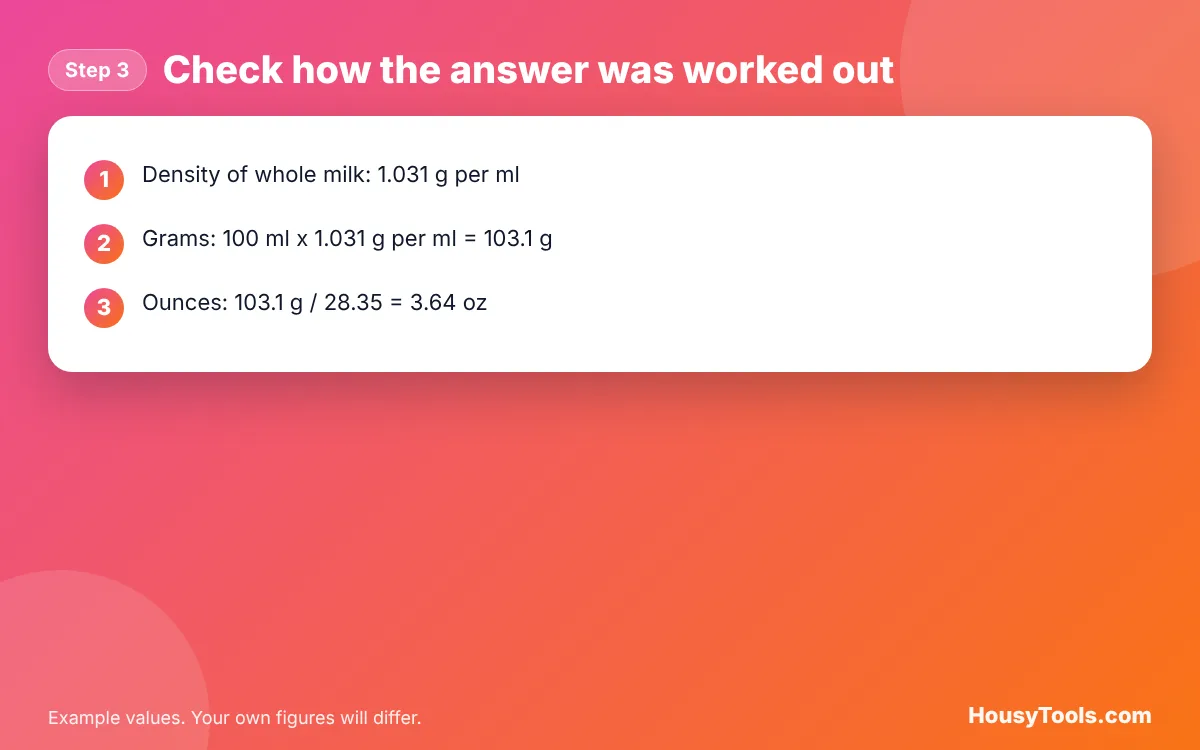
An ml to grams converter is a tool that turns a volume in millilitres into the weight of a particular ingredient in grams, using that ingredient’s density. Millilitres measure space and grams measure mass, so there is no single conversion factor for every food. The formula is: grams = millilitres x density (g per ml). To go the other way, millilitres = grams / density.
Water is the reference point. As the Wikipedia article on the litre explains, one litre of water has a mass of almost exactly one kilogram, because the kilogram was first defined from a cubic decimetre of water. Ingredients that are heavier than water, such as honey and salt, weigh more than their volume in millilitres. Light powders such as flour and cocoa weigh much less.
How Do You Use the Ml to Grams Converter?
- Choose the Direction: “Millilitres to grams” or “Grams to millilitres”.
- Enter the quantity in Amount (ml or grams). Use millilitres for the first direction and grams for the second.
- Select the food from the Ingredient list.
- If your product is not listed, or its label gives a density, type it into Own density (optional) in grams per millilitre. Leave it at 0 to use the list.
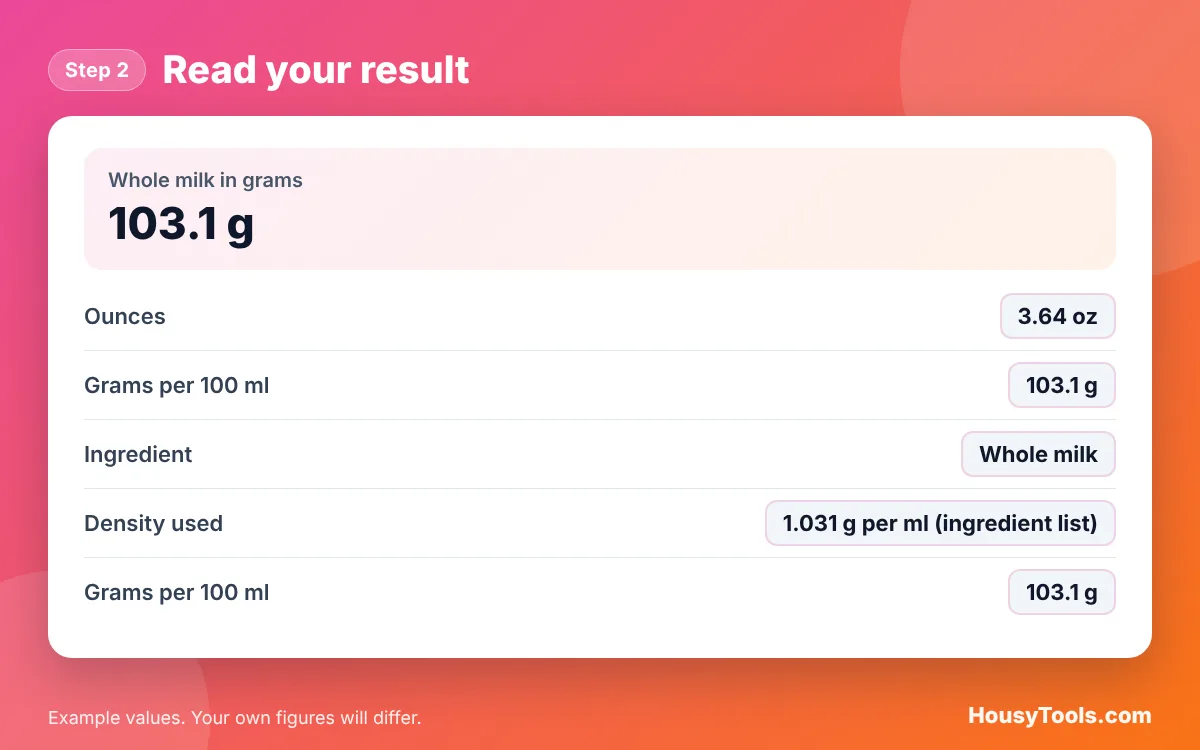
- Read the result, then open “Show the formula and working” to see the density used and each step of the sum.

Is 1 ml Equal to 1 Gram?
One millilitre equals one gram only for water and liquids with the same density. Whole milk is slightly heavier at about 1.03 g per ml, cooking oils are lighter at about 0.91 to 0.92 g per ml, and honey is much heavier at about 1.42 g per ml. For dry ingredients the gap is bigger still: 1 ml of plain flour weighs only about 0.5 g.
How Many Grams Is 100 ml of Milk?
100 ml of whole milk weighs about 103 g. This figure comes from the USDA Nutritive Value of Foods tables, which list 244 g for one US cup of 236.6 ml. A 250 ml metric cup of whole milk weighs about 258 g.
Why Do Flour and Sugar Weigh Less Than Water per ml?
Flour and sugar weigh less than water per millilitre because air fills the gaps between the grains, so 100 ml of plain flour weighs about 51 g and 100 ml of granulated sugar about 84 g. How you fill the jug changes the result: scooped and packed flour weighs noticeably more than flour that is spooned in and levelled. For baking, weighing the dry ingredients is far more reliable than measuring them in millilitres.
Ml to Grams Conversion Table
| Ingredient | Density (g per ml) | 100 ml in grams | 250 ml in grams | 100 g in ml |
|---|---|---|---|---|
| Water | 1.000 | 100 g | 250 g | 100 ml |
| Whole milk | 1.031 | 103.1 g | 257.8 g | 97 ml |
| Cream (double or whipping) | 1.006 | 100.6 g | 251.5 g | 99.4 ml |
| Vegetable or rapeseed oil | 0.921 | 92.1 g | 230.4 g | 108.5 ml |
| Olive oil | 0.913 | 91.3 g | 228.2 g | 109.5 ml |
| Butter | 0.955 | 95.5 g | 238.8 g | 104.7 ml |
| Honey | 1.420 | 142 g | 355 g | 70.4 ml |
| Maple syrup | 1.319 | 131.9 g | 329.7 g | 75.8 ml |
| Plain flour | 0.507 | 50.7 g | 126.8 g | 197.2 ml |
| Self raising flour | 0.478 | 47.8 g | 119.4 g | 209.4 ml |
| Granulated or caster sugar | 0.837 | 83.7 g | 209.2 g | 119.5 ml |
| Icing sugar, unsifted | 0.478 | 47.8 g | 119.4 g | 209.4 ml |
| Cocoa powder | 0.355 | 35.5 g | 88.8 g | 281.7 ml |
| Table salt | 1.217 | 121.7 g | 304.3 g | 82.1 ml |
Densities for flour, sugar, cocoa, salt, honey and maple syrup are calculated from the King Arthur Baking ingredient weight chart. Milk, cream, oils and butter come from the USDA tables. Your own brand may differ slightly, which is why the converter accepts your own density.
Worked Example: Weighing Milk for Pancakes
Example: a pancake recipe asks for 300 ml of whole milk, and you would rather pour it straight into the bowl on digital scales than wash a measuring jug. Set Direction to “Millilitres to grams”, type 300 into Amount (ml or grams) and pick Whole milk. The converter multiplies 300 ml x 1.031 g per ml = 309.4 g, so pour until the scales read about 309 g. Pouring 300 g of milk instead, thinking 1 ml equals 1 g, would use about 9 ml too little.
For more practical tools around the house, browse the home calculators hub. If you bake often and want to know what each oven session costs, try the electricity cost calculator.
Ml to Grams FAQs
How many grams is 250 ml?
250 ml of water weighs 250 g. The same volume of whole milk weighs about 258 g, olive oil about 228 g, granulated sugar about 209 g and plain flour about 127 g. Choose the ingredient in the converter for the right figure.
How many ml is 100 g of flour?
100 g of plain flour fills about 197 ml when spooned into a jug and levelled. Self raising flour is a little lighter, so 100 g takes up about 209 ml. Packed or sifted flour gives different volumes, so weighing flour is always more accurate.
How many grams is 100 ml of oil?
100 ml of vegetable or rapeseed oil weighs about 92 g and 100 ml of olive oil about 91 g. Oil is lighter than water, which is why it floats. If a recipe gives oil in grams, pour slightly more than the same number of millilitres.
How many grams is 100 ml of honey?
100 ml of honey weighs about 142 g. Honey is around 40% heavier than water because it is mostly dissolved sugar, and its density usually falls between 1.38 and 1.45 g per ml depending on how much water it contains. Weighing honey avoids scraping a sticky jug.
Does temperature change ml to grams?
Temperature changes density slightly, but the effect is too small to matter for most cooking. Warm liquids expand a little, so a millilitre weighs fractionally less. The bigger change is with fats: melted butter and solid butter behave differently in a jug, so weigh butter whenever you can.
Can I use this converter for medicine or chemicals?
No, this converter is designed for kitchen ingredients only. Medicines should be measured with the spoon, cup or oral syringe supplied, following the label or a pharmacist’s advice. For chemicals, use the density on the product’s safety data sheet and suitable lab equipment.
Checked October 2026. Sources: King Arthur Baking: Ingredient Weight Chart, USDA Agricultural Research Service: Nutritive Value of Foods (Home and Garden Bulletin 72), Wikipedia: Litre, Wikipedia: Honey.