
Show the formula and working
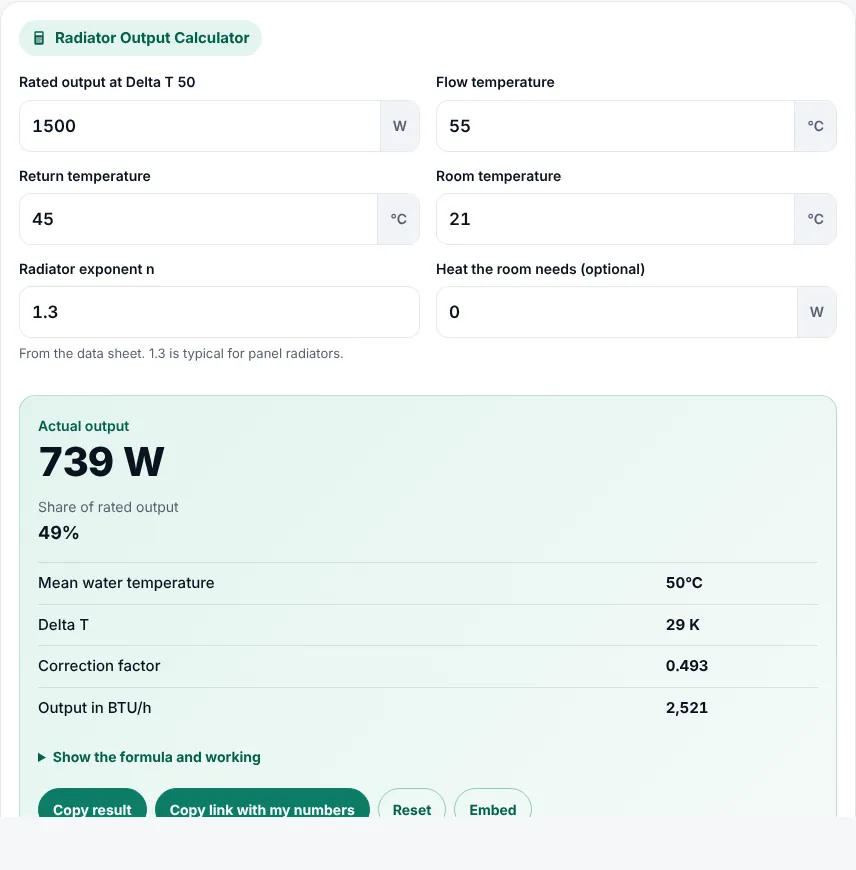
This radiator output calculator converts a radiator’s rated output at Delta T 50 into the heat it really gives at your flow, return and room temperatures, for UK and European homes running a boiler at lower temperatures or a heat pump. Enter the room’s heat need as well, and it tells you whether the radiator is big enough.
Quick answer: the radiator output calculator finds the mean water temperature, subtracts room temperature to get Delta T, then multiplies the rated Delta T 50 output by (Delta T / 50) to the power n, usually 1.3. At 50°C flow, 45°C return and 21°C room, a 1,500 W radiator gives about 657 W.
What Is a Radiator Output Calculator?
A radiator output calculator works out how much heat a radiator actually gives when the water inside it is cooler or hotter than the conditions it was tested at.
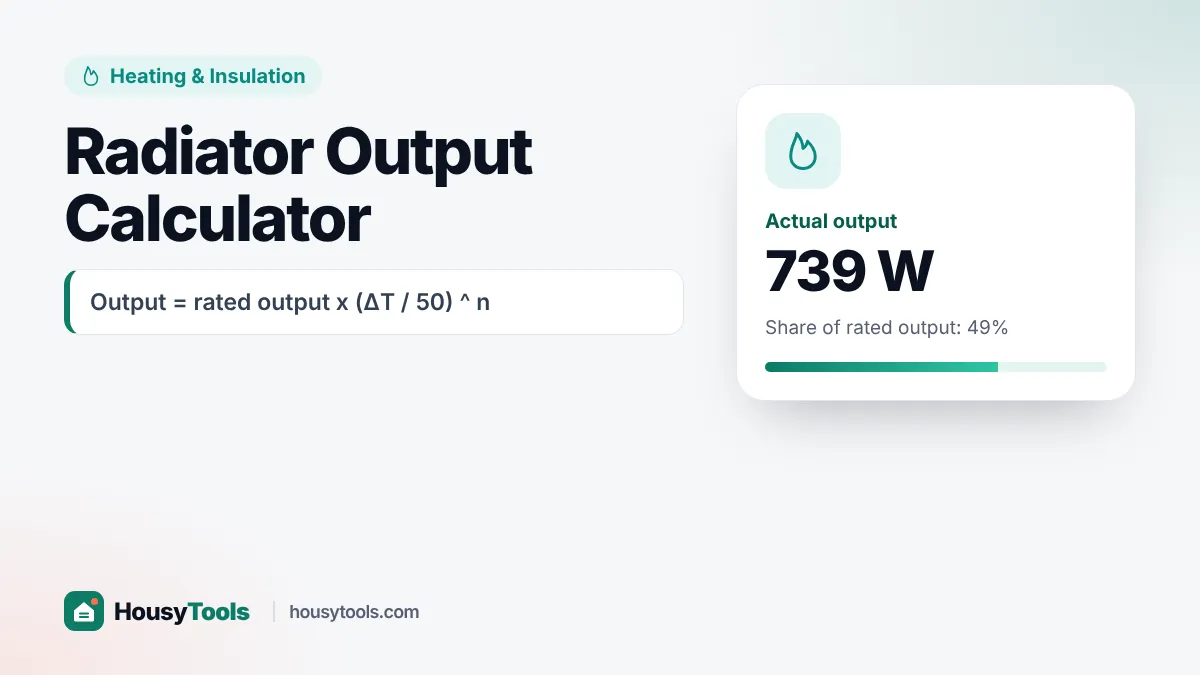
In plain words: add the flow and return temperatures and halve them to get the mean water temperature. Subtract the room temperature to get Delta T. Divide Delta T by 50, raise the result to the power n (the radiator exponent, typically 1.3 for steel panel radiators), and multiply the rated output by that correction factor.
The radiator output calculator also converts the answer to BTU per hour (watts x 3.412) and shows the correction factor as a percentage of the rated output, so you can compare radiators quickly.
How Do You Use the Radiator Output Calculator?
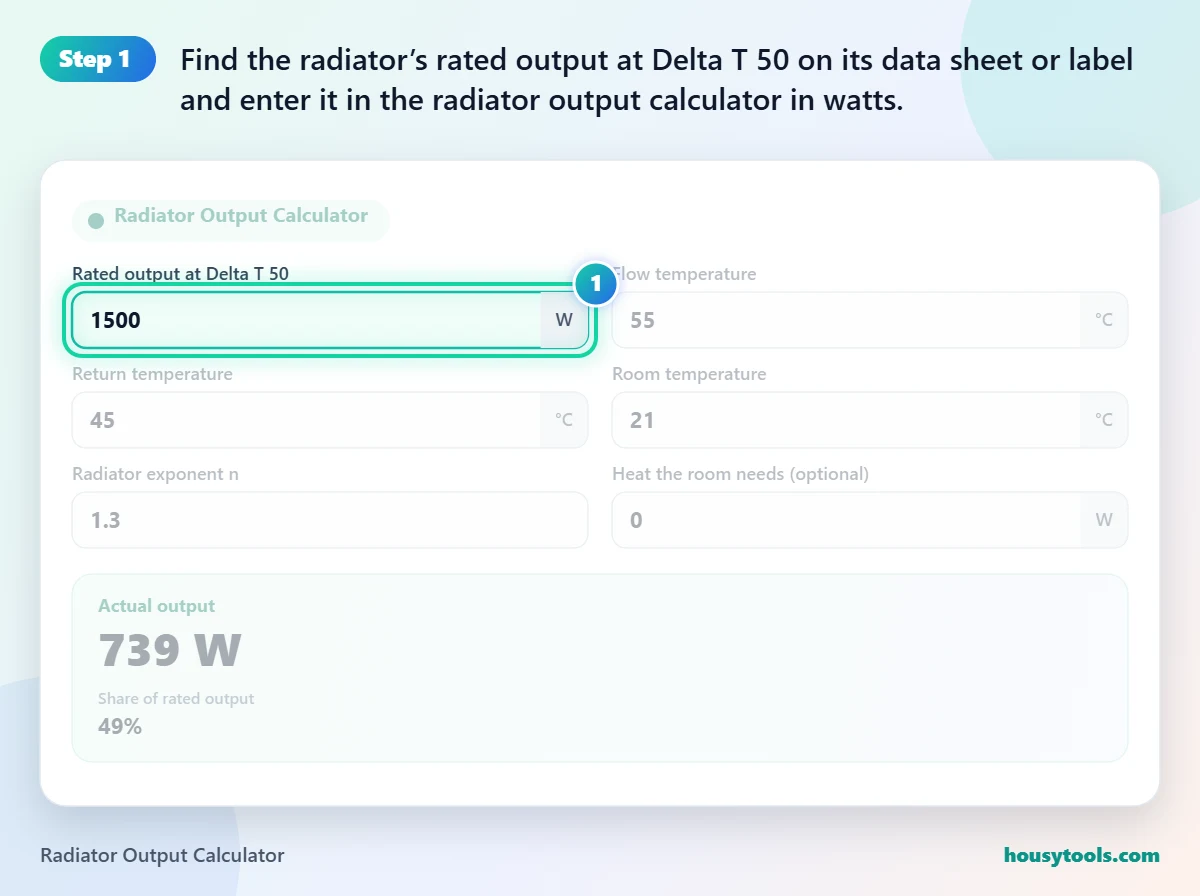
- Find the radiator’s rated output at Delta T 50 on its data sheet or label and enter it in the radiator output calculator in watts.
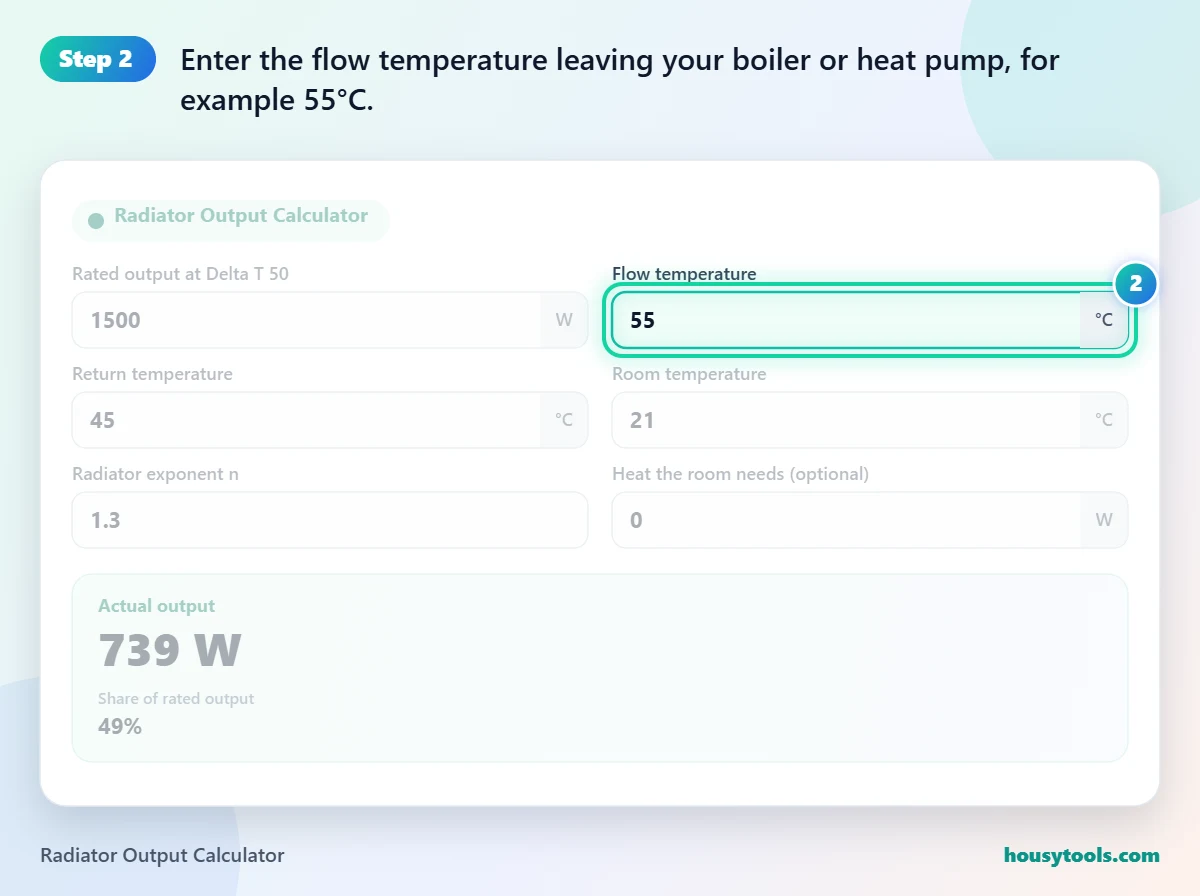
- Enter the flow temperature leaving your boiler or heat pump, for example 55°C.
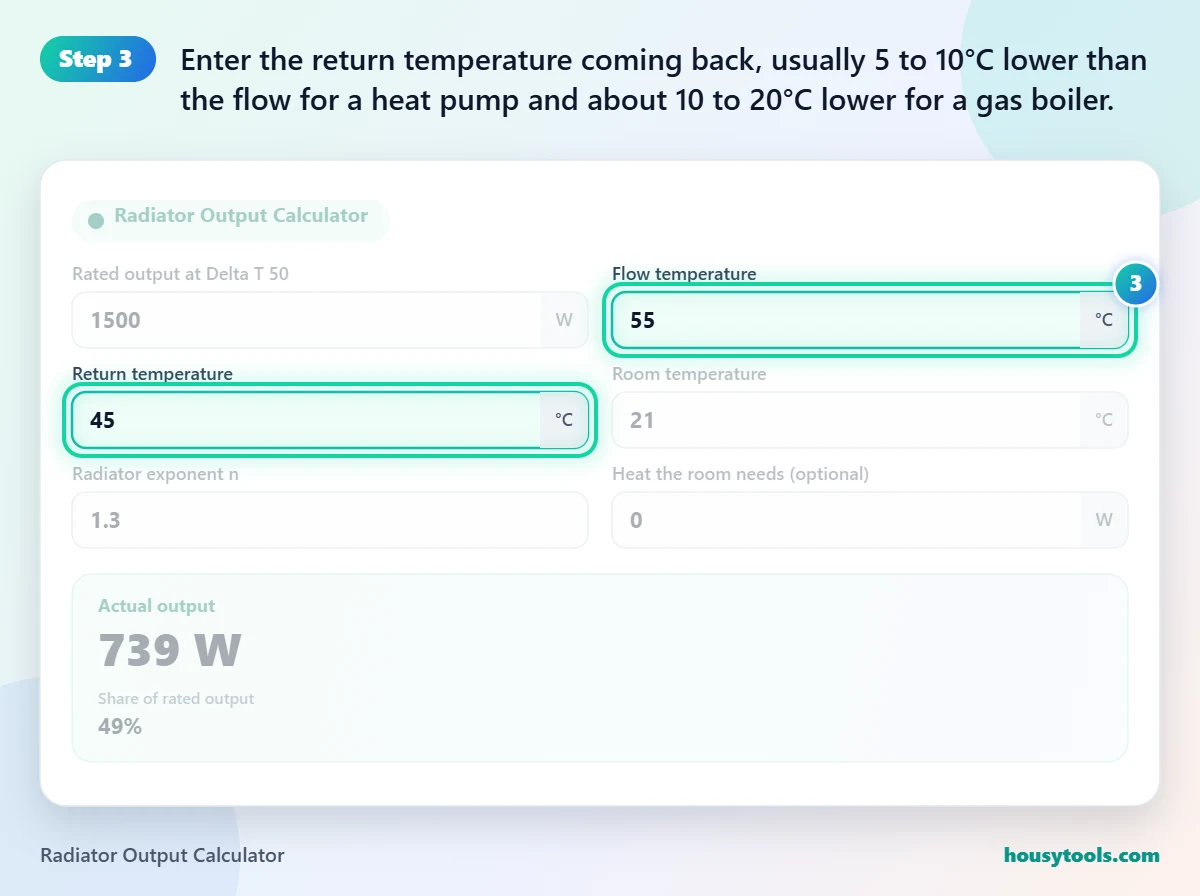
- Enter the return temperature coming back, usually 5 to 10°C lower than the flow for a heat pump and about 10 to 20°C lower for a gas boiler.
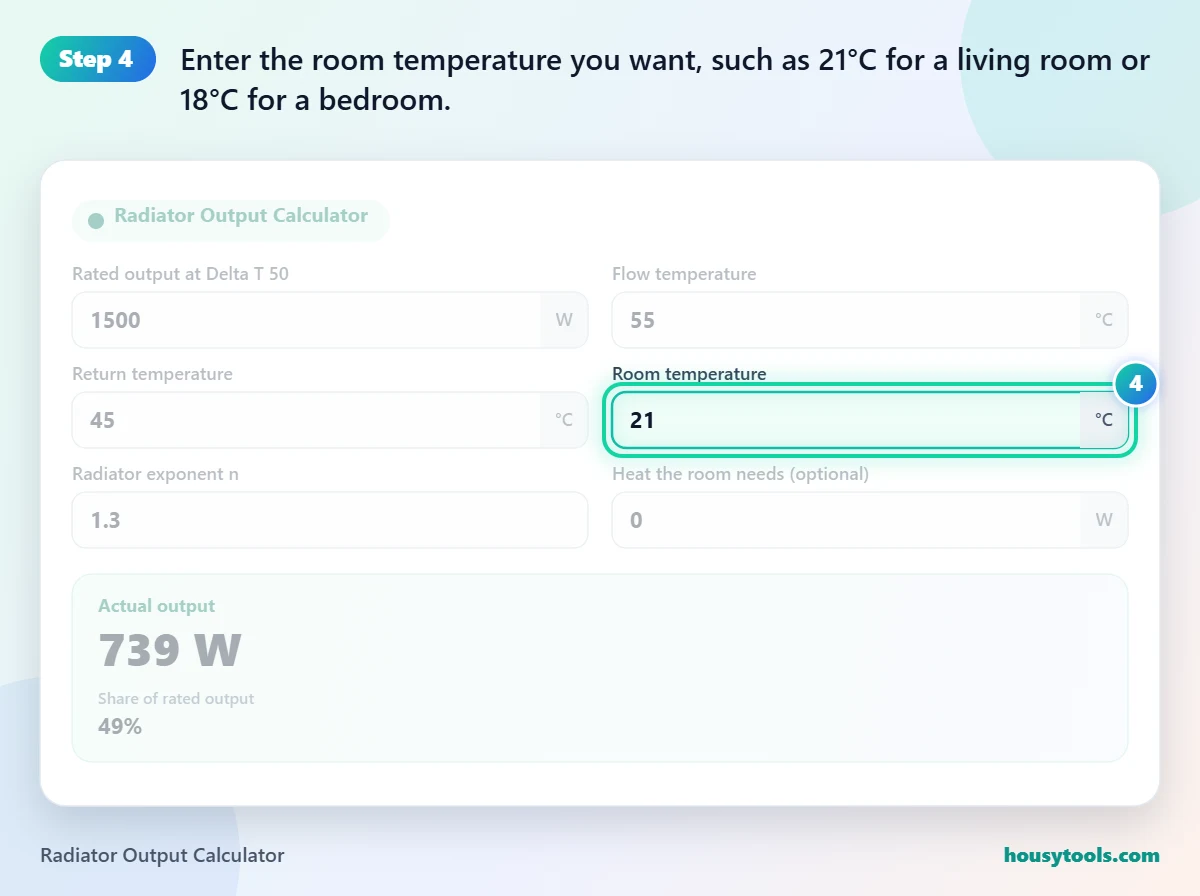
- Enter the room temperature you want, such as 21°C for a living room or 18°C for a bedroom.
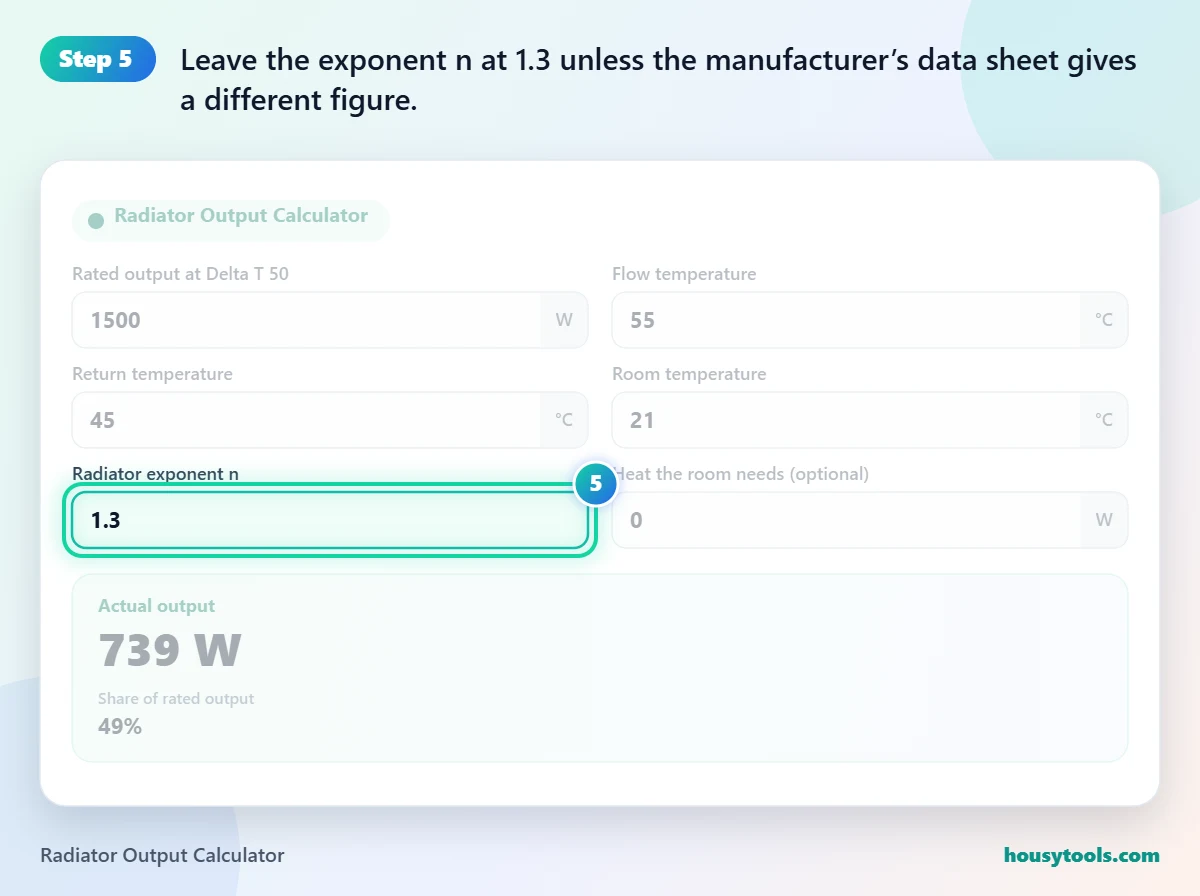
- Leave the exponent n at 1.3 unless the manufacturer’s data sheet gives a different figure.
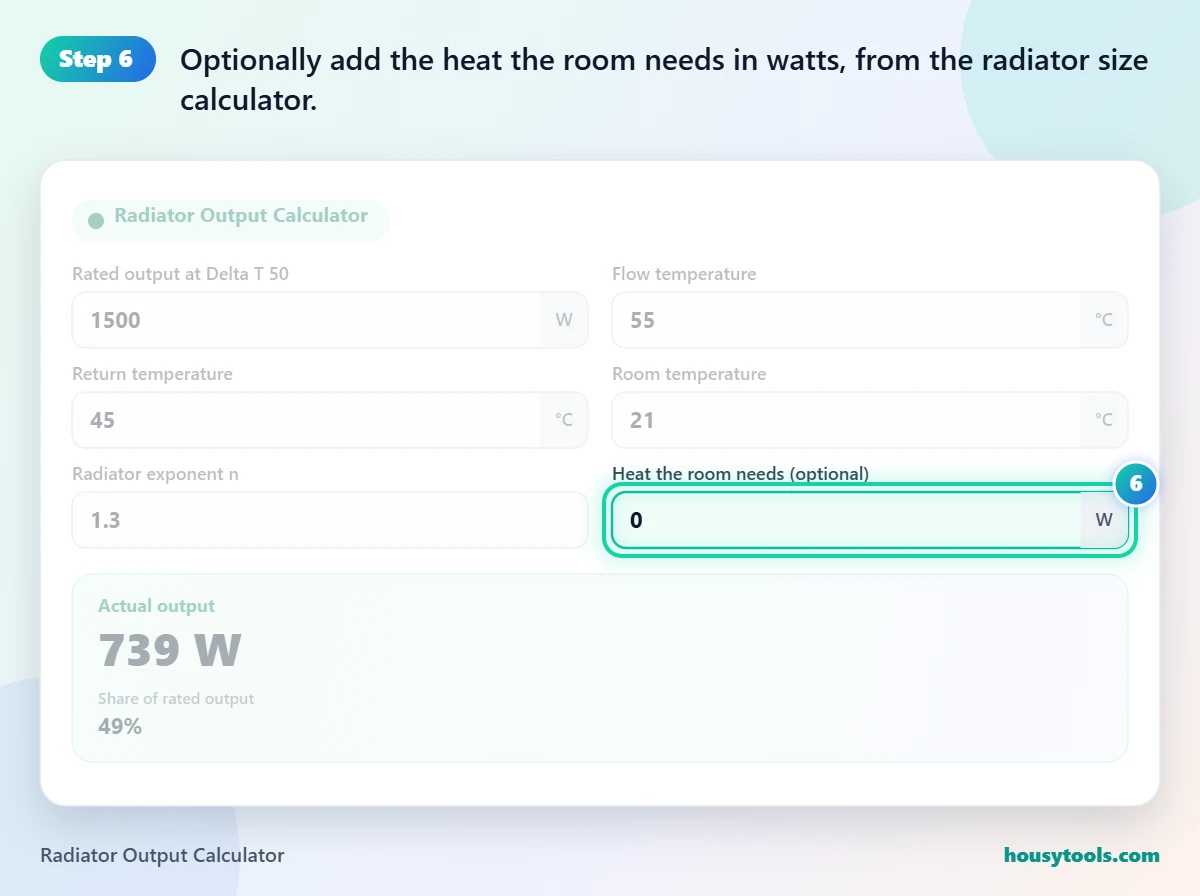
- Optionally add the heat the room needs in watts, from the radiator size calculator.
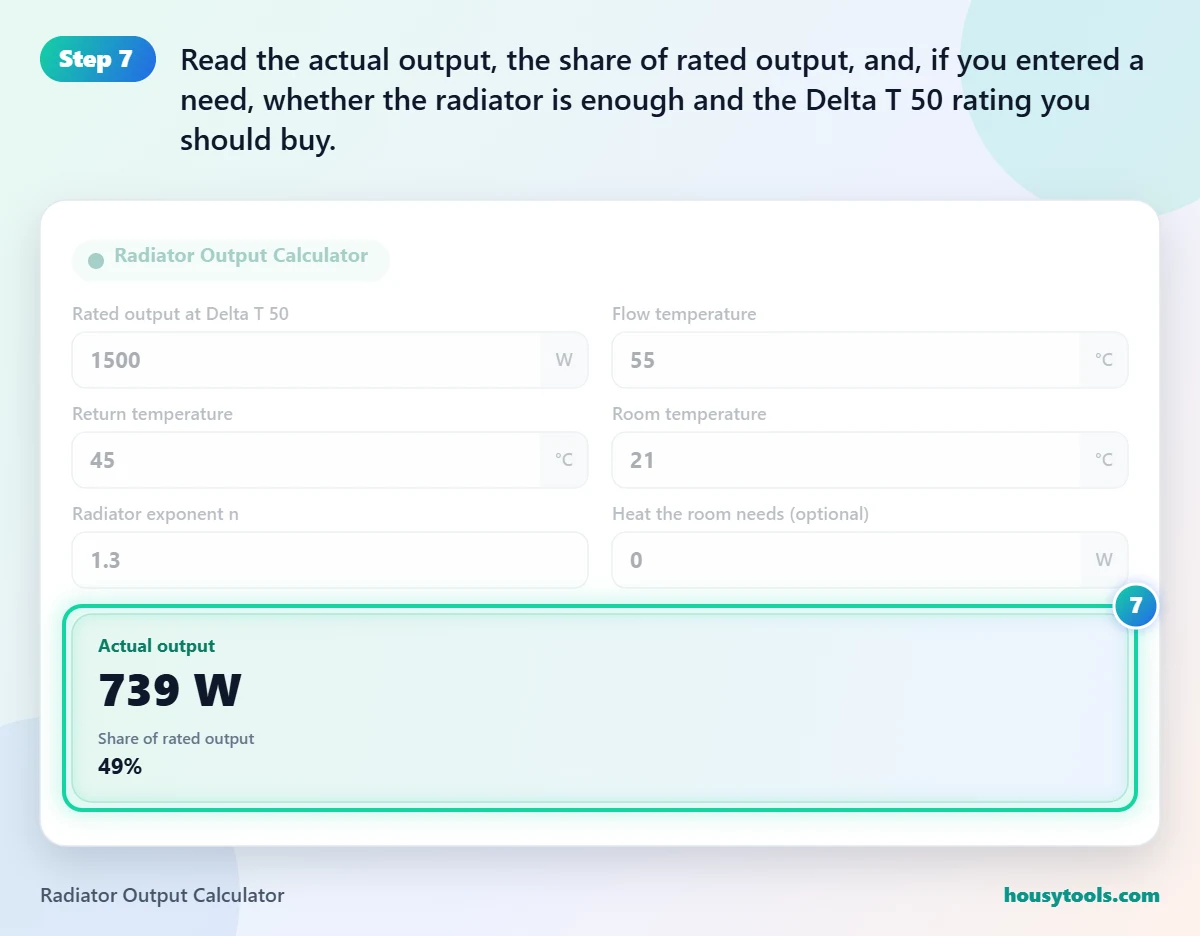
- Read the actual output, the share of rated output, and, if you entered a need, whether the radiator is enough and the Delta T 50 rating you should buy.
What Does Delta T 50 Mean?
Delta T 50 means the radiator was tested with its average water temperature 50°C above the room, typically 75°C flow, 65°C return and a 20°C room under the European standard EN 442.
Most UK and European manufacturers, including Stelrad, quote Delta T 50 as the headline figure. Some older or imported catalogues quote Delta T 60, which makes the same radiator look about 27% more powerful. Always convert to the same basis before you compare, and the radiator output calculator does that for you.
How Much Does Radiator Output Drop at Lower Flow Temperatures?
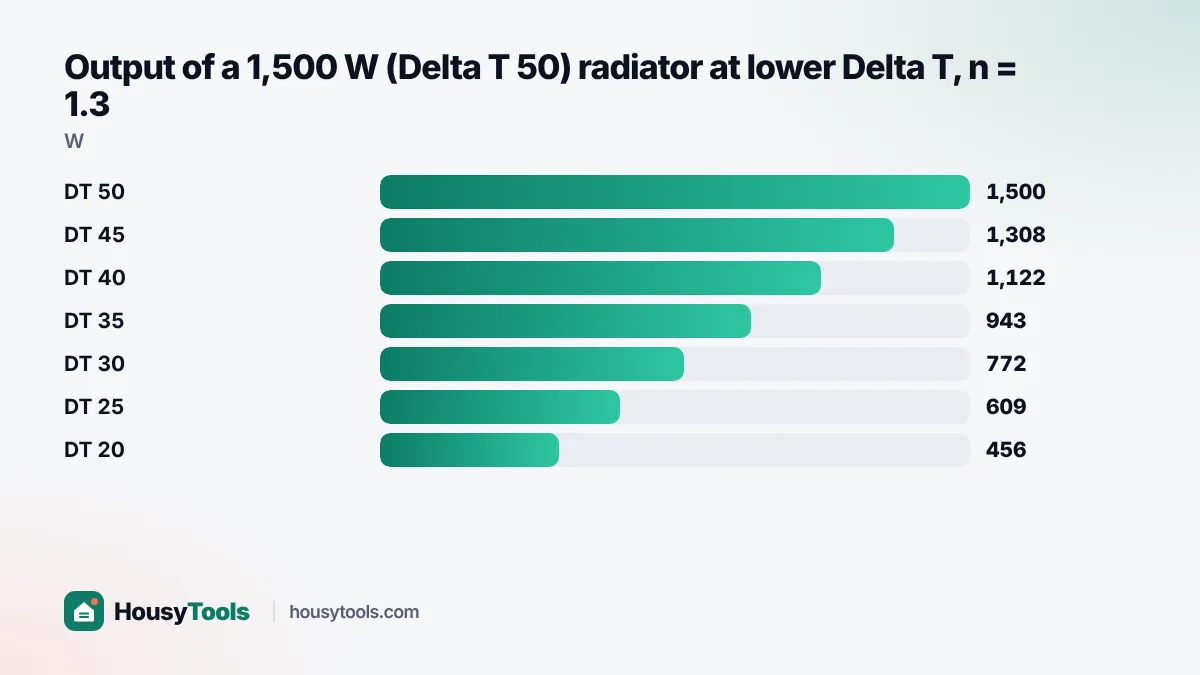
Output drops by about half at Delta T 30 and by about 60% at Delta T 25, because heat output falls faster than the temperature difference: with n = 1.3, a radiator gives 51.5% of its rating at Delta T 30 and 40.6% at Delta T 25.
That is why heat pumps often need larger radiators, and why a radiator output calculator is the first check before any switch. A heat pump is most efficient at low flow temperatures, commonly 35 to 50°C, which gives a Delta T of roughly 15 to 30 K in a 21°C room. A condensing gas boiler also runs more efficiently when its return water is below about 55°C, so lowering a boiler’s flow temperature can save gas, as long as every radiator still meets its room’s heat loss.
Radiator Correction Factors From Delta T 50 to Delta T 20
The table shows the correction factor the radiator output calculator applies at each Delta T with n = 1.3, and what a radiator rated at 1,500 W gives.
| Delta T | Typical mean water in a 21°C room | Correction factor | Output of a 1,500 W radiator |
|---|---|---|---|
| 50 | 71°C | 1.000 | 1,500 W |
| 45 | 66°C | 0.872 | 1,308 W |
| 40 | 61°C | 0.748 | 1,122 W |
| 35 | 56°C | 0.629 | 943 W |
| 30 | 51°C | 0.515 | 772 W |
| 25 | 46°C | 0.406 | 609 W |
| 20 | 41°C | 0.304 | 456 W |
What Exponent n Should I Use?
Use 1.3 for standard steel panel and column radiators unless the data sheet states otherwise; manufacturers such as Zehnder use n = 1.3 for most radiators in their own correction tools.
Emitters that rely more on convection, such as fin tube convectors, tend to have a higher exponent and lose output faster at low temperatures. The radiator output calculator accepts any value from 1.0 to 1.6, so copy the exact figure from the EN 442 test data if the manufacturer publishes it.
Worked Example: Tom’s Bedroom on a Heat Pump
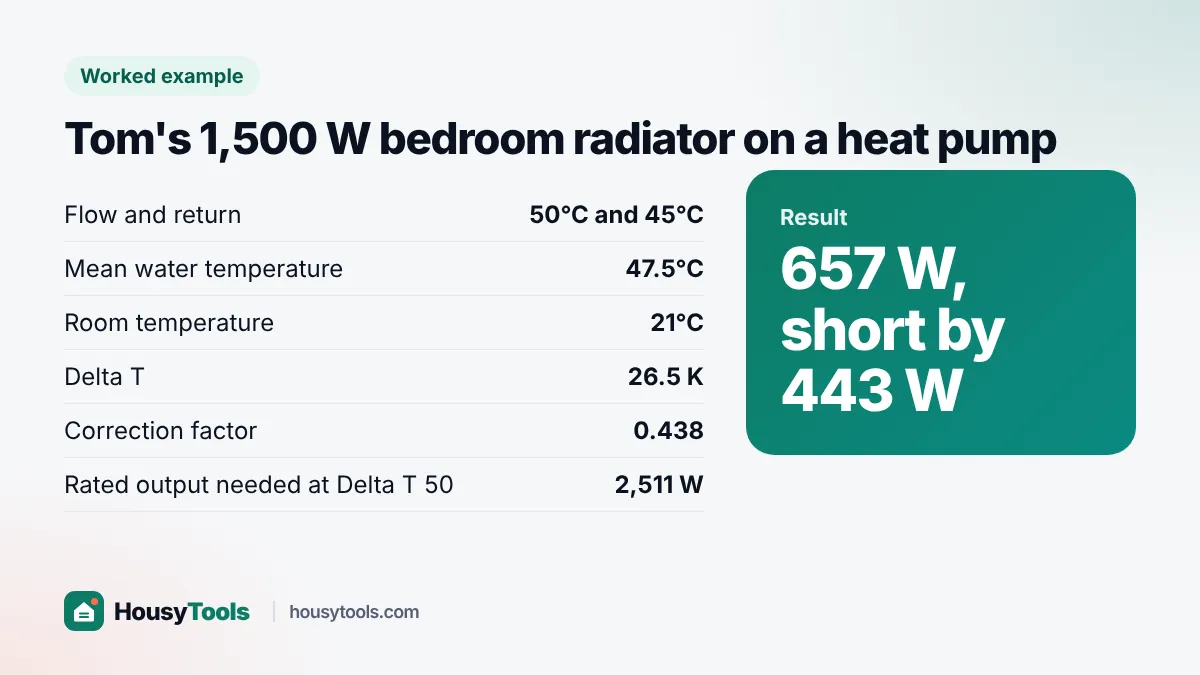
Tom is replacing the gas boiler in his Leeds terrace with an air source heat pump. His back bedroom has a 1,500 W (Delta T 50) double panel radiator, and the installer’s survey says the room needs 1,100 W. The heat pump will run at 50°C flow and 45°C return, and Tom wants 21°C because he works from home in that room.
- Mean water temperature: (50 + 45) / 2 = 47.5°C.
- Delta T: 47.5 minus 21 = 26.5 K.
- Correction factor: (26.5 / 50) to the power 1.3 = 0.438.
- Actual output: 1,500 W x 0.438 = 657 W, or 2,242 BTU per hour.
- Room needs 1,100 W, so the radiator is short by 443 W.
- Rated output needed: 1,100 / 0.438 = 2,511 W at Delta T 50.
Tom’s options are a larger radiator rated at about 2,500 W or more, a second radiator, or accepting 18°C in that room. Dropping to 18°C raises Delta T to 29.5 K, so the same radiator gives more, which the radiator output calculator shows instantly.
What Are Common Mistakes When Checking Radiator Output?
The most common mistake is trusting the headline catalogue figure at a Delta T your system never reaches; a radiator output calculator fixes this by applying your real temperatures.
- Comparing a Delta T 60 or Delta T 70 figure with a Delta T 50 one without converting.
- Using the flow temperature as if it were the mean water temperature.
- Forgetting that bedrooms at 18°C get more output from the same radiator than living rooms at 21°C.
- Assuming towel rails and designer radiators match a panel radiator of the same size. Check their own rated watts.
- Sizing for the average winter day instead of the design temperature, so the room is cold in a frost.
In mainland Europe, some catalogues still list output at other test conditions, such as 90/70/20, which is Delta T 60. Convert those figures to Delta T 50 first, using the FAQ below, and then enter them in the radiator output calculator with your own flow, return and room temperatures.
Why Use Mean Water Temperature Instead of Flow Temperature?
Mean water temperature is used because a radiator’s surface is hot at the inlet and cooler at the outlet, so its average temperature, not the flow alone, sets how much heat it gives off.
Entering only the flow temperature into a radiator output calculator overstates output, especially on a boiler with a 20°C drop across the radiator. If you do not know your return temperature, a smart thermostat or the heat pump controller often shows it. Heat pumps are usually designed for a 5°C drop, and many gas boilers for about 10 to 20°C.
To find what each room needs before you start, use the radiator size calculator. For heat pump running costs at the current price cap, try the heat pump running cost calculator. Any change to boiler settings beyond the user controls, or to gas pipework, needs a Gas Safe registered engineer.
Radiator Output Calculator FAQs
How do I convert Delta T 60 to Delta T 50?
Multiply the Delta T 60 output by (50 / 60) to the power 1.3, which is about 0.789. A radiator listed at 2,000 W at Delta T 60 gives roughly 1,578 W at Delta T 50. Compare radiators only after converting to the same Delta T.
What flow temperature does a heat pump use?
Most air source heat pumps in the UK are designed for flow temperatures between about 35 and 50°C. Lower flow temperatures raise efficiency but cut radiator output, so the installer balances radiator size against running cost in the design.
Will my radiators work with a heat pump?
Some will. Enter each radiator’s rating and the planned flow temperature in the radiator output calculator, then compare with each room’s heat loss. Rooms that fall short usually need a larger radiator, often a double panel with fins.
What is the radiator exponent n?
The exponent n describes how quickly a radiator’s output falls as the water cools. It comes from EN 442 testing at several temperatures. Steel panel radiators typically sit around 1.3, and the manufacturer’s data sheet gives the exact figure.
Does turning down the boiler flow temperature save money?
Usually yes, because condensing boilers recover more heat when the return water is cooler. Rooms still need enough radiator output at the lower temperature, so check each one with the radiator output calculator before turning it down a long way.
Why is my radiator not reaching its rated output?
Common reasons are a lower water temperature than the Delta T 50 test, trapped air, sludge, or poor balancing. If a radiator is cold at the top, bleed it. If cold at the bottom, a heating engineer may need to flush the system.
Checked October 2026. Sources: Stelrad, Zehnder, EN 442 test conditions as published by manufacturers.