
Show the formula and working
This sand and cement screed calculator works out the volume of a traditional floor screed and the bags of cement and tonnes of sharp sand needed to mix it, for UK and European floors measured in metres and millimetres. Choose a 1:3, 1:4 or 1:4.5 mix, set the thickness and wastage, and it shows the materials with the full working. It also tells you which type of screed your chosen thickness usually suits.
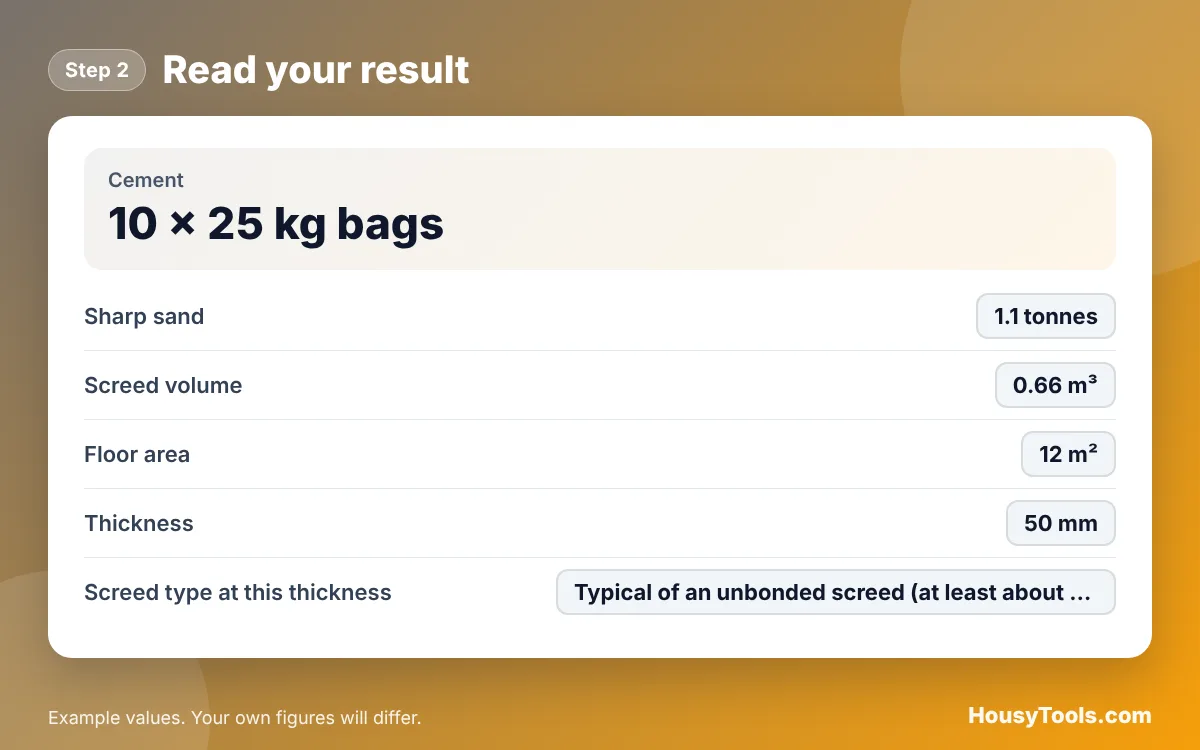
Quick answer: Multiply length x width x thickness in metres, add 10% wastage, multiply by about 1.3 for dry materials, then split by the mix ratio. A 4 m by 3 m floor screeded 50 mm thick at 1:4 needs 0.66 m³, so the sand and cement screed calculator shows 10 bags of cement and 1.1 tonnes of sand.

What Is a Sand and Cement Screed Calculator?
A sand and cement screed calculator is a tool that converts a floor’s area and screed thickness into the cement and sharp sand needed for a traditional semi dry screed. The formula in plain words: wet volume = length x width x thickness x (1 + wastage); dry volume = wet volume x a dry volume factor, because loose sand and cement pack down once mixed and compacted; cement volume = dry volume / (1 + sand parts); sand volume = dry volume x sand parts / (1 + sand parts). Weights come from multiplying each volume by its bulk density, and cement bags = cement weight / bag size, rounded up.
A screed is a levelled layer laid over a concrete slab or insulation to take the final floor finish. Most sand and cement screeds are mixed at between 1:3 and 1:4.5 cement to sand.
How Do You Use the Sand and Cement Screed Calculator?
- Enter the Floor length and Floor width.
- Enter the Screed thickness in millimetres.
- Choose the Mix (cement to sand) from your specification.
- Set the Wastage and check the Dry volume factor.
- Check the Cement bulk density, Sharp sand density and Cement bag size.
- Read the cement bags, sand tonnes and volume, then open “Show the formula and working” to see each step.

How Much Sand and Cement Do I Need for a Screed?
Each square metre of screed 50 mm thick at 1:4 needs about 20 kg of cement and 92 kg of sharp sand, including 10% wastage and a 1.3 dry volume factor. A 10 m² floor therefore needs about 9 bags of cement and just under a tonne of sand.
| Screed thickness | Wet volume per 10 m² (+10%) | Cement (25 kg bags) | Sharp sand |
|---|---|---|---|
| 25 mm | 0.28 m³ | 100 kg, 5 bags | 0.46 t |
| 40 mm | 0.44 m³ | 160 kg, 7 bags | 0.73 t |
| 50 mm | 0.55 m³ | 200 kg, 9 bags | 0.92 t |
| 65 mm | 0.72 m³ | 260 kg, 11 bags | 1.19 t |
| 75 mm | 0.83 m³ | 300 kg, 13 bags | 1.37 t |
The table uses a 1:4 mix, 1,400 kg/m³ cement and an example 1,600 kg/m³ for sand. Sand density varies with moisture, so your merchant’s figure may differ.
How Thick Should a Sand and Cement Screed Be?
A bonded screed stuck directly to the slab is usually about 25 to 40 mm thick, an unbonded screed laid on a membrane at least about 50 mm, and a floating screed over insulation more than 65 mm for lightly loaded floors and 75 mm for heavier loads. These figures summarise the British Standard guidance in BS 8204. A screed over underfloor heating pipes is a floating screed, and the underfloor heating calculator covers the heating side.
What Is the Best Mix Ratio for Floor Screed?
A 1:4 cement to sand mix is a common choice for domestic floor screeds, with 1:3 for a stronger, harder wearing screed and 1:4.5 for a leaner mix. Use sharp sand, not soft building sand, and only enough water to make a semi dry mix that holds together when squeezed. If the specification or the floor finish maker states a mix, use that. For thin levelling under 25 mm, a self levelling compound calculator is a better fit.
How Long Does a Sand and Cement Screed Take to Dry?
A sand and cement screed takes weeks rather than days to dry, and thicker screeds take longer. Underfloor heating should not be used to force dry it early, and the screed should cure slowly at first. Moisture should be tested before laying timber, vinyl or other moisture sensitive finishes. Portland cement, the binder in the mix, is described in Wikipedia’s Portland cement article. For thicker concrete slabs, use the concrete calculator.
Worked Example: Screed for a 4 m by 3 m Floor
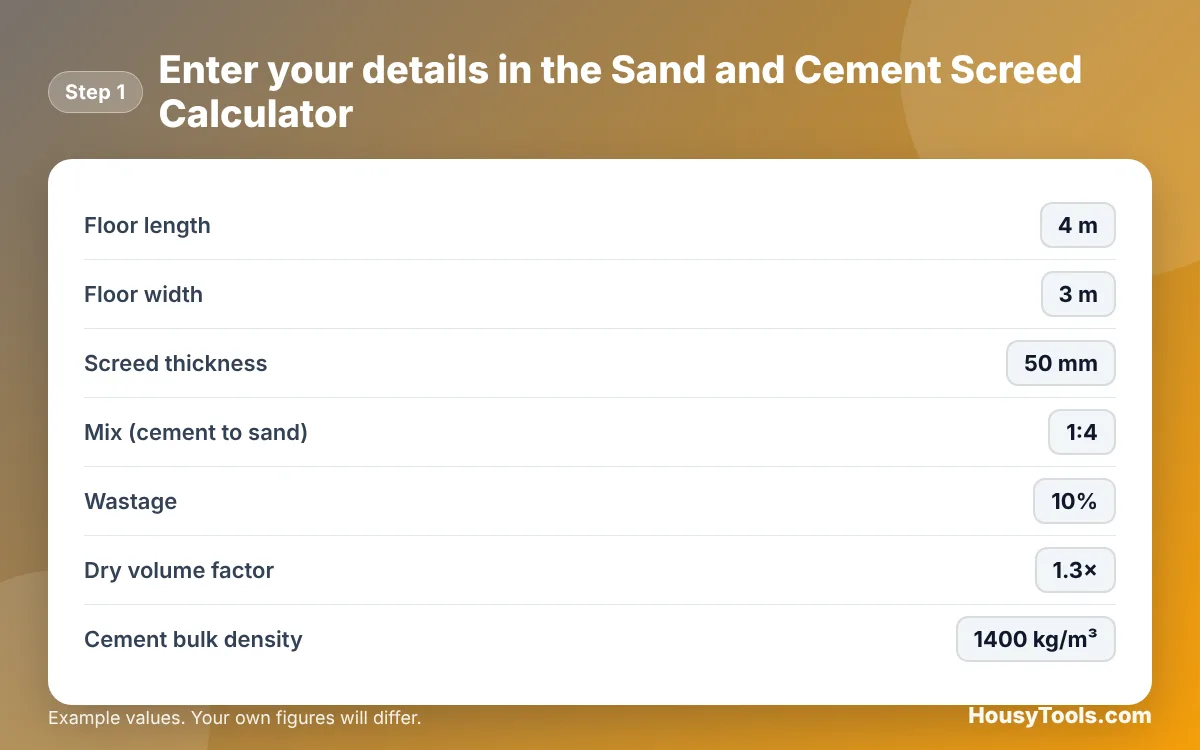
Example: a kitchen floor 4 m by 3 m gets an unbonded screed 50 mm thick at a 1:4 mix, with 10% wastage and a 1.3 dry volume factor. Cement is taken at 1,400 kg/m³ in 25 kg bags, and sharp sand at an example 1,600 kg/m³. These are the calculator’s default inputs.
- Wet volume: 12 m² x 0.05 m x 1.1 = 0.66 m³.
- Dry materials: 0.66 m³ x 1.3 = 0.858 m³.
- Cement: 0.858 m³ / 5 parts = 0.172 m³ x 1,400 kg/m³ = 240 kg, so 10 bags of 25 kg.
- Sand: 0.858 m³ x 4 / 5 = 0.686 m³ x 1,600 kg/m³ = 1,098 kg, about 1.1 tonnes.
At 1:3 the same floor needs 13 bags of cement and 1.03 tonnes of sand.
Sand and Cement Screed Calculator FAQs
How many bags of cement do I need for a screed?
For a 50 mm screed at 1:4, allow about 2 bags of 25 kg cement for every 2.5 m² of floor, including wastage. A 12 m² floor needs about 10 bags. A 1:3 mix uses about a quarter more cement.
What sand should I use for screed?
Use sharp sand, sometimes sold as concreting or grit sand, rather than soft building sand. Sharp sand has coarser, angular grains that give a stronger screed. Check it is clean and free of clay, and keep it covered so the moisture stays even.
Why is there a dry volume factor?
Loose cement and sand contain air. When mixed with a little water and compacted, the volume shrinks, so you need more dry material than the finished screed volume. The calculator uses 1.3 as an example, which you can change.
What is the minimum screed thickness?
Bonded screeds are usually about 25 to 40 mm, unbonded screeds at least about 50 mm, and floating screeds over insulation over 65 mm, or 75 mm for heavier loads. Below about 25 mm, a levelling compound is usually more suitable.
Can I buy ready mixed screed instead?
Yes. Ready mixed semi dry screed and premixed screed bags save mixing on site and give a more consistent mix. Use the screed volume from the calculator to order, and check the supplier’s yield per bag or per cubic metre.
Should I add fibres or additives to screed?
Fibres and additives can reduce cracking or speed up drying, but they change the mix and the timings. Follow the additive maker’s instructions and any specification for the floor, especially over underfloor heating or under moisture sensitive finishes.
Checked October 2026. Sources: Designing Buildings Wiki, Screed (BS 8204 thickness summary: bonded 25 to 40 mm, unbonded about 50 mm, floating over 65 mm or 75 mm; mixes 1:3 to 1:4.5), Breedon Portland cement data sheet (settled bulk density 1,300 to 1,450 kg/m³), Wikipedia: Screed, Wikipedia: Portland cement.