
Show the formula and working
This free lining paper calculator tells homeowners and decorators in the UK, Ireland and Europe how many rolls of lining paper to buy for the walls of a room, and for the ceiling if you are lining that too. Enter the room size, the doors and windows, how you will hang the paper and the roll size, and it shows the rolls, the wall area and every step of the sum.
Quick answer: A lining paper calculator divides the wall height by the roll width to get the courses, multiplies by the room perimeter and divides by the roll length. A 4 m by 3 m room with 2.4 m walls, one door and a window needs 4 double rolls of 20 m x 0.53 m hung horizontally, with 10% waste.
What Is a Lining Paper Calculator?
A lining paper calculator is a tool that works out the number of lining paper rolls needed to cover a room from its size, the openings and the roll dimensions.
The formula in plain words: the perimeter is twice the length plus twice the width. For horizontal hanging, the number of courses is the wall height divided by the roll width, rounded up. The paper length is the courses multiplied by the perimeter, minus the openings (their area divided by the roll width), plus a waste allowance. Rolls are that length divided by the roll length, rounded up. For vertical hanging, the drops are the perimeter divided by the roll width, rounded up, each drop is the wall height plus a trim allowance, and rolls are the drops divided by the whole drops you can cut from one roll.
How Do You Use the Lining Paper Calculator?
- Measure and enter the Room length, Room width and Wall height.
- Enter the number of Doors and the Window area (total), adding together the width times height of each window.
- Choose the Hanging direction: horizontal if you will wallpaper over the lining, or vertical if you prefer to hang it like wallpaper. Tick Line the ceiling too if needed.
- Pick the Roll size printed on the label, or choose Custom and enter the Custom roll length and Custom roll width.
- Adjust the Waste allowance (horizontal) and the Trim allowance per length (vertical and ceiling) if your room has lots of corners, alcoves or uneven ceilings.
- Read the number of rolls in the result, then open “Show the formula and working” to see the courses or drops and the sum.

How Many Rolls of Lining Paper Do You Need for a Room?
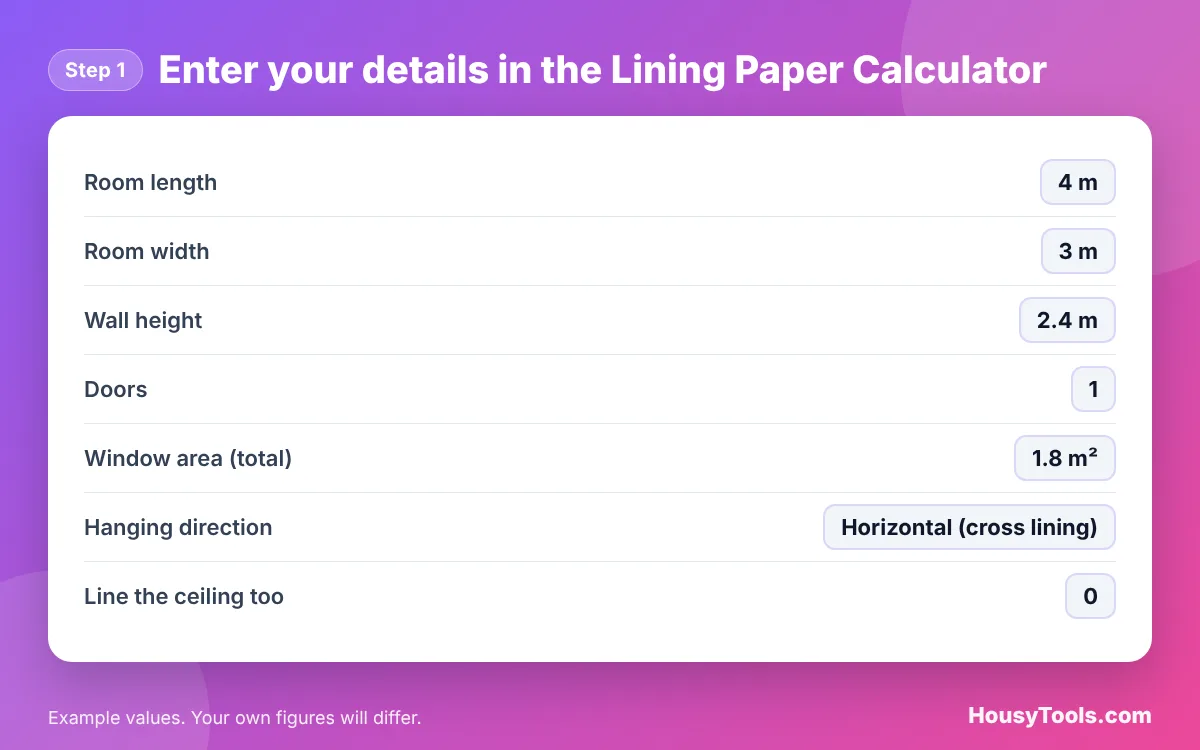
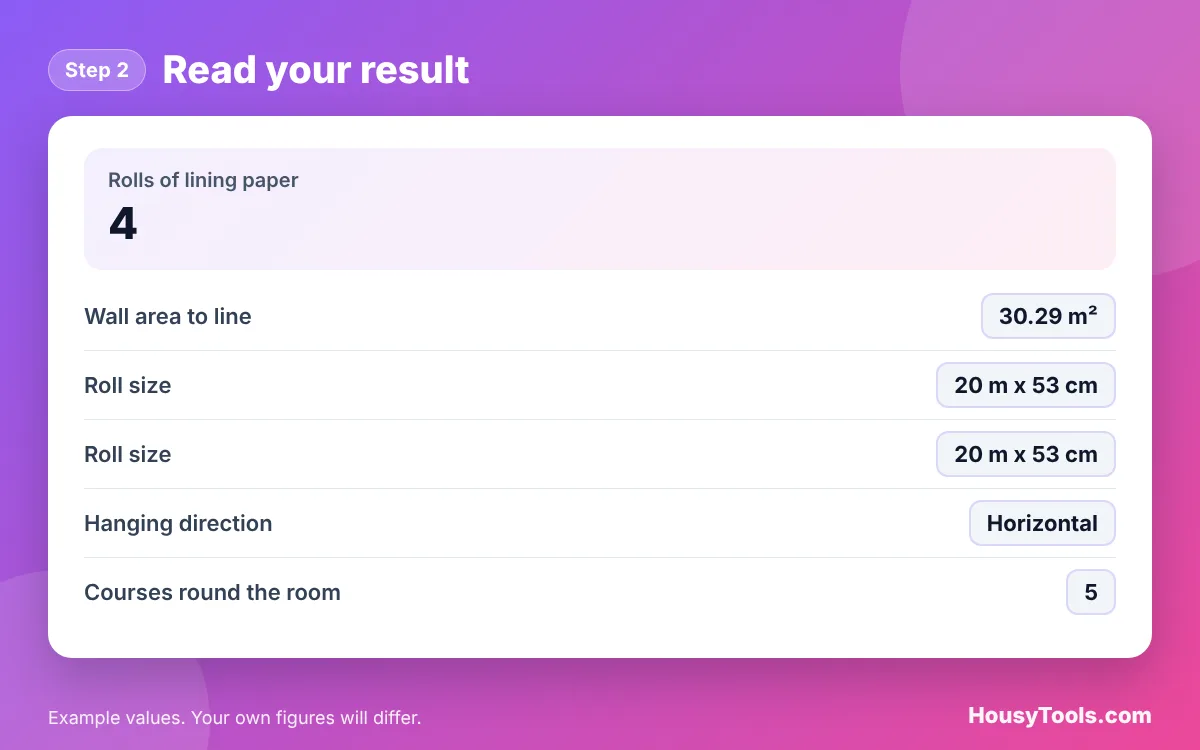
An average bedroom of 4 m by 3 m with 2.4 m walls needs 4 double rolls (20 m x 0.53 m) or 6 standard rolls (10 m x 0.56 m) for the walls. Lining the ceiling as well adds 2 double rolls. The B&Q guide gives standard rolls as 530 to 560 mm wide and 10 m long, and many trade lining papers, such as the Erfurt range, come as 20 m double rolls. Check the label, because a 20 m roll covers twice the area of a 10 m one.
Should You Hang Lining Paper Horizontally or Vertically?
Hang lining paper horizontally if you will wallpaper over it, so the joins in the lining never line up with the joins in the wallpaper. This is called cross lining. If you will only paint over the lining, either direction works, and vertical drops are shorter and easier to handle on your own. The roll count can differ by one or two between the two methods, so try both in the calculator.
What Grade of Lining Paper Should You Use?
Grade 1400 is a good all round choice, and the grades run from 800 (thinnest) to 2000 (thickest). Thin grades such as 800 suit sound, new plaster; thicker grades hide more cracks and uneven surfaces but are heavier to hang. Erfurt describes its lining paper as giving an even, absorbent base for paint or wallpaper. The grade does not change how many rolls you need, only the roll size does.
Do You Subtract Doors and Windows for Lining Paper?
Yes, but only roughly: the calculator deducts each door as a standard 1981 x 762 mm door (1.51 m²) and the window area you enter. That door size is the most common in England and Wales according to Howarth Timber’s door size guide. For vertical hanging it removes only whole drops, because the short pieces above and below openings still need paper. If you plan to paint over the lining, the paint calculator works out the emulsion for the same walls.
Lining Paper Rolls by Room Size
Walls only, 2.4 m high, one door and 1.8 m² of windows. Horizontal uses a 10% waste allowance; vertical uses a 10 cm trim on each drop.
| Room size | Wall area to line | Double rolls 20 m x 0.53 m, horizontal | Double rolls 20 m x 0.53 m, vertical | Standard rolls 10 m x 0.56 m, vertical |
|---|---|---|---|---|
| 3 m x 2.5 m | 23.09 m² | 3 | 3 | 5 |
| 3.5 m x 3 m | 27.89 m² | 4 | 3 | 6 |
| 4 m x 3 m | 30.29 m² | 4 | 4 | 6 |
| 4.5 m x 3.5 m | 35.09 m² | 5 | 4 | 7 |
| 5 m x 4 m | 39.89 m² | 5 | 4 | 8 |
| 6 m x 4 m | 44.69 m² | 6 | 5 | 9 |
Worked Example: Cross Lining a 4 m by 3 m Bedroom
Example: a 4 m by 3 m bedroom is being lined before wallpaper goes up. The walls are 2.4 m high, with one door and a 1.8 m² window. Keep Horizontal (cross lining), the 20 m x 0.53 m double roll and a 10% waste allowance.
- Perimeter: 2 x (4 + 3) = 14 m. Wall area: 14 x 2.4 = 33.6 m², less 3.31 m² for the door and window = 30.29 m².
- Courses: 2.4 / 0.53 = 4.53, rounded up to 5. Length: 5 x 14 m = 70 m, less 6.24 m for openings = 63.76 m.
- With 10% waste: 63.76 x 1.1 = 70.13 m.
- Rolls: 70.13 / 20 = 3.51, rounded up to 4 double rolls.
When you tick Line the ceiling too, the tool adds 8 strips of 3.1 m, six to a roll, so 2 more rolls and 6 in total. For the wallpaper that goes on top, the wallpaper calculator works out the rolls with the pattern repeat.
Lining Paper Calculator FAQs
How much does a roll of lining paper cover?
A standard 10 m x 0.56 m roll covers 5.6 m² and a 20 m x 0.53 m double roll covers 10.6 m² before waste. In practice you lose some to trimming at corners, ceilings and skirting, which is why the calculator rounds up to whole courses, whole drops and whole rolls.
What is cross lining?
Cross lining means hanging lining paper horizontally, at right angles to the wallpaper that will go over it. The joins in the two layers then cross instead of lining up, which gives a smoother, stronger finish. Start at the top of the wall and work down in courses.
Can you paint straight onto lining paper?
Yes, once the paste has dried fully. A first coat of emulsion thinned as the tin advises helps it soak in evenly, followed by full coats. Fill any small gaps at joins with flexible decorators’ caulk before painting so they do not show through the emulsion.
Should lining paper joins overlap?
No, lining paper joins should butt edge to edge without overlapping, because an overlap leaves a ridge that shows through paint or wallpaper. Slide each length into place with your hands so the edges meet neatly, then smooth out air bubbles from the centre.
Which grade of lining paper is best for bad walls?
Use a heavy grade such as 1700 or 2000 for walls with fine cracks or an uneven surface, and 1400 for most ordinary walls. Lining paper cannot hide large holes, loose plaster or damp, so repair those first and let any new plaster dry before you hang paper.
How many extra rolls of lining paper should I buy?
The calculator already allows for trimming and rounds up, so most rooms need no extra roll. Buy one more if the room has many alcoves, a chimney breast, sloping ceilings or you are new to hanging paper. Lining paper has no batch or pattern to match, so a later roll will match.
For the rest of the room, the paint and decorating calculators cover paint, wallpaper, ceilings and skirting boards.
Checked October 2026. Sources: How to hang lining paper (B&Q), Makulatur lining paper (Erfurt), Erfurt MAV lining paper, grades and 20 m x 0.53 m roll (Decorating Warehouse), UK door sizes (Howarth Timber).