
Show the formula and working
This free inverter size calculator works out the continuous watts, the surge rating and the battery current you need to run 230 V appliances from a 12 V, 24 V or 48 V battery, for homeowners, campervan and boat owners, and anyone planning backup power in the UK, Ireland or Europe. It adds a safety margin, allows for motors that surge when they start and suggests the next common inverter size.
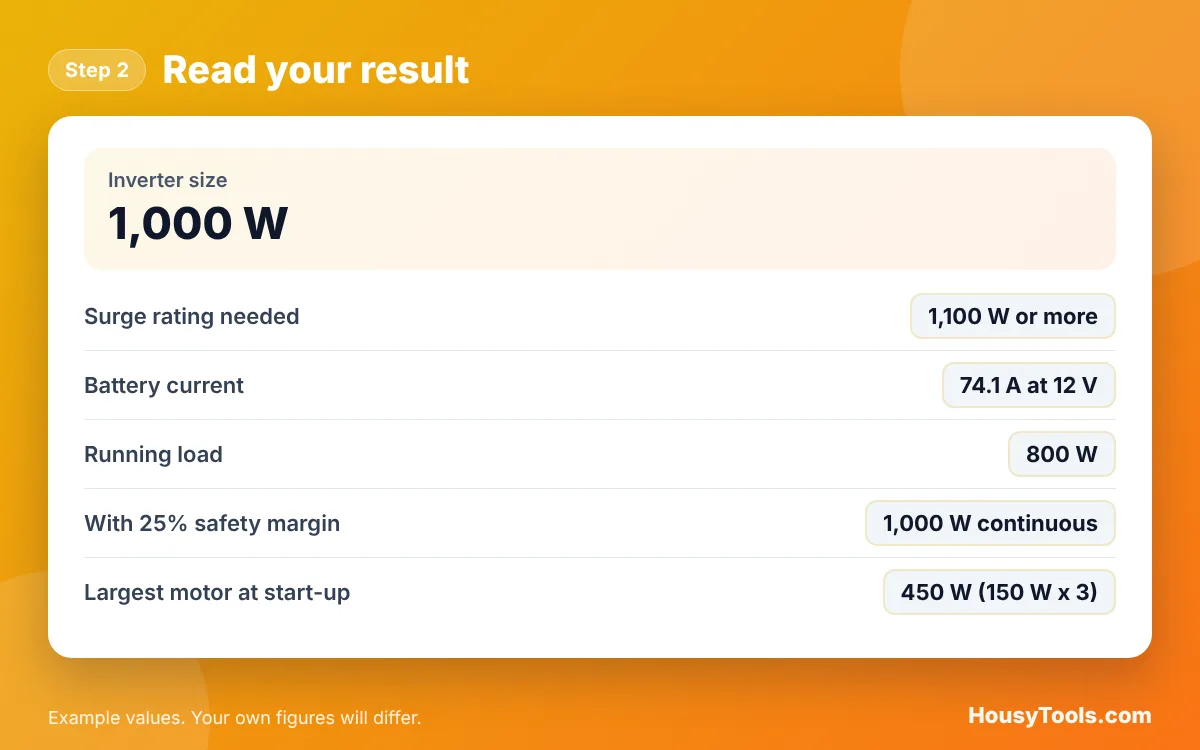
Quick answer: Add the running watts of everything used at once, then add about 25% headroom. For 800 W of appliances, this inverter size calculator suggests a 1,000 W inverter with at least 1,100 W of surge if a 150 W fridge starts at three times its power. On 12 V it draws about 74 A.
What Is an Inverter Size Calculator?
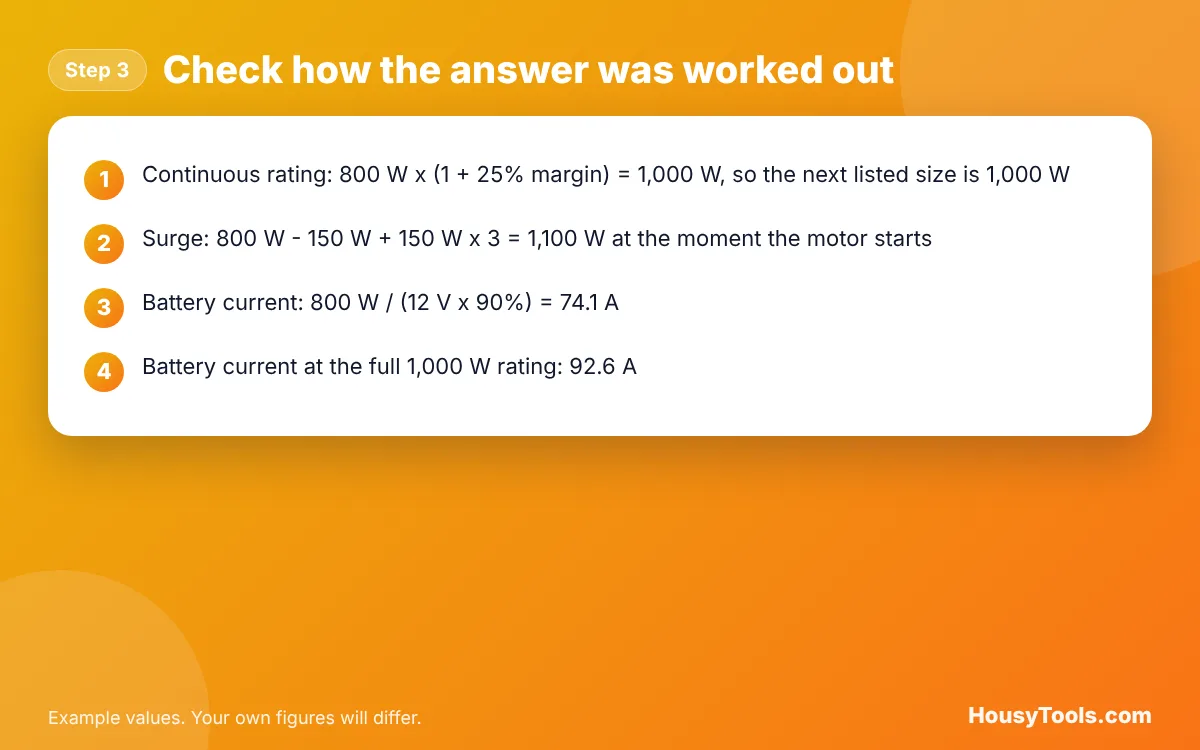
An inverter size calculator is a tool that finds the smallest inverter that can safely power your appliances from a battery. In plain words: continuous rating = total running watts x (1 + safety margin). Surge rating = total running watts minus the largest motor’s running watts, plus that motor’s watts x its start-up multiplier. Battery current = running watts / (battery volts x inverter efficiency).
A power inverter turns direct current from a battery into alternating current like the mains. It has two ratings: the continuous power it can deliver all the time, and a short surge or peak power for the moment a motor or compressor starts. Both must cover your appliances.
How Do You Use the Inverter Size Calculator?
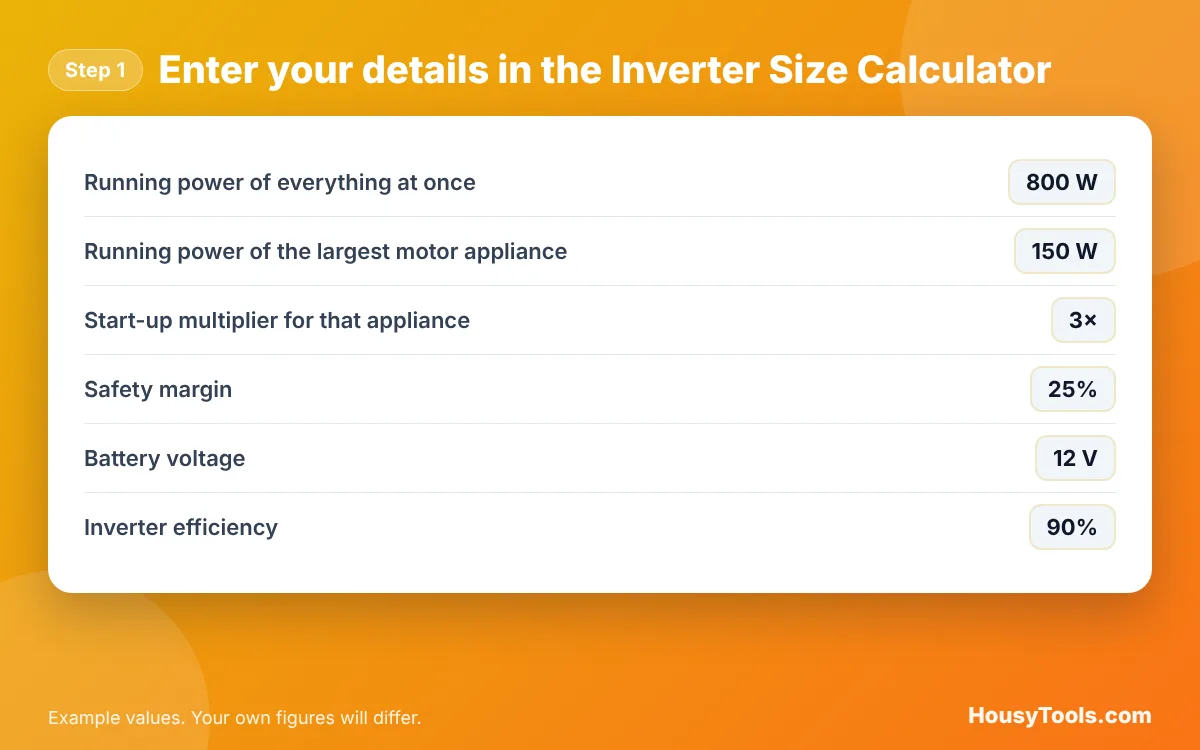
- Add up the watts on the rating labels and enter the total in Running power of everything at once.
- Enter the Running power of the largest motor appliance, such as a fridge or pump, or 0 if there is none.
- Set the Start-up multiplier for that appliance from the maker’s data, or leave the example of 3.
- Choose a Safety margin, pick the Battery voltage and enter the Inverter efficiency from the data sheet.
- Read the suggested size, the surge rating and the battery current, then open “Show the formula and working” to see each step.
What Size Inverter Do I Need?
Choose an inverter whose continuous rating is at least your total running watts plus about 25%, and whose surge rating covers the start-up of your largest motor. A kettle, a microwave and a hair dryer are the usual surprises: each can draw well over 1,000 W, so check every label. If you are unsure of a current, the watts to amps converter turns watts into amps at 230 V or 12 V.
| Running load | With 25% margin | Next listed size | Battery current at 12 V | At 24 V | At 48 V |
|---|---|---|---|---|---|
| 300 W | 375 W | 500 W | 27.8 A | 13.9 A | 6.9 A |
| 500 W | 625 W | 800 W | 46.3 A | 23.1 A | 11.6 A |
| 1,000 W | 1,250 W | 1,500 W | 92.6 A | 46.3 A | 23.1 A |
| 1,500 W | 1,875 W | 2,000 W | 138.9 A | 69.4 A | 34.7 A |
| 2,000 W | 2,500 W | 2,500 W | 185.2 A | 92.6 A | 46.3 A |
| 3,000 W | 3,750 W | 4,000 W | 277.8 A | 138.9 A | 69.4 A |
Battery currents assume 90% inverter efficiency at the running load. Sizes follow the list of common ratings the calculator uses; any inverter at or above the figure will do.
Why Does a Fridge Need a Bigger Inverter Than Its Wattage?
A fridge’s compressor motor draws several times its running power for a moment when it starts, so the inverter’s surge rating must cover that peak, not just the label watts. Pumps, power tools and air conditioners behave the same way. The calculator uses an editable start-up multiplier, 3 by default, because the real figure depends on the motor. If an inverter cannot meet the surge, it shuts down or the motor fails to start.
Should I Choose a 12 V, 24 V or 48 V Inverter?
As a rule of thumb, use 12 V for small systems up to about 1,000 W to 1,500 W, and 24 V or 48 V for larger ones, because doubling the voltage halves the current. A 2,000 W load draws about 185 A from a 12 V battery but only 46 A at 48 V. High currents need very thick cables and a correctly rated fuse close to the battery, and they waste more energy as heat. Match the inverter’s input voltage to your battery bank.
Can I Connect an Inverter to My House Wiring?
Only through a proper changeover switch fitted by a qualified electrician, because feeding power into a house circuit through a socket can electrocute someone working on the supply. Plugging appliances straight into the inverter’s own sockets is the safe DIY option. UK sockets and plugs follow BS 1363 and are rated at 13 A, which is 2,990 W at 230 V, with plug fuses commonly 3 A or 13 A. Do not run more than that through one socket or one extension lead.
Worked Example: Running a Fridge, TV and Laptop
Example: during a power cut you want to run appliances that add up to 800 W at once, including a fridge that uses 150 W when running, from a 12 V battery. With a 25% margin, the continuous rating is 800 x 1.25 = 1,000 W, so a 1,000 W inverter fits. When the fridge starts at 3 times its power, the peak is 800 – 150 + 150 x 3 = 1,100 W, so the inverter’s surge rating must be 1,100 W or more.
At 90% efficiency, the battery supplies 800 / (12 x 0.9) = 74.1 A, rising to 92.6 A if the inverter runs at its full 1,000 W. To see how long a battery would last at that load, divide its usable watt hours by the load, or size a storage battery with the solar battery size calculator. More power tools are on the energy unit converters page.
Inverter Size Calculator FAQs
How do I calculate inverter size?
Add the running watts of every appliance used at the same time, multiply by 1.25 for headroom, and choose the next inverter size up. Then check the surge rating covers the start-up power of any motor, such as a fridge or pump.
What will a 1,000 W inverter run?
A 1,000 W inverter comfortably runs about 800 W of appliances, such as a fridge, a TV, lights and phone chargers. It will not run most kettles, toasters or microwaves, which often draw more than 1,000 W on their own.
How many amps does a 2,000 W inverter draw from a 12 V battery?
About 185 A at full load with 90% efficiency, because 2,000 / (12 x 0.9) = 185.2 A. On a 24 V battery it is about 93 A. Cables and fuses must be rated for the full current.
Do I need a pure sine wave inverter?
For most homes, yes. A pure sine wave inverter produces power like the mains, which suits motors, fridges, chargers and sensitive electronics. Modified sine wave inverters are cheaper but can make some appliances run hot, noisy or not at all.
Is a bigger inverter always better?
No. An oversized inverter costs more and uses some power even with no load, which drains the battery. Size it for your real load plus a margin, and make sure the battery and cables can supply the current at the full rating.
What safety margin should I use for an inverter?
A margin of about 20% to 25% keeps the inverter from running flat out and leaves room for small extra loads. The calculator uses 25% as an editable example. Use more if you plan to add appliances later.
Checked October 2026. Sources: Power inverter (Wikipedia), BS 1363 (Wikipedia).