
Show the formula and working
This free ounces to grams converter changes ounces into grams, or grams into ounces, for cooks, bakers and anyone in the UK, Ireland and Europe working from older British recipes, American packaging or postal weights. It also gives the result in kilograms and in pounds and ounces, and has a troy ounce setting for gold and silver.
Quick answer: One ounce equals exactly 28.349523125 grams, usually rounded to 28.35 g. To convert ounces to grams, multiply the ounces by 28.35; to convert grams to ounces, divide by 28.35. So 4 oz is 113.4 g, 8 oz is 226.8 g and 16 oz, one pound, is 453.6 g.
What Is an Ounces to Grams Converter?
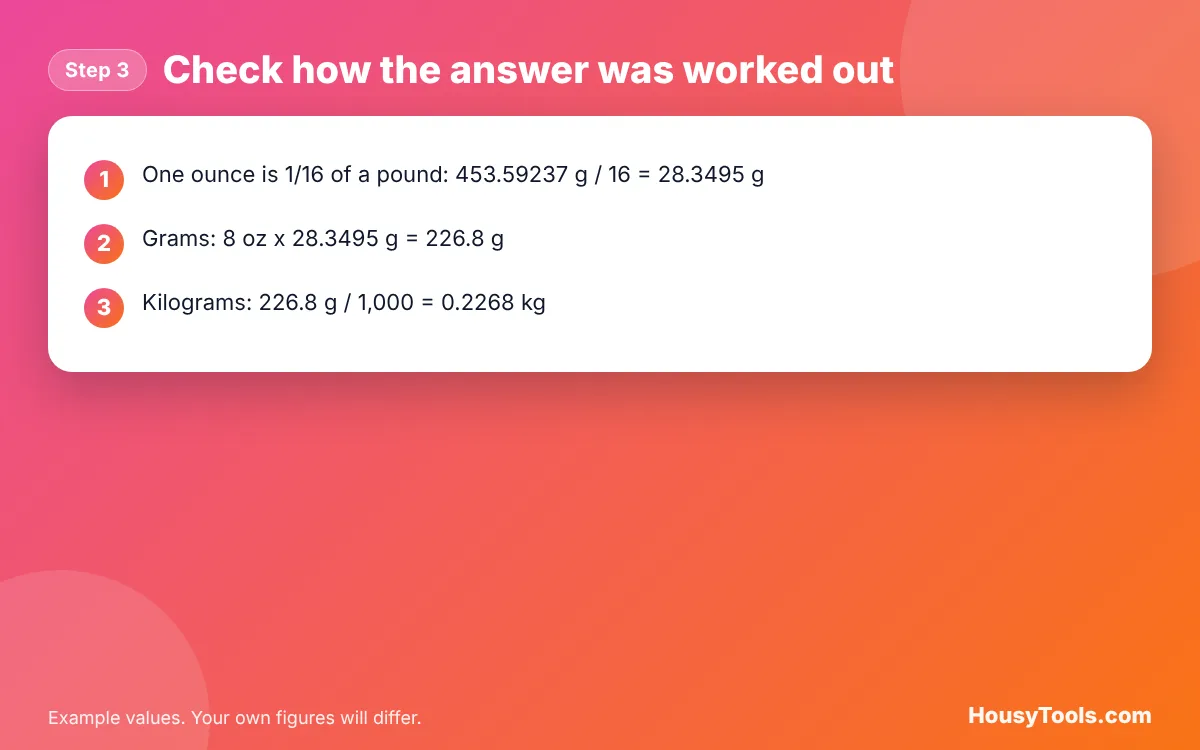
An ounces to grams converter is a tool that turns a weight in imperial ounces into metric grams, and back. Because both are units of mass, the conversion is exact and works the same for every ingredient. The formula is: grams = ounces x 28.349523125. For the reverse, ounces = grams / 28.349523125.
The factor comes from the legal definitions. Under Schedule 1 of the Weights and Measures Act 1985, the pound is 0.45359237 kilogram and the ounce is one sixteenth of a pound. Dividing 453.59237 g by 16 gives 28.349523125 g. The United States uses the same international pound, agreed in 1959, so a UK ounce and a US ounce of weight are identical.
How Do You Use the Ounces to Grams Converter?
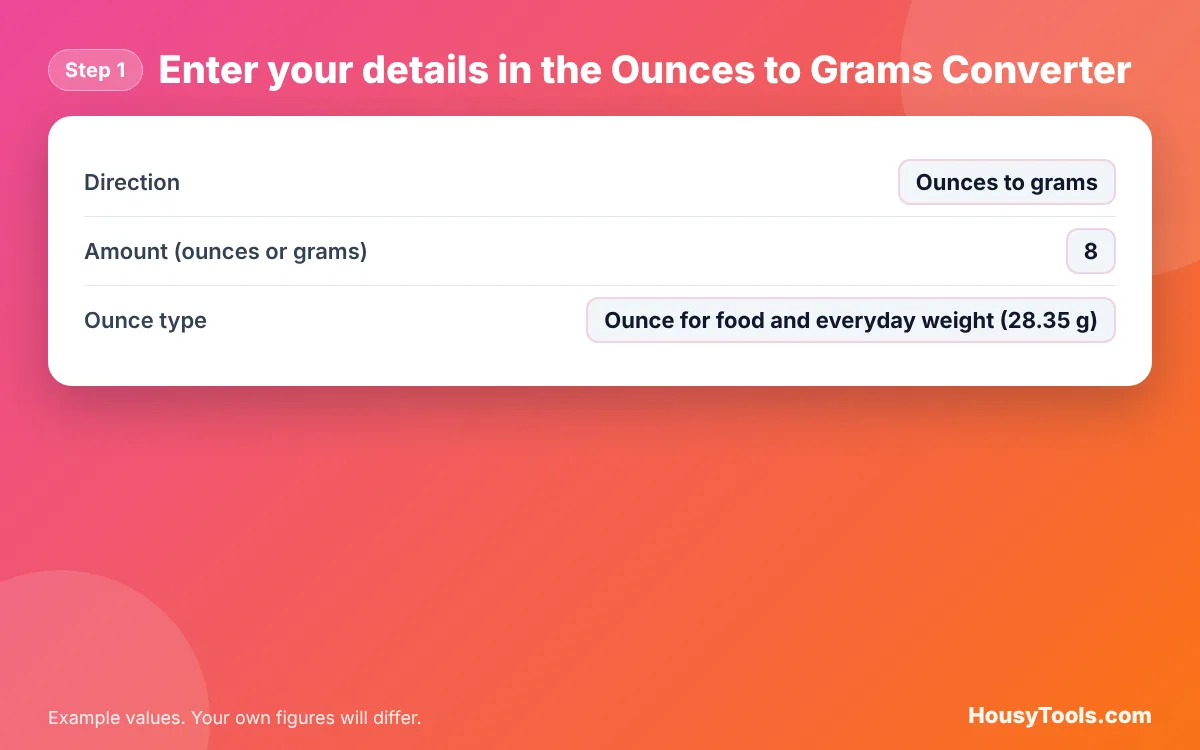
- Choose the Direction: “Ounces to grams” or “Grams to ounces”.
- Enter the weight in Amount (ounces or grams). Use ounces for the first direction and grams for the second. Decimals work, so 2.5 means two and a half ounces.
- Leave Ounce type on “Ounce for food and everyday weight (28.35 g)” for cooking, post and body weight. Choose “Troy ounce for gold and silver (31.10 g)” only for precious metals.
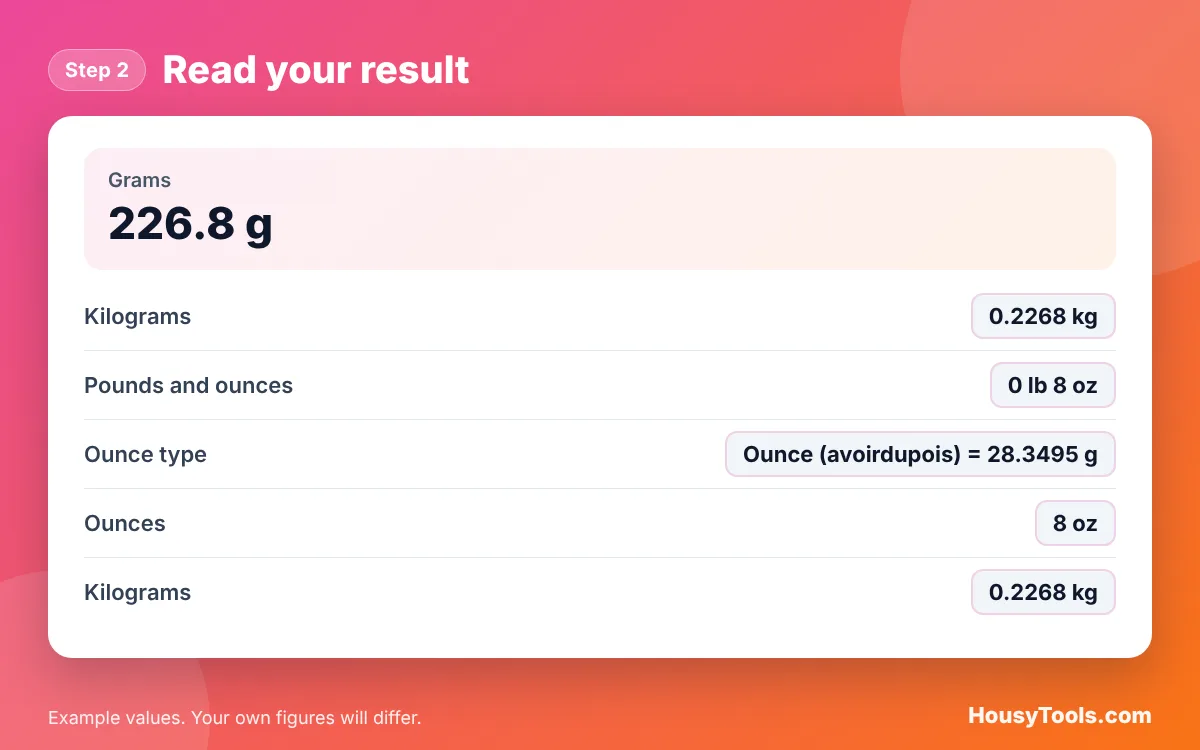
- Read the result, then open “Show the formula and working” to see the factor used, kilograms and the pounds and ounces breakdown.
How Many Grams Are in an Ounce?
There are 28.35 grams in an ounce, or exactly 28.349523125 g. Some recipes round 1 oz to 25 g or 30 g so the metric amounts look tidy, which is fine as long as every ingredient in the recipe uses the same rounding. When you convert a single ingredient on its own, use 28.35 g for accuracy.
Is an Ounce the Same as a Fluid Ounce?
No, an ounce measures weight and a fluid ounce measures volume, so they only match for water and similar liquids. A UK fluid ounce of water is 28.41 ml and weighs about 28.4 g, very close to one ounce. For flour, sugar or oil, a fluid ounce and an ounce of weight are quite different amounts, so check which one the recipe means.
What Is the Difference Between an Ounce and a Troy Ounce?
A troy ounce weighs 31.1034768 g, about 10% more than the everyday ounce of 28.35 g. As the Wikipedia article on the ounce explains, the troy ounce is used only for precious metals such as gold and silver, while the avoirdupois ounce is the general unit for food and other goods. Gold and silver prices quoted per ounce use the troy ounce.
Ounces to Grams Conversion Table
| Ounces | Grams | Grams | Ounces |
|---|---|---|---|
| 1 oz | 28.35 g | 25 g | 0.88 oz |
| 2 oz | 56.7 g | 50 g | 1.76 oz |
| 4 oz (1/4 lb) | 113.4 g | 100 g | 3.53 oz |
| 6 oz | 170.1 g | 200 g | 7.05 oz |
| 8 oz (1/2 lb) | 226.8 g | 250 g | 8.82 oz |
| 10 oz | 283.5 g | 300 g | 10.58 oz |
| 12 oz (3/4 lb) | 340.2 g | 500 g | 17.64 oz |
| 16 oz (1 lb) | 453.6 g | 1,000 g (1 kg) | 35.27 oz |
Worked Example: A Classic Victoria Sponge
Example: a family Victoria sponge recipe is written as 8 oz each of butter, caster sugar and self raising flour, plus 4 eggs, and the digital scales only show grams. Leave Direction on “Ounces to grams”, type 8 into Amount (ounces or grams) and keep the everyday ounce. The converter multiplies 8 oz x 28.3495 g = 226.8 g, so weigh 227 g of each ingredient. Rounding to 225 g each would also work, because the proportions stay the same.
Ounces still turn up around the home outside the kitchen too, on older DIY packaging and parcel weights. For more practical tools, see the home calculators hub, or work out what your oven costs to run for a bake with the electricity cost calculator.
Ounces to Grams FAQs
How many grams is 4 oz?
4 oz is 113.4 g, which is a quarter of a pound. It is the weight of one US stick of butter and a common amount in older British recipes for flour, sugar and butter. Many recipes round it to 110 g or 115 g.
How many ounces are in 100 grams?
100 grams is 3.53 ounces. To work it out, divide 100 by 28.35. This is useful for reading nutrition labels, which in the UK and EU give values per 100 g, when you think in ounces.
How many ounces are in a pound?
There are 16 ounces in a pound, so one pound is 16 x 28.35 = 453.6 g. The converter shows any weight as pounds and ounces, which helps with baby weights, older recipes and luggage limits given in pounds.
Is a UK ounce the same as a US ounce?
Yes, a UK ounce and a US ounce of weight are both exactly 28.349523125 g, because both countries use the international pound of 0.45359237 kg. Only fluid ounces differ: a UK fluid ounce is 28.41 ml and a US fluid ounce is 29.57 ml.
How many ounces are in a kilogram?
One kilogram is 35.27 ounces, or 2 lb 3.27 oz. That is why a 1 kg bag of flour or sugar is a little heavier than two pounds. Divide any weight in grams by 28.35 to get ounces.
What does oz stand for?
Oz is the standard abbreviation for ounce. It comes from “onza”, the Italian word related to ounce. A troy ounce is often written oz t or ozt, and a fluid ounce is written fl oz, so check the label to see which one is meant.
Checked October 2026. Sources: Weights and Measures Act 1985, Schedule 1 (legislation.gov.uk), Wikipedia: Ounce, Wikipedia: Fluid ounce.