
Show the formula and working
This free paving calculator works out how many paving slabs or block pavers you need for a patio, path or driveway in the UK, Ireland and Europe, then adds the Type 1 sub-base and bedding layer in cubic metres and tonnes. Enter the area, pick a paver size and joint width, and it allows for cuts and breakages.
Quick answer: A paving calculator divides the area by the size of one paver plus its joint. A 4 m by 3 m patio of 600 x 600 mm slabs with 3 mm joints needs 33 slabs, or 35 with 5% extra, plus 2.52 tonnes of Type 1 at 100 mm and 0.58 tonnes of bedding sand at 30 mm.
What Is a Paving Calculator?
A paving calculator is a tool that turns the size of an area into the number of slabs or blocks to buy and the weight of the layers underneath them.
The formula in plain words: pavers per square metre equal 1 divided by the paver length plus the joint, times the paver width plus the joint, all in metres. Multiply by the area and add a percentage for cuts, then round up. The sub-base and bedding volumes are the area times each layer’s depth, and the tonnes are the volume times the material’s density.
How Do You Use the Paving Calculator?
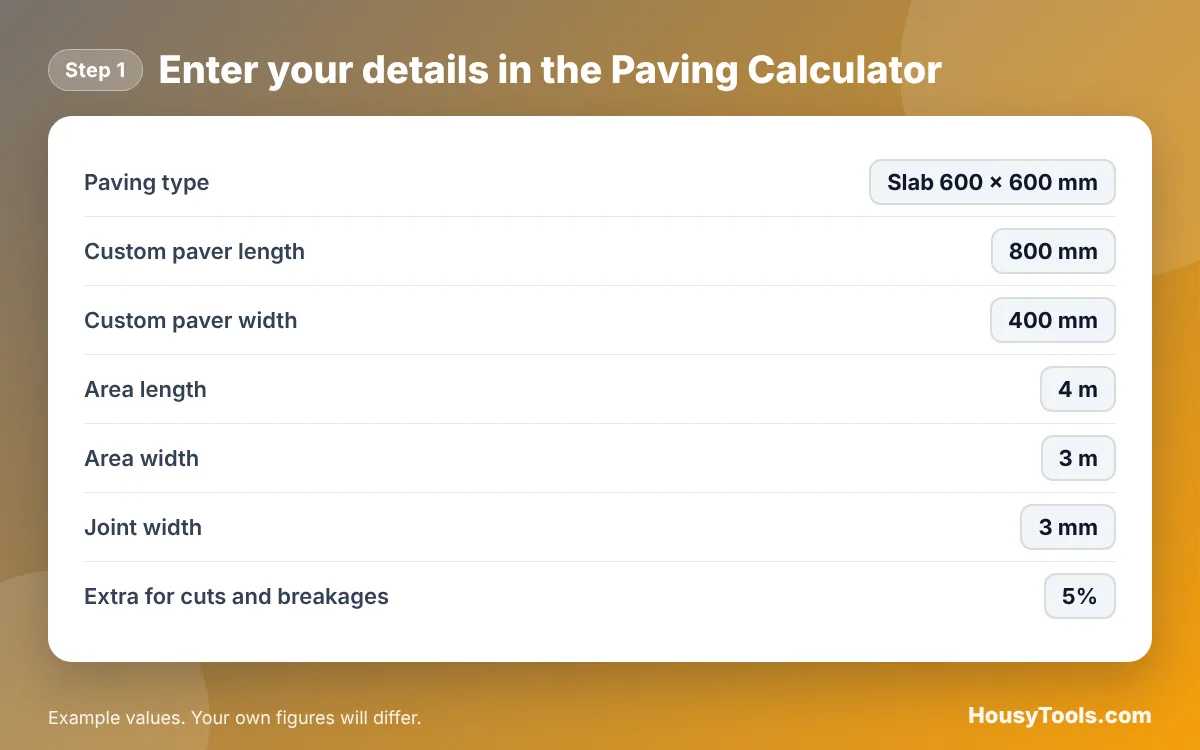
- Choose the Paving type. For a size that is not listed, pick Custom size and fill in Custom paver length and Custom paver width.
- Enter the Area length and Area width in metres. For an L shape, work out each rectangle separately and add the results.
- Set the Joint width and the Extra for cuts and breakages.
- Enter the Sub-base depth (Type 1) and Bedding layer depth, and change the Type 1 density or Sand density if your supplier gives different figures.
- Read the number of pavers and the tonnes of each layer in the result, then open “Show the formula and working” to check every step.


How Many Paving Slabs Do I Need per Square Metre?
You need 2.78 slabs of 600 x 600 mm per square metre with no joints, or 2.75 with 3 mm joints. Smaller sizes need more: 600 x 300 mm slabs work out at 5.47 per square metre and standard 200 x 100 mm block pavers at 47.83 per square metre with 3 mm joints, against 50 if they were laid tight. The joint width matters more for small pavers, because there are more joints in every metre.
How Deep Should the Sub-Base Be for Paving?
Allow 100 mm of compacted Type 1 for a patio or path and 150 mm for a domestic driveway. The Marshalls porcelain paving installation guide asks for 100 mm of Type 1 laid in two 50 mm layers under a patio, and the Marshalls Drivesys guidelines ask for 150 mm under a block paved drive. Soft or clay ground may need more, so dig out any soft spots and fill them with compacted Type 1 first.
How Much Sand Do I Need Under Paving?
A 30 mm bedding layer needs 0.03 cubic metres of sand per square metre, about 48 kg at an example density of 1.6 tonnes per cubic metre. Block paving sits on a screeded grit sand laying course of about 30 mm, while slabs sit on a full mortar bed of 30 to 40 mm made from sharp sand and cement. For a mortar bed, this tool gives the sand volume only; the patio slab calculator splits the bed into sand and cement.
How Much Extra Paving Should I Order?
Order about 5% extra for a simple rectangle and 10% or more for curves, angles, manholes or a herringbone pattern. The extra covers cut pieces at the edges and the odd broken or chipped paver. Slabs from different batches can vary slightly in colour, so it is better to buy all of them at once than to top up later.
Pavers per Square Metre by Size
Figures for a 12 m² area (4 m by 3 m) with 3 mm joints and 5% extra, rounded up.
| Paver size | Per m², tight | Per m², 3 mm joints | For 12 m² with 5% extra |
|---|---|---|---|
| Block 200 x 100 mm | 50.00 | 47.83 | 603 |
| Slab 450 x 450 mm | 4.94 | 4.87 | 62 |
| Slab 600 x 300 mm | 5.56 | 5.47 | 69 |
| Slab 600 x 600 mm | 2.78 | 2.75 | 35 |
| Slab 900 x 600 mm | 1.85 | 1.84 | 24 |
Worked Example: A 4 m by 3 m Patio
Example: a 4 m by 3 m patio is laid with 600 x 600 mm slabs, 3 mm joints, 5% extra, 100 mm of Type 1 and a 30 mm bed. These are the calculator’s default inputs.
- Area: 4 m x 3 m = 12 m².
- Slabs per m²: 1 / (0.603 m x 0.603 m) = 2.75.
- Slabs: 12 x 2.75 = 33.0, plus 5% = 34.65, so 35 slabs.
- Type 1: 12 m² x 0.1 m = 1.2 m³, x 2.1 t/m³ = 2.52 tonnes.
- Bedding: 12 m² x 0.03 m = 0.36 m³, x 1.6 t/m³ = 0.58 tonnes.
If the same area were a block paved parking space, choose Block paving 200 x 100 mm and set the sub-base to 150 mm: you would need 603 blocks and 3.78 tonnes of Type 1. For a loose stone path instead, the gravel calculator works out the tonnes of stone.
Paving Calculator FAQs
How many 600 x 600 slabs are in a square metre?
There are 2.78 slabs of 600 x 600 mm in a square metre if they are laid tight, and 2.75 with 3 mm joints. Each slab covers 0.36 m², so a 10 m² patio needs about 28 slabs before you add extra for cuts.
How many block pavers do I need per square metre?
Standard 200 x 100 mm block pavers need 50 per square metre laid tight, or about 48 with 3 mm joints. Add 5% for a straight laying pattern and more for herringbone, which needs extra cutting at every edge.
How many tonnes of Type 1 do I need?
Multiply the area by the depth to get cubic metres, then by the density. At an example 2.1 tonnes per cubic metre, 100 mm of Type 1 needs about 0.21 tonnes per square metre and 150 mm needs about 0.32 tonnes. Ask your supplier for their compacted figure.
What joint width should paving have?
Block paving is usually laid with joints of about 2 to 5 mm, and the Marshalls porcelain guide asks for 3 to 5 mm joints with spacers. Natural stone is often laid with wider joints. Follow the maker’s instructions for your product, because the joint width changes how many pavers you need.
Do I need planning permission to pave my front garden?
In England you do not need permission for a new or replacement front garden surface over 5 m² if it is permeable or drains onto a lawn or border. An impermeable surface over 5 m² that drains to the road needs permission, as the GOV.UK permeable surfacing guidance explains.
Can I use building sand under paving slabs?
Use sharp sand for a slab mortar bed and grit sand for a block paving laying course. Soft building sand is meant for bricklaying mortar and does not drain or compact well under paving. The sand calculator helps if you need sand for other jobs too.
For more outdoor projects, see the building and DIY calculators.
Checked October 2026. Sources: Porcelain paving installation guide (Marshalls), Drivesys installation guidelines (Marshalls), Permeable surfacing of front gardens (GOV.UK).