
These free kitchen converters turn cups, spoons, ounces and pints into grams and millilitres, swap oven temperatures between Celsius, Fahrenheit, fan and gas mark, and scale recipes and cooking times for UK, Irish, EU and US recipes.
Quick answer: Pick the converter that matches the measurement in your recipe, enter the amount and choose the ingredient or oven type. Each tool shows the result, the conversion factor it used and the working, so you can check the maths before you bake. Weights by volume depend on the ingredient, so always choose it.
Why Do Cup and Spoon Conversions Depend on the Ingredient?
A cup is a measure of volume, so the weight it holds changes with the ingredient: a US cup of plain flour weighs about 120 g, while the same cup of granulated sugar weighs about 198 g. That is why our cup, tablespoon, teaspoon and millilitre converters ask you to choose the ingredient and show the grams per cup they used.
How Do You Convert a Conventional Oven Temperature for a Fan Oven?
Most UK recipes and oven makers suggest lowering a conventional temperature by about 20 °C for a fan oven, so 200 °C becomes about 180 °C fan. Ovens vary, so the oven converters let you change the reduction and show the matching Fahrenheit and gas mark values.
Which Cup Size Should You Use for a Recipe?
Use the cup size of the country the recipe comes from: a US cup is about 236.6 ml and a metric cup used in Australia and some UK books is 250 ml. The difference is about 5%, which matters most in baking, so the converters offer both and state which one they used.
Which Kitchen Converters Do You Need?
Most recipe problems come down to one of three things: a volume measure where you want a weight, an oven setting that does not match your oven, or a recipe written for a different number of people or tin size. Find the line that matches your problem below and open that converter.

| Tool | What it works out |
|---|---|
| Cups to Grams Converter | Converts cups to grams, or grams to cups, for 28 common baking ingredients. |
| Oven Temperature Converter | Converts oven temperatures between Celsius, fan oven Celsius, Fahrenheit and gas mark. |
| Gas Mark Converter | Converts gas marks to Celsius, Fahrenheit and fan oven settings, and back again. |
| Fan Oven Temperature Converter | Converts conventional oven temperatures to fan oven settings, and fan settings back again. |
| Tablespoons to Grams Converter | Converts tablespoons to grams, or grams to tablespoons, for 28 common cooking ingredients. |
| Teaspoons to Grams Converter | Converts teaspoons to grams, or grams to teaspoons, for 22 common kitchen ingredients. |
| Ml to Grams Converter | Converts millilitres to grams, or grams to millilitres, using the density of 22 kitchen ingredients. |
| Butter Sticks to Grams Converter | Converts US sticks of butter to grams, or grams to sticks, with tablespoons and cups. |
| Ounces to Grams Converter | Converts ounces to grams, or grams to ounces, with pounds and troy ounces too. |
| Fluid Ounces to Ml Converter | Converts UK or US fluid ounces to millilitres, or millilitres back to fluid ounces. |
| Pints to Ml Converter | Converts UK or US pints to millilitres and back, with litres and fluid ounces. |
| Cake Tin Size Converter | Scales a cake recipe from one tin size or shape to another by base area. |
| Air Fryer Conversion Calculator | Converts oven temperatures and cooking times to air fryer settings, or back again. |
| Microwave Wattage Converter | Adjusts microwave cooking times from the wattage on the pack to your microwave. |
| Egg Size Converter | Works out how many eggs of your size replace the eggs a recipe asks for. |
| Recipe Scaler | Scales recipe ingredient amounts up or down for any number of servings. |
| Rice to Water Ratio Calculator | Works out how much water to add for your amount and type of rice. |
| Fresh to Dry Yeast Converter | Converts fresh yeast to fast action or dried active yeast, and back again. |
| Turkey Cooking Time Calculator | Works out turkey roasting time by weight using UK Food Standards Agency guidance. |
| Meat Roasting Time Calculator | Works out roasting time and oven timings for beef, lamb, pork and chicken by weight. |
How Our Kitchen Converters Work
Our kitchen converters weigh a cup of flour differently from a cup of sugar because the two have different densities, which is why a single cups-to-grams factor gives poor results. Each converter shows the density or factor it used, so you can check it against your own scales.
Unit definitions such as the millilitre, the gram and the imperial pint follow the Weights and Measures Act 1985, and the cooking time tools follow guidance from the Food Standards Agency on cooking meat until it is steaming hot all the way through.
Tips for Accurate Results With Our Kitchen Converters
- Weigh dry ingredients when you can: a cup of plain flour weighs about 120 g, but scooped flour can be 20 % heavier.
- Check which cup a recipe means. A US cup is 236.6 ml and a metric cup is 250 ml, so the kitchen converters let you pick.
- Lower a conventional oven temperature by about 20 °C for a fan oven, then check food a few minutes early.
- Scale baking time with tin depth, not just tin area: a deeper cake needs longer at a slightly lower temperature.
- Use a food thermometer for meat and poultry. Cook until steaming hot all the way through, with no pink juices.

Common Mistakes to Avoid
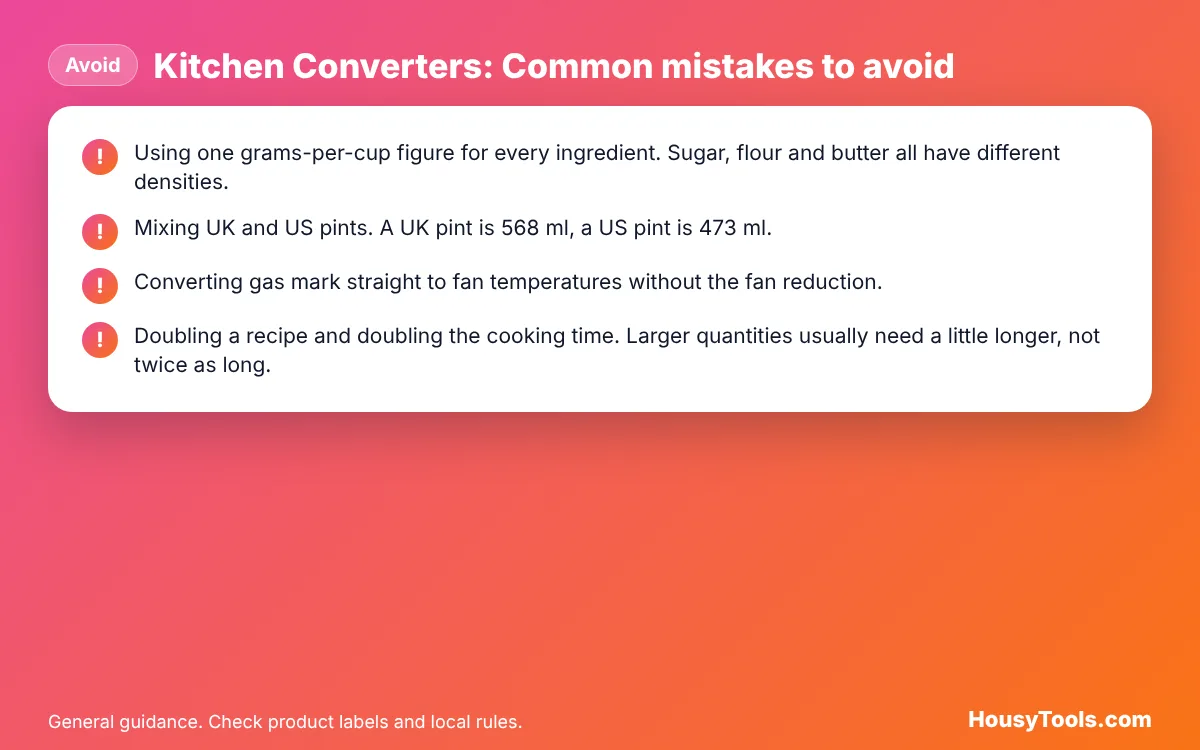
- Using one grams-per-cup figure for every ingredient. Sugar, flour and butter all have different densities.
- Mixing UK and US pints. A UK pint is 568 ml, a US pint is 473 ml.
- Converting gas mark straight to fan temperatures without the fan reduction.
- Doubling a recipe and doubling the cooking time. Larger quantities usually need a little longer, not twice as long.
Kitchen Converter FAQs
Are these kitchen converters free?
Yes. Every HousyTools converter is free, needs no sign up and works in your browser on a phone or computer. Results update as you type, and each one shows the factor and working so you can check it.
Is it better to weigh ingredients than use cups?
Weighing is more accurate because a cup of flour can vary by 20 g or more depending on how it is filled. If a recipe gives cups, convert to grams once with the right ingredient selected, then weigh on digital scales for repeatable results.
Do UK and US pints hold the same amount?
No. A UK imperial pint is 568 ml and a US liquid pint is about 473 ml, so a UK pint is roughly 20% larger. Fluid ounces differ too, which is why the pint and fluid ounce converters ask which system your recipe uses.
How accurate are the conversions?
Unit conversions such as ounces to grams use exact legal definitions. Volume to weight conversions use published ingredient weights, which are averages, so treat them as close guides and use the custom weight field if your pack states its own figure.
For energy costs while you cook, the electricity cost calculator works out what an oven, kettle or air fryer costs to run, and every other category is listed on our home calculators page.