
Show the formula and working
This heating cost per room calculator estimates what it costs to heat one room per day and per year with a gas boiler, electric heating or a heat pump, for homes in the UK, Germany, the Netherlands and the Nordic countries. It starts from the room’s heat loss in watts, scales it to your average outdoor temperature and heating hours, and prices the heat for all three systems side by side. Rates default to the Ofgem cap and every figure can be changed, in pounds or euros.
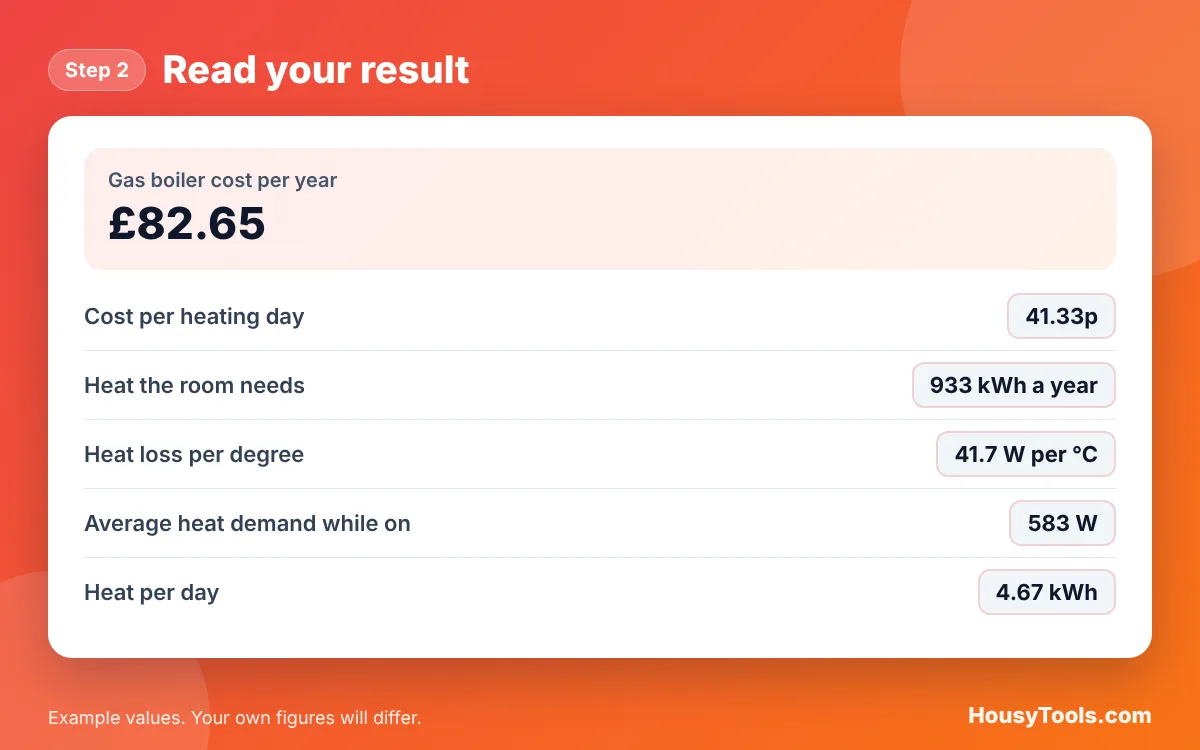
Quick answer: Scale the room’s heat loss by the average temperature difference, multiply by hours and days, then divide by the efficiency and multiply by the unit rate. A room losing 1,000 W at -3 °C, heated 8 hours a day for 200 days, needs 933 kWh of heat. The heating cost per room calculator shows £82.65 a year by gas boiler.
What Is a Heating Cost Per Room Calculator?
A heating cost per room calculator is a tool that turns a single room’s heat demand into the energy and money needed to keep it warm. The formula in plain words: heat loss per degree = design heat loss / (design room temperature minus design outside temperature); average heat demand = heat loss per degree x (the temperature you heat to minus the average outside temperature); heat per year = average demand x hours per day x heating days / 1,000. Fuel used = heat / boiler efficiency for gas, heat / 1 for electric heaters, and heat / SCOP for a heat pump. Cost = fuel used x unit rate.
Heat loss rises in a straight line with the temperature difference between inside and outside, so a room that needs 1,000 W on a -3 °C day needs only about 583 W when it is 7 °C outside. That is why the average outside temperature matters more than the coldest day for running costs.
How Do You Use the Heating Cost Per Room Calculator?
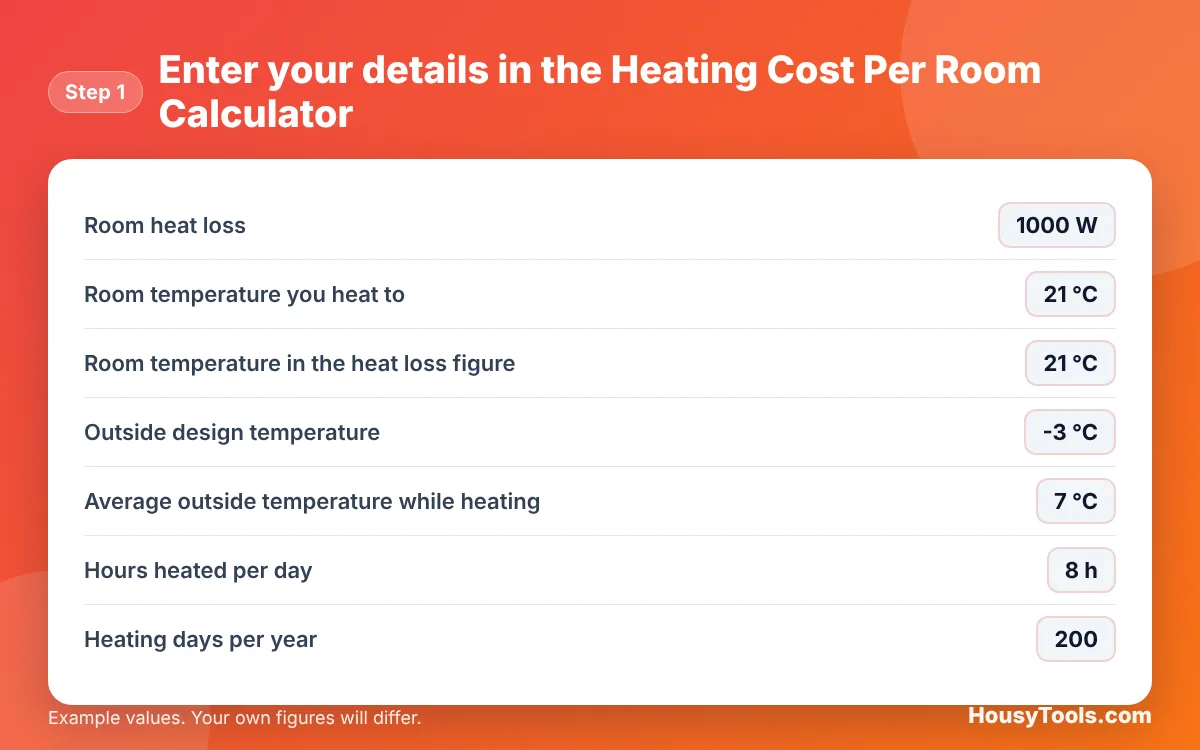
- Enter the Room heat loss in watts, from a heating survey or our heat loss tools.
- Enter the Room temperature in the heat loss figure and the Outside design temperature that the heat loss was worked out for, then the Room temperature you heat to.
- Enter the Average outside temperature while heating, the Hours heated per day and the Heating days per year.
- Choose the Heating system to show as the main result.
- Check the Gas unit rate, Boiler efficiency, Electricity unit rate and Heat pump efficiency (SCOP).
- Read the yearly and daily cost for all three systems, then open “Show the formula and working” to see each step.
How Do I Find a Room’s Heat Loss?
Work out the heat loss with a room by room calculation that adds the heat lost through each wall, window, floor and ceiling, plus air leakage, at a design outdoor temperature. Our room heat loss calculator does this from U-values, and the BTU calculator gives the same figure in watts and BTU per hour. A heat pump installer’s survey also lists the heat loss of every room.
Is It Cheaper to Heat One Room With an Electric Heater?
Heating one room with an electric heater costs about three times as much per unit of heat as a 90% efficient gas boiler at the October to December 2026 cap rates, because electricity is 26.32p per kWh and gas is 7.97p. It can still save money if it means the rest of the house stays cold, since a boiler heating every radiator uses far more in total. A heat pump with a SCOP of 3 costs about the same per unit of heat as gas at these rates.
| Room heat loss at -3 °C | Heat per year | Gas boiler (90%) | Electric heater | Heat pump (SCOP 3) |
|---|---|---|---|---|
| 500 W | 467 kWh | £41.33 | £122.83 | £40.94 |
| 1,000 W | 933 kWh | £82.65 | £245.65 | £81.88 |
| 1,500 W | 1,400 kWh | £123.98 | £368.48 | £122.83 |
| 2,000 W | 1,867 kWh | £165.30 | £491.31 | £163.77 |
The table uses a 21 °C room, 7 °C average outside, 8 hours a day for 200 days, and the Ofgem cap rates for October to December 2026. The average outdoor temperature and heating days are examples, so adjust them for your area and habits.
What SCOP Should I Use for a Heat Pump?
Use the seasonal efficiency your installer gives in the system design, as it depends on the heat pump, the radiators and the flow temperature. The Energy Saving Trust describes air source heat pumps as more than three times as efficient as conventional heating, which is why the calculator uses 3 as its example. For a whole house comparison, the heat pump vs gas boiler cost calculator includes standing charges.
Why Is the Real Cost Different From the Estimate?
Real costs differ because rooms share heat with the rooms around them, the sun and people add free heat, and heating from cold takes extra energy at the start of each period. A room surrounded by heated rooms costs less than the estimate, and one with cold rooms next door costs more. Treat the result as a comparison between systems and settings, not a bill forecast.
Worked Example: Heating a Living Room for a Year
Example: a living room has a heat loss of 1,000 W at an outside design temperature of -3 °C with the room at 21 °C. It is heated 8 hours a day for 200 days, with an example average outside temperature of 7 °C, by a 90% efficient gas boiler at 7.97p per kWh. These are the calculator’s default inputs.
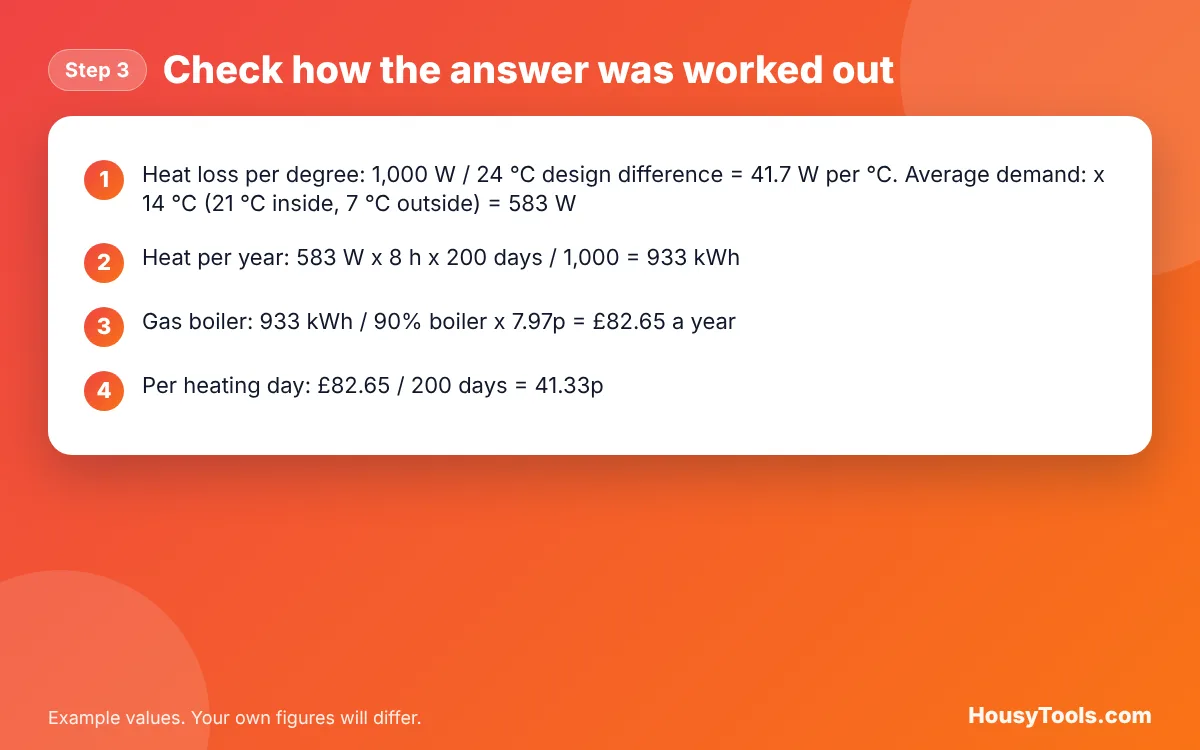
- Heat loss per degree: 1,000 W / 24 °C (21 °C inside, -3 °C outside) = 41.7 W per °C.
- Average demand: 41.7 W per °C x 14 °C (21 °C inside, 7 °C outside) = 583 W.
- Heat per year: 583 W x 8 h x 200 days / 1,000 = 933 kWh.
- Gas: 933 kWh / 90% = 1,037 kWh x 7.97p = £82.65 a year, about 41p per heating day.
Heated by an electric heater at 26.32p, the same room costs £245.65 a year, and by a heat pump with a SCOP of 3 it costs £81.88.
Heating Cost Per Room Calculator FAQs
How much does it cost to heat one room?
It depends on the room’s heat loss, how long you heat it and your fuel. A room losing 1,000 W on a cold day, heated 8 hours a day for 200 days, costs about £83 a year by gas and about £246 by electric heater at the October to December 2026 cap rates.
How do I convert a room’s heat loss to running cost?
Scale the design heat loss by the average temperature difference over the design difference, multiply by the hours heated and divide by 1,000 to get kWh. Divide by the system efficiency and multiply by the unit rate to get the cost.
What average outside temperature should I use?
Use the average temperature during your heating hours over the heating season. UK mean annual air temperatures are about 8.5 to 11.3 °C, and winter months are colder, so the calculator uses 7 °C as an example. Lower figures suit colder regions.
Is it cheaper to heat one room or the whole house?
Heating one room is cheaper than heating the whole house to the same temperature, because less heat is lost in total. With a boiler, turning down radiators in unused rooms with thermostatic valves usually gives most of the saving without a separate heater.
Does turning the thermostat down by 1 °C save money?
Yes. The heat lost is proportional to the difference between inside and outside, so a lower room temperature cuts the heat needed. In the default example, lowering the room from 21 °C to 20 °C reduces the yearly heat by about 7%.
Why are a heat pump and gas boiler so close?
At the October to December 2026 cap, electricity costs about 3.3 times as much as gas per kWh. A heat pump with a SCOP of 3 makes 3 kWh of heat from 1 kWh of electricity, which almost exactly offsets the price gap against a 90% boiler.
Checked October 2026. Sources: Ofgem: price cap 1 October to 31 December 2026 (electricity 26.32p, gas 7.97p per kWh), Energy Saving Trust: Air source heat pumps, MCS heat load calculator design conditions (CIBSE -3 °C London, UK mean annual temperatures 8.5 to 11.3 °C).