
Show the formula and working
This plug fuse calculator tells you which fuse to fit in a UK three pin plug, 3 A or 13 A, from the appliance wattage on its rating plate. It is for households in the UK and Ireland using BS 1363 plugs. It also works out the current the appliance draws, checks the fuse against the flex size, and flags appliances too powerful for a plug.
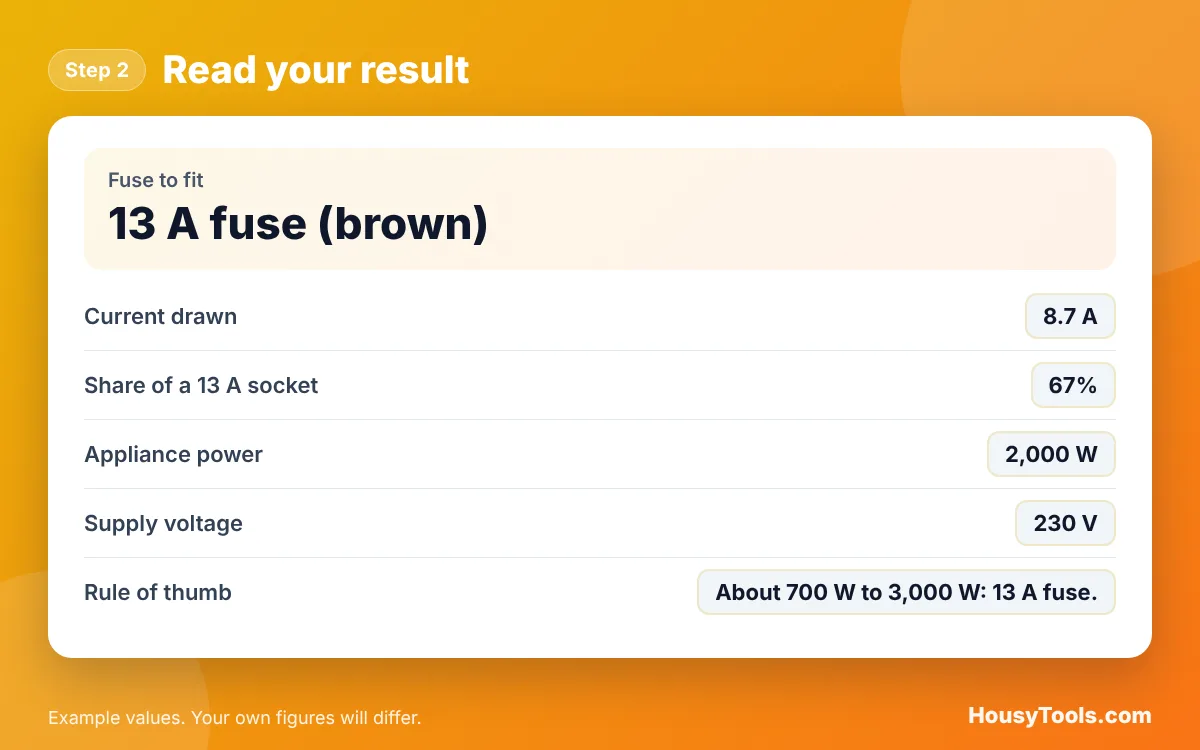
Quick answer: A plug fuse calculator divides watts by 230 volts to find the current, then picks the fuse. Appliances up to about 700 W take a 3 A red fuse, and appliances from about 700 W to 3,000 W take a 13 A brown fuse. A 2,000 W appliance draws 8.7 A, so it needs 13 A.
What Is a Plug Fuse Calculator?
A plug fuse calculator is a tool that chooses the correct cartridge fuse for a UK plug from an appliance’s power rating. In plain words: current in amps equals power in watts divided by the voltage, which is 230 V in the UK. The fuse should be the smallest standard rating above the normal current, and in practice that means 3 A for appliances up to about 700 W and 13 A for appliances between about 700 W and 3,000 W.
The fuse in a plug protects the flexible cable, called the flex, from overheating if a fault makes too much current flow. It does not protect you from an electric shock. UK plugs follow the BS 1363 standard, their fuses are made to BS 1362, and the common sizes are colour coded: 3 A red, 5 A black and 13 A brown. The Greater Manchester Fire and Rescue Service fuse guidance gives the same 700 W dividing line.
How Do You Use the Plug Fuse Calculator?
- Find the wattage on the appliance’s rating plate or in the manual, and enter it as Appliance power.
- Leave the Supply voltage at 230 V for the UK.
- If the manual or label names a fuse, choose it in Fuse stated by the maker. The maker’s choice always comes first.
- Optionally pick the Flex size (printed on the cable) to check the fuse is not too big for the cable.
- Read the fuse to fit, the current drawn and any warnings, then open “Show the formula and working” to see each step.


What Fuse Should Be in a Plug?
Use a 3 A fuse for appliances rated up to about 700 W and a 13 A fuse for appliances from about 700 W to 3,000 W, unless the maker says otherwise. Lamps, TVs, games consoles, chargers and fridges with small motors are often under 700 W. Kettles, toasters, irons, hair dryers, heaters and washing machines are usually over 700 W. Some appliances with motors or large start up currents need a 13 A fuse even though their running power is low, which is why the manual comes first.
What Happens If You Fit the Wrong Fuse?
A fuse that is too small blows as soon as the appliance runs, which is safe but annoying, while a fuse that is too big can let a thin flex overheat in a fault and start a fire. That is why a 13 A fuse in the plug of a lamp with thin flex is a risk. Never replace a fuse with foil, wire or a higher rating to stop it blowing. A fuse that keeps blowing means a fault, so stop using the appliance and have it checked.
How Many Watts Can a 13 A Socket or Extension Lead Take?
A 13 A socket or extension lead can supply about 3,000 W in total, because 13 A x 230 V is 2,990 W. Everything plugged into one extension lead shares that limit, so a 2,000 W heater and a 2,000 W kettle together overload it even though each plug is fine on its own. Our watts to amps converter helps add up a lead’s load. Appliances over 3 kW, such as electric showers and most cookers, need their own circuit fitted by a qualified electrician.
Plug Fuse Chart by Wattage
| Appliance power | Current at 230 V | Fuse to fit |
|---|---|---|
| 60 W | 0.26 A | 3 A (red) |
| 300 W | 1.30 A | 3 A (red) |
| 700 W | 3.04 A | 3 A (red), borderline |
| 1,000 W | 4.35 A | 13 A (brown) |
| 2,000 W | 8.70 A | 13 A (brown) |
| 3,000 W | 13.04 A | 13 A (brown), the most a plug can take |
| Over 3,000 W | Over 13 A | No plug, needs its own circuit |
Flex has its own limit too. Commonly quoted ratings for flexible cords in BS 7671 are about 3 A for 0.5 mm², 6 A for 0.75 mm², 10 A for 1.0 mm², 13 A for 1.25 mm² and 16 A for 1.5 mm², so a 13 A fuse should only protect a flex of 1.25 mm² or larger.
Worked Example: A 2,000 W Fan Heater
Example: a fan heater’s rating plate says 2,000 W and the manual does not name a fuse. The current is 2,000 / 230 = 8.70 A. Because 2,000 W is between about 700 W and 3,000 W, it needs a 13 A brown fuse. It uses 67% of a 13 A socket, leaving room for only about 1,000 W more on the same extension lead. With the default inputs the calculator shows exactly this.
Now pick 0.75 mm² as the flex size. The calculator warns that a 13 A fuse is larger than the 6 A rating of that flex, which means the cable is too thin for a 2,000 W heater and should be checked by a qualified electrician. To see what the heater costs to run, try the electric heater running cost calculator.
Plug Fuse Calculator FAQs
When should I use a 5 A fuse?
Use a 5 A black fuse only when the appliance maker specifies one, which is less common today. Some older appliances and a few lamps with high switch on currents use them. If no fuse is named, the usual choice is 3 A up to about 700 W and 13 A above.
What fuse does a kettle need?
A kettle needs a 13 A fuse, because UK kettles are usually rated at about 2,000 to 3,000 W, which is 8.7 to 13 A at 230 V. Most kettles come with a moulded plug already fitted with the correct fuse.
Can I use a 13 A fuse instead of a 3 A fuse?
You should not. A 13 A fuse in a low power appliance with thin flex may not blow before the flex overheats in a fault. Fit the correct 3 A fuse, and keep a few spare 3 A and 13 A fuses at home.
How do I change a fuse in a plug?
Unplug the appliance first. On most moulded plugs, the fuse sits in a small carrier on the pin side that you lever out with a flat screwdriver. Swap in a new fuse of the correct rating marked BS 1362, push the carrier back and test the appliance.
Why does my plug fuse keep blowing?
A fuse that blows repeatedly usually means a fault in the appliance or flex, or a fuse that is too small for the appliance. Check the rating against the calculator. If it is correct, stop using the appliance and have it repaired or checked by a qualified electrician.
Do I need an electrician to rewire a plug?
Changing a plug fuse is a simple job for a homeowner. Rewiring plugs, replacing flex, and any work on sockets, circuits or the consumer unit should be done by a qualified electrician, and some fixed wiring work in England must be notified under Building Regulations Part P.
Checked October 2026. Sources: Sockets, plugs and fuses (Greater Manchester Fire and Rescue Service), BS 1363 (Wikipedia).