
Show the formula and working
This free rubble volume calculator works out how much broken concrete, brick or block you will have to remove, for homeowners and builders in the UK, Ireland and Europe clearing a patio, path, slab or wall. It turns the solid size into the bigger loose volume after breaking up, estimates the weight in tonnes, and tells you how many bulk bags or which skip size to plan for.
Quick answer: A rubble volume calculator multiplies length by width by depth, then adds bulking because broken pieces trap air. A 4 m by 3 m concrete slab 0.1 m thick is 1.2 m³ solid, about 1.68 m³ loose at 40% bulking, and roughly 2.5 tonnes at 1.5 t/m³.
What Is a Rubble Volume Calculator?
A rubble volume calculator is a tool that estimates the loose volume and weight of demolition waste, so you can order the right number of bags or the right skip before you start.
The formula in plain words: multiply the length, width and depth to get the solid volume. If the material is still in place, multiply by one plus the bulking percentage to get the loose volume. Multiply the loose volume by the loose density to get the weight. Divide the loose volume by the bag volume, and the weight by the bag load limit, and take the larger number of bags. For skips, divide the loose volume by 0.7646, because one cubic yard is exactly 0.764555 m³.
How Do You Use the Rubble Volume Calculator?
- Choose What are you measuring?: “Solid, still in place (slab, wall, path)” or “Already broken up (loose heap)”.
- Enter the Length, Width and Depth or height. For a wall, the width is the wall thickness and the depth is the wall height.
- Keep or change Bulking when broken up. It only applies to solid material.
- Set Loose rubble density to your own figure if you have one, or keep the example 1.5 t/m³.
- Enter the Bulk bag volume and Bulk bag load limit printed on the bags you plan to use.
- Read the result and open “Show the formula and working” to see the solid volume, loose volume, weight, bag count and skip size.

How Much Does Rubble Expand When Broken Up?
Broken concrete and brick usually take up noticeably more room than the solid they came from, so this calculator uses an example bulking allowance of 40%, which you can change. The exact figure depends on how small the pieces are and how tightly they settle. Large slabs of broken concrete leave big air gaps, while crushed hardcore packs down more closely. If you have already broken some of the material, measure a heap and choose “Already broken up (loose heap)” for a direct figure with no bulking guess.
How Much Does a Cubic Metre of Rubble Weigh?
A cubic metre of loose mixed rubble weighs roughly 1.5 tonnes, which is the example default in the tool, but the real figure varies with the material, piece size and moisture. Solid concrete is much heavier per cubic metre than loose broken concrete, because the loose pile is part air. For a closer figure, fill a builder’s bucket of known volume, weigh it on bathroom scales, and divide the weight by the volume. Our tonnes to cubic metres converter uses the same density method for sand, gravel and other aggregates.
How Many Bulk Bags Do You Need for Rubble?
Take the larger of two counts: loose volume divided by the bag volume, and weight divided by the bag load limit. Rubble is heavy, so a bag can reach its weight limit before it looks full. With an example 0.7 m³ bag rated at 1 tonne and rubble at 1.5 t/m³, a full bag would weigh about 1.05 tonnes, so the weight count decides. Grab lorry collection firms also set their own limits, so check before you fill.
What Size Skip Do You Need for Rubble?
For rubble, many hire firms only allow skips up to about 6 cubic yards, because a larger skip filled with heavy waste can exceed the lorry’s weight limit. The calculator converts the loose volume to cubic yards and suggests the smallest of the 2, 3, 4 and 6 yard sizes that fits, or several 6 yard skips for big jobs. For mixed household waste instead, use the skip size calculator.
| Job (solid size) | Solid volume | Loose at 40% bulking | Weight at 1.5 t/m³ | Cubic yards | Skip |
|---|---|---|---|---|---|
| Path 6 m x 1 m x 0.1 m | 0.6 m³ | 0.84 m³ | 1.26 t | 1.10 | 2 yard |
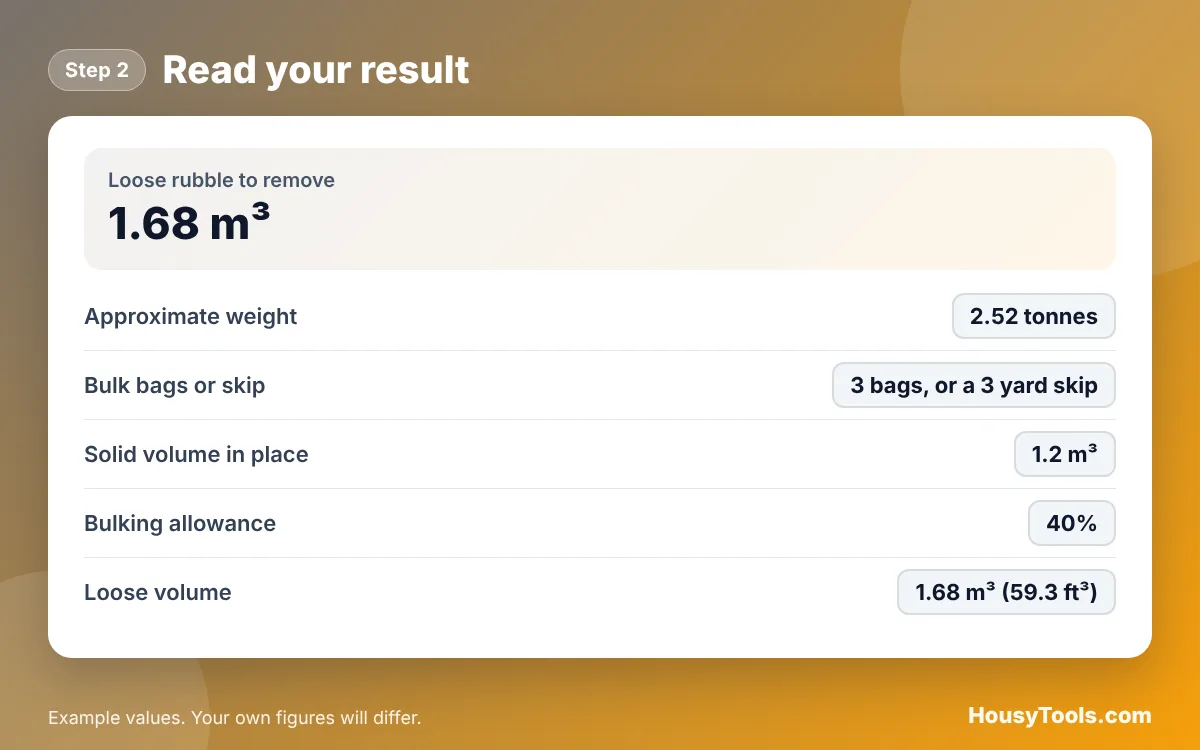
| Patio 4 m x 3 m x 0.1 m | 1.2 m³ | 1.68 m³ | 2.52 t | 2.20 | 3 yard |
| Shed base 3 m x 2.5 m x 0.15 m | 1.125 m³ | 1.58 m³ | 2.36 t | 2.06 | 3 yard |
| Garden wall 5 m x 0.1 m x 1 m | 0.5 m³ | 0.7 m³ | 1.05 t | 0.92 | 2 yard |
| Driveway 6 m x 4 m x 0.15 m | 3.6 m³ | 5.04 m³ | 7.56 t | 6.59 | 2 x 6 yard |
Worked Example: Breaking Out a Concrete Patio
Example: a concrete patio 4 m long, 3 m wide and 0.1 m thick is being broken out, using the tool’s default settings.
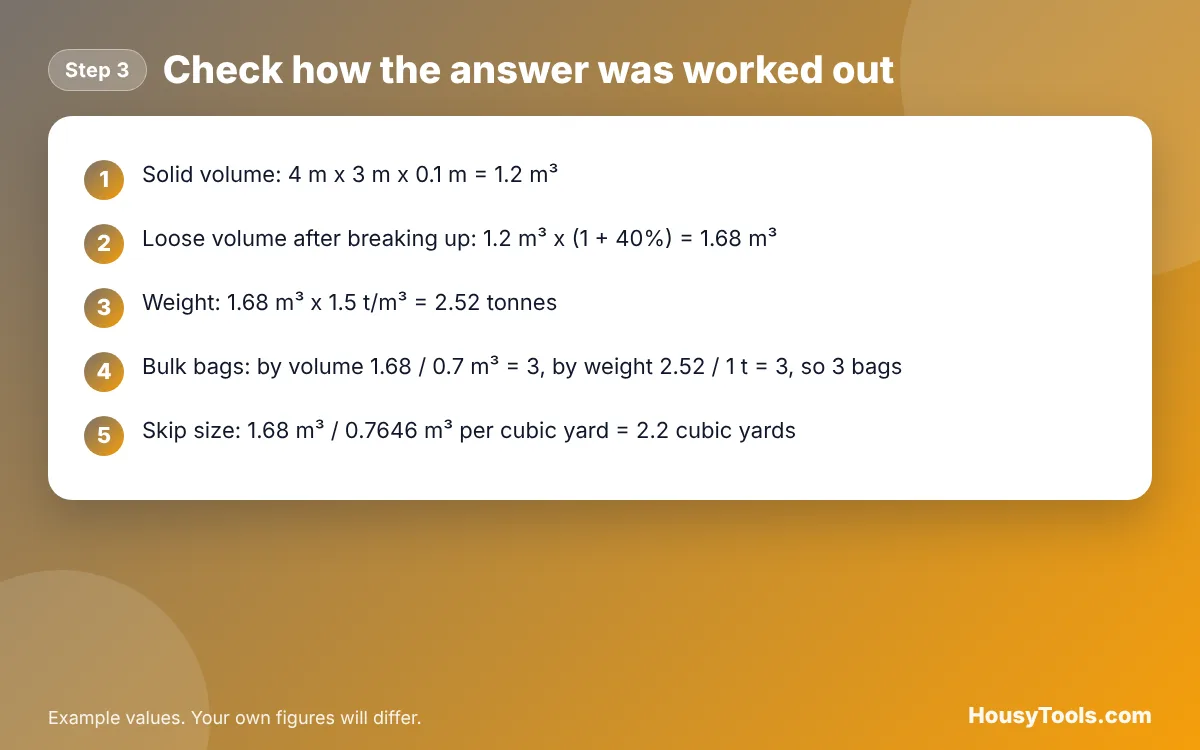
- Solid volume: 4 x 3 x 0.1 = 1.2 m³.
- Loose volume: 1.2 m³ x 1.40 = 1.68 m³, or 59.3 ft³.
- Weight: 1.68 m³ x 1.5 t/m³ = 2.52 tonnes.
- Bulk bags: 1.68 / 0.7 = 2.4, so 3 by volume, and 2.52 / 1 = 2.52, so 3 by weight. Plan for 3 bags.
- Skip: 1.68 / 0.7646 = 2.2 cubic yards, so a 3 yard skip.
Breaking concrete and brick releases silica dust, so damp the work down, wear eye protection and a well fitted FFP3 dust mask, and check for buried cables and pipes before you dig into a slab. Whoever takes the waste away must be a registered waste carrier. The government’s waste duty of care code of practice explains what to check. If you are laying a new slab afterwards, the concrete calculator works out the replacement volume.
Rubble Volume Calculator FAQs
How do I calculate the volume of rubble?
Multiply length by width by depth in metres to get the solid volume, then add a bulking allowance for broken material. A 1.2 m³ slab becomes about 1.68 m³ of loose rubble at 40% bulking. If the rubble is already in a heap, measure the heap instead.
How many tonnes is a cubic metre of broken concrete?
Loose broken concrete is often around 1.5 tonnes per cubic metre, but it varies with piece size and moisture. Solid concrete in place weighs much more per cubic metre because it has no air gaps. Weigh a bucket of your own rubble for the best figure.
How much rubble fits in a bulk bag?
It depends on the bag’s volume and its safe working load. A bag rated at 1 tonne holds only about two thirds of a cubic metre of rubble at 1.5 t/m³, even if the bag itself is larger. Always check the label and never exceed the rated load.
How many cubic yards is a cubic metre?
One cubic metre is about 1.308 cubic yards, and one cubic yard is exactly 0.764555 m³. Skip sizes in the UK are still quoted in cubic yards, so 1.68 m³ of rubble is about 2.2 cubic yards.
Can I put rubble in a large skip?
Often only a small one. Many skip firms limit heavy waste such as rubble, soil and concrete to skips of about 6 cubic yards or less, because larger skips would be too heavy to lift. Ask the hire firm about their limit before booking.
Should I measure the rubble before or after breaking it?
Either works. Measuring the solid slab or wall is easier and more accurate, then the bulking allowance converts it to loose volume. Measuring a heap after breaking avoids guessing the bulking, but heaps are irregular, so use the average height.
Checked October 2026. Sources: NIST, SI units of length, Wikipedia, Cubic yard, GOV.UK, Waste duty of care code of practice.