
Show the formula and working
This converter swaps fresh to dry yeast and back again, so bakers in the UK, Ireland and Europe can follow any bread recipe with the yeast they actually have. Enter the grams in your recipe, pick fast action or dried active yeast, and it gives the equivalent weight, level teaspoons and 7 g sachets.
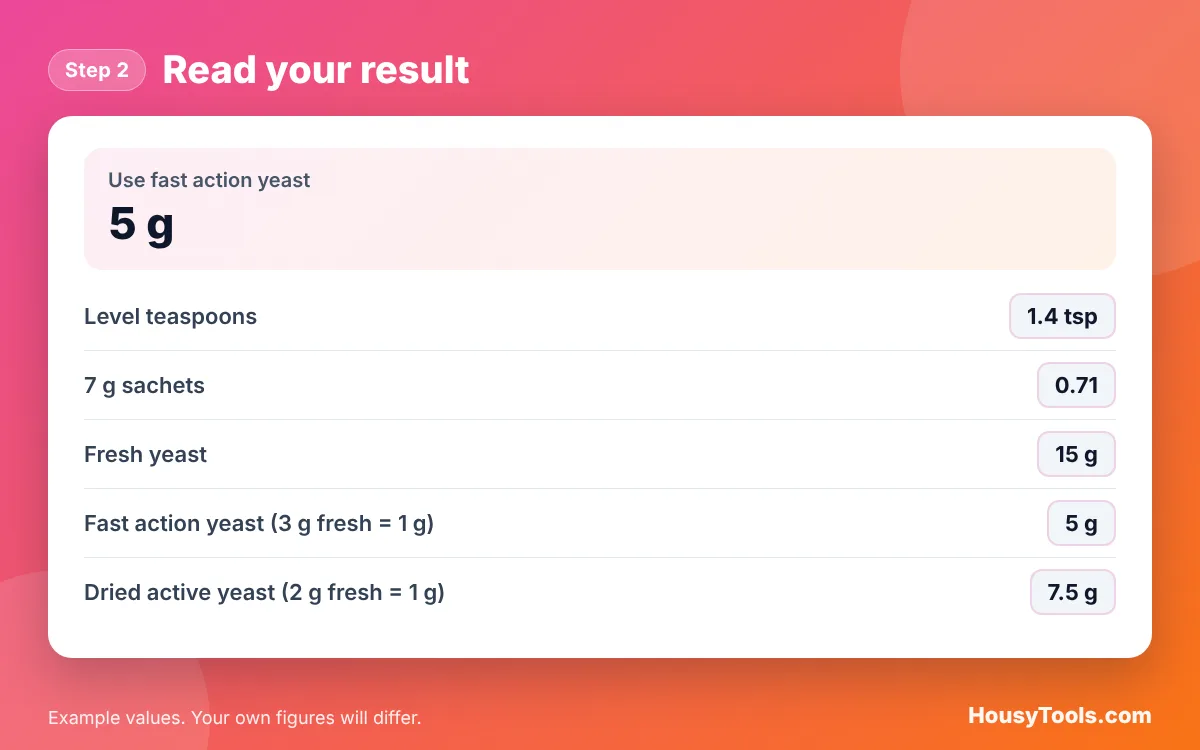
Quick answer: To convert fresh to dry yeast, divide the fresh yeast weight by 3 for fast action (instant) yeast, or by 2 for dried active yeast. So 15 g fresh yeast equals 5 g fast action or 7.5 g dried active. To go back, multiply the dry weight by 3 or 2.
What Is a Fresh to Dry Yeast Converter?
A fresh to dry yeast converter is a calculator that finds how much dried yeast does the same job as a given weight of fresh (compressed) yeast. Fresh yeast contains a lot of water, so you need less of the dried forms. The formula is: dry yeast = fresh yeast / ratio, where the ratio is 3 for fast action yeast and 2 for dried active yeast. Going the other way, fresh yeast = dry yeast x ratio.
The 3 to 1 figure for instant yeast follows the yeast conversion table from Freee by Doves Farm, which gives 3 g fresh = 1 g instant. The 2 to 1 figure for dried active yeast follows Allinson’s pack advice to use half the quantity of dried yeast in place of fresh. Brands differ slightly, so a Custom ratio option is included.
How Do You Use the Fresh to Dry Yeast Converter?
- Choose the Direction: “Fresh yeast to dry yeast” or “Dry yeast to fresh yeast”.
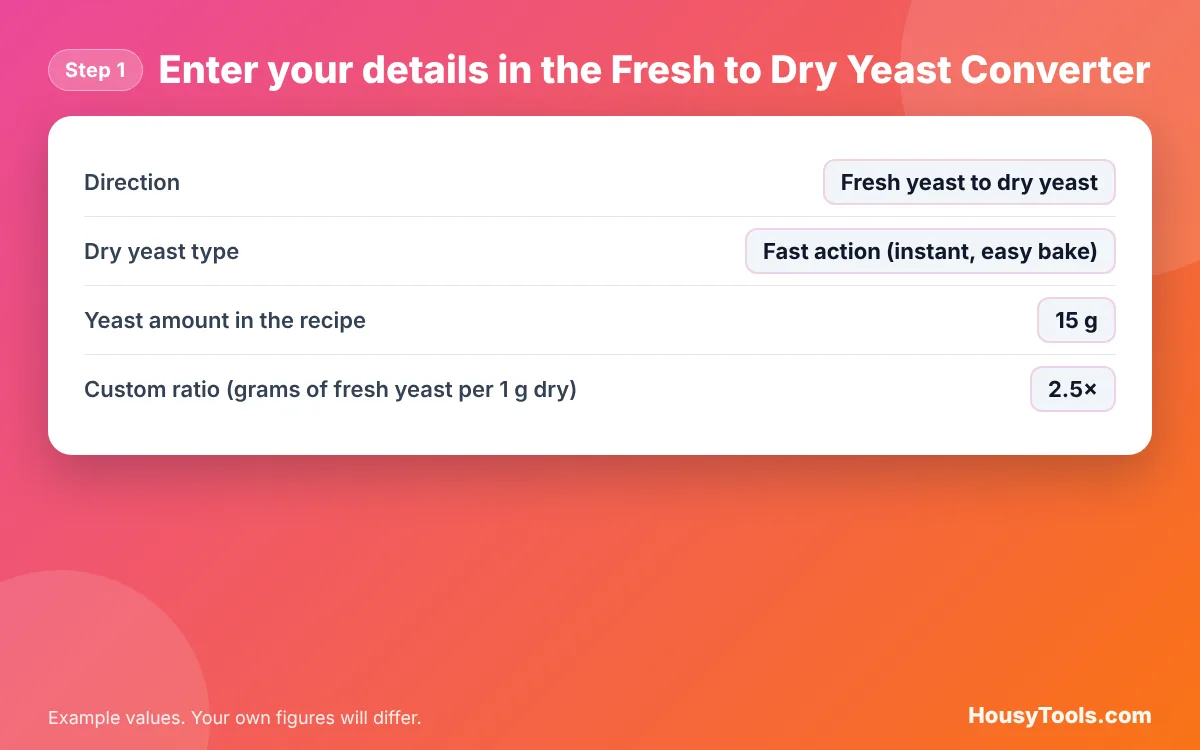
- Pick the Dry yeast type: fast action (also sold as instant or easy bake), dried active, or a custom ratio.
- Enter the Yeast amount in the recipe in grams.
- If you chose a custom ratio, enter it in Custom ratio (grams of fresh yeast per 1 g dry).
- Read the converted weight, teaspoons and sachets, then open “Show the formula and working” to see the sums.
How Much Dry Yeast Equals 25 g of Fresh Yeast?
25 g of fresh yeast equals about 8.3 g of fast action yeast or 12.5 g of dried active yeast. That is a little over one 7 g sachet of fast action yeast, or about 2.4 level teaspoons.
What Is the Difference Between Fast Action and Dried Active Yeast?
Fast action yeast is mixed straight into the flour, while dried active yeast is usually dissolved in warm water with a little sugar and left to froth before use. Allinson’s dried active yeast instructions, for example, ask you to whisk the yeast into 150 ml of warm water and wait about 15 minutes. Take that water from the liquid in your recipe so the dough is not too wet. Fast action yeast is also the type recommended for bread machines.
How Many Grams Are in a Teaspoon of Yeast?
A level teaspoon of fast action yeast weighs about 3.5 g, and a level teaspoon of dried active yeast about 5 g. These figures come from Allinson’s packs, which give 2 teaspoons as 7 g of Easy Bake yeast and 1 level tablespoon as 15 g of dried active yeast. A standard UK sachet of fast action yeast holds 7 g, enough for one large loaf from about 500 g of flour.
How Should You Store Fresh Yeast?
Keep fresh yeast wrapped in the fridge and use it within the date on the pack, because it is highly perishable, as the entry on baker’s yeast on Wikipedia explains. Dried yeast keeps far longer: sealed packs are stored at room temperature, and an opened tin should be closed tightly and kept cool and dry. If dried active yeast does not froth after 15 minutes in warm water, it is probably past its best.
| Fresh yeast | Fast action (instant) yeast | Dried active yeast | Fast action in level teaspoons |
|---|---|---|---|
| 7 g | 2.3 g | 3.5 g | 0.7 tsp |
| 10 g | 3.3 g | 5 g | 1 tsp |
| 15 g | 5 g | 7.5 g | 1.4 tsp |
| 21 g | 7 g (1 sachet) | 10.5 g | 2 tsp |
| 25 g | 8.3 g | 12.5 g | 2.4 tsp |
| 30 g | 10 g | 15 g | 2.9 tsp |
| 42 g | 14 g (2 sachets) | 21 g | 4 tsp |
| 50 g | 16.7 g | 25 g | 4.8 tsp |
Worked Example: Converting a Bakery Recipe
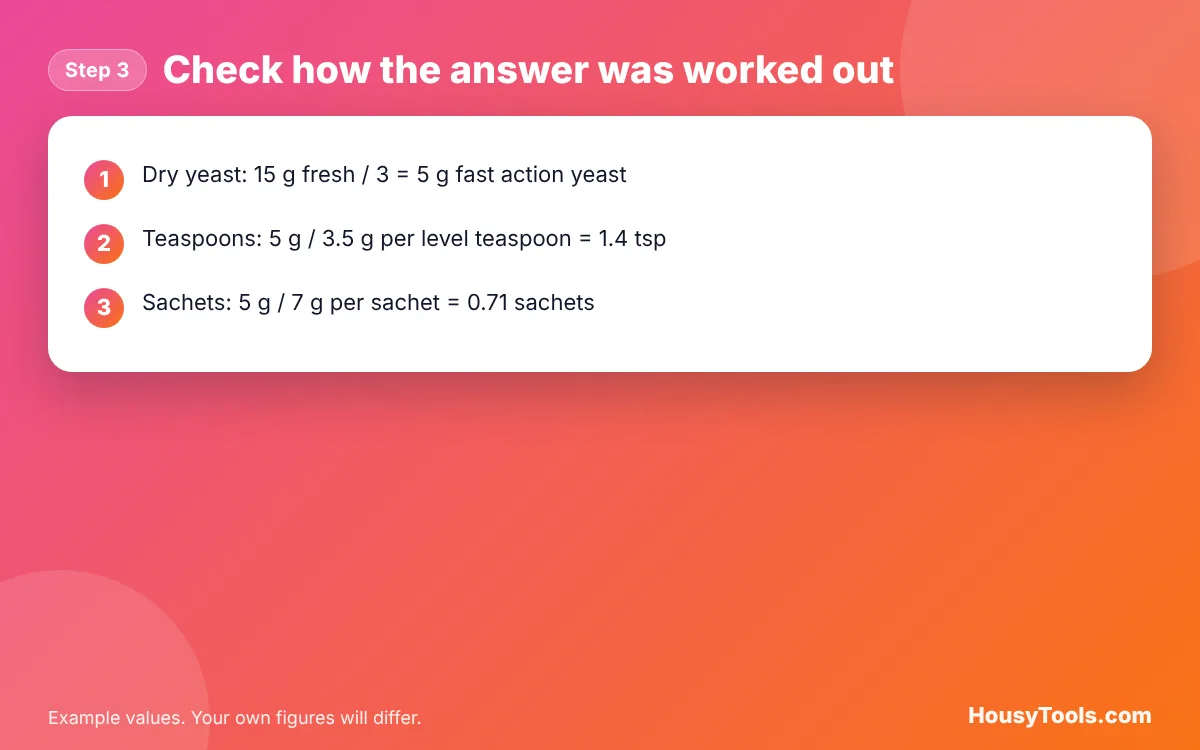
Example: a focaccia recipe from an Italian bakery book asks for 15 g of fresh yeast, but the cupboard only has a tin of fast action yeast. Set Direction to “Fresh yeast to dry yeast”, leave Dry yeast type on fast action and enter 15 g.
- Dry yeast: 15 g fresh / 3 = 5 g fast action yeast
- Teaspoons: 5 g / 3.5 g per level teaspoon = 1.4 tsp
- Sachets: 5 g / 7 g per sachet = 0.71 sachets
Weigh 5 g on digital scales and mix it straight into the flour. With dried active yeast, the tool shows you would need 7.5 g, dissolved first. If you are scaling the whole loaf as well, our home calculators collection has more kitchen helpers, and the electricity cost calculator shows what a long bake in an electric oven costs.
Fresh to Dry Yeast FAQs
What is the ratio of fresh yeast to dry yeast?
Use 3 g of fresh yeast for every 1 g of fast action (instant) yeast, and 2 g of fresh yeast for every 1 g of dried active yeast. In practice that means a third of the fresh weight for fast action yeast and half for dried active yeast.
How much fresh yeast is one 7 g sachet?
A 7 g sachet of fast action yeast replaces about 21 g of fresh yeast, using the 3 to 1 ratio. That is enough for one large loaf made with around 500 g of strong flour, which is how UK sachets are usually sized.
Can I use dried active yeast instead of fast action?
Yes. Use about 1.5 times the weight of fast action yeast, because 1 g of fast action matches 3 g of fresh and 1 g of dried active matches 2 g of fresh. Dissolve it in warm water from the recipe first and expect a slightly slower rise.
How much yeast do I need for 500 g of flour?
Allinson’s packs give 7 g of Easy Bake (fast action) yeast for one large loaf, and 15 g of dried active yeast per 500 g of flour. Using the ratios in this converter, 7 g of fast action yeast matches about 21 g of fresh yeast.
Does the rising time change with dried yeast?
Rising time depends mostly on dough temperature, so it stays similar when you swap at the correct ratio. Dried active yeast can be a little slower to start. Judge by the dough, which should roughly double in size, rather than by the clock.
Is instant yeast the same as fast action yeast?
Yes, for home baking in the UK the names are used for the same kind of yeast. Allinson’s Easy Bake yeast, for example, says it can be used whenever a recipe calls for quick, fast action, instant or easy blend yeast. Choose fast action in this converter for all of them.
Checked October 2026. Sources: Freee by Doves Farm: Fresh yeast to dry yeast conversion, Allinson’s Dried Active Yeast pack information, Allinson’s Easy Bake Yeast pack information, Wikipedia: Baker’s yeast.