
Show the formula and working
This free paint drying time calculator tells homeowners and decorators in the UK, Ireland and Europe how long to wait between coats of paint at the actual temperature in the room, and what time the job will be finished. Choose the paint type, enter the temperature, humidity, coats and start time, and it adjusts the maker’s drying times and builds a timeline for each coat.
Quick answer: A paint drying time calculator takes the recoat time printed on the tin, which assumes normal room conditions, and lengthens it for cooler air. Water based matt emulsion is recoatable in 2 to 4 hours, solvent based gloss in 16 to 24 hours. At 15°C, a 4 hour wait becomes about 5 hours 39 minutes.
What Is a Paint Drying Time Calculator?
A paint drying time calculator is a tool that estimates the touch dry and recoat times of a paint at your temperature and turns them into a painting schedule.
The formula in plain words: start with the touch dry and recoat times from the maker, which are quoted for normal conditions, usually taken in data sheets as about 20°C. Work out a temperature factor: the slowdown figure raised to the power of (20 minus your temperature) divided by 10. With the default slowdown of 2, the factor is 1 at 20°C, about 1.41 at 15°C and 2 at 10°C. Multiply the maker’s times by that factor. The schedule then adds the time you spend painting each coat, the adjusted wait between coats, and a final wait after the last coat.
How Do You Use the Paint Drying Time Calculator?
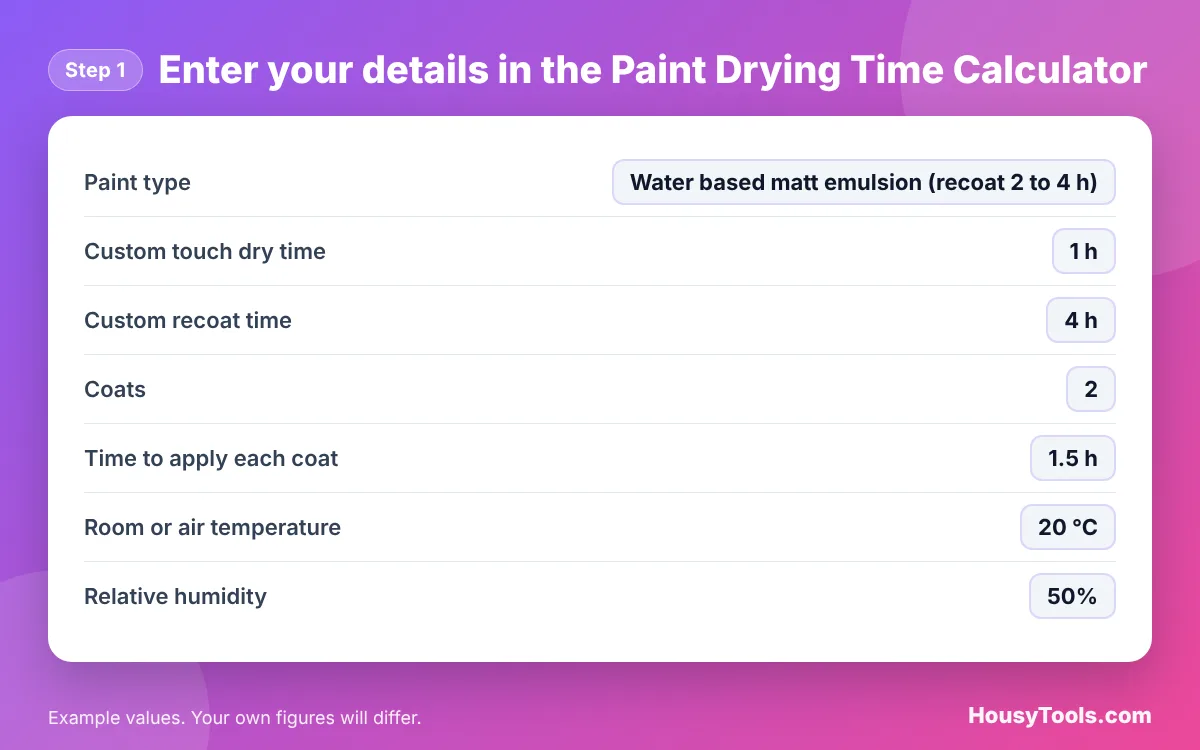
- Choose the Paint type. If your tin gives different times, choose Custom and enter the Custom touch dry time and Custom recoat time.
- Enter the number of Coats and the Time to apply each coat.
- Enter the Room or air temperature and the Relative humidity where you are painting.
- Set Plan with to the longer time for a safe plan, or the shorter time if the room is warm, dry and well ventilated.
- Leave Slowdown for every 10 C cooler than 20 C at 2 unless your paint’s data sheet gives times at other temperatures, and set the Start time (24 hour clock).
- Read the wait between coats and the timeline in the result, then open “Show the formula and working” to see the factor and each step.


How Long Does Paint Take to Dry Between Coats?
Water based emulsion takes 2 to 4 hours before a second coat, water based quick dry wood paints take 4 to 6 hours, and solvent based gloss and satinwood take 16 to 24 hours. These figures come from Dulux Trade product pages: the page for Dulux Trade Vinyl Matt gives a recoat time of 2 to 4 hours and says drying depends on temperature and humidity. Always check your own tin, because brands and finishes differ.
Does Paint Dry Slower in the Cold?
Yes, paint dries noticeably slower in cold air: as a rule of thumb, allow about twice as long at 10°C as at 20°C. Most decorative paint tins give one time for normal conditions only, so the calculator uses an editable estimate. Industrial data sheets that list several temperatures support it: one Jotun data sheet gives touch dry in 2 hours at 23°C but 5 hours at 10°C, and recoat in 4 hours against 7 hours. Very cold rooms are a separate problem, because paint may not form a proper film; Dulux gives 7°C as the lowest temperature for its smooth masonry paint.
How Does Humidity Affect Paint Drying?
High humidity slows drying because the air cannot take up moisture and solvent as fast, and above about 80% relative humidity drying can stall. The product page for Dulux Trade Weathershield Smooth Masonry Paint says not to apply it in rain, fog or relative humidity above 80%. The calculator warns above 80% rather than adding a fixed delay, because the effect varies so much. Opening a window or running a dehumidifier helps indoors.
What Is the Difference Between Touch Dry and Recoat Time?
Touch dry means the surface no longer feels tacky to a light touch, while recoat time is the minimum wait before the next coat will not lift or drag the first. Recoat time is always the longer of the two. Paint keeps hardening after it reaches the recoat stage, so treat new paintwork gently for the first few days and check the tin for any full cure time before cleaning or heavy use.
Paint Drying Times by Type and Temperature
Recoat times from Dulux Trade product pages at normal room conditions, adjusted with the default slowdown of 2 for every 10°C cooler.
| Paint type | Touch dry | Recoat at about 20°C | Recoat at 15°C (x 1.41) | Recoat at 10°C (x 2) |
|---|---|---|---|---|
| Water based matt emulsion | Not stated | 2 to 4 h | 2 h 50 min to 5 h 39 min | 4 to 8 h |
| Water based quick dry satinwood | Not stated | 4 to 6 h | 5 h 39 min to 8 h 29 min | 8 to 12 h |
| Water based quick dry gloss | 1 to 2 h | 4 to 6 h | 5 h 39 min to 8 h 29 min | 8 to 12 h |
| Solvent based high gloss | 4 to 6 h | 16 to 24 h | 22 h 38 min to 33 h 56 min | 32 to 48 h |
| Solvent based satinwood | 4 to 6 h | 16 to 24 h | 22 h 38 min to 33 h 56 min | 32 to 48 h |
| Solvent based undercoat | 2 to 6 h | 6 to 16 h | 8 h 29 min to 22 h 38 min | 12 to 32 h |
| Smooth masonry paint | 30 min | 2 to 4 h | 2 h 50 min to 5 h 39 min | 4 to 8 h |
Worked Example: Two Coats in a Cool Bedroom
Example: the walls of a 4 m by 3 m bedroom are being painted with water based matt emulsion on a cool day. The room is 15°C with 50% humidity. Enter 2 Coats, 1.5 hours for Time to apply each coat, keep the longer time and start at 9.
- Temperature factor: 2 to the power of ((20 minus 15) / 10) = 1.41.
- Wait between coats: 4 h x 1.41 = 5 h 39 min.
- Coat 1 from 09:00 to 10:30, coat 2 from 16:09 to 17:39.
- The last coat reaches the recoat stage at 23:19, so the whole job takes 14 h 19 min.
To estimate the painting time itself from the wall area, use the painting time calculator, and the paint calculator for the litres.
Paint Drying Time Calculator FAQs
Can I put a second coat of emulsion on after 2 hours?
Often yes in a warm, dry, well ventilated room, because many emulsions give a recoat time of 2 to 4 hours. In a cool or damp room wait for the longer end, or more. If the first coat still feels cool or tacky, or looks patchy, it is not ready.
How long does gloss paint take to dry?
Solvent based gloss is touch dry in about 4 to 6 hours and recoatable in 16 to 24 hours, according to Dulux Trade. Water based quick dry gloss is much faster, touch dry in 1 to 2 hours and recoatable in 4 to 6 hours. Cold rooms lengthen all these times.
What happens if I recoat paint too soon?
Recoating too soon can drag or lift the first coat, leave brush and roller marks, and trap moisture or solvent so the finish stays soft or wrinkles. It can also make the colour patchy. Waiting until the recoat time on the tin has passed gives a smoother, harder finish.
Does heating a room help paint dry faster?
Gentle, even warmth helps, because paint dries faster at around normal room temperature than in a cold room. Avoid blowing hot air straight onto fresh paint or painting a hot radiator, since very fast surface drying can cause marks. Good ventilation matters as much as warmth.
What is the minimum temperature for painting?
It depends on the product, so check the tin. Dulux gives 7°C as the minimum for its Weathershield smooth masonry paint and says not to paint in rain, fog or humidity above 80%. Remember that walls and woodwork can be colder than the air, especially outdoors early in the day.
How accurate is a paint drying time estimate?
Treat it as a planning guide. The base times come from the maker, but the temperature adjustment is an estimate, and humidity, airflow, film thickness and colour all change real drying. Test an inconspicuous spot before the next coat, and use your tin’s figures in the Custom option for the closest match.
Painting outside? The masonry paint calculator works out the litres for exterior walls, and the paint and decorating calculators cover the rest of the job.
Checked October 2026. Sources: Dulux Trade Vinyl Matt, Dulux Trade Quick Dry Gloss, Dulux Trade High Gloss, Dulux Trade Weathershield Smooth Masonry Paint, Jotacote Universal N10 technical data sheet (Jotun).