
Show the formula and working
This kettle running cost calculator works out what each boil of your kettle costs, and the daily and yearly totals, for households in the UK, Ireland and Europe. You can estimate the energy from the amount of water you boil, or time a real boil and use the kettle’s wattage, then add your unit rate in pounds or euros to see the cost with the working.
Quick answer: A kettle running cost calculator multiplies the kWh per boil by your unit rate. Boiling 1 litre from 15 °C takes about 0.11 kWh with a 90% efficient kettle, which costs about 2.9p at the October to December 2026 price cap rate of 26.32p per kWh. A 3 kW kettle boiling for 2 minutes 15 seconds costs about 3p.
What Is a Kettle Running Cost Calculator?
A kettle running cost calculator is a tool that works out the electricity a kettle uses to boil water and what that costs per boil, per day and per year. It offers two methods. With a timed boil, the energy is wattage multiplied by minutes, divided by 60 and by 1,000, giving kWh. With the water volume method, the energy is litres multiplied by 4.184 kJ per litre per degree, multiplied by the temperature rise to 100 °C, divided by 3,600 to give kWh, then divided by the kettle efficiency.
The 4.184 figure is the specific heat capacity of water: it takes about 4,184 joules to warm 1 kg of water by 1 °C, as the Wikipedia specific heat capacity article notes, and 1 litre of water weighs about 1 kg. In both methods, the cost per boil is the kWh multiplied by your unit rate, the same rule the electricity cost calculator uses for any appliance.
How Do You Use the Kettle Running Cost Calculator?
- Choose the Method: Water volume to estimate the energy, or Wattage and boil time if you have timed a boil.
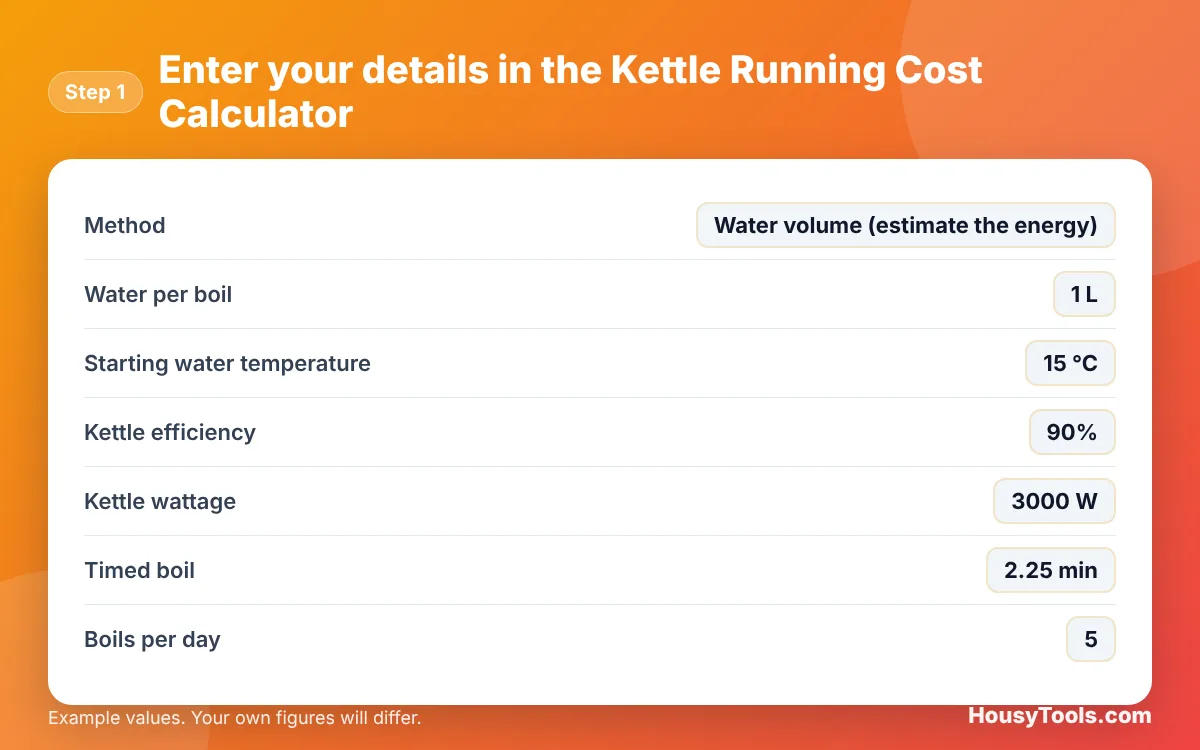
- For the water volume method, enter the Water per boil in litres, the Starting water temperature and the Kettle efficiency, or keep the example values.
- Enter the Kettle wattage from the base or rating label. With the water method it gives an estimated boil time.
- For the timed method, enter the Timed boil in minutes, for example 2.25 for 2 minutes 15 seconds.
- Enter your Boils per day and check the Electricity unit rate, replacing the Ofgem price cap rate with the rate on your bill if it differs.
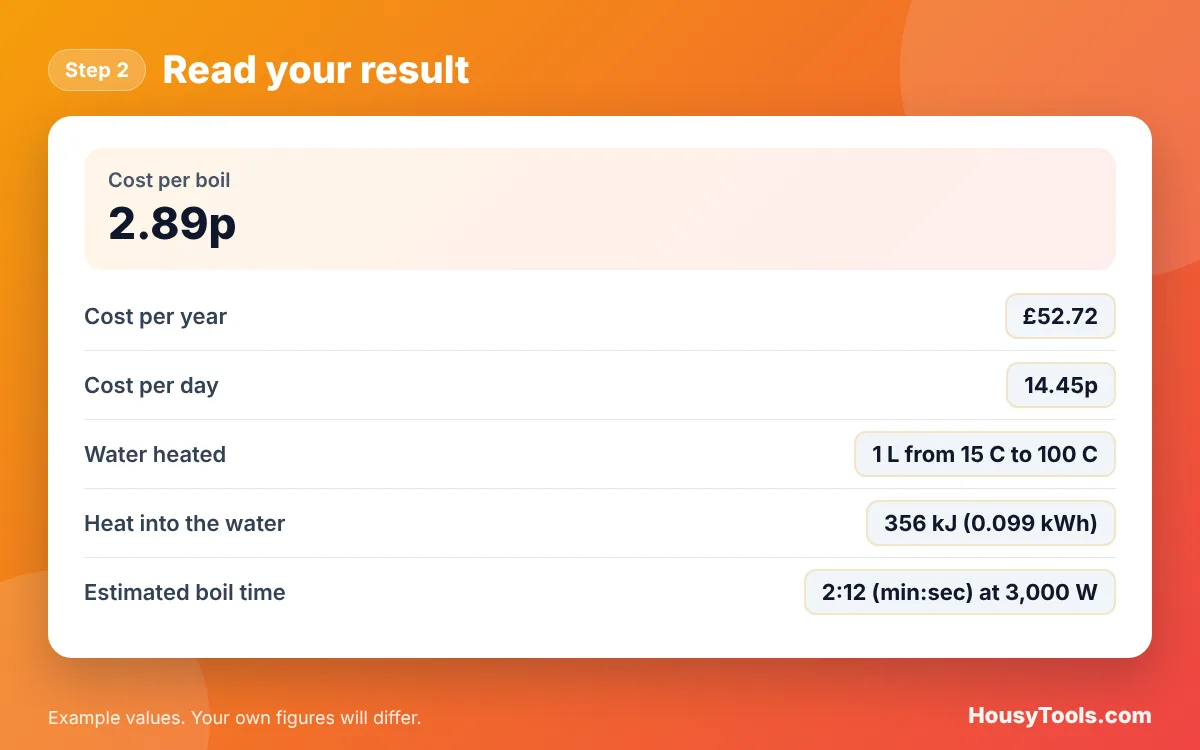
- Read the cost per boil, per day and per year, then open “Show the formula and working” to see each step with your numbers.

How Much Does It Cost to Boil a Kettle?
Boiling a full 1.7 litre kettle from 15 °C costs about 4.9p at 26.32p per kWh, while boiling just one mug of about 0.25 litres costs about 0.7p, assuming 90% efficiency. The cost rises in direct proportion to the water you boil, which is why filling only what you need is the easiest saving. Colder water in winter needs a bigger temperature rise, so each boil costs slightly more.
How Much Can You Save by Not Overfilling the Kettle?
The Energy Saving Trust estimates that avoiding overfilling the kettle saves about £10 a year in Great Britain. Each extra litre you boil from 15 °C adds about 0.11 kWh, around 2.9p at the price cap rate. Measure the water with a mug, keep it above the minimum fill line marked on the kettle, and descale the element in hard water areas so it heats efficiently.
Does a 3 kW Kettle Cost More to Run Than a 2 kW Kettle?
No, a 3 kW kettle costs about the same per boil as a 2 kW kettle, because the energy needed to heat the water is the same; the 3 kW model simply boils it faster. A slow kettle loses a little more heat while it works, so faster can be very slightly cheaper. Electric kettles are rated 2 to 3 kW and draw up to 13 A, according to the Wikipedia kettle article. That is the limit of a UK plug and its fuse, so plug a kettle into a wall socket rather than a crowded extension lead and use a qualified electrician for any wiring.
Kettle Cost per Boil Table
| Water boiled | Electricity | Cost per boil | Estimated boil time at 3 kW |
|---|---|---|---|
| 0.25 L (one mug) | 0.027 kWh | 0.72p | 0:33 |
| 0.5 L | 0.055 kWh | 1.44p | 1:06 |
| 1.0 L | 0.110 kWh | 2.89p | 2:12 |
| 1.5 L | 0.165 kWh | 4.33p | 3:18 |
| 1.7 L (full) | 0.187 kWh | 4.91p | 3:44 |
Water heated from 15 °C to 100 °C with 90% efficiency (an example), at 26.32p per kWh, the Ofgem price cap average for October to December 2026. Times are minutes and seconds.
Worked Example: Five Boils a Day
Example: 1 litre of cold water at about 15 °C is boiled in a 3,000 W kettle 5 times a day at 26.32p per kWh. Choose Water volume, enter 1 in Water per boil, 15 in Starting water temperature, keep 90% Kettle efficiency, enter 3000 as Kettle wattage and 5 Boils per day. The calculator works out 1 x 4.184 x 85 = 356 kJ of heat, then 356 / 3,600 / 90% = 0.1098 kWh per boil, and 0.1098 x 26.32p = 2.89p per boil. That is 14.45p a day and £52.72 a year, with an estimated boil time of 2 minutes 12 seconds.
Switching to euros at a tariff of 30 cents per kWh, the same boil costs about 3.3c. To compare the kettle with the rest of your usage, you can use the electricity bill calculator or the other energy bill calculators.
Kettle Running Cost Calculator FAQs
How many kWh does it take to boil a kettle?
About 0.11 kWh per litre from cold, with a 90% efficient kettle. A full 1.7 litre kettle takes about 0.19 kWh and a single mug about 0.03 kWh. Warmer starting water needs less.
How much does a kettle cost to run per year?
Multiply the cost per boil by boils per day and by 365. Boiling 1 litre 5 times a day costs about £53 a year at 26.32p per kWh, while boiling just enough for two mugs each time costs about half that.
Which method is more accurate?
The timed boil method is usually closer, because it measures your own kettle with its real heat losses. Time a boil from switch on to switch off, and use the wattage printed on the base. The water method is a good estimate when you cannot time it.
Does reboiling the kettle cost money?
Yes. Water that has cooled must be heated again, and every reboil adds energy. Boiling only what you need, when you need it, avoids paying to heat the same water twice.
Is a kettle cheaper than a microwave or a hob for boiling water?
A kettle is often the cheapest way to boil water at home, because its element heats the water directly and loses little heat. A pan on a hob loses heat to the air around it. Time each method with an energy monitor to compare yours.
Why is the default efficiency 90%?
It is an example. Some electricity warms the kettle body and the air instead of the water. Your kettle may differ, so time a real boil, then adjust the efficiency until the estimated boil time matches.
Checked October 2026. Sources: Energy price cap unit rates and standing charges (Ofgem), Quick tips to save energy (Energy Saving Trust), Specific heat capacity (Wikipedia), Kettle (Wikipedia).