
Show the formula and working
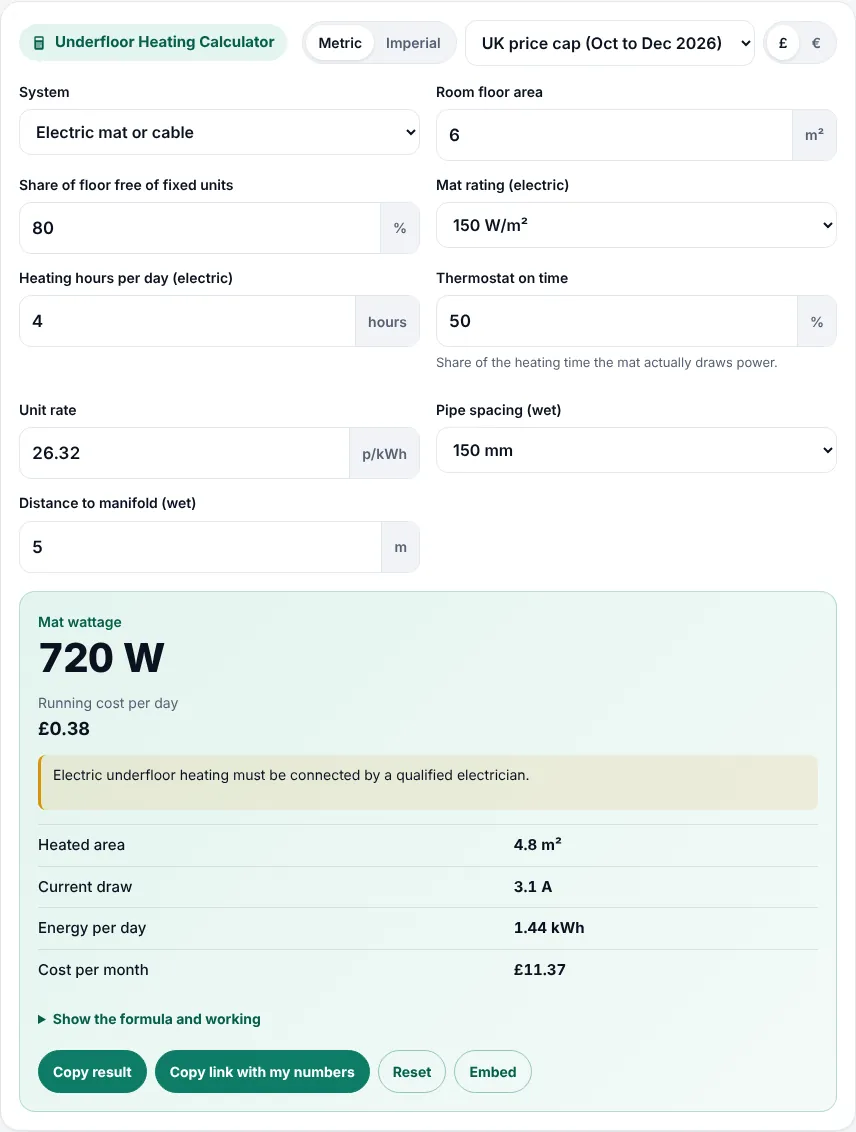
This underfloor heating calculator works out the wattage, current draw and running cost of an electric mat, or the pipe length and number of loops for a wet system, for UK and European homes. It uses the Ofgem price cap unit rate for October to December 2026 by default, and you can enter your own tariff.
Quick answer: the underfloor heating calculator multiplies the free floor area by the mat rating to get watts, then kW x hours x thermostat on time x unit rate for cost. A 619 W bathroom mat running 4 hours a day at 50% on time uses 1.24 kWh, about 33p a day at 26.32p per kWh.
What Is an Underfloor Heating Calculator?
An underfloor heating calculator sizes an underfloor system for one room and estimates what it costs to run, so you can choose the right mat or plan pipework before you buy.
For electric systems the formula is: heated area = floor area x share free of fixed units; watts = heated area x mat rating; daily energy = kW x heating hours x thermostat on time; daily cost = energy x unit rate. For wet systems: pipe length = heated area x (1,000 / pipe spacing in mm) + 2 x the distance to the manifold, and loops = pipe length / 100 m, rounded up.
How Do You Use the Underfloor Heating Calculator?
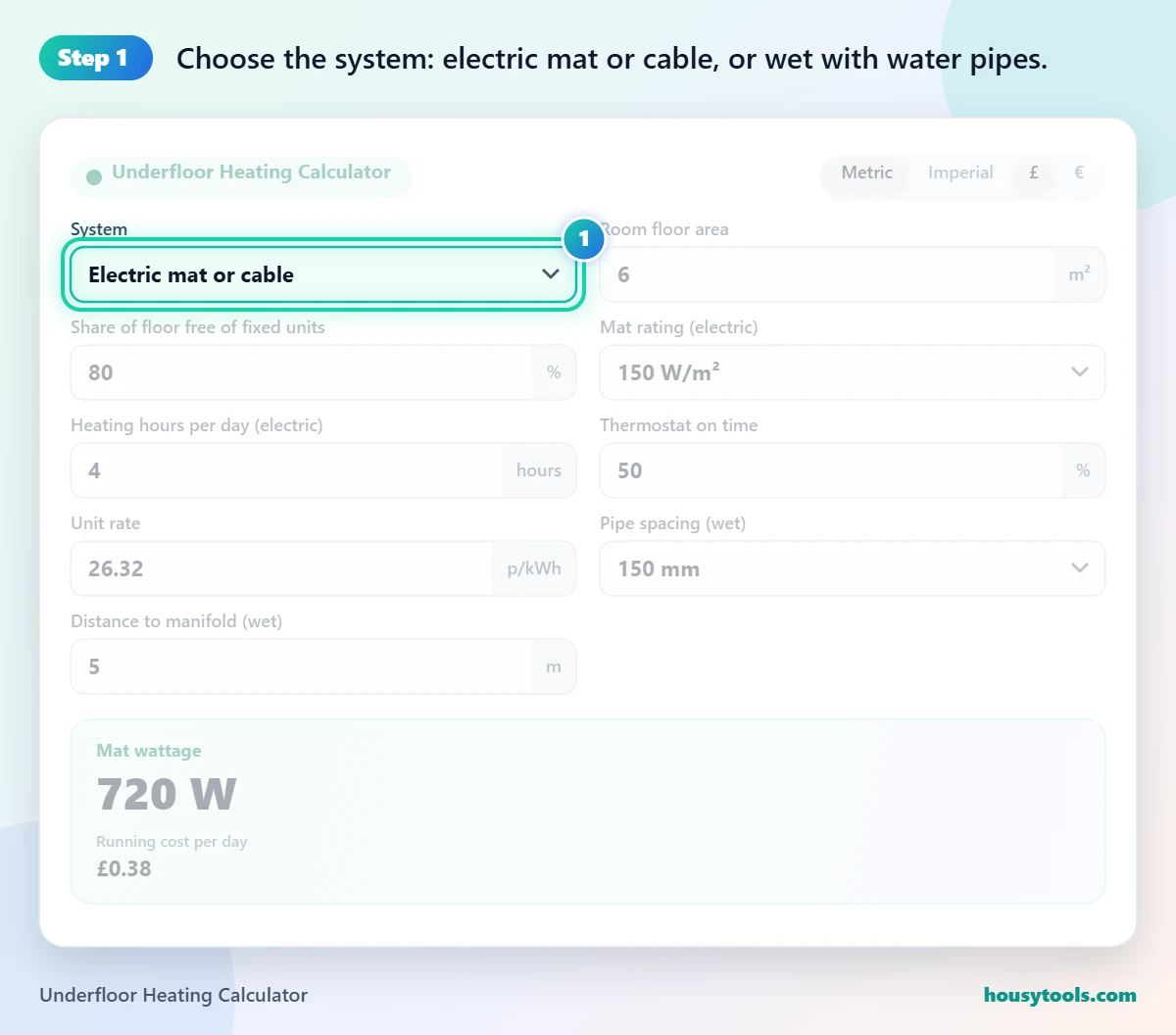
- Choose the system: electric mat or cable, or wet with water pipes.
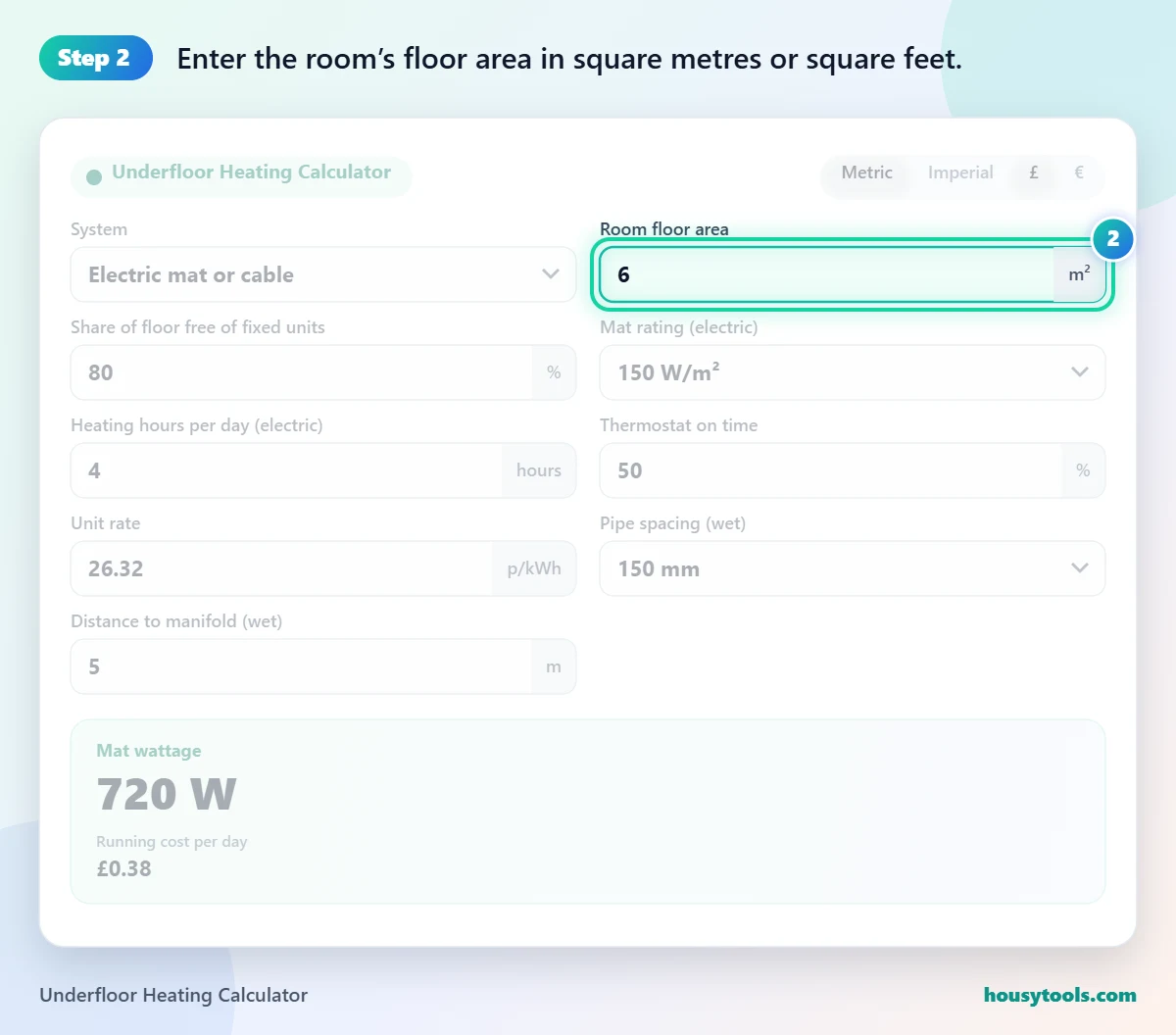
- Enter the room’s floor area in square metres or square feet.
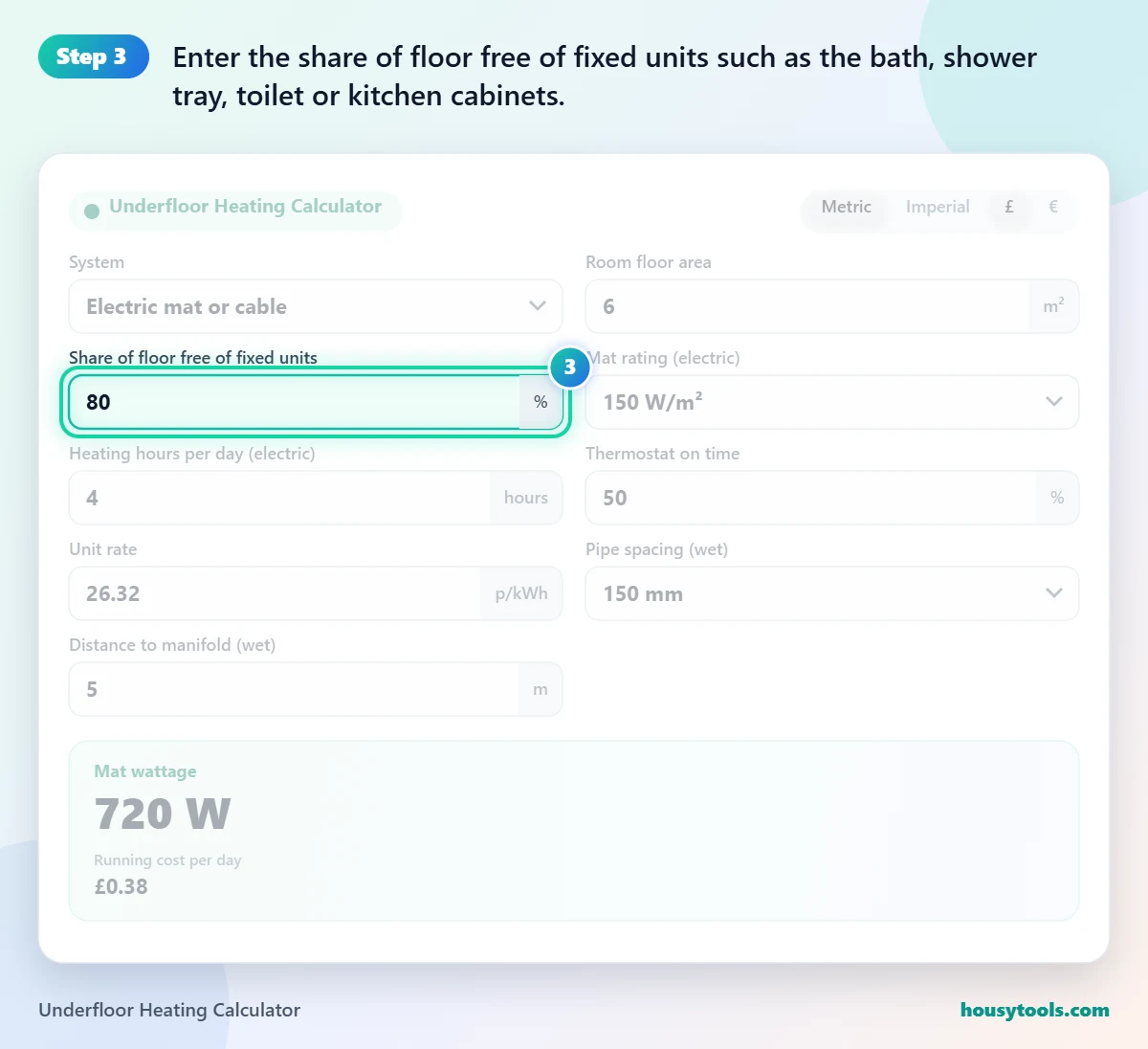
- Enter the share of floor free of fixed units such as the bath, shower tray, toilet or kitchen cabinets. 70 to 85% is common.
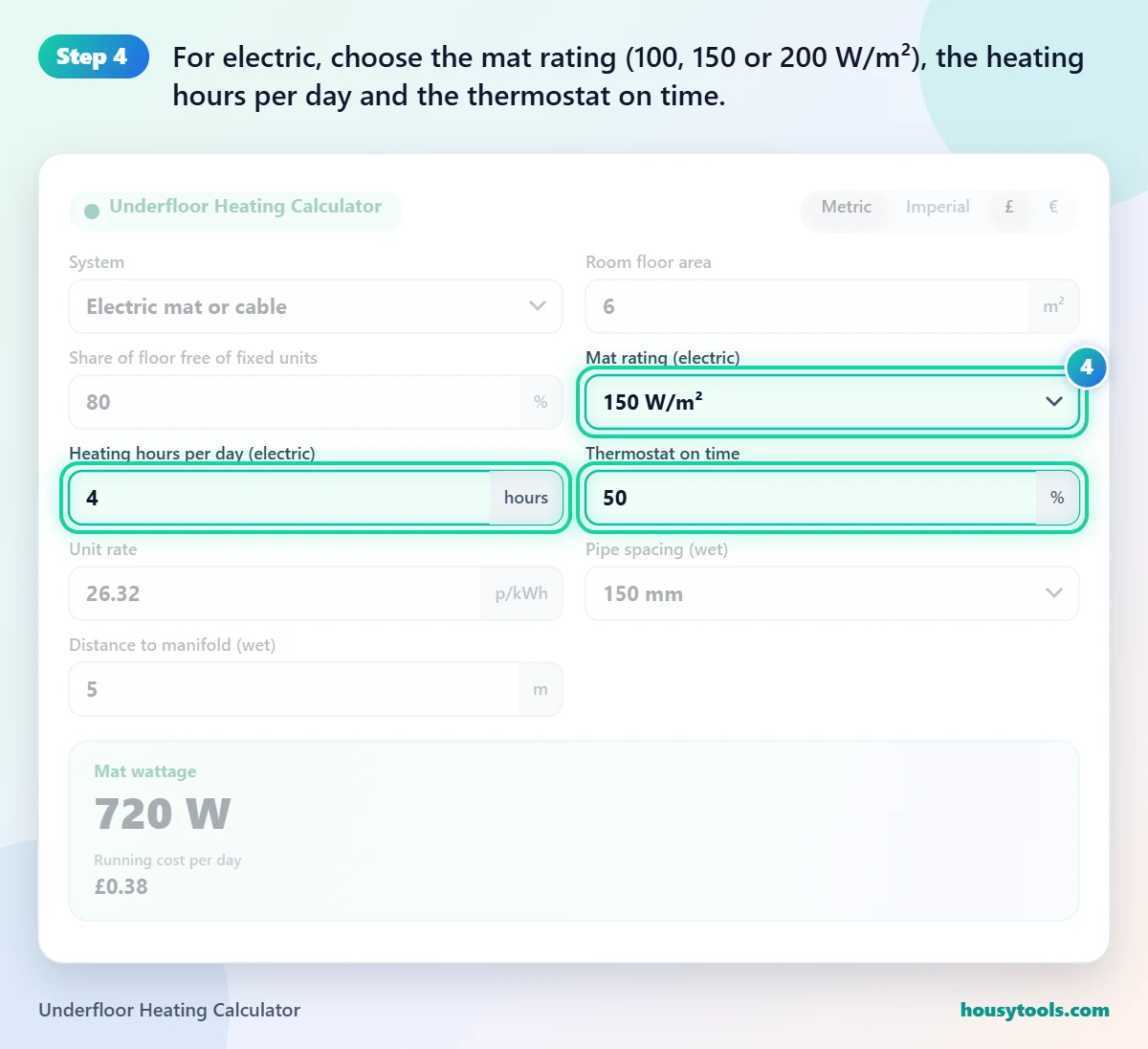
- For electric, choose the mat rating (100, 150 or 200 W/m²), the heating hours per day and the thermostat on time.
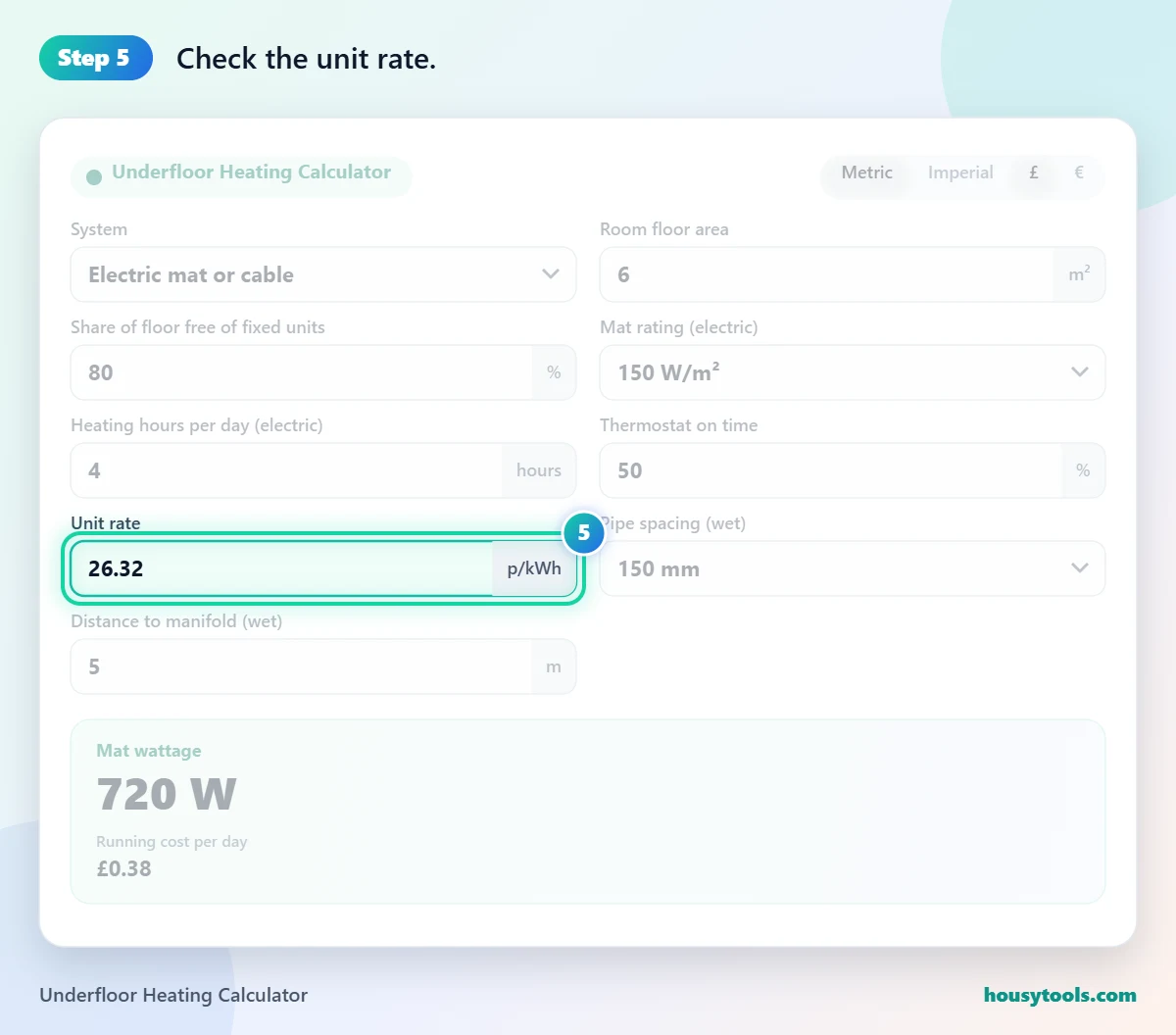
- Check the unit rate. It defaults to 26.32p per kWh; change it for your own tariff or an EU price.
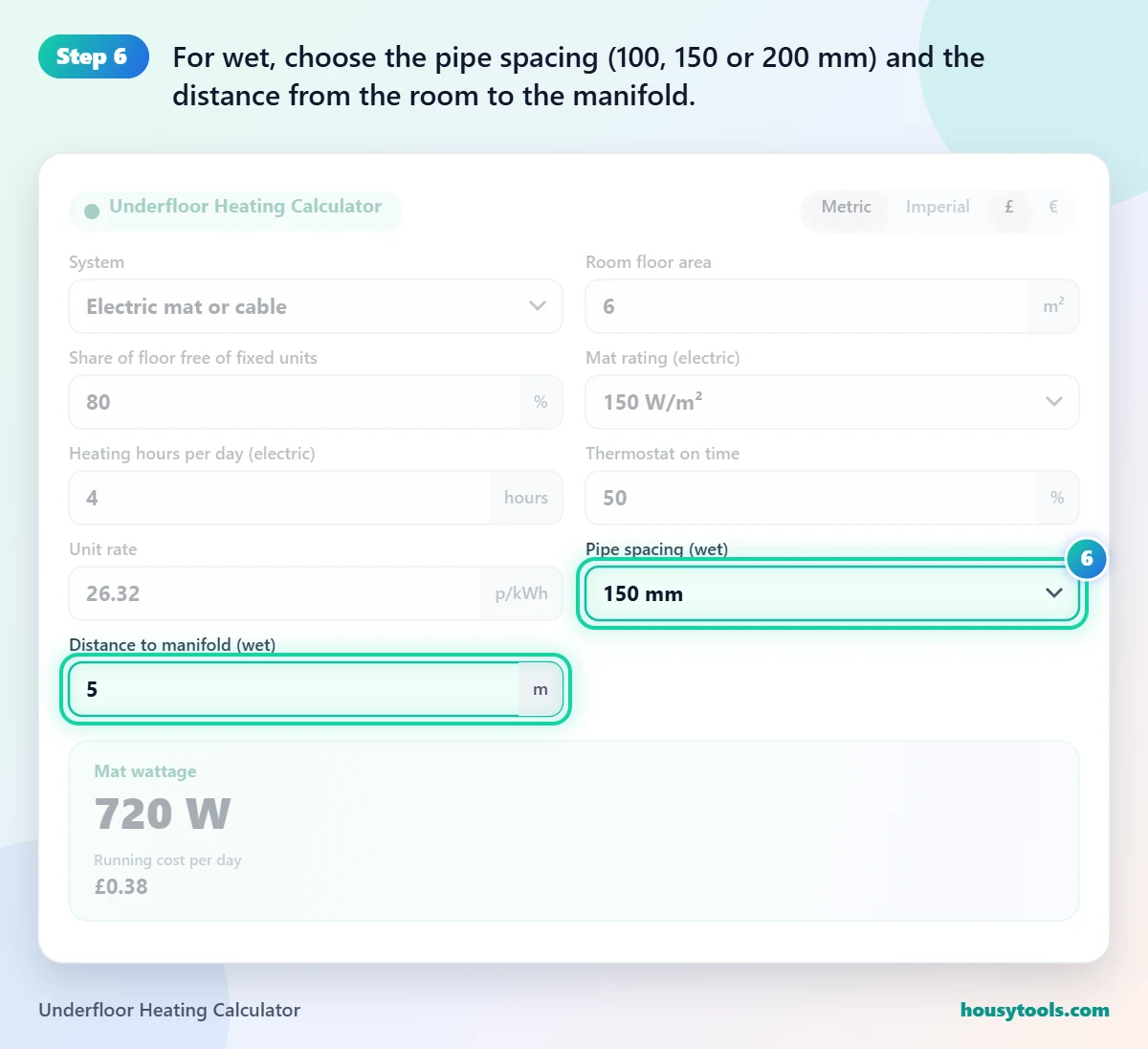
- For wet, choose the pipe spacing (100, 150 or 200 mm) and the distance from the room to the manifold.
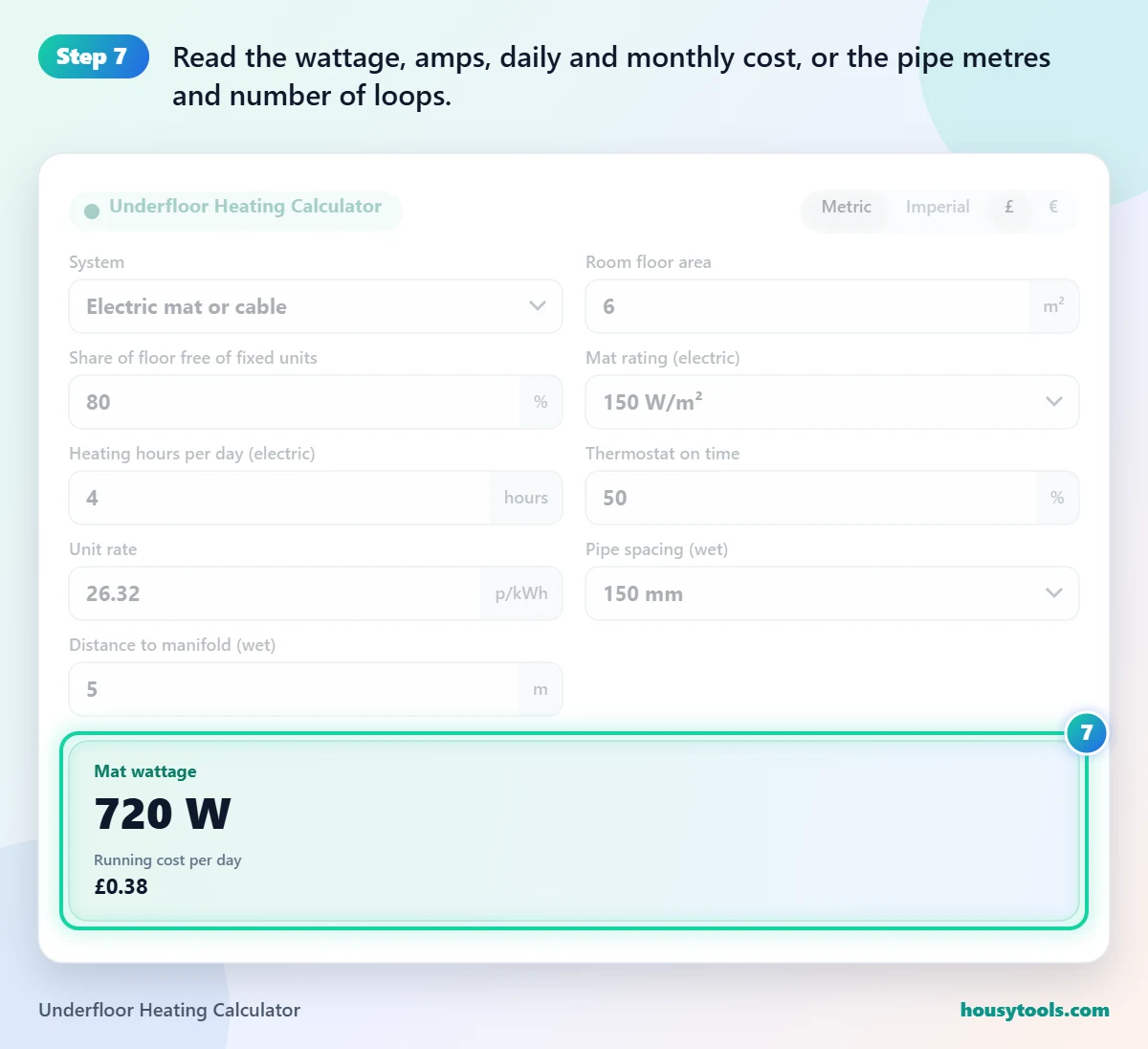
- Read the wattage, amps, daily and monthly cost, or the pipe metres and number of loops.
How Much Does Electric Underfloor Heating Cost to Run?
A typical bathroom mat of about 600 W costs roughly 30 to 35p a day when it runs 4 hours with the thermostat drawing power half the time, at the Ofgem price cap rate of 26.32p per kWh for October to December 2026.
The thermostat on time matters most. A mat only draws its full rating while the floor is warming. Once the room reaches temperature, the thermostat switches it on and off, so the average draw is lower. The underfloor heating calculator defaults to 50%, a middle figure you should change for your room: a cold, poorly insulated floor will be nearer 70 to 100%, and a well insulated one can be lower.
Whatever the underfloor heating calculator shows, fitting insulation boards under the mat reduces heat lost downwards into a concrete slab, so the floor warms faster and the thermostat switches off sooner. For other appliances, try the electricity cost calculator.
Which Mat Rating Should I Choose: 100, 150 or 200 W/m²?
Choose 150 W/m² for most tiled bathrooms and kitchens, 100 W/m² where the flooring maker sets a lower limit, often under timber or laminate, and 200 W/m² mainly for rooms with high heat loss such as conservatories.
Always check the flooring manufacturer’s maximum, as some engineered wood and vinyl floors are limited by surface temperature. A higher rating warms the floor faster but does not necessarily cost much more to run, because the thermostat cuts it off sooner. The underfloor heating calculator shows the extra current draw, which matters when choosing the circuit.
Running Cost by Hours per Day
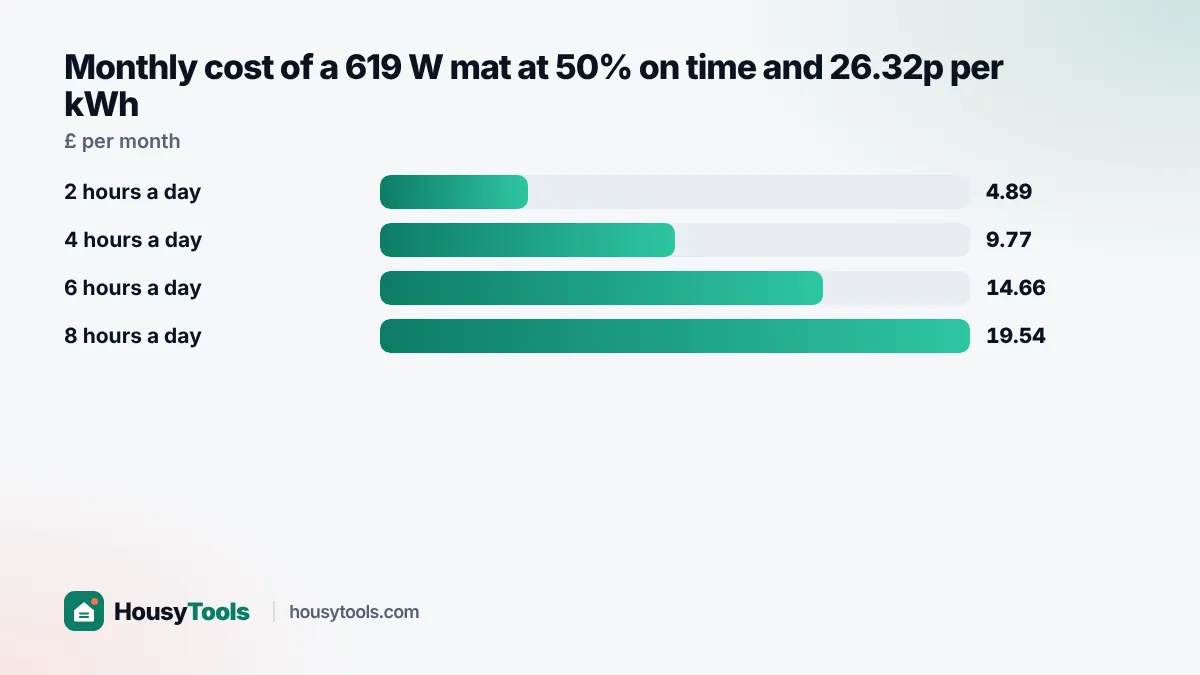
The table uses Siobhan’s 619 W mat at 50% thermostat on time and 26.32p per kWh, straight from the underfloor heating calculator.
| Heating hours per day | Energy per day | Cost per day | Cost per month (30 days) |
|---|---|---|---|
| 2 | 0.62 kWh | £0.16 | £4.89 |
| 4 | 1.24 kWh | £0.33 | £9.77 |
| 6 | 1.86 kWh | £0.49 | £14.66 |
| 8 | 2.48 kWh | £0.65 | £19.54 |
Worked Example: Siobhan’s Bathroom
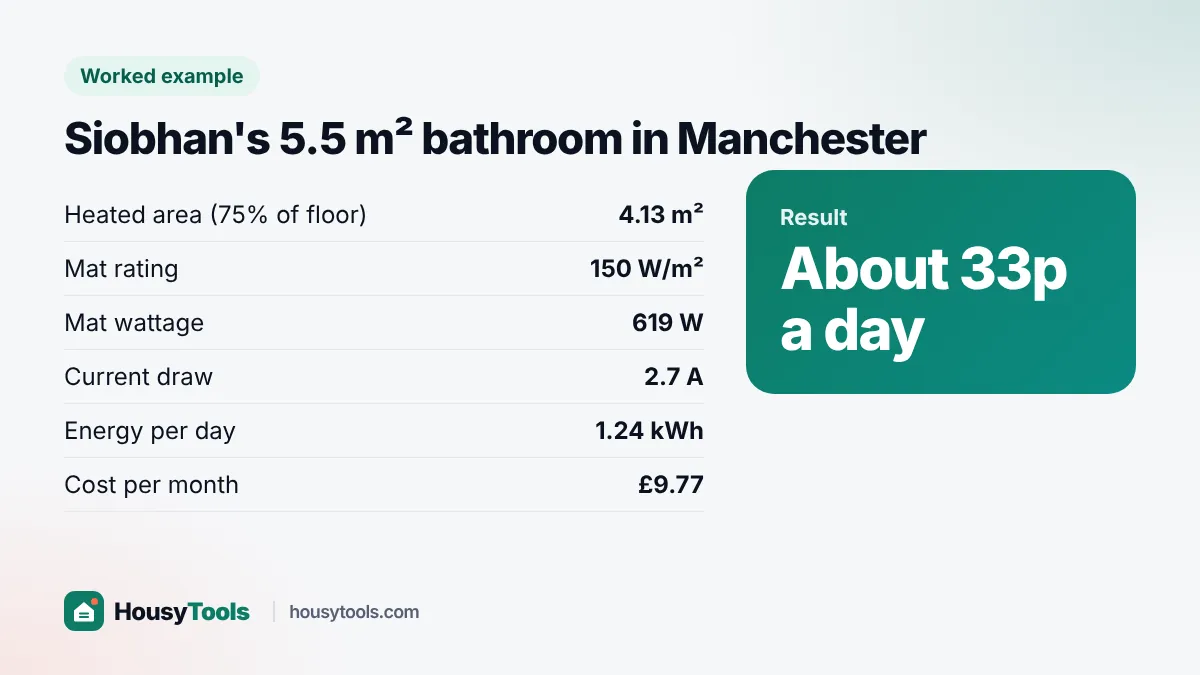
Siobhan is retiling a 5.5 m² bathroom in her Manchester flat and adding an electric mat under the new porcelain tiles. The bath, vanity unit and toilet cover about a quarter of the floor, so she enters 75% free. She chooses a 150 W/m² mat, 4 hours a day (an hour each morning and three in the evening) and a 50% thermostat on time.
- Heated area: 5.5 m² x 75% = 4.13 m².
- Mat wattage: 4.13 m² x 150 W/m² = 619 W.
- Current draw: 619 W / 230 V = 2.7 A.
- Energy: 0.62 kW x 4 h x 50% = 1.24 kWh a day.
- Cost: 1.24 kWh x 26.32p = £0.33 a day, or £9.77 a month.
At 2.7 A the mat is well under 13 A, but because it is in a bathroom it still needs RCD protection and a qualified electrician to connect it. If Siobhan chose a wet system instead, the underfloor heating calculator gives 38 m of pipe at 150 mm spacing with a 5 m run to the manifold, which fits in one loop.
How Much Pipe Does Wet Underfloor Heating Need?
In the underfloor heating calculator, wet underfloor heating needs about 10 m of pipe per square metre at 100 mm spacing, 6.7 m at 150 mm and 5 m at 200 mm, plus the flow and return runs to the manifold.
Closer spacing gives more output at a lower water temperature, which suits heat pumps running at 35 to 45°C and rooms with higher heat loss. Wider spacing saves pipe in well insulated rooms. Loop length is limited by pressure loss: 16 mm pipe is often limited to about 100 m per loop, but follow the manufacturer’s figure for your pipe. The underfloor heating calculator rounds up to whole loops so each fits that limit.
Wet systems connected to a gas boiler need a Gas Safe registered engineer for any work on the boiler itself, and if you are fitting a heat pump, check room heat needs first with the radiator size calculator.
Do You Need an Electrician for Electric Underfloor Heating?
Yes: electric underfloor heating must be connected by a qualified electrician, and in England a new circuit or work in a bathroom is normally notifiable under Approved Document P of the Building Regulations.
Any system drawing over 13 A, roughly 3 kW or more, needs its own circuit from the consumer unit, and the underfloor heating calculator warns you when the current goes above that. Test the mat’s resistance before, during and after tiling, as the manufacturer instructs, and keep the readings for the warranty.
What Are Common Underfloor Heating Mistakes?
The most common mistake is buying a mat for the whole floor area instead of the free floor, which the underfloor heating calculator avoids by asking what share is clear of fixed units.
- Skipping insulation boards on a concrete floor, so much of the heat goes down instead of up.
- Leaving the thermostat on time at 100% in the underfloor heating calculator, which overstates the cost of a well insulated room.
- Forgetting the standing charge when comparing with other heating.
- Choosing a mat rating above the flooring maker’s limit.
- Planning a single long wet loop over 100 m instead of splitting it into two.
The underfloor heating calculator updates as you type, so change one setting at a time, such as mat rating or hours, and watch how the cost responds before you buy.
Underfloor Heating Calculator FAQs
Is underfloor heating expensive to run?
Electric underfloor heating in a small bathroom often costs around 20 to 40p a day at current UK rates. Heating a whole house electrically costs far more, while wet systems on a heat pump or condensing boiler are cheaper per unit of heat.
Can underfloor heating be the only heat source?
Yes, if its output meets the room’s heat loss. Well insulated rooms often need 50 to 70 W/m², which most systems provide. Older rooms with high heat loss may need a radiator as well. Check with a heat loss calculation.
Should I put underfloor heating under the bath or units?
No. Do not lay mats or pipes under baths, fitted units, toilets or kitchen cabinets, as heat gets trapped and can damage the heater or floor. That is why the calculator asks for the share of floor free of fixed units.
How long does underfloor heating take to warm up?
An electric mat under tiles on insulation boards usually warms in under an hour. Wet systems in a screed can take several hours, so they suit steady, long heating periods better than short bursts.
Is wet or electric underfloor heating better?
Electric suits single rooms and renovations because it is cheap and quick to fit. Wet suits whole floors, extensions and new builds, especially with a heat pump, because running costs per kWh of heat are lower.
What is thermostat on time?
It is the share of the heating period the mat actually draws power. Once the floor reaches its set temperature, the thermostat cycles it on and off. A well insulated floor might run 30 to 50% of the time; a cold one, much more.
Checked October 2026. Sources: Ofgem energy price cap (1 October to 31 December 2026), GOV.UK Approved Document P, manufacturer installation guidance.