
Show the formula and working
This free guttering calculator works out the gutter lengths, fascia brackets, joints, downpipes and clips you need for a run of eaves guttering, for homes in the UK, Ireland and Europe. It also checks whether one outlet can carry the rain from your roof, using the roof’s effective area and a design rainfall rate.
Quick answer: A guttering calculator divides the run by the length of each gutter and by the bracket spacing. An 8 m run needs two 4 m lengths, one union and 9 brackets at 1 m centres. Its 30 degree roof, 4 m deep on plan, sends about 0.86 litres a second to the outlet at 75 mm an hour.
What Is a Guttering Calculator?
A guttering calculator is a tool that turns the length of your eaves and the height of your wall into a parts list, and checks the gutter’s outlet against the rain your roof collects.
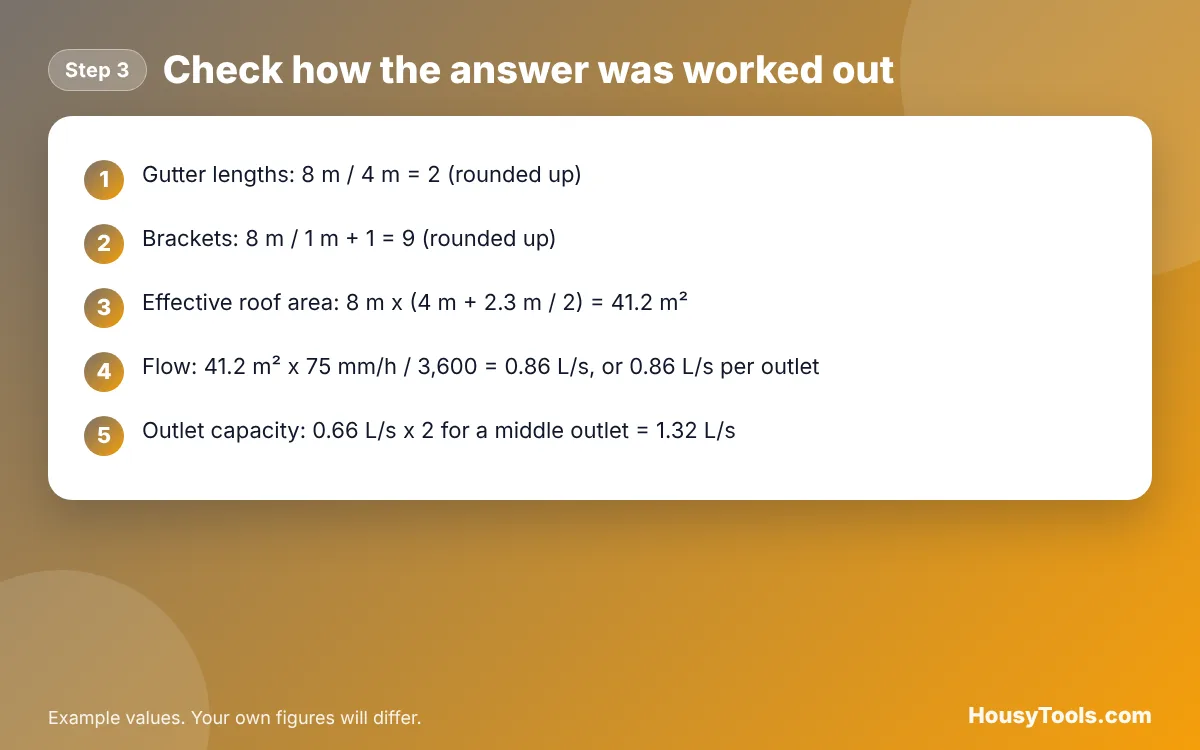
The formula in plain words: gutter lengths equal the run divided by the length of one gutter, rounded up. Brackets equal the run divided by the bracket spacing, rounded up, plus one. Downpipe lengths equal the wall height divided by one pipe length. For the flow check, the effective roof area is the gutter length times the roof depth on plan plus half its rise, and the flow in litres a second is that area times the rainfall in mm an hour, divided by 3,600.
How Do You Use the Guttering Calculator?
- Measure the eaves and enter the Gutter run length, then pick the Gutter length size your supplier sells.
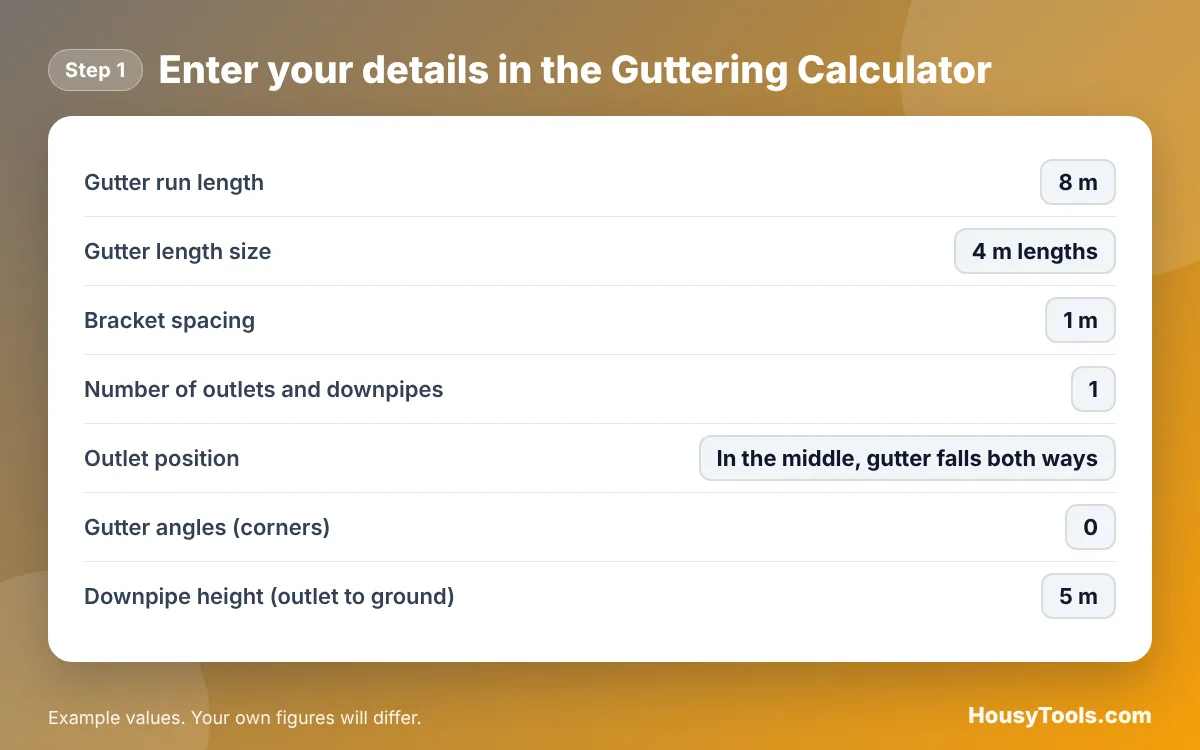
- Set the Bracket spacing, the Number of outlets and downpipes, the Outlet position and any Gutter angles (corners).
- Enter the Downpipe height (outlet to ground) and the Downpipe length size.
- For the flow check, enter the Roof slope depth on plan and the Roof rise, keep or change the Design rainfall, and type the Outlet flow capacity from your gutter maker’s data.
- Read the parts list and the flow check in the result, then open “Show the formula and working” to see each sum.

How Far Apart Should Gutter Brackets Be?
Fit gutter brackets no more than 1 m apart, with one within 150 mm of every joint, angle and stop end. Those figures come from the JDP guide to installing rainwater guttering, which also gives downpipe clips no more than 1.8 m apart, placed just under each socket. Some systems allow different spacing, and areas with heavy snow may need closer brackets, so always follow the instructions for the system you buy.
How Much Fall Should Guttering Have?
A fall of about 1 in 350, roughly 3 mm for every metre, keeps water moving towards the outlet. On an 8 m run that is a drop of about 23 mm from the far end to the outlet. With the outlet in the middle, each half falls towards it, so the drop on each side is half as much. Too much fall makes the gutter look crooked and can let water overshoot the outlet in heavy rain.
How Do You Know if Your Gutter Is Big Enough?
A gutter is big enough when the flow from its roof area is no more than the outlet’s rated capacity. The Polypipe Elegance technical information explains the method from BS EN 12056-3: add half the roof’s rise to its depth on plan, multiply by the length, then compare the flow with the outlet capacity. In that data sheet, a centre outlet carries twice the flow of an end outlet, 1.32 against 0.66 litres a second, because water reaches it from both sides. If your roof sends too much water, add a second outlet, move the outlet to the middle, or choose a deeper gutter.
What Parts Do You Need for a Gutter Run?
A straight run needs gutter lengths, union joints, fascia brackets, two stop ends and a running outlet, plus a downpipe kit for each outlet. A downpipe kit is the pipe lengths, clips, a shoe at the bottom and usually two offset bends to bring the pipe back to the wall under overhanging eaves. If the roof pitch is unknown, the roof pitch calculator works out the rise from the span and angle.
Roof Pitch and Rainwater Flow
For a gutter 8 m long draining a roof slope 4 m deep on plan (32 m²), at 75 mm an hour. Effective area = plan area x (1 + tan of the pitch / 2).
| Roof pitch | Area multiplier | Effective area | Flow to the gutter |
|---|---|---|---|
| Flat (0°) | 1.000 | 32.0 m² | 0.67 L/s |
| 15° | 1.134 | 36.3 m² | 0.76 L/s |
| 22.5° | 1.207 | 38.6 m² | 0.80 L/s |
| 30° | 1.289 | 41.2 m² | 0.86 L/s |
| 35° | 1.350 | 43.2 m² | 0.90 L/s |
| 40° | 1.420 | 45.4 m² | 0.95 L/s |
| 45° | 1.500 | 48.0 m² | 1.00 L/s |
Worked Example: An 8 m Gutter on a Two-Storey House
Example: an 8 m run of eaves on a two-storey house, 4 m gutter lengths, brackets at 1 m, one outlet in the middle, a 5 m downpipe made from 2.5 m lengths, and a 30 degree roof 4 m deep on plan with a 2.3 m rise. These are the default inputs.
- Gutter: 8 / 4 = 2 lengths and 1 union joint.
- Brackets: 8 / 1 + 1 = 9, plus one beside the union if your system uses separate union brackets.
- Downpipe: 5 / 2.5 = 2 lengths, 4 clips, 1 shoe and 2 offset bends.
- Flow: 8 x (4 + 2.3 / 2) = 41.2 m², x 75 / 3,600 = 0.86 L/s.
- Check: 0.86 L/s is within the 1.32 L/s of a middle outlet rated 0.66 L/s at an end, so one outlet is enough.
With the outlet at one end instead, the same 0.86 L/s would be more than 0.66 L/s, and the tool warns you to add an outlet or move it. To work out the roof area in more detail, the square metre calculator handles several rectangles.
Guttering Calculator FAQs
How many gutter brackets do I need?
Divide the run by the bracket spacing, round up and add one. At 1 m spacing, an 8 m run needs 9 brackets, plus one within 150 mm of each joint, angle and stop end if those positions are not already covered.
How long are gutter lengths?
Plastic gutter is commonly sold in 4 m lengths, with shorter 2 m and 3 m lengths in some ranges. Longer lengths mean fewer joints and fewer places to leak, so choose the longest length you can transport and handle safely.
How many downpipes do I need?
You need enough outlets that the flow to each one stays within its rated capacity. Many short runs need just one, but long runs or large, steep roofs often need two. Enter your roof size and outlet capacity, and the calculator tells you whether one is enough.
How far apart should downpipe clips be?
JDP guidance gives downpipe clips no more than 1.8 m apart, with a clip just under each socket joint. A 5 m downpipe therefore needs about 4 clips. Leave a 10 mm gap at the bottom of each socket so the pipe can expand.
What rainfall rate should I design gutters for?
The calculator uses 75 mm an hour as an example design rate, a figure commonly used for UK eaves gutters. Exposed or very wet areas may need a higher rate. Gutter makers publish their outlet capacities for a stated design method, so use the figures from the same source.
Is it safe to fit guttering myself?
Ground floor gutters are a common DIY job, but work at height on a two-storey house is risky. Use a properly footed ladder or a scaffold tower, never work alone, and consider a professional for high or fragile roofs and fascias.
For other outdoor jobs, see the building and DIY calculators.
Checked October 2026. Sources: How to install rainwater guttering (JDP), Elegance gutter technical information (Polypipe).