
Show the formula and working
This solar string calculator checks whether a string of solar panels stays inside your inverter’s voltage and current limits in cold and hot weather. Enter the panel figures from the data sheet, the number of panels in series and strings in parallel, the temperature range at your site and the inverter limits, and it shows the cold weather voltage, the hot weather working voltage and the range of panels per string that fits.
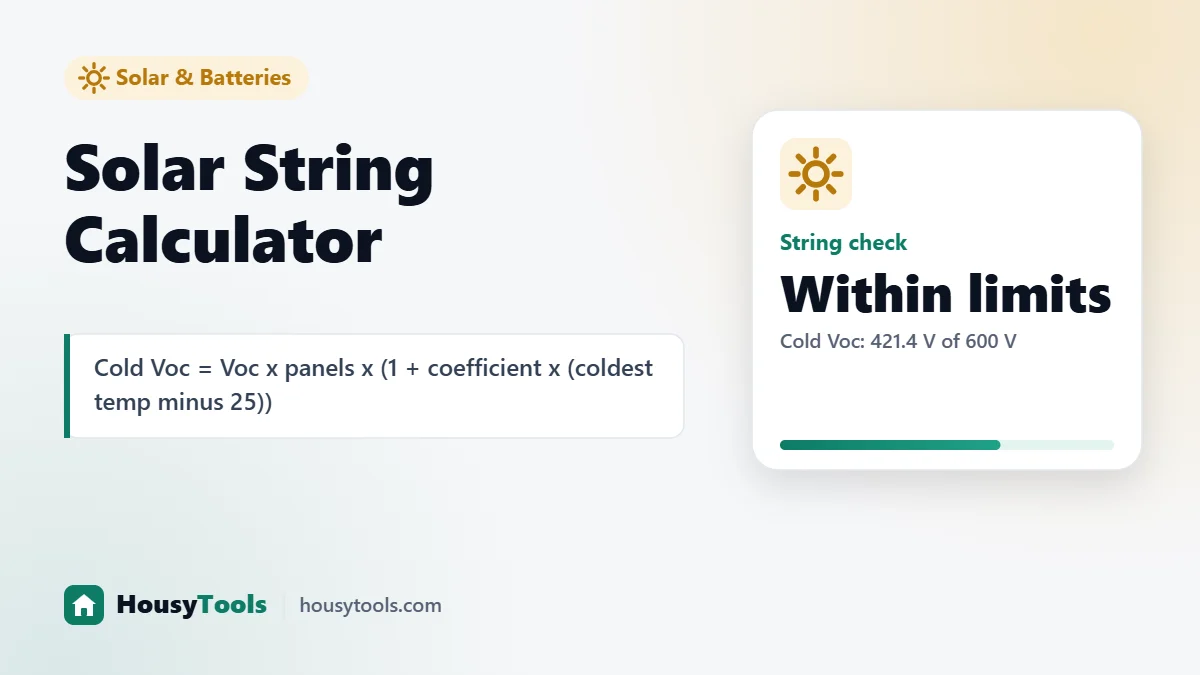
Quick answer: To size a solar string, multiply panel Voc by the panels in series and correct it for the coldest temperature using the data sheet coefficient. That cold voltage must stay below the inverter maximum. Ten 38.5 V panels at minus 10 °C reach about 421 V, inside a 600 V limit, which allows up to 14 panels in series.
What Is a Solar String Calculator?
A solar string calculator is a tool that checks a series string of solar panels against an inverter’s maximum DC voltage, its MPPT working range and its input current limit.
The formula in plain words: panel voltage changes with cell temperature. The open circuit voltage at the coldest temperature is Voc times the number of panels in series times one plus the temperature coefficient times the difference from 25 °C. Because the coefficient is negative, the voltage rises in the cold. The same correction at the hottest cell temperature, applied to Vmp, shows the lowest working voltage, which must stay above the bottom of the MPPT range. The string current is the panel short circuit current times the number of parallel strings.
How Do You Use the Solar String Calculator?
- Enter the panel Voc, Vmp and Isc from the data sheet.
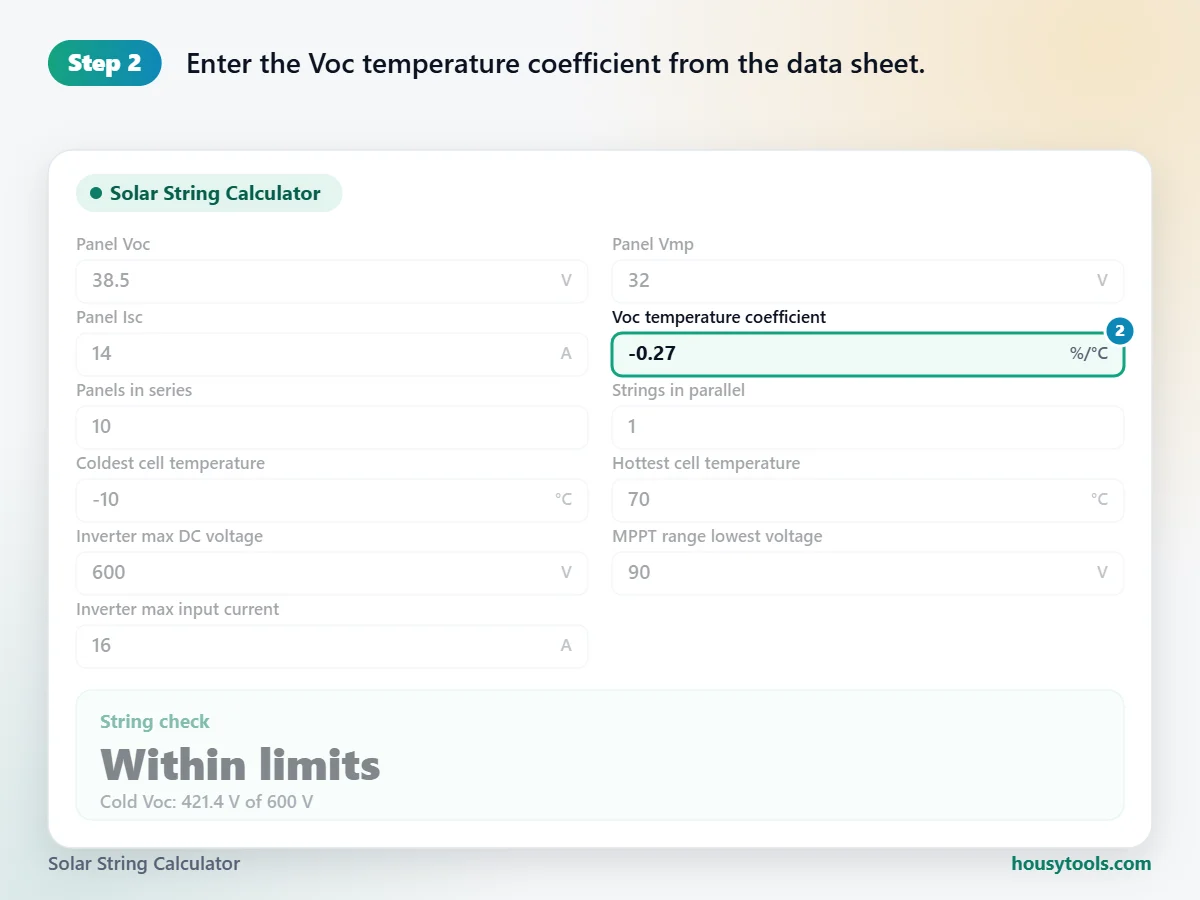
- Enter the Voc temperature coefficient from the data sheet.
- Enter how many panels are in series and how many strings are in parallel.
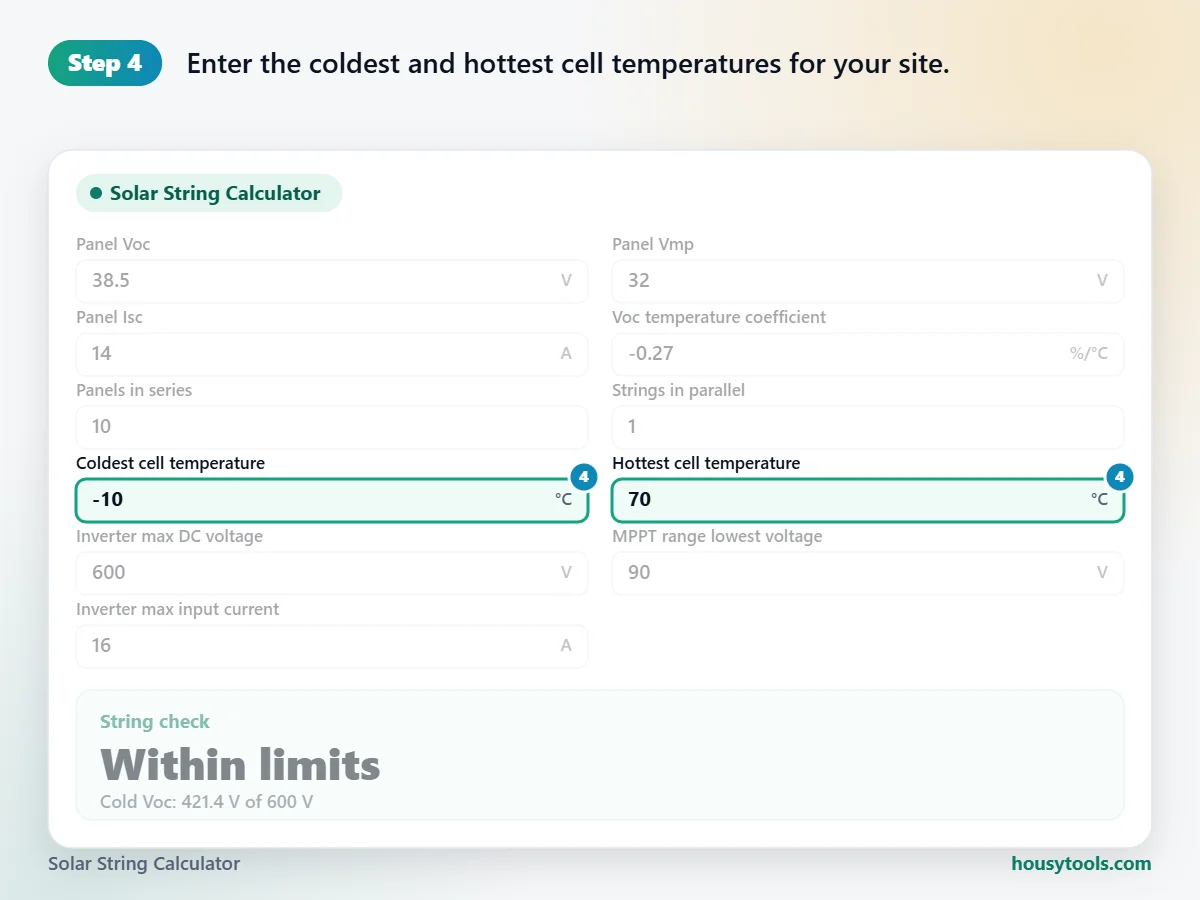
- Enter the coldest and hottest cell temperatures for your site.
- Enter the inverter maximum DC voltage, lowest MPPT voltage and input current.
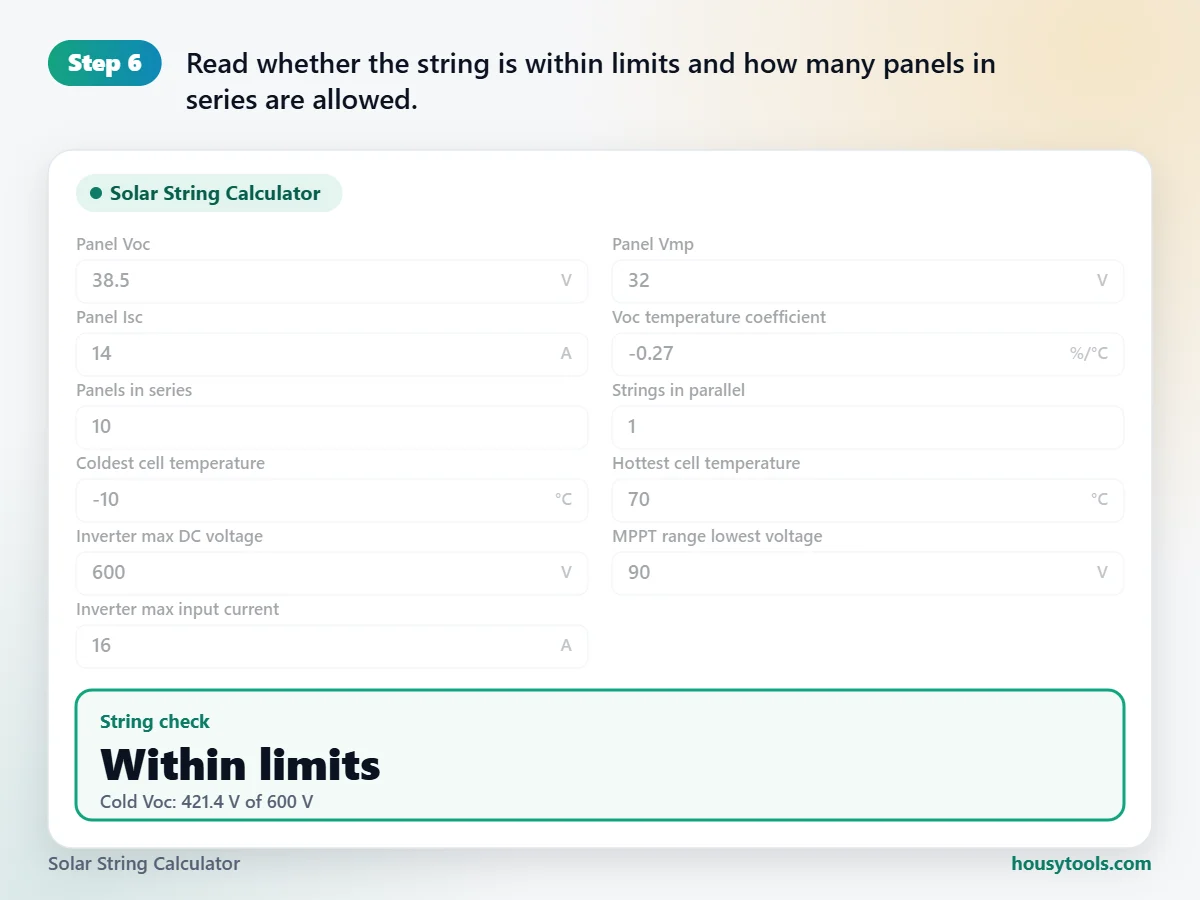
- Read whether the string is within limits and how many panels in series are allowed.



How Many Solar Panels Can You Put in Series?
With 38.5 V panels, a minus 0.27% per °C coefficient and a coldest cell temperature of minus 10 °C, a 600 V inverter allows up to 14 panels in series, because 15 would reach about 632 V on a frosty morning.
| Panels in series | Voc at 25 °C | Voc at minus 10 °C | Vmp at 70 °C | Result |
|---|---|---|---|---|
| 3 | 115.5 V | 126.4 V | 84.3 V | Below the 90 V MPPT minimum |
| 10 | 385 V | 421.4 V | 281.1 V | Within limits |
| 12 | 462 V | 505.7 V | 337.3 V | Within limits |
| 14 | 539 V | 589.9 V | 393.6 V | Within limits |
| 15 | 577.5 V | 632.1 V | 421.7 V | Above the 600 V maximum |
| 16 | 616 V | 674.2 V | 449.8 V | Above the 600 V maximum |
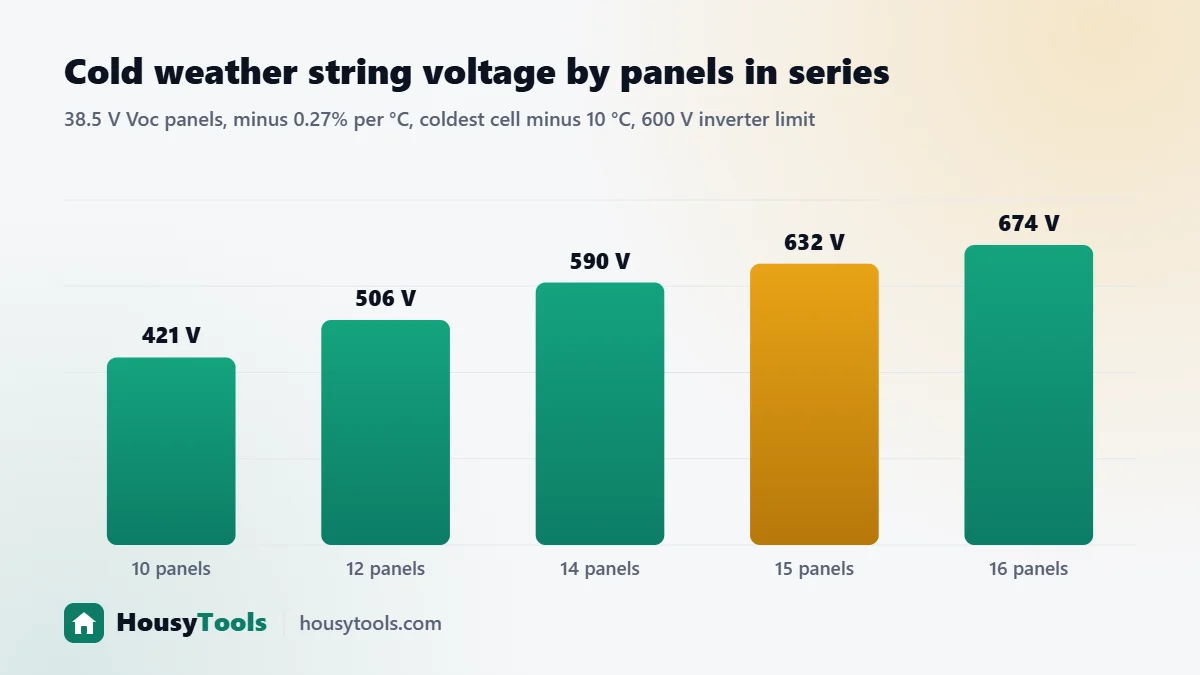
Notice that 15 panels look fine at 25 °C, at 577.5 V, but exceed 600 V when cold. That is the most common string sizing mistake. Exceeding the inverter’s maximum DC voltage can damage it and is not covered by warranty.
What Temperatures Should You Use?
Use the lowest cell temperature you can expect at dawn in winter for the voltage check, and a high summer cell temperature for the MPPT check, because cells in sunshine run much hotter than the air.
Cells before sunrise are close to air temperature, so use a record low for your area rather than an average winter day. In full summer sun, cells often run 20 to 30 degrees above air temperature, which is why the hot default is 70 °C. Your inverter maker’s string sizing software or your installer’s design will use local data, and the panel coefficients come from the data sheet. The physics behind the correction is explained in the solar cell temperature effects article.
Why Does String Current Matter?
Each inverter MPPT input has a maximum current, so parallel strings on the same input add their currents and can exceed it.
Some modern inverters accept panels with a higher short circuit current than the input rating and simply limit the current, while others must not be overloaded. Check the data sheet for both the maximum operating current and the maximum short circuit current per input. For off grid charge controllers, use the solar charge controller calculator instead.
Worked Example: 14 Panels at Minus 20 °C
Example: an installer plans a single string of fourteen 38.5 V panels on a 600 V inverter at a site where the record low is minus 20 °C.
- At minus 10 °C: 38.5 x 14 x (1 + 0.0027 x 35) = 589.9 V, within 600 V
- At minus 20 °C: 38.5 x 14 x (1 + 0.0027 x 45) = 604.5 V, above 600 V
- Most panels in series at minus 20 °C: 600 / 43.18 = 13
- Hot Vmp at 70 °C: 393.6 V, well above the 90 V MPPT minimum
- Current: 14 A against a 16 A input limit

The string must drop to 13 panels, or be split across two MPPT inputs. A single degree of colder weather can be the difference, so always design for the coldest likely day. To check the array output, use the solar panel output calculator.
Solar String Safety
Solar strings carry high DC voltages that can cause serious injury and fires, and they cannot be switched off while light falls on the panels.
DC design, isolators, cable sizing and earthing must follow the wiring rules in your country, such as BS 7671 in the UK, and installers certified under MCS follow its standards. This calculator is a planning check, not a design. Have the system designed, installed and signed off by a qualified installer.
Solar String Calculator FAQs
How many solar panels can I connect in series?
Divide the inverter’s maximum DC voltage by the panel Voc corrected for your coldest temperature, then round down. With 38.5 V panels at minus 10 °C on a 600 V inverter, that is 14 panels.
Why does solar panel voltage go up in cold weather?
Silicon cells produce a higher open circuit voltage at lower temperatures. With a typical coefficient of about minus 0.27% per °C, a panel gains about 9.5% of its Voc at minus 10 °C compared with 25 °C.
What is the difference between Voc and Vmp?
Voc is the voltage with no load, the highest the panel produces. Vmp is the voltage at maximum power, the normal working voltage. Use Voc for the safety limit and Vmp for the MPPT range.
What happens if string voltage is too high?
Above the inverter’s maximum DC voltage, the inverter can be permanently damaged and the warranty may be void. Always design for the coldest likely morning.
Is series or parallel wiring better for solar panels?
Series raises voltage and keeps current low, which suits most grid tied inverters. Parallel raises current. Most home systems use one or two series strings per MPPT input.
Can I mix different panels in one string?
It is best not to. Panels in a string carry the same current, so a mismatched or shaded panel can reduce the output of the whole string. Keep each string to identical panels facing the same way.
Checked October 2026. Sources: panel and inverter data sheet conventions, BS 7671 wiring regulations, MCS standards.