
Show the formula and working
This moving box calculator estimates how many cardboard boxes you need to pack up your home, split into small, medium and large, plus how many rolls of packing tape to buy. It is designed for house and flat moves in the UK and Europe, works room by room, and lets you change every rule of thumb so the estimate matches how much you actually own.
Quick answer: A typical three bedroom house with two living rooms, a kitchen, a bathroom and a loft needs about 84 moving boxes: roughly 25 small, 34 medium and 25 large, plus four 66 m rolls of tape. The moving box calculator adds boxes room by room and adjusts for how much you own.
What Is a Moving Box Calculator?
A moving box calculator is a planning tool that estimates the number of packing boxes a move needs from the rooms in your home. In plain words: boxes = (bedrooms x boxes per bedroom) + (living rooms x boxes per living room) + kitchen boxes + bathroom boxes + loft, garage and shed boxes, then multiplied by 0.75 if you own little, 1 for an average home or 1.3 if every cupboard is full. The total is split 30% small, 40% medium and 30% large, and tape is boxes x metres per box divided by the roll length.
The boxes per room figures are a starting rule of thumb, not a fixed fact. Every household is different, which is why each one is an input you can change.
How Do You Use the Moving Box Calculator?
- Enter Bedrooms, Living rooms, dining rooms and studies, Kitchens and Bathrooms.
- Enter Lofts, garages and sheds to empty. Leave it at 0 if they are already clear.
- Choose How much you own: light, average or a lot.
- Adjust Boxes per bedroom (example) and the other boxes per room figures if you have already packed one room and know your own count.
- Check Tape per box and Tape roll length against the tape you plan to buy.
- Read the total boxes, the small, medium and large split and the rolls of tape, then open “Show the formula and working” to see the room by room sums.


How Many Boxes Do I Need to Move House?
Allow roughly 10 to 15 boxes for each main room and a few for a bathroom, so a one bedroom flat needs about 40 boxes and a three bedroom house about 85, or up to 110 if you own a lot. The table below uses the calculator’s default boxes per room, so you can see how the estimate changes with home size and how much you own.
| Home (rooms used in the calculator) | Light | Average | A lot |
|---|---|---|---|
| Studio (1 living room, kitchen, bathroom) | 21 | 28 | 37 |
| 1 bed flat (1 bedroom, 1 living room, kitchen, bathroom) | 30 | 40 | 52 |
| 2 bed house (2 bedrooms, 1 living room, kitchen, bathroom, loft) | 47 | 62 | 81 |
| 3 bed house (3 bedrooms, 2 living rooms, kitchen, bathroom, loft) | 63 | 84 | 110 |
| 4 bed house (4 bedrooms, 2 living rooms, kitchen, 2 bathrooms, loft) | 75 | 99 | 129 |
| 5 bed house (5 bedrooms, 3 living rooms, kitchen, 2 bathrooms, loft and garage) | 99 | 131 | 171 |
Kitchens take more boxes than their size suggests, because plates, glasses and pans need wrapping and packing in smaller boxes. Bedrooms with built in wardrobes full of clothes also run high. If you are clearing a lot of clutter before the move, our home calculators include tools for sizing the rest of the job.
What Size Moving Boxes Should I Use for Each Item?
Put heavy items in small boxes and light, bulky items in large boxes, so that every packed box stays light enough to lift safely. Books, tins, records and tools go in small boxes. Kitchenware, toys, shoes and ornaments go in medium boxes. Bedding, cushions, towels and lampshades go in large boxes.
The Health and Safety Executive’s manual handling guidance notes that the law sets no single weight limit, but heavy, awkward loads cause injuries, so keep each box to a weight you can carry close to your body. Double wall boxes, described in the Wikipedia article on corrugated fibreboard, stack better than single wall ones in a removal van.
How Much Packing Tape Do I Need for Moving?
Allow about 3 m of tape per box, which means one 66 m roll seals about 22 boxes. Taping the top and bottom of a medium box with an H pattern, one strip along the centre seam and one along each edge, uses about 1.5 m per side.
Buy one extra roll for labelling, repairs and the boxes you will inevitably add at the last minute. A tape gun makes the job much faster and keeps the strips straight.
Worked Example: A Three Bedroom House
Example: a household is moving out of a three bedroom house with a living room, a dining room, one kitchen, one bathroom and a loft to empty. The contents are about average, so keep the default boxes per room.
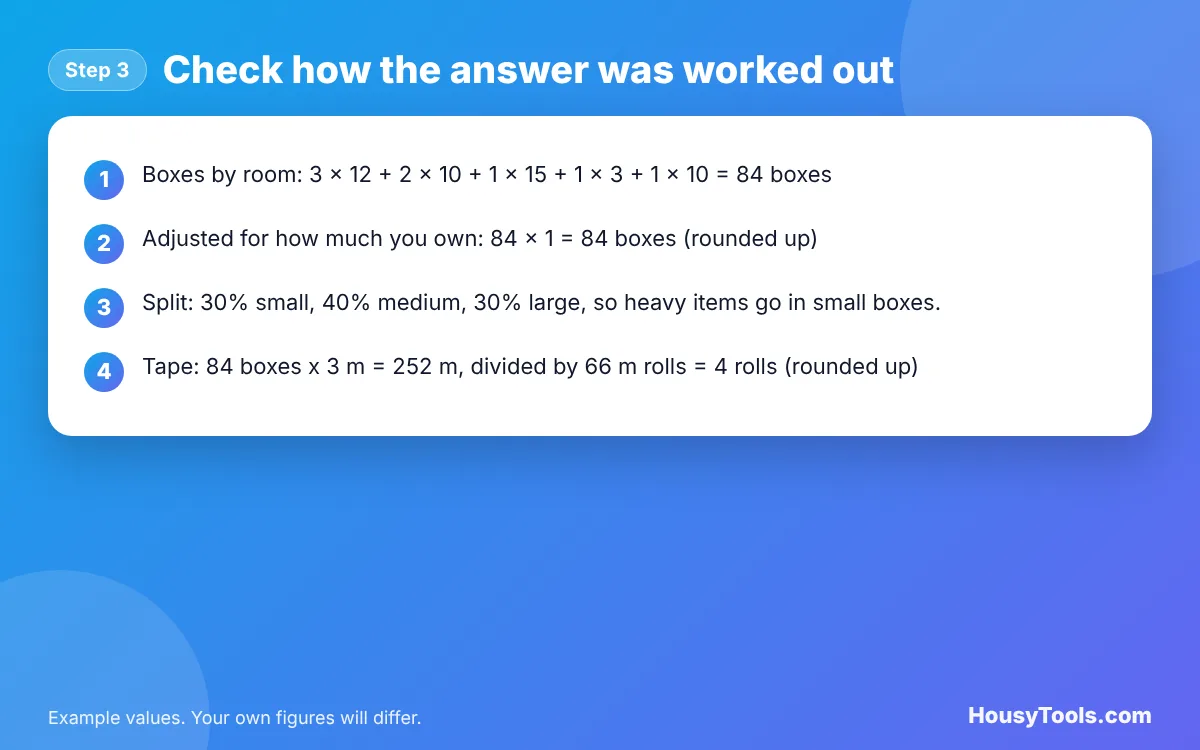
- Bedrooms: 3 x 12 = 36 boxes. Living and dining rooms: 2 x 10 = 20 boxes.
- Kitchen: 15 boxes. Bathroom: 3 boxes. Loft: 10 boxes.
- Total: 36 + 20 + 15 + 3 + 10 = 84 boxes, x 1 for an average home.
- Split: 25 small, 34 medium and 25 large.
- Tape: 84 x 3 m = 252 m, so 4 rolls of 66 m.
Once moved in, the household plans to repaint, so the paint calculator is the next stop for the new living room walls.
Moving Box Calculator FAQs
How many boxes do I need for a 2 bedroom flat?
A 2 bedroom flat with one living room, a kitchen and a bathroom needs about 52 boxes on the calculator’s default figures, or around 40 if you own little and 68 if every cupboard is full. Add more if you have a storage cupboard or balcony store to clear.
How many boxes does a kitchen need?
A kitchen usually needs around 15 boxes, more than most other rooms, because crockery, glasses, pans and food all need packing separately. Use small and medium boxes for plates and glasses and wrap each item, as large boxes full of crockery get too heavy.
Is it better to have too many or too few moving boxes?
It is better to have a few too many. Running out on moving day leads to loose items and rushed packing. Some box suppliers take back unused boxes, and spare flat packed boxes are easy to give away afterwards.
How heavy should a packed moving box be?
A packed box should be light enough for you to lift and carry close to your body without straining. UK health and safety guidance sets no single weight limit, so pack heavy items such as books in small boxes and fill large boxes only with light things.
When should I start packing boxes for a move?
Start packing rooms you use least, such as the loft, spare room and books, two to three weeks before the move. Leave the kitchen and everyday clothes until the last few days, and pack one clearly labelled first night box with essentials.
How do I label moving boxes?
Write the destination room and a short list of contents on the top and at least one side of every box, and mark fragile boxes clearly. Numbering boxes and keeping a simple list makes it easy to check nothing has gone missing on the day.
Checked October 2026. Sources: HSE: Manual handling at work, Wikipedia: Corrugated fiberboard. Boxes per room are editable rules of thumb, not published standards.