
Show the formula and working
This free r-value to u-value calculator converts thermal resistance (R-value) into thermal transmittance (U-value) and back, for builders, self-builders and homeowners comparing insulation in the UK, Europe and the US. It handles metric R-values in m²K/W, American R-values in ft²·°F·h/BTU, and thickness with lambda, and can add the standard surface resistances.
Quick answer: An r-value to u-value calculator divides 1 by the R-value. A metric R-value of 2.5 m²K/W gives a U-value of 0.4 W/m²K, which is about R-14.2 in US units. To convert a US R-value to metric, multiply by 0.17611, so US R-13 is 2.29 m²K/W and U 0.437.
What Is an R-Value to U-Value Calculator?
An R-value to U-value calculator is a tool that converts how well a material resists heat flow into how much heat passes through it, in metric or American units.
The formula in plain words: U equals 1 divided by R, and R equals 1 divided by U, when both are in metric units. A material’s R-value equals its thickness in metres divided by its lambda. For a whole wall, add the inside and outside surface resistances before taking 1 over the total. A US R-value times 0.17611 gives the metric R-value.
How Do You Use the R-Value to U-Value Calculator?
- Choose the Direction: metric R to U, U to R, US R to U, or thickness and lambda.
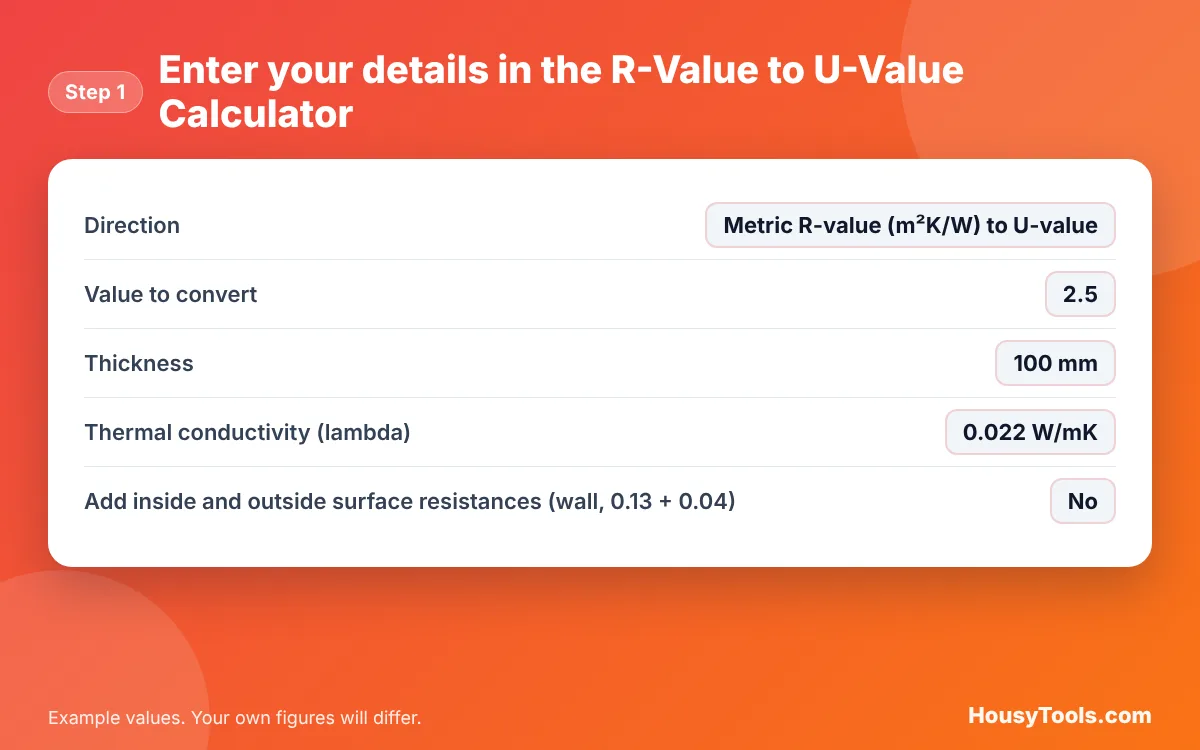
- Enter the Value to convert, or for the thickness option the Thickness and Thermal conductivity (lambda).
- Tick Add inside and outside surface resistances (wall, 0.13 + 0.04) if you want a U-value for a complete wall rather than the material alone.
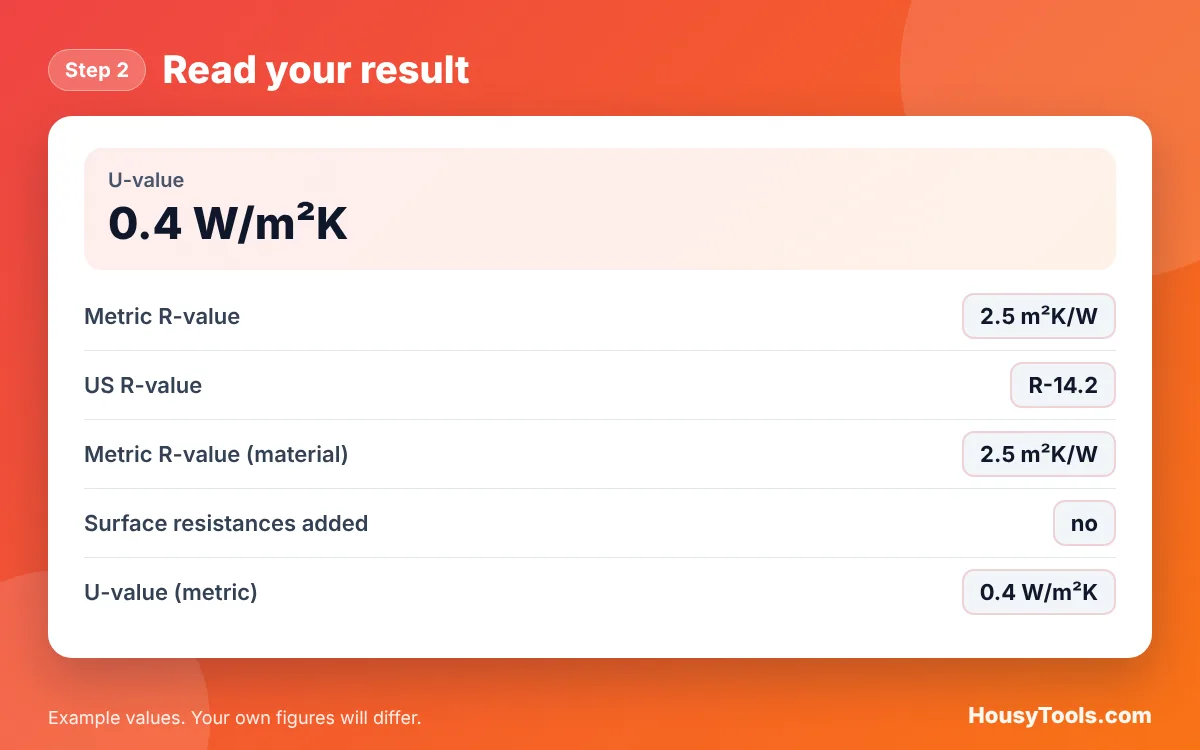
- Read the U-value, metric R-value and US R-value in the result, then open “Show the formula and working” to see the conversion.

How Do You Convert R-Value to U-Value?
Divide 1 by the R-value: U = 1 / R, as explained on Wikipedia’s thermal transmittance page. An R-value of 2.5 m²K/W gives 1 / 2.5 = 0.4 W/m²K. This only works when R is metric; convert a US R-value first. The relation is exact for a single layer, and for several layers you add their R-values before dividing.
How Do You Convert US R-Values to Metric?
Multiply the US R-value by 0.17611 to get m²K/W, or divide a metric R-value by 0.17611 to get the US figure. The factor comes from the definitions of the foot, the BTU and the degree Fahrenheit, as set out on Wikipedia’s R-value page. So US R-13 wall batts are 2.29 m²K/W and US R-38 loft insulation is 6.69 m²K/W.
What Are Surface Resistances?
Surface resistances are the thin layers of still air at each face of a wall that add a little insulation. For heat flowing sideways through a wall, the inside value is 0.13 m²K/W and the outside value is 0.04 m²K/W under BS EN ISO 6946, as used in BRE’s U-value conventions. Adding them to a 2.5 m²K/W material changes the U-value from 0.400 to 0.375. Roofs and floors use different inside values, which the U-value calculator handles layer by layer.
What Is a Good U-Value?
Lower is better: about 0.18 W/m²K is the Approved Document L figure for a new wall in an existing home in England, which equals an R-value of 5.56 m²K/W including all layers. An uninsulated solid brick wall is around 2.1. To see what a U-value means for a room’s heat loss in watts, use the room heat loss calculator.
US R-Values in Metric
Material only, and with wall surface resistances (0.13 + 0.04) added.
| US R-value | Metric R (m²K/W) | U-value, material only | U-value with surfaces |
|---|---|---|---|
| R-5 | 0.88 | 1.136 | 0.952 |
| R-11 | 1.94 | 0.516 | 0.475 |
| R-13 | 2.29 | 0.437 | 0.407 |
| R-19 | 3.35 | 0.299 | 0.284 |
| R-30 | 5.28 | 0.189 | 0.183 |
| R-38 | 6.69 | 0.149 | 0.146 |
| R-49 | 8.63 | 0.116 | 0.114 |
Worked Example: Comparing a US and a UK Product
Example: a metric R-value of 2.5 m²K/W, which is the calculator’s default input, compared with 100 mm of PIR board at lambda 0.022.
- R 2.5 m²K/W: U = 1 / 2.5 = 0.4 W/m²K, and 2.5 / 0.17611 = US R-14.2.
- 100 mm PIR: R = 0.1 / 0.022 = 4.545 m²K/W, which is US R-25.81.
- With surface resistances: 4.545 + 0.17 = 4.715, so U = 0.212 W/m²K.
To repeat the last line, choose Thickness and lambda to R-value and U-value in Direction, keep 100 mm and 0.022, and tick the surface resistance box.
R-Value to U-Value Calculator FAQs
Is a higher R-value better?
Yes. A higher R-value means more resistance to heat flow, so better insulation. A U-value works the other way round: lower is better. They are reciprocals, so doubling the R-value halves the U-value.
What is U-value 0.3 as an R-value?
A U-value of 0.3 W/m²K equals a total R-value of 1 / 0.3 = 3.33 m²K/W, or about US R-18.9. Remember that this total includes every layer of the wall and its surface resistances, not just the insulation.
How do I find the R-value of insulation?
Divide the thickness in metres by the lambda from the data sheet. 100 mm of a board with lambda 0.022 W/mK has an R-value of 4.55 m²K/W. Many UK products also print the declared R-value for each thickness.
Can I add R-values of different layers?
Yes, R-values of layers in series simply add up. U-values cannot be added; convert each layer to R, add them, then take 1 over the total. Timber studs and fixings that bridge the insulation need a more detailed method.
What is the US U-factor?
The US U-factor is the U-value in BTU per hour per square foot per °F. Multiply a metric U-value by 0.17611 to get it, so 0.3 W/m²K is about 0.053. Window U-factors in the US use these units.
Why do some sources use RSI?
RSI is the name used, especially in Canada, for the metric R-value in m²K/W, to tell it apart from the US R-value. An RSI of 1 equals about US R-5.68.
For more heating and insulation tools, see the heating calculators.
Checked October 2026. Sources: Thermal transmittance (Wikipedia), R-value (insulation) (Wikipedia), Conventions for U-value calculations, BR 443 (BRE), Approved Document L (GOV.UK).