
Show the formula and working
This converter changes tonnes to cubic metres aggregate figures and back for sand, gravel, Type 1 sub-base, ballast and topsoil, so homeowners and builders in the UK, Ireland and the rest of Europe can match a merchant’s price per tonne to the space they need to fill. Pick a material, enter tonnes or cubic metres, and add a depth to see the area it will cover.
Quick answer: To convert tonnes to cubic metres for aggregate, divide the tonnes by the material’s density in tonnes per cubic metre. Loose sand and gravel weigh about 1.6 t/m³, so 1 tonne is about 0.63 m³. Type 1 sub-base is denser at about 1.84 t/m³ loose, and topsoil lighter at about 1.31 t/m³.
What Is a Tonnes to Cubic Metres Aggregate Converter?
A tonnes to cubic metres aggregate converter is a tool that turns a weight of loose building material into the volume it fills, or a volume into the weight to order. The formula is cubic metres equal tonnes divided by bulk density. The reverse is tonnes equal cubic metres multiplied by bulk density.
Bulk density is the weight of a cubic metre of the material as delivered, including the air gaps between grains. It is lower than the density of the stone itself, because a heap of gravel is partly air, as the Wikipedia bulk density article explains. A tonne is exactly 1,000 kg under the Weights and Measures Act 1985, so the only uncertain number in the sum is the density.
How Do You Use the Tonnes to Cubic Metres Aggregate Converter?
- Choose the Direction: “Tonnes to cubic metres” if you know the weight, or “Cubic metres to tonnes” if you know the space to fill.
- Pick the Material. Each option shows the typical loose density it uses.
- If your supplier gives a density, choose “Custom density (enter below)” and type it into Custom density in t/m³.
- Enter the Amount: tonnes or cubic metres, to match the Direction.
- Optionally set the Depth to spread in millimetres, for example 50 for a gravel path, to see the area covered. Use 0 to hide it.
- Read the result and the coverage, then open “Show the formula and working” to see the density and each step.

How Many Cubic Metres Are in a Tonne of Gravel?
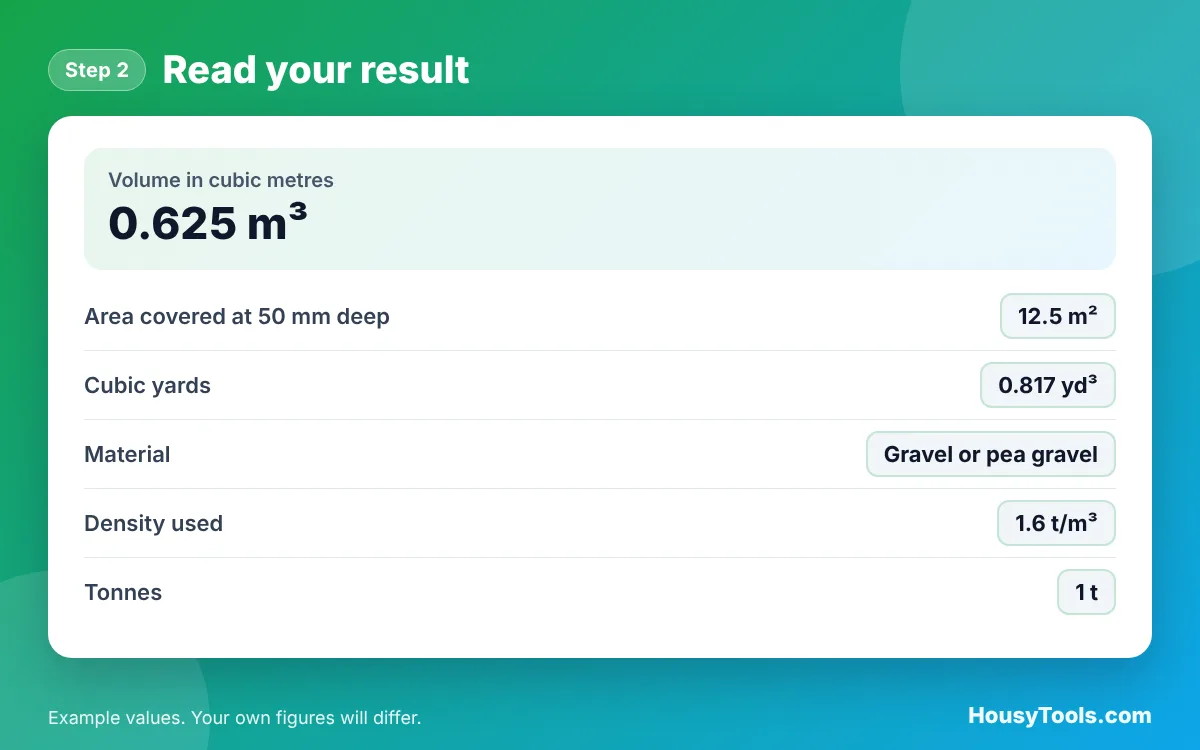
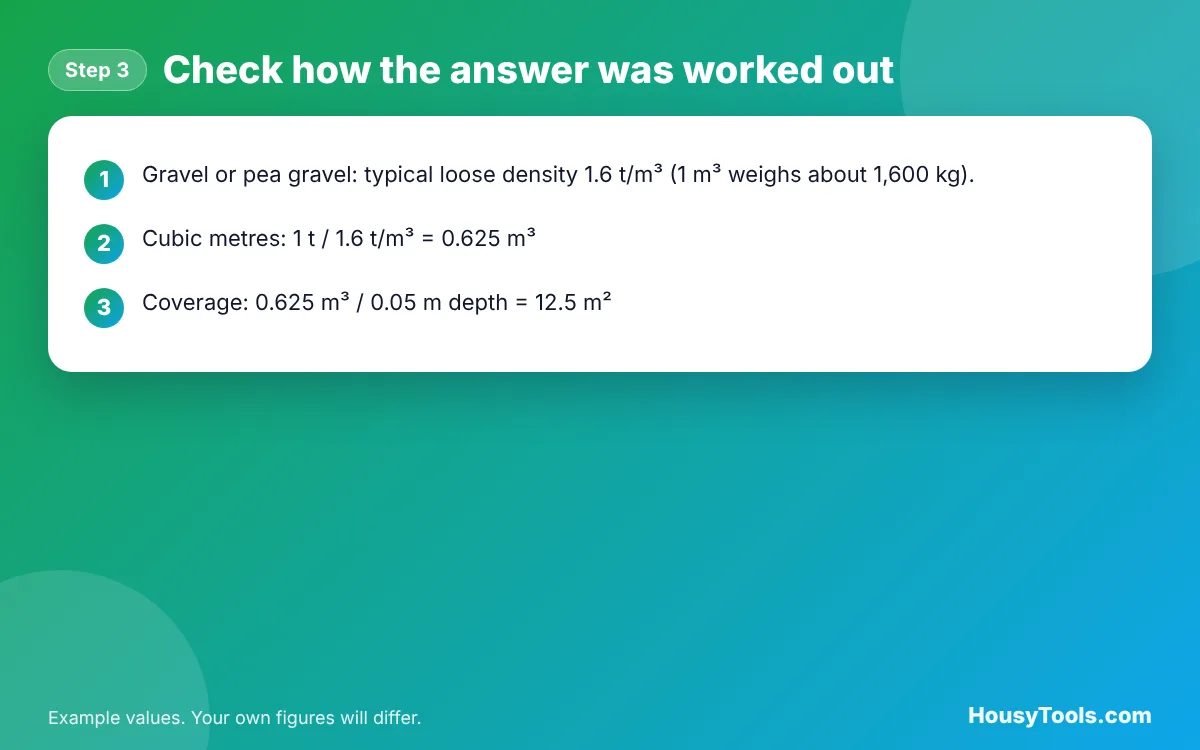
One tonne of loose 10 to 20 mm gravel is about 0.63 cubic metres, based on a typical bulk density of 1.6 t/m³. Spread 50 mm deep, that covers about 12.5 m². Larger crushed stone of 40 mm or more packs less tightly, at about 1.48 t/m³, so a tonne fills a little more, about 0.68 m³. Wet gravel is heavier, so a tonne of it fills less space.
How Many Tonnes of Type 1 Do You Need per Cubic Metre?
Loose Type 1 sub-base or crusher run weighs about 1.84 tonnes per cubic metre, so each cubic metre of loose material needs about 1.84 tonnes. Type 1 is laid and then compacted with a plate compactor or roller, which pushes the grains closer together. A compacted cubic metre therefore holds more material than a loose one. Ask your merchant for their compacted density and enter it as a Custom density when ordering for a finished depth.
How Much Does a Cubic Metre of Sand Weigh?
A cubic metre of dry, loose sharp sand weighs about 1.6 tonnes, and soft building sand about 1.54 tonnes. Damp sand from an open heap can weigh noticeably more because water fills the gaps. That matters when a bulk bag is sold by weight: a bag of wet sand gives you less volume than the same weight of dry sand.
Aggregate Density and Coverage Table
| Material (loose) | Density | Cubic metres per tonne | Area per tonne at 50 mm | Area per tonne at 100 mm |
|---|---|---|---|---|
| Sharp or concrete sand | 1.60 t/m³ | 0.625 m³ | 12.5 m² | 6.3 m² |
| Building or soft sand | 1.54 t/m³ | 0.649 m³ | 13.0 m² | 6.5 m² |
| Gravel or pea gravel, 10 to 20 mm | 1.60 t/m³ | 0.625 m³ | 12.5 m² | 6.3 m² |
| Crushed stone, 40 mm or larger | 1.48 t/m³ | 0.676 m³ | 13.5 m² | 6.8 m² |
| Type 1 sub-base or crusher run | 1.84 t/m³ | 0.543 m³ | 10.9 m² | 5.4 m² |
| Ballast | 1.54 t/m³ | 0.649 m³ | 13.0 m² | 6.5 m² |
| Topsoil | 1.31 t/m³ | 0.763 m³ | 15.3 m² | 7.6 m² |
| Subsoil or general fill | 1.48 t/m³ | 0.676 m³ | 13.5 m² | 6.8 m² |
These are indicative loose densities. Real figures vary with the quarry, grading, particle shape and moisture, so use your supplier’s figure when you have one.
Worked Example: Gravel for a Garden Path
Example: a gravel path is 10 m long and 1 m wide, 50 mm deep, and the local merchant sells 10 to 20 mm gravel by the tonne. The path needs 10 x 1 x 0.05 = 0.5 m³. Set the Direction to “Cubic metres to tonnes”, leave the Material on “Gravel or pea gravel, 10 to 20 mm (1.60 t/m³)”, enter 0.5 as the Amount and 50 as the Depth to spread. The converter shows 0.8 tonnes, or 800 kg, covering 10 m². Order one tonne to allow for an uneven base.
Indoor jobs follow the same area times depth logic. The self levelling compound calculator turns a floor area and depth into bags, and the tile adhesive calculator does the same for adhesive. Browse more in our home calculators.
Tonnes to Cubic Metres Aggregate Converter FAQs
How do you convert tonnes to cubic metres?
Divide the tonnes by the bulk density in tonnes per cubic metre. For sand at 1.6 t/m³, 3 tonnes is 3 / 1.6 = 1.875 m³. Water is the only common material where one tonne is almost exactly one cubic metre.
How many tonnes is a cubic metre of topsoil?
A cubic metre of loose topsoil weighs about 1.31 tonnes, so one tonne fills about 0.76 m³. Wet or clay rich topsoil is heavier. Topsoil also settles after spreading, so allow a little extra when filling raised beds or levelling a lawn.
How much area does a tonne of gravel cover?
A tonne of 10 to 20 mm gravel at 1.6 t/m³ covers about 12.5 m² at 50 mm deep, or about 6.3 m² at 100 mm. For a decorative layer of 30 to 40 mm, it covers more. Enter your own depth in the Depth to spread field.
Why do aggregate densities vary?
Density depends on the rock type, the mix of grain sizes, the particle shape, moisture and how tightly the material is packed. Well graded mixes such as Type 1 fill their own gaps and weigh more per cubic metre than single sized gravel. Always prefer your supplier’s figure.
Is a tonne the same as a ton?
Not quite. A metric tonne is exactly 1,000 kg. The UK long ton is 1,016 kg and the US short ton is 907 kg. Builders’ merchants in the UK and Ireland sell aggregates by the metric tonne, which is what this converter uses.
How many cubic yards are in a tonne of aggregate?
A tonne of sand or gravel at 1.6 t/m³ is about 0.82 cubic yards, because one cubic yard is 0.7646 m³. Put the other way, a cubic yard of the same material weighs about 1.22 tonnes. The converter shows cubic yards in its breakdown.
Checked October 2026. Sources: Weights and Measures Act 1985, Schedule 1 (legislation.gov.uk), Bulk density (Wikipedia), Converting between weight and volume for bulk construction materials (Designing Buildings Wiki).