
Show the formula and working
This free timber calculator works out the volume of sawn timber in cubic metres, the total linear metres, the weight and how many stock lengths to buy, for DIYers, joiners and builders in the UK, Ireland and Europe ordering studs, joists, battens or rails. It uses C16 or C24 structural softwood densities or a density you enter, and can add a cost from a price per metre.
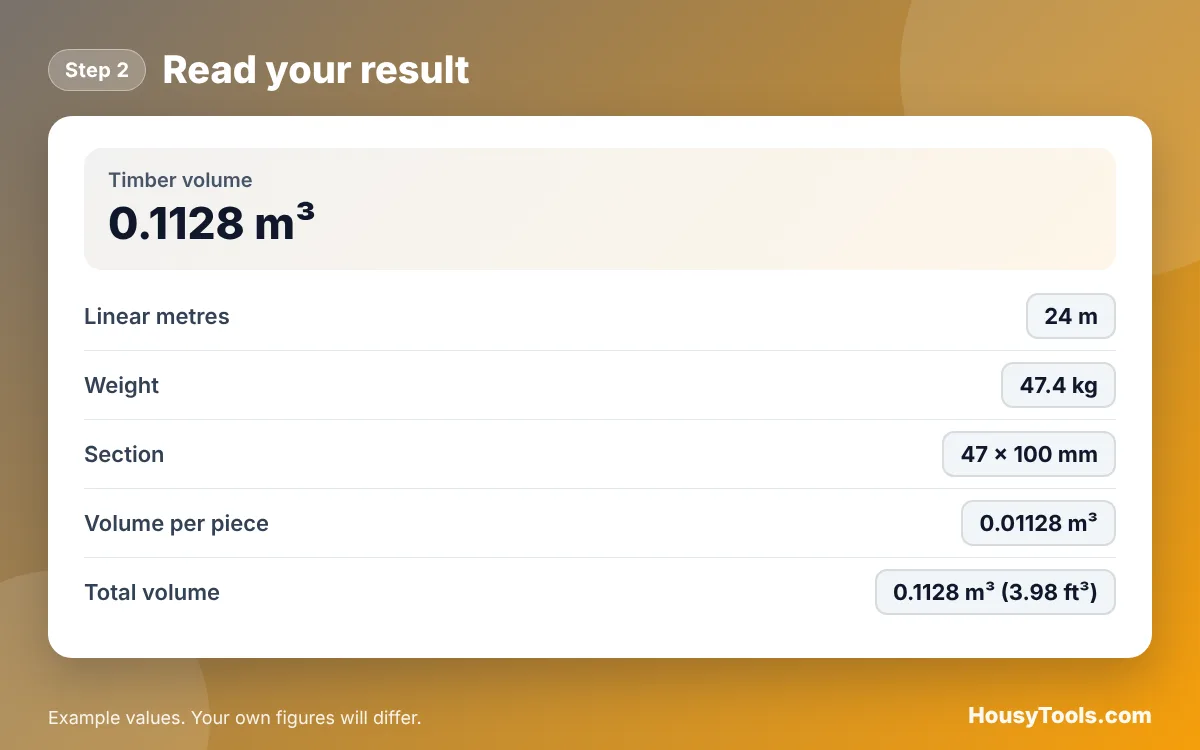
Quick answer: Multiply the number of pieces by length, width and thickness in metres to get cubic metres. Ten 2.4 m lengths of 47 x 100 mm timber are 0.1128 m³ and 24 linear metres. At the C24 mean density of 420 kg/m³, this timber calculator shows they weigh about 47.4 kg.
What Is a Timber Calculator?
A timber calculator is a tool that converts a cutting list of pieces into the quantities merchants and hauliers use. In plain words: volume of one piece = length x width x thickness, all in metres; total volume = volume of one piece x number of pieces; linear metres = pieces x length; weight = volume x density. Stock lengths to buy = pieces / how many pieces fit in one stock length, rounded up.
Structural softwood in the UK and Europe is graded into strength classes under EN 338. According to the Taylor Maxwell strength data sheet for C16, C24 and TR26, C16 has a mean density of 370 kg/m³ and C24 a mean density of 420 kg/m³. Wet or treated timber weighs more, so treat the weight as a guide.
How Do You Use the Timber Calculator?
- Enter the Number of pieces and the Length of each piece in metres.
- Enter the section as Width and Thickness in mm, for example 100 and 47.
- Choose the Timber grade or type, or pick Own density and fill in Own density for hardwood or other species.
- To see how many lengths to buy, enter the Stock length to cut from (optional).
- For a cost, enter the Price per metre (optional) and pick pounds or euros.
- Read the volume, linear metres and weight, then open “Show the formula and working” to see each step.


How Do You Calculate Cubic Metres of Timber?
Convert every measurement to metres and multiply: a 2.4 m length of 47 x 100 mm timber is 2.4 x 0.1 x 0.047 = 0.01128 m³. Multiply by the number of pieces for the total. Remember that 1 mm is 0.001 m, so a 47 mm thickness becomes 0.047. Timber merchants sometimes price large orders per cubic metre, so it helps to know how many linear metres one cubic metre gives.
| Section (mm) | Volume per metre | Linear metres per m³ | Weight per metre, C16 | Weight per metre, C24 |
|---|---|---|---|---|
| 38 x 63 | 0.00239 m³ | 418 m | 0.89 kg | 1.01 kg |
| 38 x 89 | 0.00338 m³ | 296 m | 1.25 kg | 1.42 kg |
| 47 x 75 | 0.00352 m³ | 284 m | 1.30 kg | 1.48 kg |
| 47 x 100 | 0.00470 m³ | 213 m | 1.74 kg | 1.97 kg |
| 47 x 150 | 0.00705 m³ | 142 m | 2.61 kg | 2.96 kg |
| 47 x 200 | 0.00940 m³ | 106 m | 3.48 kg | 3.95 kg |
| 75 x 200 | 0.01500 m³ | 67 m | 5.55 kg | 6.30 kg |
What Is the Difference Between C16 and C24 Timber?
C24 is a stronger structural grade than C16, so it can span further or carry more load in the same size, and it is slightly denser at a mean 420 kg/m³ against 370 kg/m³. Both are softwood strength classes from EN 338. For joists, rafters and other structural members, the size and grade should come from span tables, a structural engineer or building control, not from this quantity tool.
How Many Stock Lengths Should I Buy?
Work out how many of your pieces fit in one stock length, then divide the number of pieces by that and round up: 2.4 m pieces come two from a 4.8 m length, so ten pieces need five lengths. Check the lengths your merchant stocks and allow a little for the saw cut and for trimming ends, which this tool ignores. For decks and fences, the decking calculator and fence panel calculator work out boards, posts and rails directly.
Worked Example: Ten Studs for a Partition Wall
Example: a stud partition needs ten pieces of C24 timber, each 2.4 m long and 47 x 100 mm in section. One piece is 2.4 x 0.1 x 0.047 = 0.01128 m³, so ten pieces are 0.1128 m³, or 3.98 ft³, and 24 linear metres. At 420 kg/m³, they weigh 0.1128 x 420 = 47.4 kg, about 4.7 kg each. From 4.8 m stock lengths, two pieces fit in each, so you buy 5 lengths with no offcuts.
Enter a price per metre to add the cost. For volumes in other units, the cubic metre calculator helps, and more tools are on the building and DIY calculators page.
Timber Calculator FAQs
How many linear metres are in a cubic metre of timber?
Divide 1 by the cross section in square metres. For 47 x 100 mm timber the section is 0.0047 m², so one cubic metre is about 213 linear metres. Smaller sections give more metres per cubic metre.
How much does a cubic metre of timber weigh?
Dry structural softwood weighs roughly 370 to 420 kg per cubic metre on average for C16 and C24. Hardwoods such as oak are much heavier, and wet or freshly treated timber weighs more than dry timber.
Why is 47 x 100 timber not exactly 2 x 4 inches?
Sizes are the finished dimensions after drying and machining, so the old nominal 2 x 4 inch section is about 47 x 100 mm in UK regularised timber. CLS timber, used for studs, is smaller again, often 38 x 63 or 38 x 89 mm.
Should I add extra timber for waste?
Yes. Allow for saw cuts, trimming split or damaged ends and the odd twisted length. Many people add a piece or two, or about 10% on larger orders. The stock length option also shows the offcuts your cutting plan leaves.
What does C24 mean on timber?
C24 is a strength class for softwood under EN 338. The C stands for conifer and 24 is the characteristic bending strength in newtons per square millimetre. Higher numbers mean stronger timber.
Can I use this calculator for hardwood?
Yes. Choose Own density and enter the density of the species from your supplier. The volume, linear metres and stock lengths work the same for any timber; only the weight depends on the density.
Checked October 2026. Sources: Taylor Maxwell, strength data for C16, C24 and TR26, Lumber (Wikipedia).