
Show the formula and working
This grout calculator works out how many kilograms and bags of grout you need for a tiled wall or floor, using your tile size, joint width, tile thickness and the grout’s density. It is built for UK and European DIYers and tilers, accepts millimetres or inches, and shows every step of the sum so you can check it against the bag.
Quick answer: a grout calculator multiplies tile length plus width by joint width and joint depth, divides by tile length times width, then multiplies by grout density (about 1.6 kg per litre). For 300 x 300 x 10 mm tiles with 3 mm joints you need about 0.32 kg per m², plus 10% for waste.
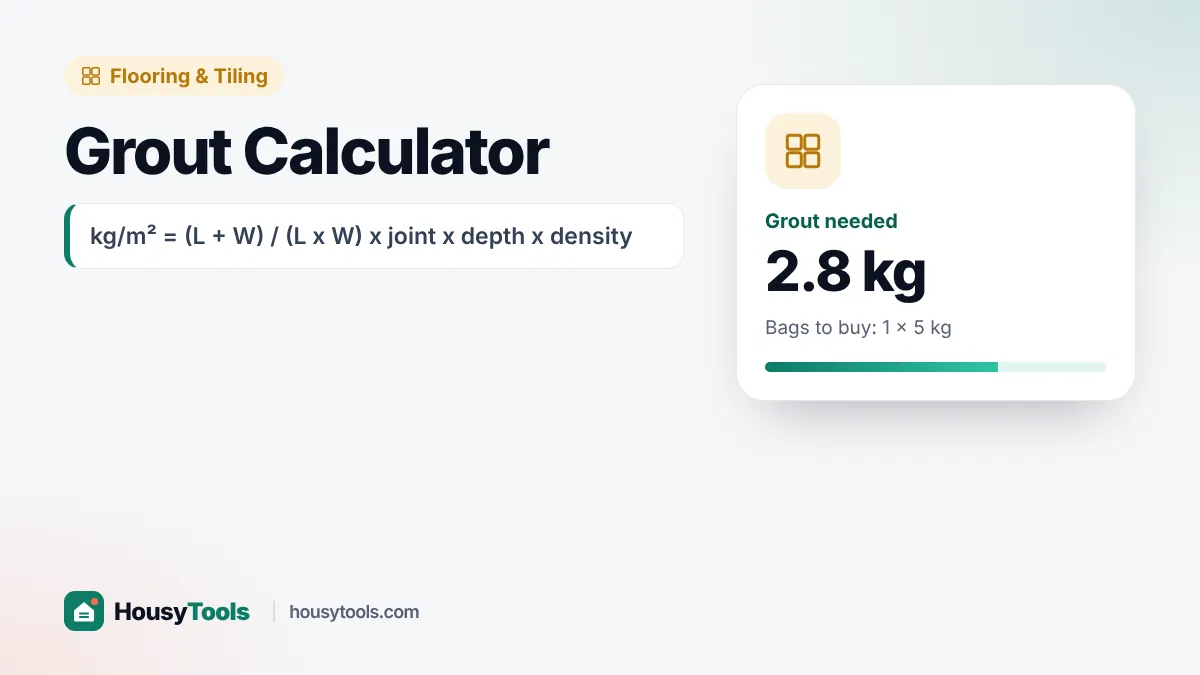
What Is a Grout Calculator?
A grout calculator is a tool that estimates the weight of grout needed to fill the joints between tiles over a given area. It works from the volume of the gaps, not the area of the tiles, because grout only goes into the joints.
The formula is the one tile adhesive makers print on their data sheets: (tile length + tile width) divided by (tile length x tile width), multiplied by joint width, joint depth and grout density. All sizes are in millimetres and density is in kilograms per litre, which gives kilograms per square metre. Our grout calculator then multiplies by your area, adds 10% for waste and rounds up to whole bags.
Joint depth is normally the full tile thickness, since a properly grouted joint is filled flush to the face. The default density of 1.6 matches the constant used in Mapei’s consumption formula for Ultracolor Plus, a widely sold cement grout.
How Do You Use the Grout Calculator?
- Enter the tiled area in m² (or ft² in imperial mode). Measure each wall or floor and add them together.
- Enter the tile width and tile height in millimetres, as printed on the box. A 300 x 600 tile is entered as 300 and 600.
- Set the joint width, which is the size of the spacers you are using, for example 2 mm or 3 mm.
- Enter the tile thickness as the joint depth. Check the box: ceramic wall tiles are often 6 to 9 mm thick and porcelain floor tiles 8 to 10 mm.
- Leave the grout density at 1.6 unless the technical data sheet for your grout gives a different figure.
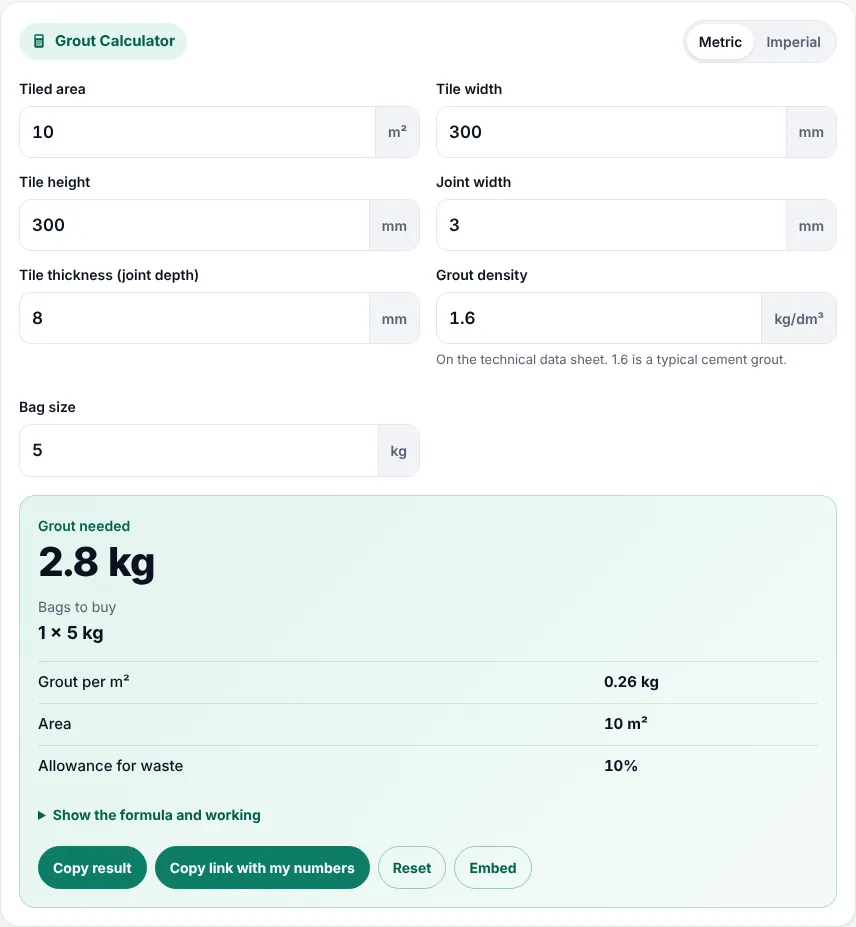
- Choose the bag size you plan to buy. The grout calculator shows kilograms needed, bags to buy and the working.
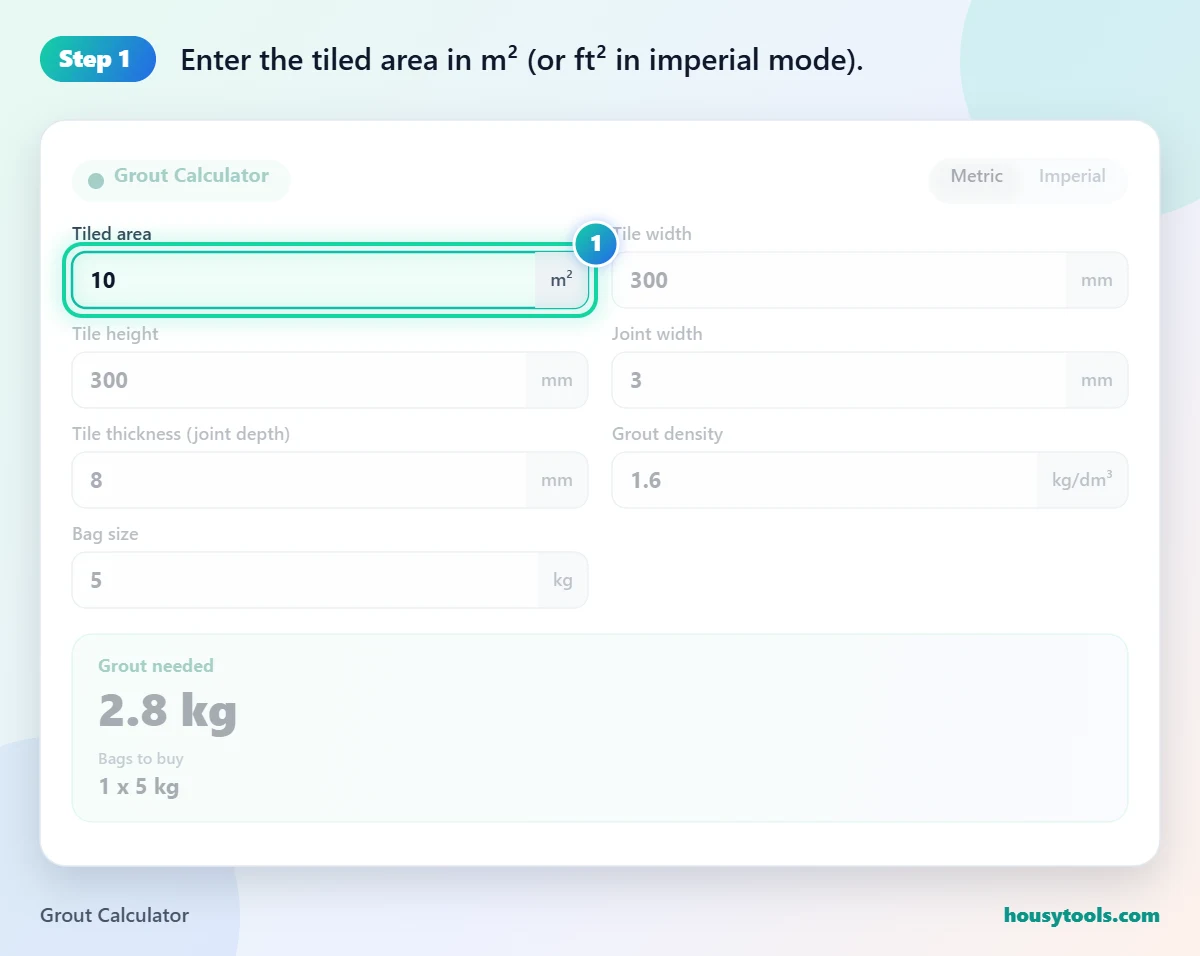
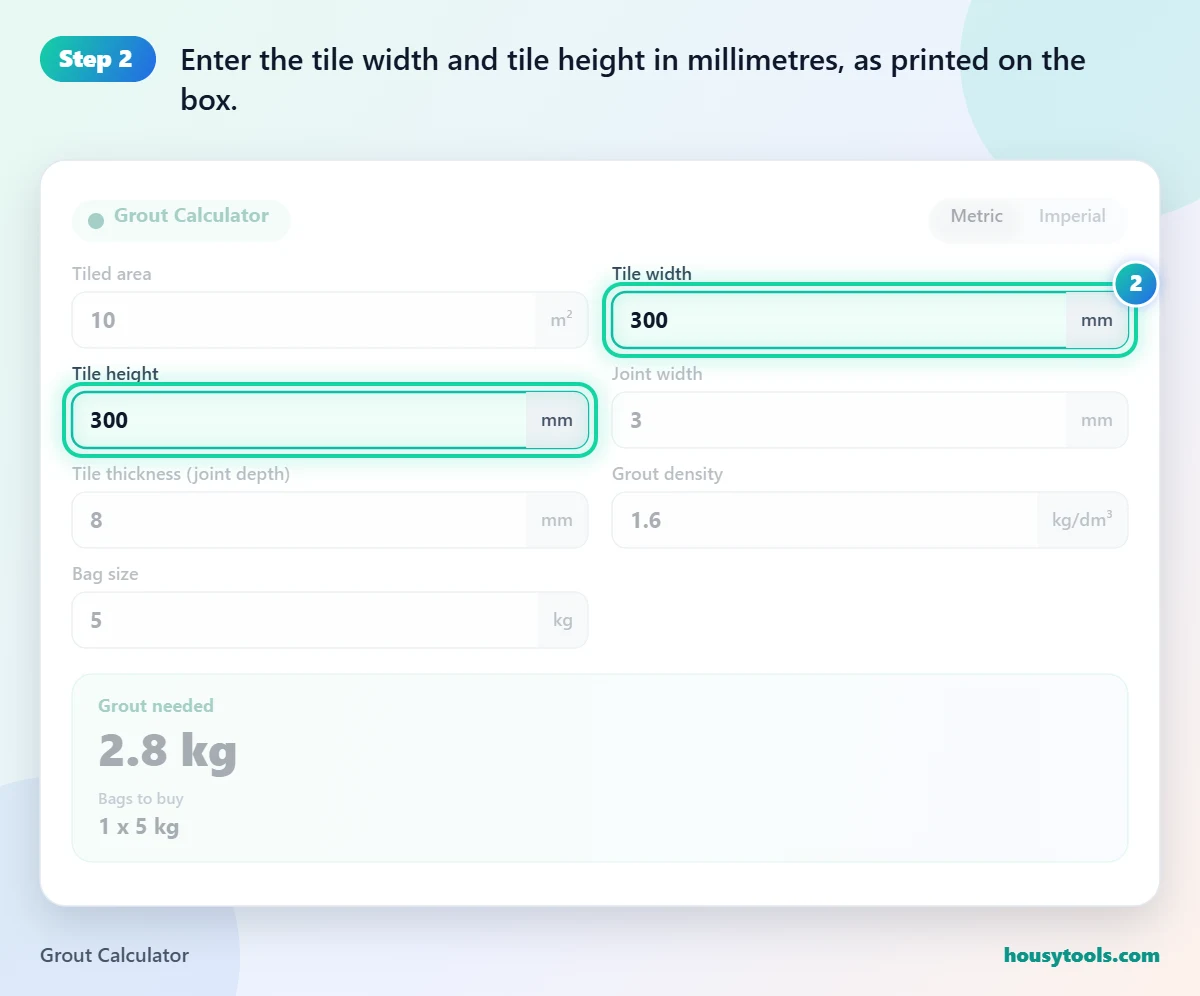
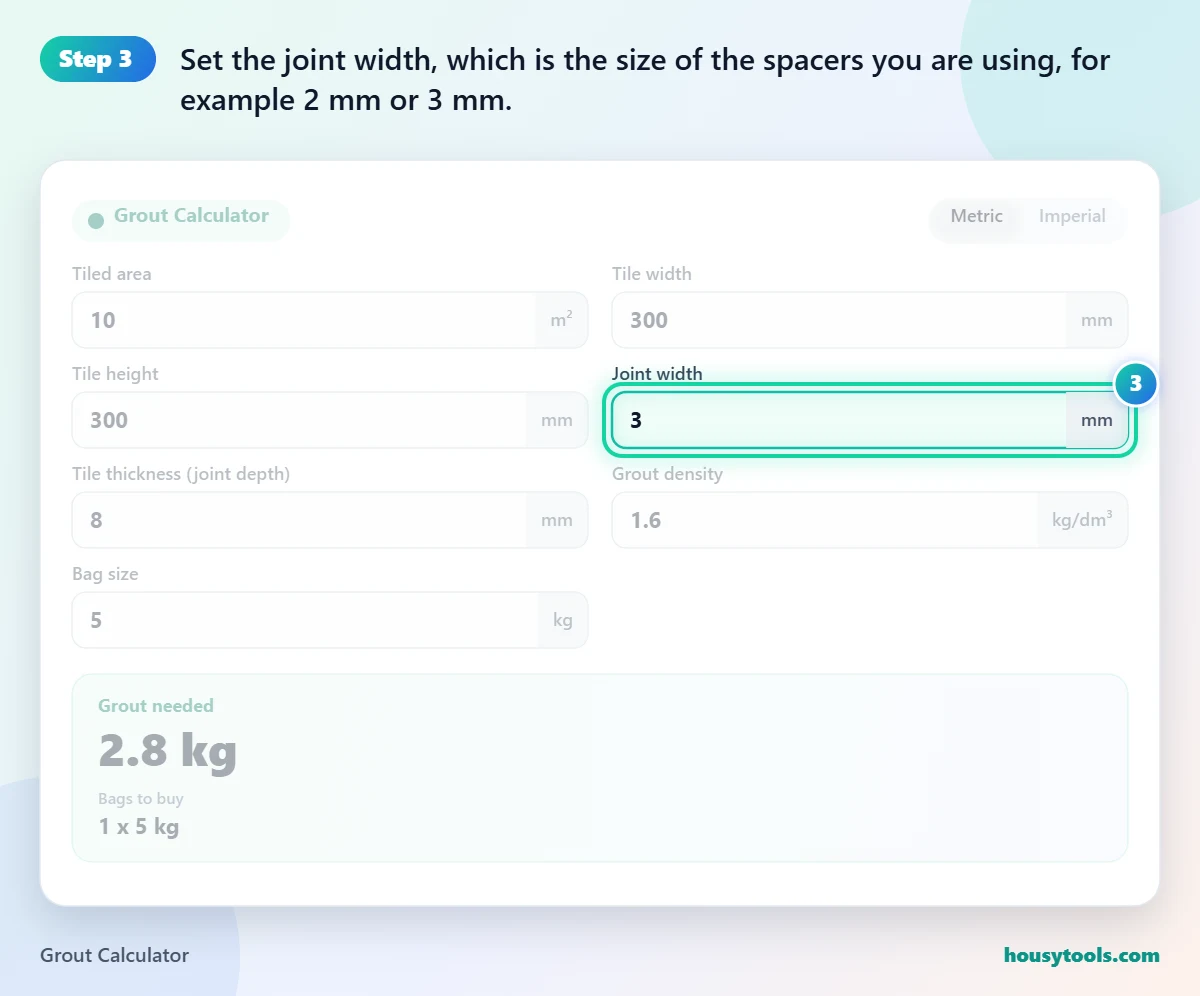
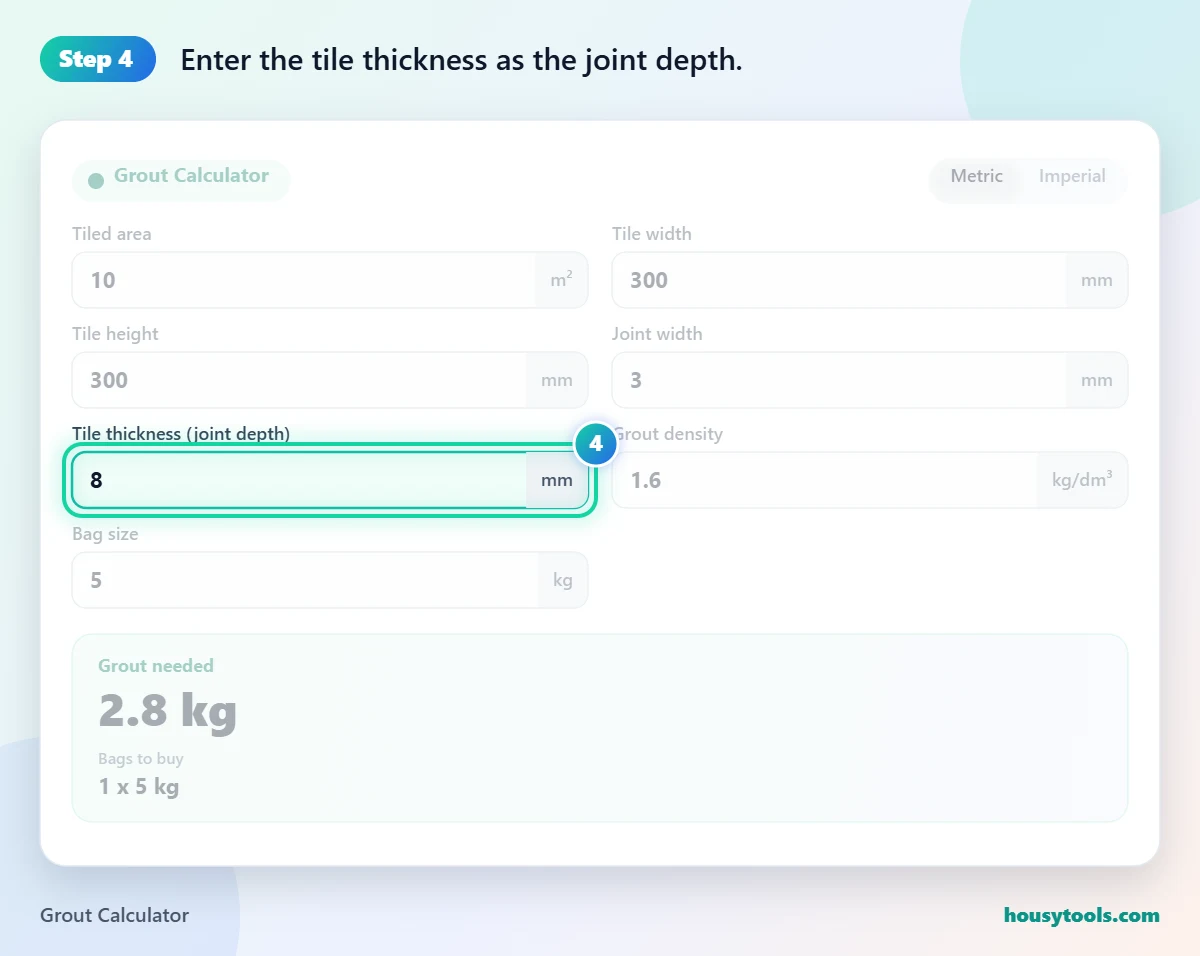
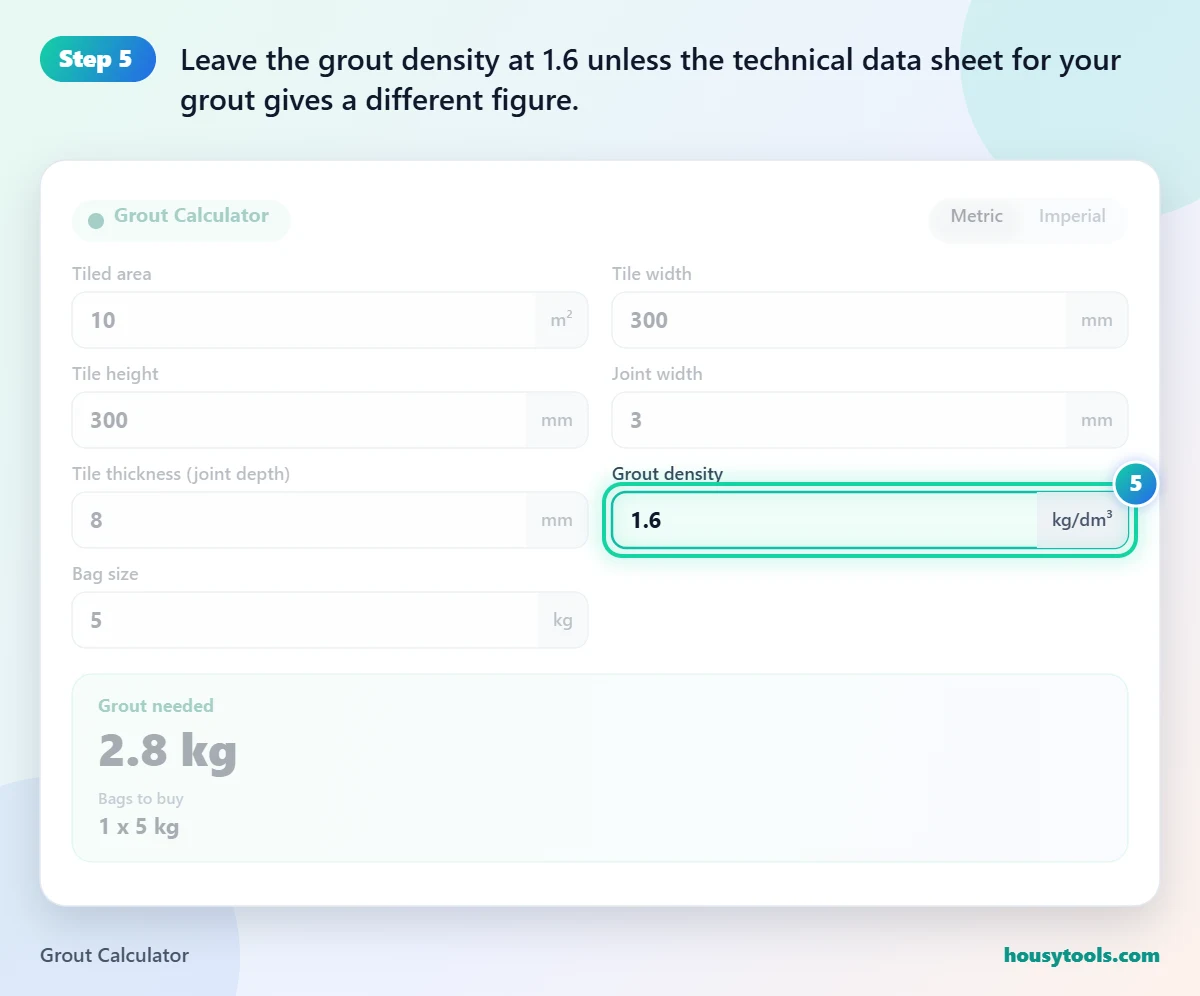
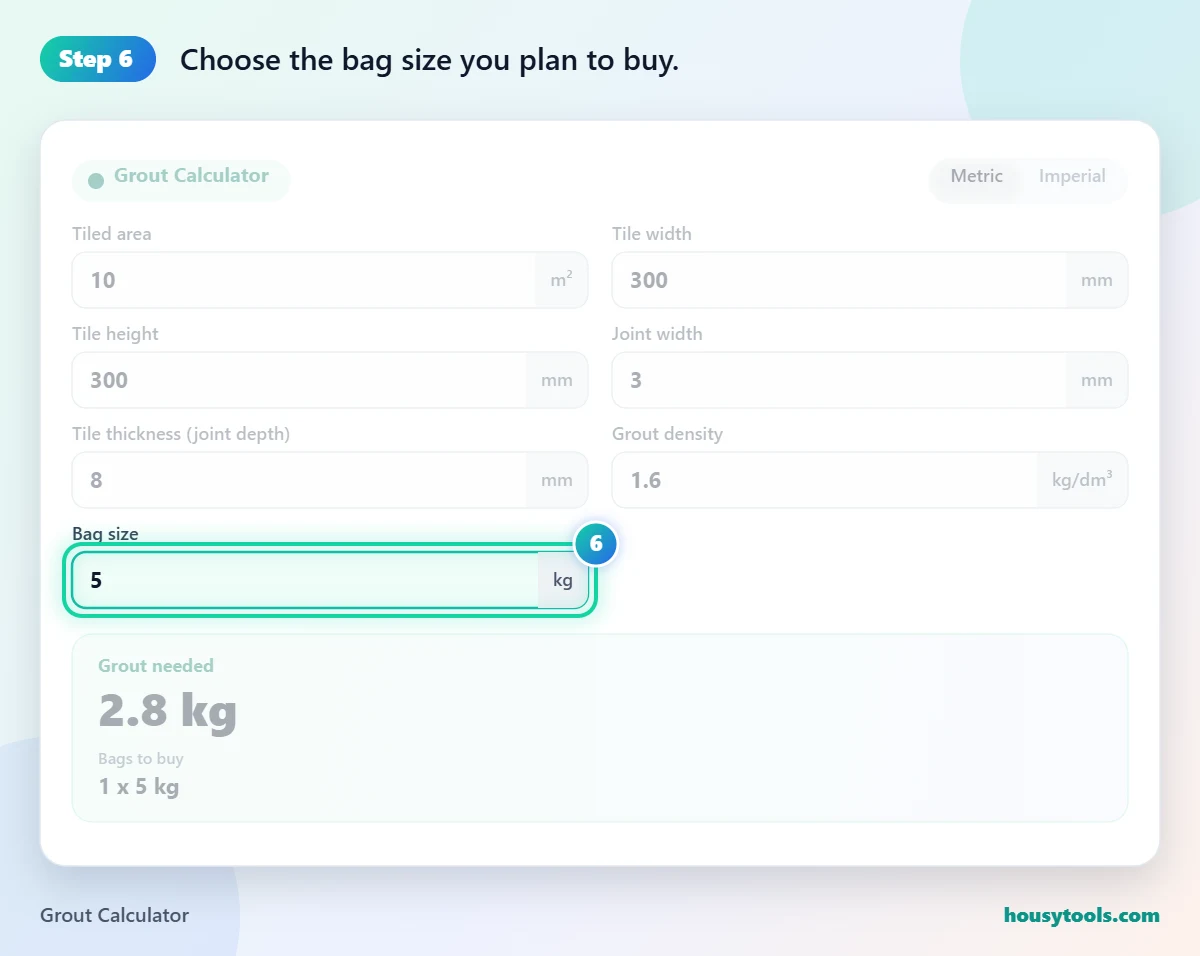
The result updates as you type. If you are still choosing tiles, try two sizes side by side: the difference in grout is often bigger than people expect.
How Much Grout Do I Need per m²?
Most tiling jobs need between 0.1 and 0.7 kg of cement grout per m², depending mainly on tile size and joint width. Large 600 x 600 mm floor tiles with 3 mm joints use about 0.16 kg per m², while 100 x 100 mm tiles with the same joints use about 0.67 kg per m².
Small tiles have far more joint length per square metre. A square metre of 600 x 600 tiles has about 3.3 m of joints, while a square metre of 100 x 100 tiles has about 20 m. That is why mosaics and metro tiles eat grout, and why a single figure such as “1 kg per m²” is unreliable. A grout calculator that uses your exact tile size avoids that guesswork.
How Wide Should Grout Lines Be?
A common starting point is 2 mm joints for wall tiles and 3 mm for floor tiles, with 5 mm or more for rustic or uneven tiles. Always stay inside the range printed on your grout: Mapei’s Ultracolor Plus, for example, is rated for joints from 2 to 20 mm wide. Enter the spacer size you will really use in the grout calculator.
Rectified porcelain with perfectly square edges can take narrower joints, but floors need room for movement, so do not go below what the tile and grout makers recommend. Doubling the joint width doubles the grout needed, so a change from 2 mm to 4 mm spacers turns one bag into two.
Grout is a dense paste that fills joints and stops dirt and water getting behind tiles, as Wikipedia’s grout article explains. Cement grouts suit most homes; epoxy grouts resist stains in kitchens and showers but have their own density and pot life, so check the data sheet before you rely on the default.
Grout Needed per m² by Tile Size
| Tile size and thickness (mm) | 2 mm joint (kg/m²) | 3 mm joint (kg/m²) | 5 mm joint (kg/m²) |
|---|---|---|---|
| 75 x 150 x 7 (metro) | 0.45 | 0.67 | 1.12 |
| 100 x 100 x 7 | 0.45 | 0.67 | 1.12 |
| 200 x 200 x 9 | 0.29 | 0.43 | 0.72 |
| 300 x 300 x 10 | 0.21 | 0.32 | 0.53 |
| 250 x 400 x 8 | 0.17 | 0.25 | 0.42 |
| 300 x 600 x 9 | 0.14 | 0.22 | 0.36 |
| 600 x 600 x 10 | 0.11 | 0.16 | 0.27 |
| 600 x 1200 x 10 | 0.08 | 0.12 | 0.20 |
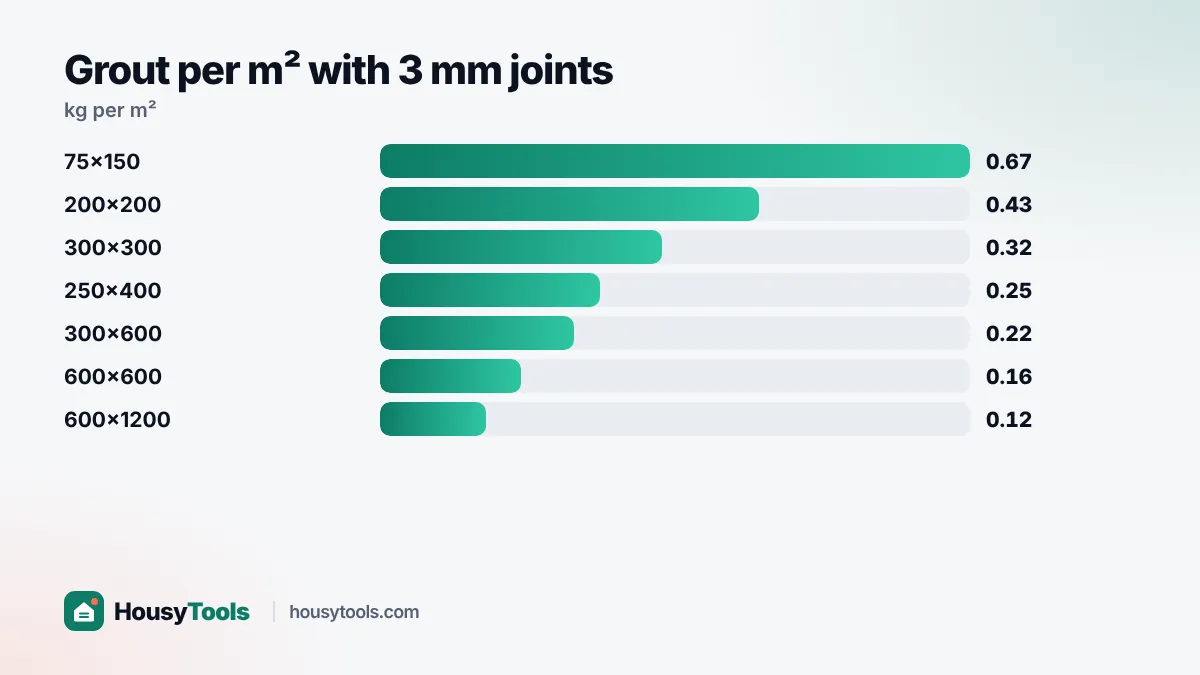
Use the table for a quick sense check, then run the grout calculator with your real area. Note that 75 x 150 metro tiles and 100 x 100 tiles need the same amount, because their joint length per m² is identical.
How Many Bags of Grout Do I Need?
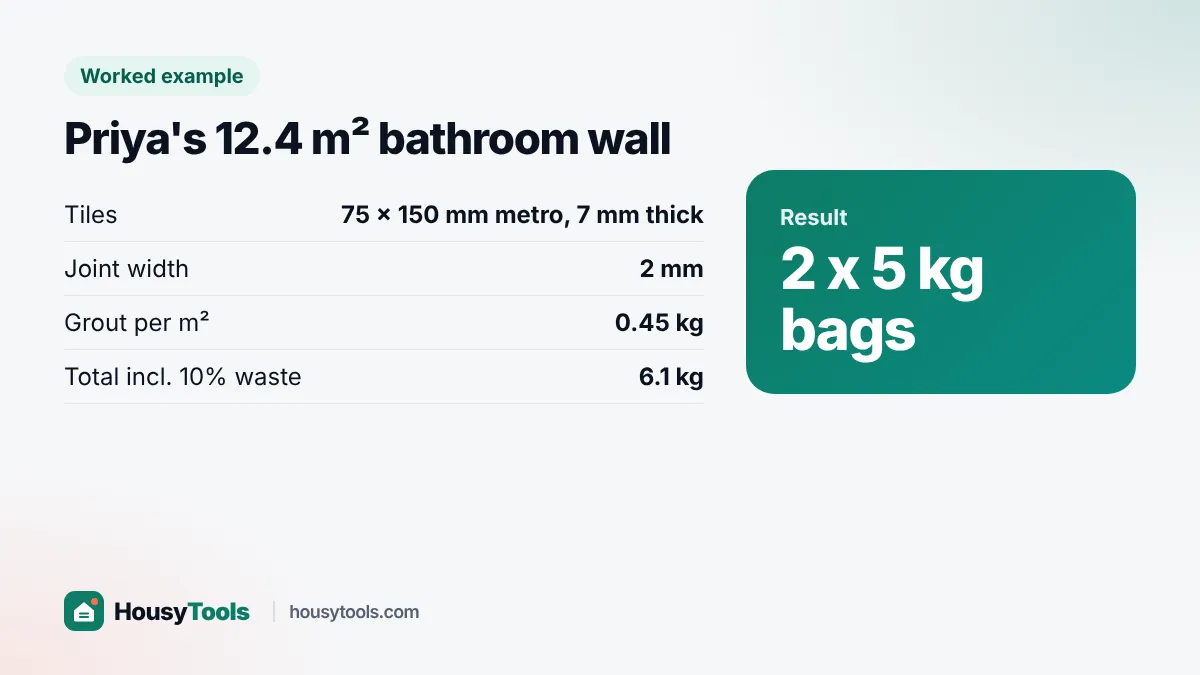
Divide the total kilograms (including 10% waste) by the bag weight and round up: 6.1 kg of grout means two 5 kg bags. Grout is sold in several pack sizes, from small tubs for a splashback to trade bags for whole floors, so enter the size you can actually buy.
Buy all bags from the same batch where you can, because colour can vary slightly between batches. If the grout calculator shows you need 5.2 kg, two 5 kg bags is safer than one 5 kg bag plus hope; a small bag of the same colour is useful for later repairs.
Grout is only part of the job. Work out tiles with our tile calculator and the bed of adhesive underneath with the tile adhesive calculator, so you can order everything in one trip.
Worked Example: Priya’s Bathroom Wall
Priya is tiling 12.4 m² of bathroom wall in Leeds and cannot decide between white metro tiles (75 x 150 mm, 7 mm thick) and large format tiles (300 x 600 mm, 9 mm thick). She will use 2 mm spacers and buys grout in 5 kg bags.
- Metro tiles: (75 + 150) / (75 x 150) x 2 x 7 x 1.6 = 0.448 kg per m²
- Metro total: 0.448 x 12.4 m² x 1.10 = 6.11 kg, so 2 x 5 kg bags
- Large tiles: (300 + 600) / (300 x 600) x 2 x 9 x 1.6 = 0.144 kg per m²
- Large total: 0.144 x 12.4 m² x 1.10 = 1.96 kg, so 1 x 5 kg bag
The metro wall needs about three times as much grout as the large format wall, and far more time with a grout float and sponge. Priya picks metro tiles anyway for the look, and buys both bags from one batch. Running the grout calculator for both options before ordering means she buys the right number of bags first time.
Common Grouting Mistakes to Avoid
- Guessing a flat rate per m². Joint length changes with tile size, so the rate can vary by a factor of five.
- Entering the joint depth as half the tile. Fill joints flush, and use the full tile thickness in the grout calculator.
- Ignoring density. Epoxy and some flexible grouts differ from 1.6, so take the figure from the data sheet.
- Mixing a whole bag at once. Mix only what you can use within the working time printed on the bag.
- Grouting too soon. Let the tile adhesive set for the time the maker states before grouting.
Our method and rounding are explained on how our calculators work. Results are estimates; the consumption figures on your product always take priority.
Grout Calculator FAQs
How much area does a 5 kg bag of grout cover?
It depends on tile size and joint width. At 0.32 kg per m² (300 x 300 x 10 mm tiles, 3 mm joints) a 5 kg bag covers about 14 m² after 10% waste. With metro tiles and 2 mm joints it covers about 10 m².
Is the grout calculator accurate for epoxy grout?
Yes, if you change the density. The grout calculator defaults to 1.6 kg per litre for cement grout. Epoxy and some flexible grouts have a different density, which is printed on the technical data sheet. Enter that figure and the result follows.
Do I use tile thickness as the grout depth?
Yes. A grout joint should be filled flush with the tile face, so the depth equals the tile thickness. Remove any adhesive squeezed into the joints before it sets, otherwise the joint is shallower and grout may crack or fall out.
Why does a mosaic need so much grout?
Mosaics have far more joint length per square metre than large tiles. A square metre of 25 mm mosaics has 80 m of joints, compared with about 3.3 m for 600 x 600 tiles, so grout use rises sharply even with narrow joints.
Should I add extra grout for waste?
Yes. The grout calculator already adds 10% to cover mixing losses, grout left on the float and grout wiped off the tile face. If you are new to grouting, or working on textured tiles, buying one extra small bag is sensible.
Can I convert grout kg to litres?
Divide kilograms by the density to get litres of joint filled. At the default 1.6, every 1.6 kg of grout fills about 1 litre of joints, so the 6.1 kg in our worked example fills roughly 3.8 litres, waste included. Use the density on your own data sheet for an exact figure.
Checked October 2026. Sources: Mapei Ultracolor Plus technical data sheet, Wikipedia.