
Show the formula and working
This solar panel angle calculator finds the tilt at which solar panels face the midday sun squarely in summer, winter and at the spring and autumn equinoxes, for any latitude in the northern hemisphere. Enter your latitude and your roof pitch, and it shows the midday sun height through the year and how much of the direct noon sunlight your angle catches in each season.
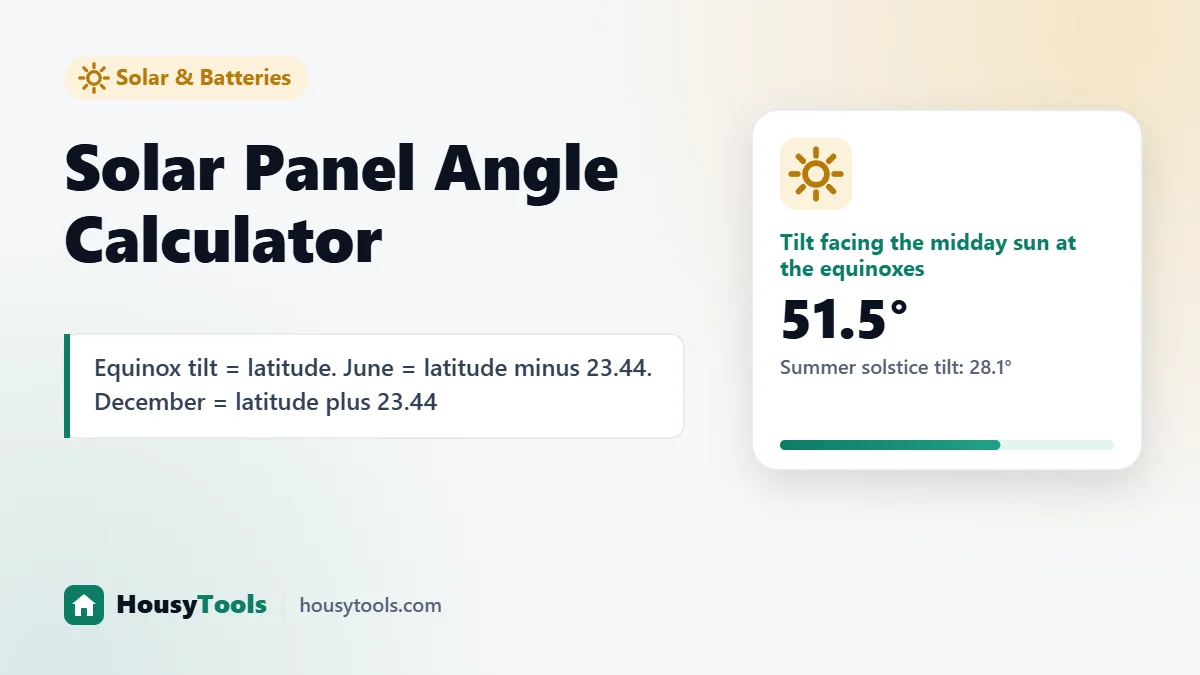
Quick answer: At midday on the equinoxes the sun is square to a panel tilted at your latitude. Subtract 23.44 degrees for the June solstice and add 23.44 for the December solstice. In London, at 51.5 degrees north, that gives 51.5 degrees at the equinoxes, 28.1 degrees in June and 74.9 degrees in December.
What Is a Solar Panel Angle Calculator?
A solar panel angle calculator is a tool that works out the tilt, measured from flat, at which a south facing panel points straight at the midday sun on key dates of the year.
The formula in plain words: the midday sun height at the equinoxes is 90 degrees minus your latitude, so a panel tilted at your latitude faces it squarely. The Earth’s axis is tilted by about 23.44 degrees, so the midday sun is 23.44 degrees higher on the June solstice and 23.44 degrees lower on the December solstice. The best tilt for those days is your latitude minus or plus 23.44. To check your roof, the calculator takes the cosine of the difference between your pitch and each ideal tilt, which gives the share of the direct midday beam your panels catch.
How Do You Use the Solar Panel Angle Calculator?
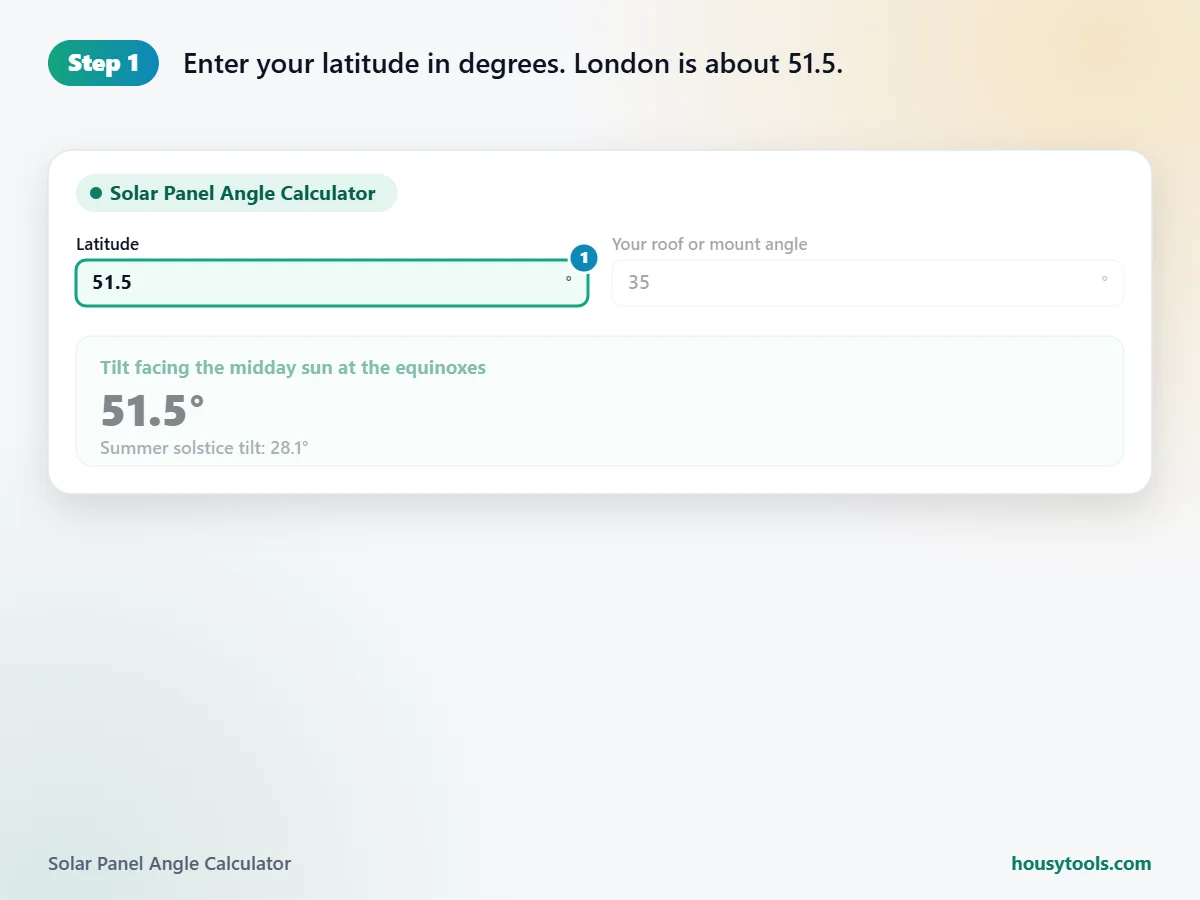
- Enter your latitude in degrees. London is about 51.5.
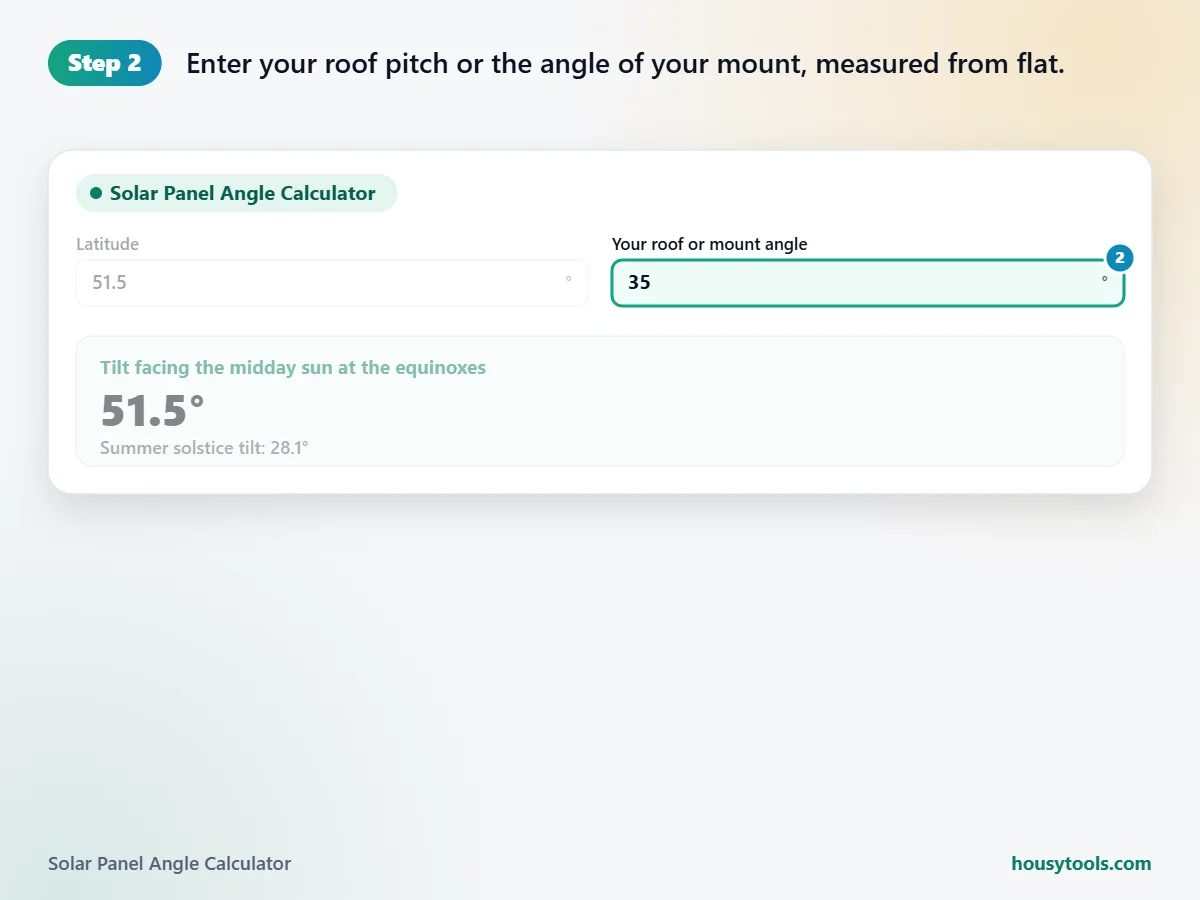
- Enter your roof pitch or the angle of your mount, measured from flat.
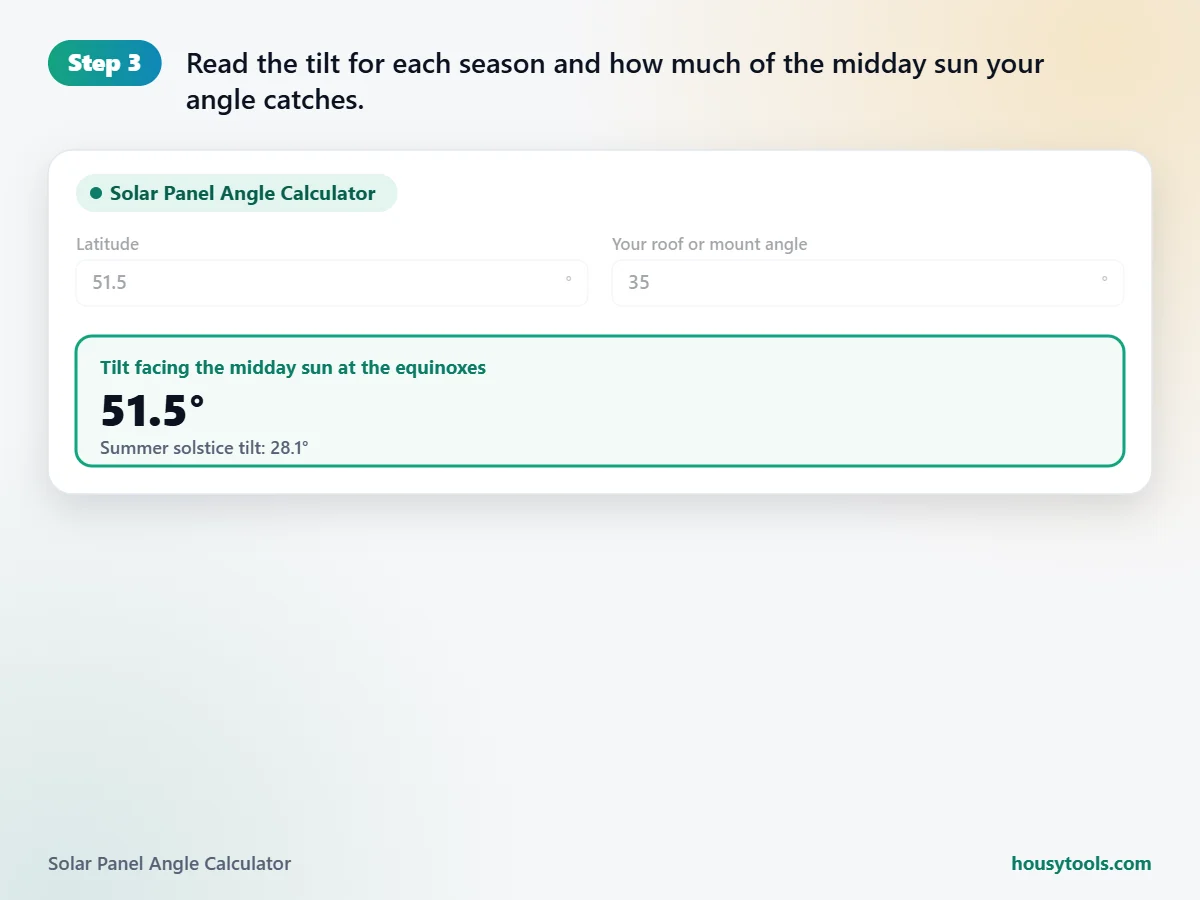
- Read the tilt for each season and how much of the midday sun your angle catches.
What Is the Best Angle for Solar Panels in the UK?
For a fixed system the best yearly angle in the UK is usually flatter than the latitude, because cloudy skies give a lot of diffuse light and most energy is made in the longer summer days.
This calculator gives the exact geometry for the midday sun, which is the right answer for seasonal or adjustable mounts. For a fixed roof, the energy optimum also depends on cloud, horizon and direction, so the most reliable figure comes from the PVGIS tool from the EU Joint Research Centre, which can calculate the optimum slope for your address. Most pitched roofs are close enough that re-angling panels on frames rarely pays, but flat roofs and ground mounts let you choose.
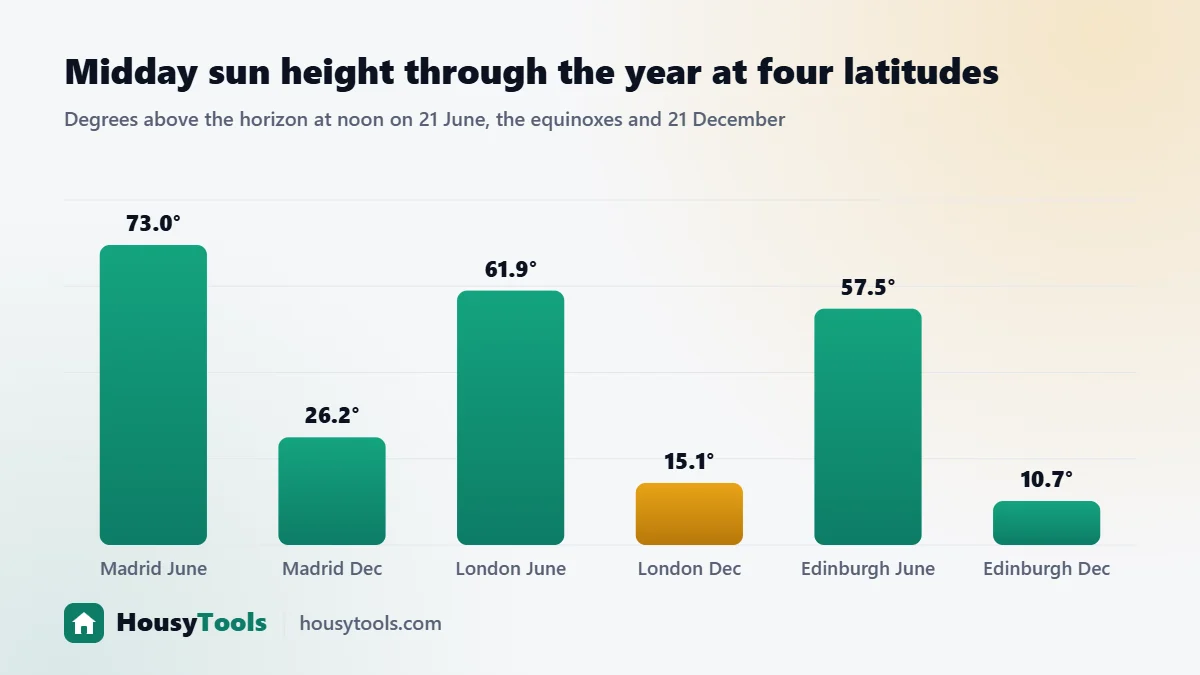
| Place | Latitude | Equinox tilt | June tilt | December tilt | December noon sun |
|---|---|---|---|---|---|
| Madrid | 40.4° | 40.4° | 17.0° | 63.8° | 26.2° |
| Paris | 48.9° | 48.9° | 25.5° | 72.3° | 17.7° |
| London | 51.5° | 51.5° | 28.1° | 74.9° | 15.1° |
| Amsterdam | 52.4° | 52.4° | 29.0° | 75.8° | 14.2° |
| Dublin | 53.3° | 53.3° | 29.9° | 76.7° | 13.3° |
| Edinburgh | 55.9° | 55.9° | 32.5° | 79.3° | 10.7° |
How Much Output Do You Lose at the Wrong Angle?
Small angle errors cost very little: a panel 15 degrees away from the ideal tilt still catches about 97% of the direct beam, because the loss follows the cosine of the angle difference.
That is why a 35 degree roof in London works well even though the equinox ideal is 51.5 degrees. At noon in June it catches about 99% of the direct beam, at the equinoxes about 96% and in December about 77%. Roof direction usually matters more than tilt: a panel facing east or west loses more than a south facing one at a slightly wrong angle. Check the effect of direction with the solar panel output calculator.
Should You Change the Angle of Solar Panels by Season?
Adjusting the tilt by season can add a little output on frames, ground mounts and off grid systems, but roof panels on rails are almost always fixed.
For a van, boat or off grid cabin used mainly in summer, set the tilt near the June figure. For a winter heavy load such as a frost protection heater, tilt closer to the December figure, which also helps snow slide off. The off grid solar calculator shows how much bigger an array must be to cover December use.
Worked Example: A 35 Degree Roof in London
Example: a house in London at about 51.5 degrees north has a south facing roof pitched at 35 degrees.
- Equinox ideal: 51.5 degrees, so the roof is 16.5 degrees flatter
- Equinox noon: cos(16.5 degrees) = 96% of the direct beam
- June noon ideal: 28.1 degrees, so the roof catches about 99%
- December noon ideal: 74.9 degrees, so the roof catches about 77%
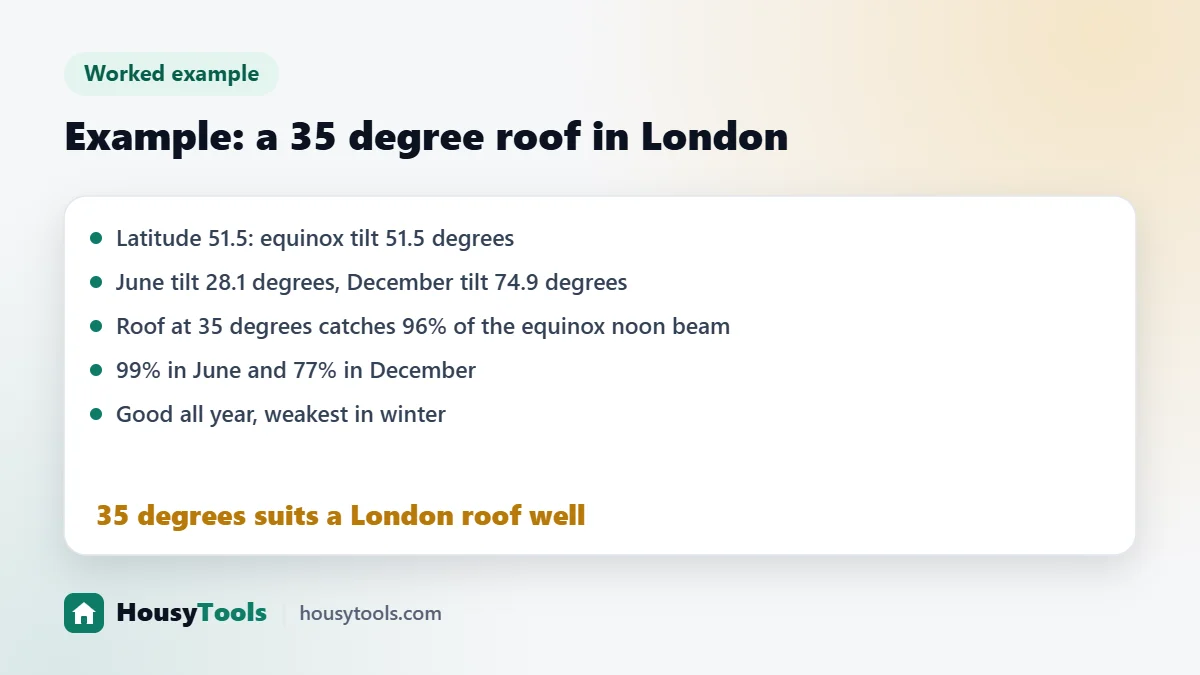
The roof is well matched for the sunny half of the year, when most solar energy is made, and weakest in winter, when output is low anyway. Fitting panels flush to this roof is the sensible choice.
Does Roof Direction Matter More Than Angle?
Often yes: in the northern hemisphere a south facing roof gets the most midday sun, and east or west facing roofs lose more output than a moderate tilt error does.
East and west roofs still work well and spread generation across the morning or afternoon, which can suit households that use more power at those times. For a precise comparison, run PVGIS for each roof face, then use the how many solar panels calculator with the yield you get.
Solar Panel Angle Calculator FAQs
What is the best angle for solar panels in London?
The midday sun is square to a panel at 51.5 degrees at the equinoxes, 28.1 degrees in June and 74.9 degrees in December. For a fixed yearly system the energy optimum is flatter than 51.5 degrees, so check PVGIS for your address.
Are solar panels better flat or tilted?
Tilted panels catch more of the low northern sun and shed rain and dirt better. Very flat panels lose output in winter and collect more dirt, so flat roof systems usually use angled frames.
Does a 30 degree roof work for solar panels?
Yes. In London a 30 degree roof catches about 93% of the direct beam at the equinox noon and 100% in June, so it works well. Direction and shading matter more.
What is the best angle for solar panels in winter?
Your latitude plus 23.44 degrees faces the December midday sun squarely. In London that is about 75 degrees, which is close to vertical and also helps snow slide off.
Do I need to change the angle of roof panels?
No. Roof panels are fixed on rails, and the small seasonal gain does not justify the cost. Adjustable angles make sense mainly for ground mounts, vans and off grid systems.
How do I find my latitude?
Search your town in an online map and read the latitude from the coordinates, or use the location shown in your phone’s compass app. One decimal place is accurate enough.
Checked October 2026. Sources: EU Joint Research Centre PVGIS, axial tilt of the Earth (IAU value of about 23.44 degrees).