
Show the formula and working
This free window frame paint calculator works out how much paint and how many tins you need to paint timber window frames, sashes and sills, inside, outside or both, for homeowners and decorators in the UK, Ireland and Europe. It turns the window size and frame width into a painted area, allows for edges and opening sashes, and can add a coat of undercoat.
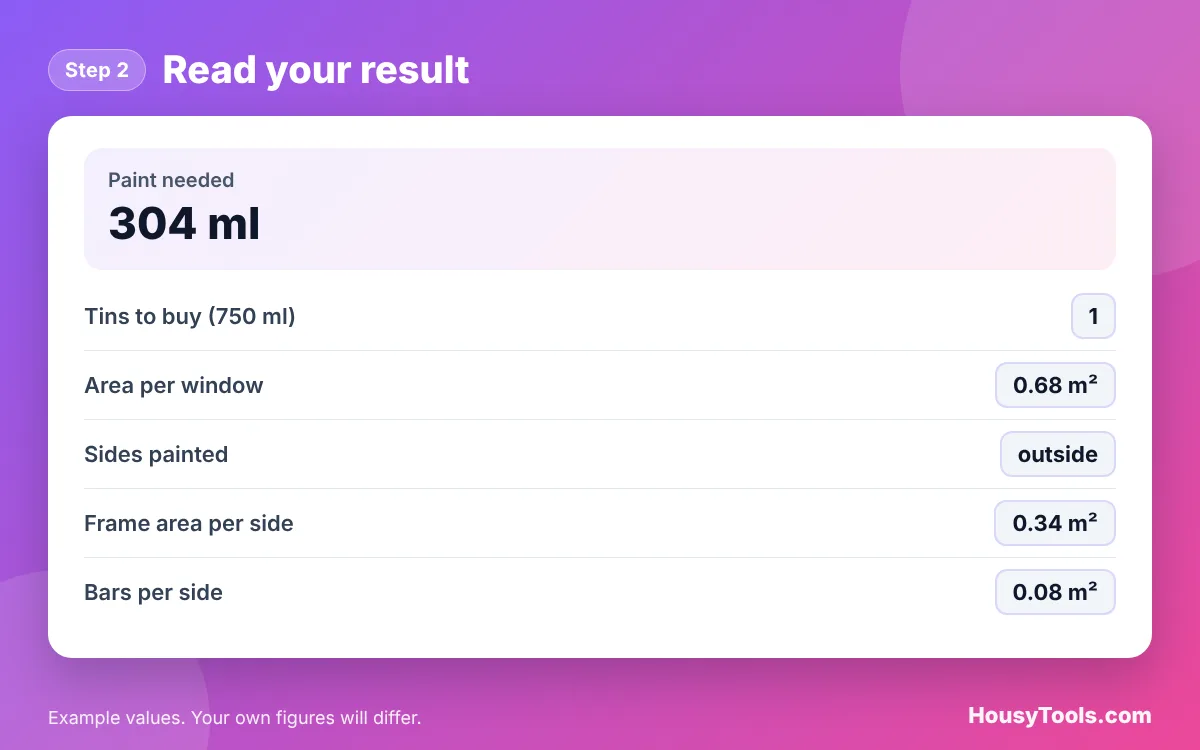
Quick answer: Multiply the frame perimeter by the visible frame width, add bars, edges and the sill, then multiply by coats and divide by coverage. Four 1.2 m square windows painted outside come to 2.74 m², so a window frame paint calculator shows 304 ml of exterior gloss for two coats.
What Is a Window Frame Paint Calculator?
A window frame paint calculator is a tool that estimates the area of timber around the glass and converts it into litres of paint. In plain words: frame area per side = 2 x (width + height) x face width, plus each mullion or rail x height x face width. Add an allowance for edges and opening sashes, add the sill if it is painted, multiply by the number of sides and windows, then paint = area x coats / coverage per litre.
Window frames are a small area, so the main question is usually which tin size to buy. The default coverage of 18 m² per litre is the figure on the Dulux Trade Weathershield Exterior High Gloss product page, which also says to apply it at 5 °C and above. Inside, a water based satinwood such as Dulux Trade Quick Dry Satinwood quotes up to 12 m² per litre. Enter the figure on your own tin.
How Do You Use the Window Frame Paint Calculator?
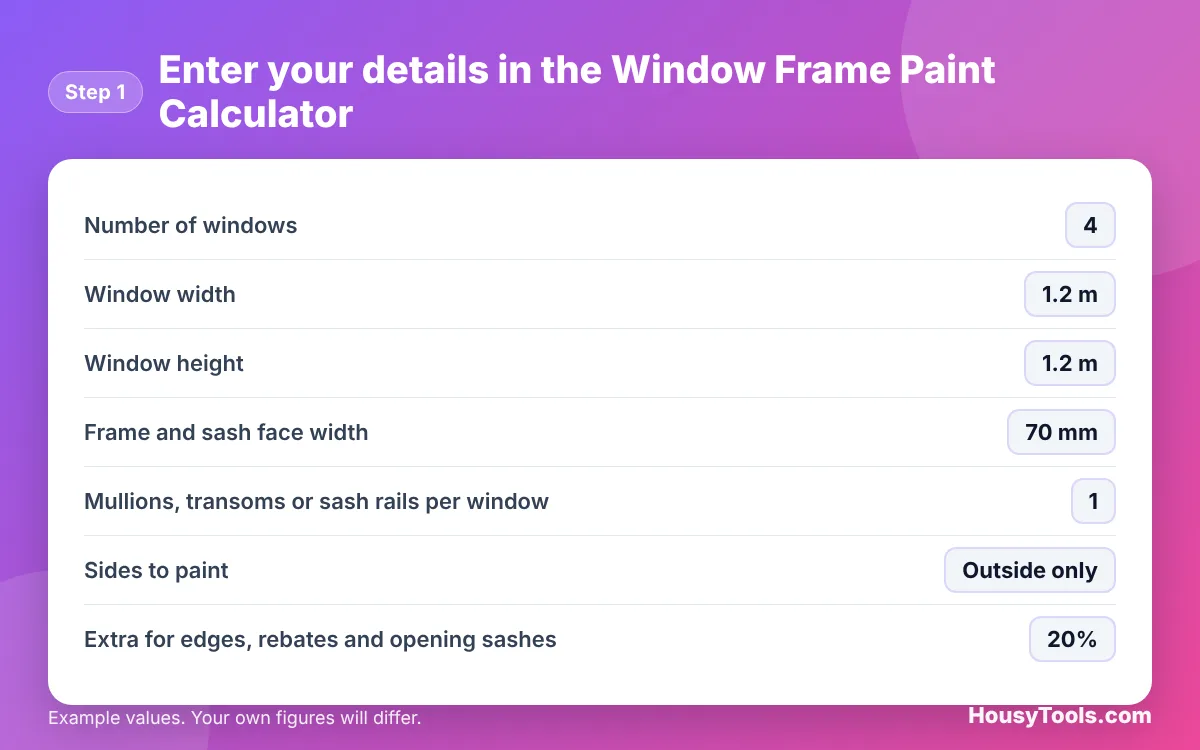
- Enter the Number of windows of the same size, then the Window width and Window height.
- Measure the Frame and sash face width and count the Mullions, transoms or sash rails per window.
- Choose the Sides to paint and set the Extra for edges, rebates and opening sashes.
- Tick Paint the outside sill and enter the Sill depth if needed.
- Enter the Coats, the Paint coverage and the Tin size, and tick Add one coat of undercoat for bare wood.
- Read the litres and tins, then open “Show the formula and working” to see each step.

How Much Paint Do I Need for Window Frames?
Very little: a 1.2 m square timber window takes about 76 ml of exterior gloss for two coats on the outside, including the sill, so one 750 ml tin covers several windows. The table uses a 70 mm frame face, one bar, 20% for edges and a 150 mm sill outside, with two coats at 18 m² per litre outside and 12 m² per litre inside.
| Window size | Outside area with sill | Outside, two coats at 18 m²/L | Inside area | Inside, two coats at 12 m²/L |
|---|---|---|---|---|
| 0.6 x 0.9 m | 0.42 m² | 46 ml | 0.33 m² | 55 ml |
| 0.9 x 1.05 m | 0.55 m² | 61 ml | 0.42 m² | 69 ml |
| 1.2 x 1.2 m | 0.68 m² | 76 ml | 0.50 m² | 84 ml |
| 1.8 x 1.2 m | 0.87 m² | 97 ml | 0.60 m² | 101 ml |
| 2.4 x 1.2 m | 1.07 m² | 118 ml | 0.71 m² | 118 ml |
What Is the Best Paint for Exterior Window Frames?
Use an exterior wood paint system made for windows: a primer on bare wood, an exterior undercoat and an exterior gloss or satin topcoat. Exterior products contain resins that flex with the timber and resist weather, while interior trim paint does not. Paint in dry weather above the minimum temperature on the tin, and leave sashes slightly open until the paint is dry so they do not stick. Uncoated timber may need a primer first; the primer calculator works out how much.
Can You Paint uPVC Window Frames?
You can, but only with a paint or primer made for uPVC, and painting may affect the maker’s guarantee, so check first. Ordinary gloss does not bond well to plastic and can peel. This calculator works the same way for uPVC because the area is the same; only the product and its coverage change.
Worked Example: Four Windows Painted Outside
Example: four timber windows, each 1.2 m by 1.2 m with a 70 mm frame face and one central rail, painted outside with two coats of exterior gloss at 18 m² per litre, sills included. The frame is 2 x (1.2 + 1.2) x 0.07 = 0.336 m² and the rail 1.2 x 0.07 = 0.084 m². With 20% for edges, one side is 0.42 x 1.2 = 0.504 m². The 150 mm sill adds 1.2 x 0.15 = 0.18 m², so each window is 0.684 m² and four are 2.74 m².
Two coats need 2.74 x 2 / 18 = 304 ml, so one 750 ml tin is enough. Painting the inside as well with satinwood at 12 m² per litre needs another 336 ml, so buy a separate 750 ml tin of the interior product. Because the calculator uses one coverage figure, run it once for the outside and once for the inside when the two paints differ. Doors are often painted at the same time; the door paint calculator covers them, and more tools are on the paint and decorating calculators page.
Window Frame Paint Calculator FAQs
How many windows will a 750 ml tin of gloss paint?
At up to 18 m² per litre, a 750 ml tin covers up to 13.5 m² for one coat. With two coats on the outside of 1.2 m square windows at about 0.68 m² each, that is roughly nine or ten windows.
How do I measure a window frame for paint?
Measure the overall width and height of the frame, then the width of visible timber from the glass to the wall. Count any bars across the window and measure the sill depth from front to back, including its front edge.
How many coats do window frames need?
Two topcoats over an undercoat is a common system on bare or weathered exterior wood. On sound paint in good condition, one or two topcoats after a light sand may be enough. Follow the system on the tin.
When is the best time to paint exterior windows?
Paint on a dry day when no rain is due, above the minimum temperature on the tin, and after any dew has dried. Avoid strong direct sun on the frame, which can make paint dry too fast and show brush marks.
Should I paint the putty or seals?
On traditional putty glazed windows, take the paint about 2 mm onto the glass to seal the putty from rain, once the putty has skinned over. Do not paint rubber seals or draught strips, which need to stay flexible.
Why is there an extra allowance for edges?
Opening sashes have edges and rebates that you paint but cannot see when the window is shut. The calculator adds an editable 20% example allowance to cover them. Use less for fixed panes and more for sliding sash windows.
Checked October 2026. Sources: Dulux Trade Weathershield Exterior High Gloss (product page), Dulux Trade Quick Dry Satinwood (product page).