
Show the formula and working
This tile backer board calculator works out how many tile backer boards you need for a bathroom wall, shower enclosure or floor, for DIYers and tilers in the UK, Ireland and Europe. It also counts the screws and washers and estimates the joint tape, works with the common 1200 x 600, 1250 x 600 and 1200 x 800 mm board sizes, and has a feet switch and a pound or euro switch for the cost.
Quick answer: Multiply the width by the height of the area, subtract openings, add 10% for cuts, then divide by the area of one board and round up. A 2.4 m by 2 m shower wall is 4.8 m², which needs 8 boards of 1250 x 600 mm. The tile backer board calculator also counts fixings and joint tape.
What Is a Tile Backer Board Calculator?
A tile backer board calculator is a tool that turns the size of the area you want to tile into the number of backer boards, fixings and joint tape to buy. In plain words: boards = (width x height x number of areas, minus openings) x (1 + wastage) / area of one board, rounded up. Fixings = boards x fixings per board.
Tile backer boards are rigid sheets, usually cement board or an insulated foam core faced with a cement and glass fibre coating, that give tiles a flat, water resistant base. They replace plasterboard or plywood in wet rooms, showers and on timber floors, which is why the count matters before a bathroom refit.
How Do You Use the Tile Backer Board Calculator?
- Measure the area and enter Width of area and Height or depth of area. For a floor, enter its length and width.
- If several walls are the same size, enter that number in Number of identical areas. Otherwise work out each wall separately.
- Enter any window, door or bath front you will not board in Openings to subtract.
- Choose your Board size, or pick Custom size and enter Custom board length and Custom board width.
- Check Wastage and set Fixings per board from your board maker’s fixing guide.
- Type your supplier’s price into Price per board (example) to see the cost.
- Read the number of boards, fixings and joint tape, then open “Show the formula and working” to check each step.

How Many Backer Boards Do I Need for a Shower?
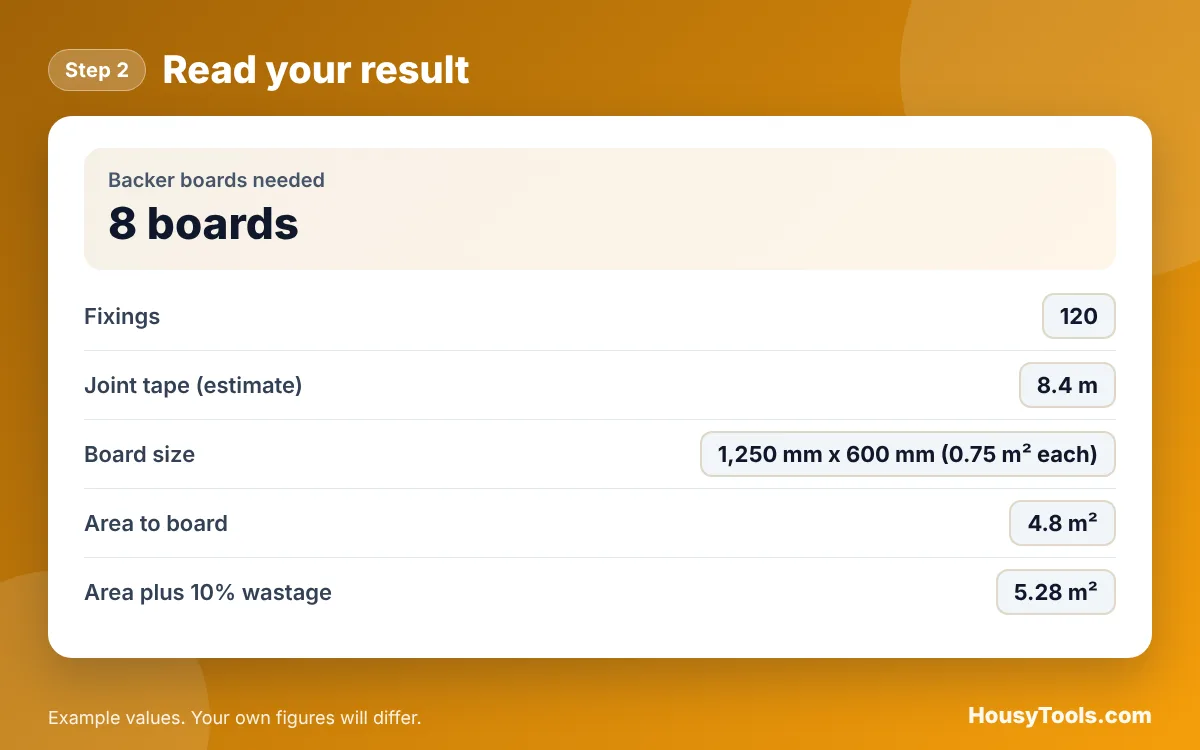
A typical shower wall 2.4 m wide and 2 m high needs 8 boards of 1250 x 600 mm with 10% wastage, so a three wall enclosure of that size needs about 24 boards. Work out each wall on its own if the sizes differ, and add the results together.
Rounding up per wall is safer than rounding the total, because offcuts from one wall rarely fit another neatly. Board the full height you plan to tile, and if the bath or tray is being tiled as well, measure the bath panel as a separate area. To count the tiles that go on top, use the tile calculator with the same measurements.
How Many Screws Do You Need per Backer Board?
Marmox gives 15 screws with washers for a 1250 x 600 mm Multiboard of 10 mm or 12.5 mm on a stud wall, fixed every 300 mm, and 10 for boards 20 mm and thicker on studs at 600 mm centres. That is the default in the calculator, but fixing patterns differ by brand and substrate, so always follow your own board’s guide.
On solid walls and floors, foam core boards are usually bedded on a full coat of flexible cement based tile adhesive as well as, or instead of, mechanical fixings. If your boards are bonded only, set Fixings per board to 0 and use the tile adhesive calculator for the bedding layer.
Do You Need to Tape Backer Board Joints?
Yes, in wet areas every joint between boards should be taped, and the Marmox Multiboard product page lists a self adhesive waterproof tape for the joints and a reinforcing tape for dry areas that will be plastered. The calculator estimates the joints between boards when they are stood upright.
The estimate covers only joints between boards. Internal corners, the junction with the shower tray or bath, and the wall to floor junction usually need tape too, so measure those edges and add them before you buy. In a shower, many installers use a tanking kit over the taped boards.
What Size Do Tile Backer Boards Come In?
The most common tile backer board sizes in the UK are 1200 x 600 mm and 1250 x 600 mm, with 1200 x 800 mm for cement boards such as Hardie Backer and long 2400 or 2500 mm boards for large walls. The table shows how many of each you need for 10 m² with 10% wastage.
| Board size | Area per board | Boards for 10 m² plus 10% |
|---|---|---|
| 1200 x 600 mm | 0.72 m² | 16 |
| 1250 x 600 mm | 0.75 m² | 15 |
| 1200 x 800 mm | 0.96 m² | 12 |
| 2400 x 600 mm | 1.44 m² | 8 |
| 2500 x 600 mm | 1.5 m² | 8 |
| 2400 x 1200 mm | 2.88 m² | 4 |
Smaller boards are easier to carry, cut and fit around pipes on your own, while larger boards mean fewer joints to tape. Thickness depends on the job and the brand: thin boards are mainly for overboarding sound walls and floors, and thicker ones for spanning studs or adding insulation.
Worked Example: A Shower Wall
Example: the back wall of a shower is being boarded, 2.4 m wide and 2 m high, on timber studs. Choose 1250 x 600 mm boards, keep 10% wastage and 15 fixings per board, and enter an example price of £20 per board.
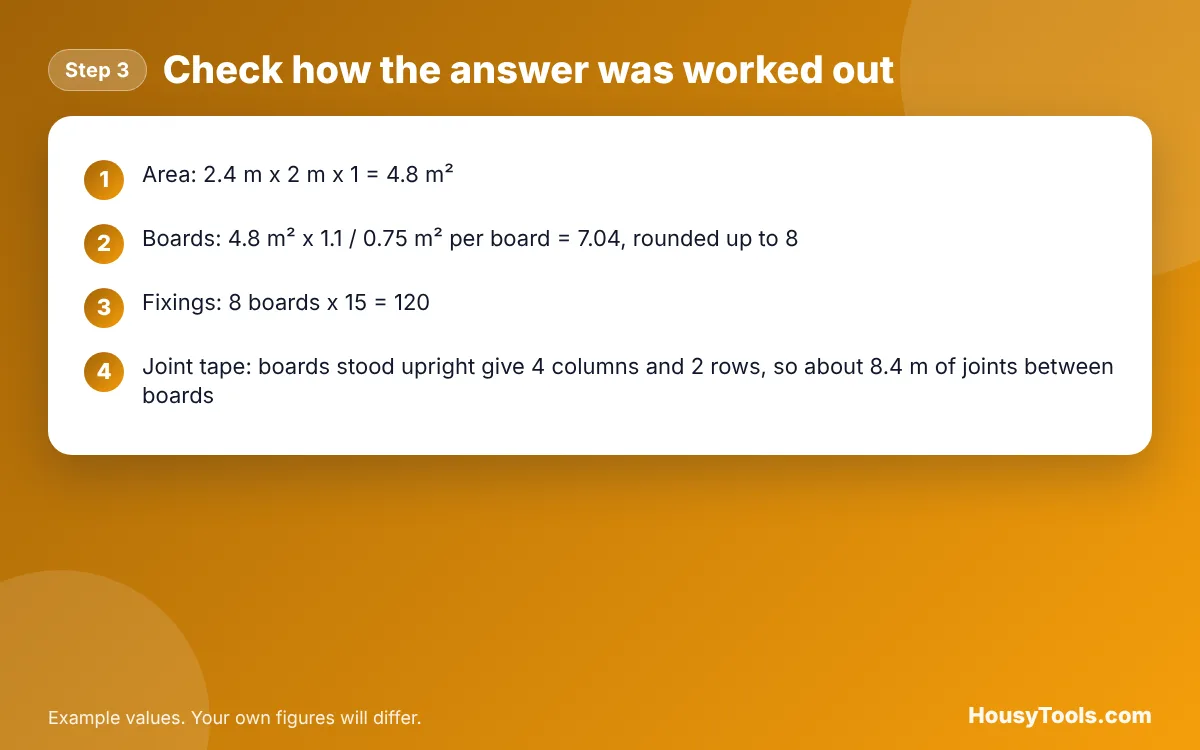
- Area: 2.4 m x 2 m = 4.8 m².
- Boards: 4.8 m² x 1.1 / 0.75 m² = 7.04, rounded up to 8 boards.
- Fixings: 8 x 15 = 120 screws and washers.
- Joint tape: 4 columns and 2 rows of boards give about 8.4 m of joints. The boards cost 8 x £20 = £160.00.
The result of 7.04 shows why rounding matters: seven boards would leave you a few centimetres short once cuts are made. More tools for tiling and floors are on the flooring calculators page.
Tile Backer Board Calculator FAQs
How many backer boards do I need for a bathroom floor?
Multiply the floor length by its width, add 10% and divide by the board area. A 2.4 m by 1.8 m floor is 4.32 m², which needs 7 boards of 1200 x 600 mm. Subtract fixed units such as a bath that will not be boarded underneath.
How much wastage should I allow for backer board?
Allow 10% for a simple wall or floor. Increase it to around 15% for rooms with many pipes, boxing, niches or angled walls, because each awkward cut leaves an offcut that is often too small to reuse.
Can I use backer board instead of plasterboard in a bathroom?
Yes, that is their main use. Backer boards are water resistant and stronger under tiles than standard plasterboard, so they suit showers and wet rooms. Check the maximum tile weight your board is rated for and fix it as the maker specifies.
Do backer boards go on walls or floors?
Both. On walls they are screwed to studs or bonded to solid walls, and on floors they are usually bedded in flexible tile adhesive and, on timber, screwed down as well. The calculator works the same way for both: enter the floor length and width.
How much weight can tile backer board hold?
It depends on the board and the wall. James Hardie rates its 6 mm and 12 mm Hardie Backer boards at 200 kg per m² on timber studs in homes. Foam core boards have their own ratings, so check the data sheet before using large or heavy stone tiles.
Which way should backer boards be fixed?
On stud walls, boards are usually fixed upright so their long edges land on studs, and joints are staggered where possible. The calculator estimates joint tape for boards stood upright. On floors, stagger the joints like brickwork so they do not line up.
Checked October 2026. Sources: Marmox: Multiboard sizes and accessories, James Hardie: Hardie Backer board sizes and load rating, Marmox Multiboard installation instructions (fixings per board).