
Show the formula and working
This gas bill calculator turns two gas meter readings into kilowatt hours and a bill in pounds for UK households, using the same conversion suppliers use. Enter your readings, the calorific value from your bill, your unit rate and standing charge, and you get the cost for the period, the kWh used and every step of the sum. It works with metric and imperial meters and is preset to the Ofgem price cap for October to December 2026.
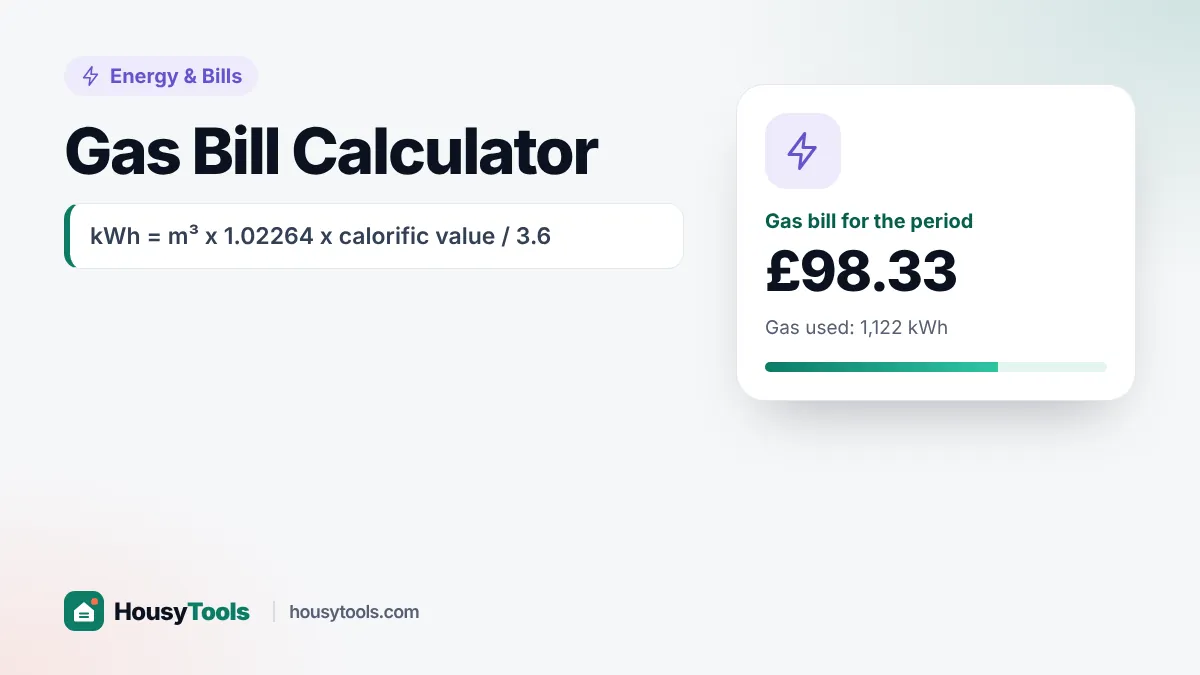
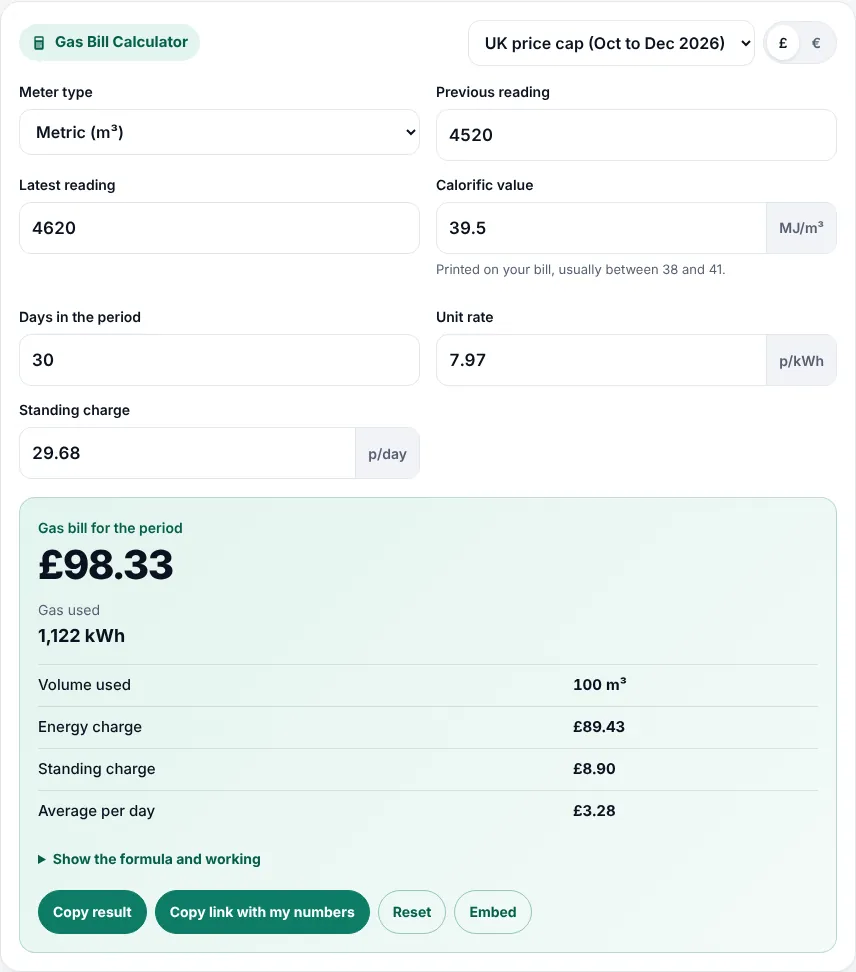
Quick answer: a gas bill calculator subtracts your previous meter reading from the latest one, converts the volume to kWh (cubic metres x 1.02264 x calorific value / 3.6), multiplies by your unit rate and adds the standing charge. At the October 2026 price cap, 100 m³ over 30 days costs about £98.
What Is a Gas Bill Calculator?
A gas bill calculator is a tool that converts the gas volume recorded on your meter into energy (kWh) and then into money, so you can check or predict a bill.
Gas meters measure volume, but suppliers charge for energy. The formula in plain words: take the units used (latest reading minus previous reading). If your meter is imperial, multiply by 2.83 to turn hundreds of cubic feet into cubic metres. Multiply the cubic metres by the volume correction factor of 1.02264, then by the calorific value, and divide by 3.6 to get kWh. Finally, multiply the kWh by your unit rate and add the standing charge for every day in the period.
These are the same steps set out in the government guide to gas meter readings and bill calculation, so the result of this gas bill calculator should match your supplier’s maths when you use the same inputs.
How Do You Use the Gas Bill Calculator?
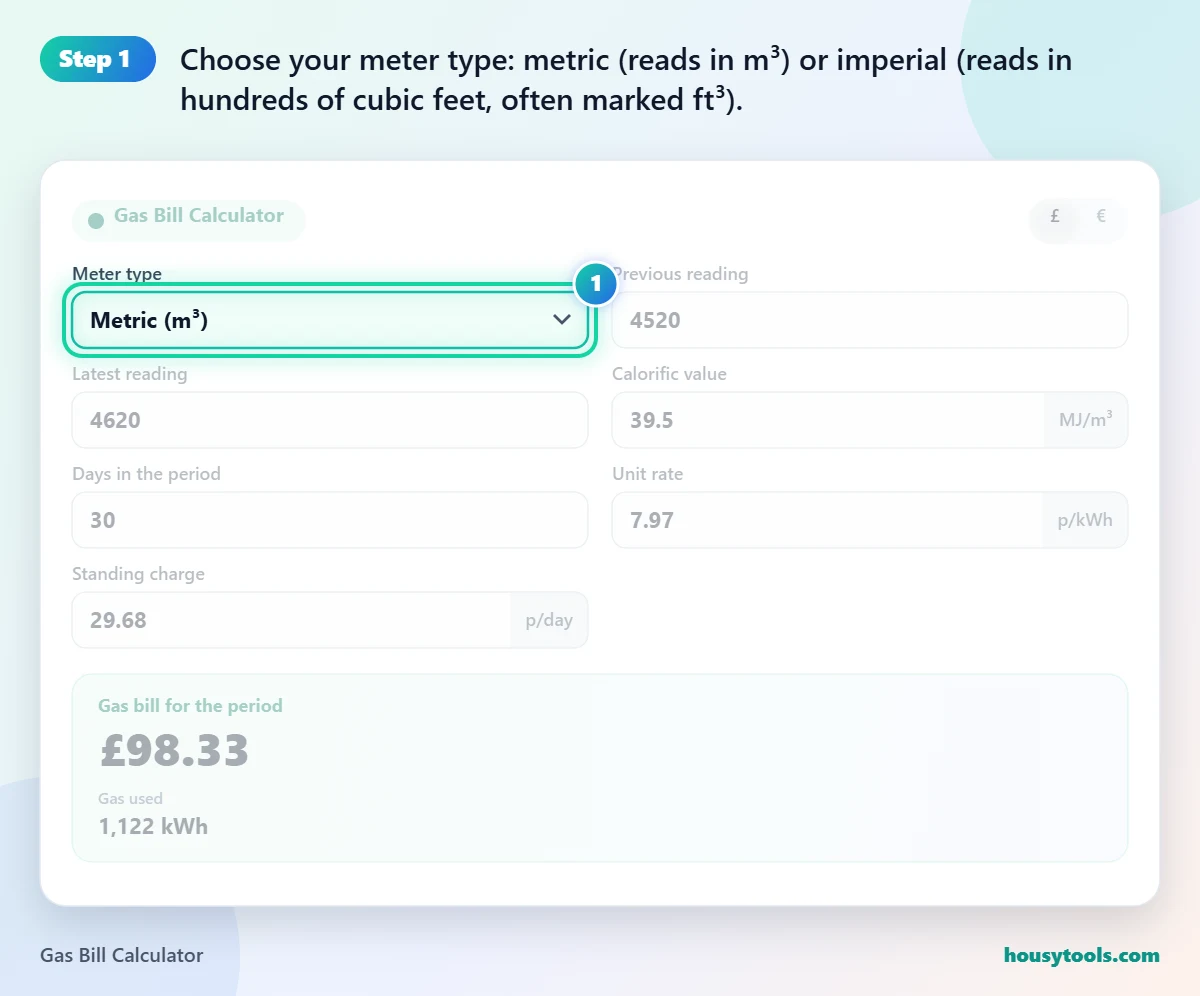
- Choose your meter type: metric (reads in m³) or imperial (reads in hundreds of cubic feet, often marked ft³).
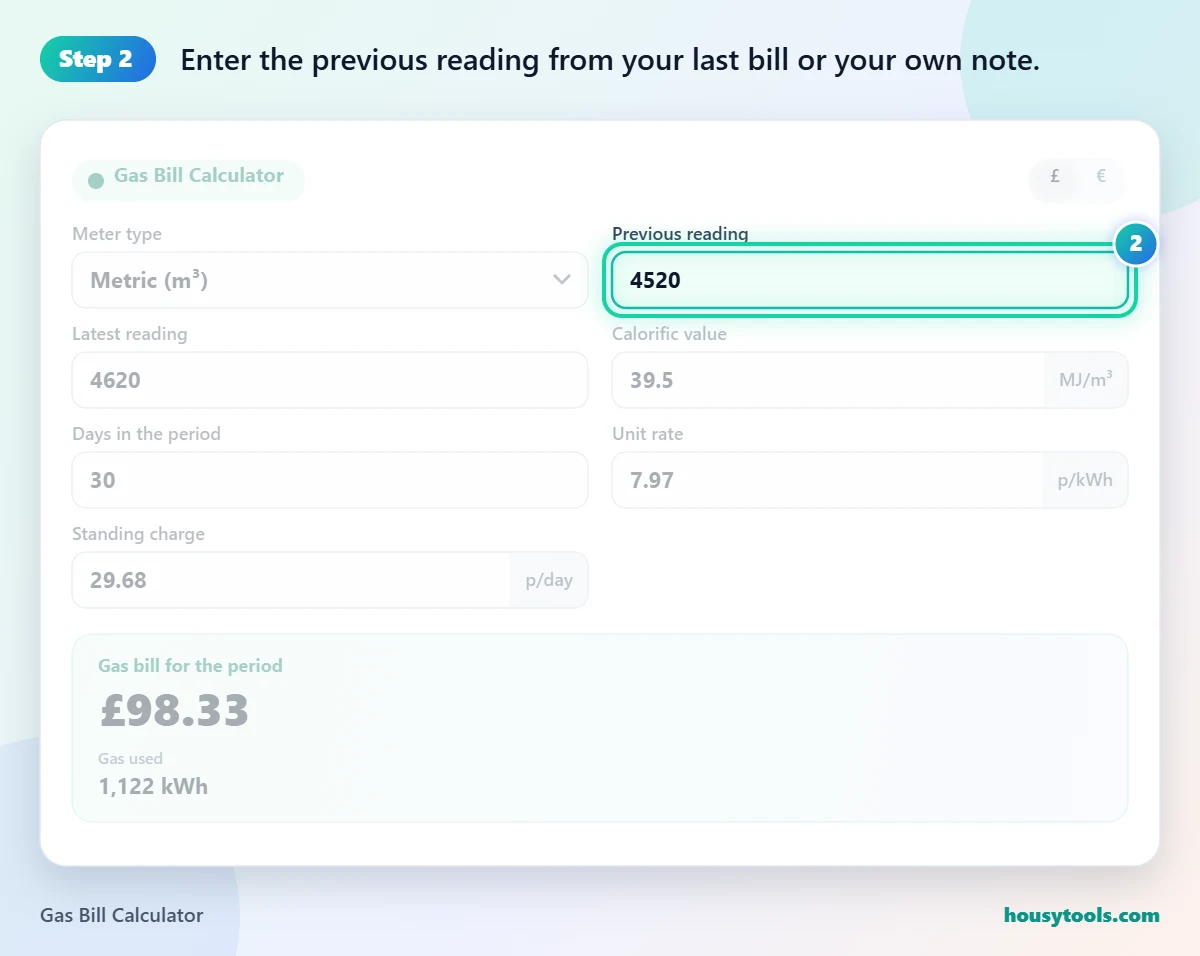
- Enter the previous reading from your last bill or your own note. Use only the black or white digits before the decimal point.
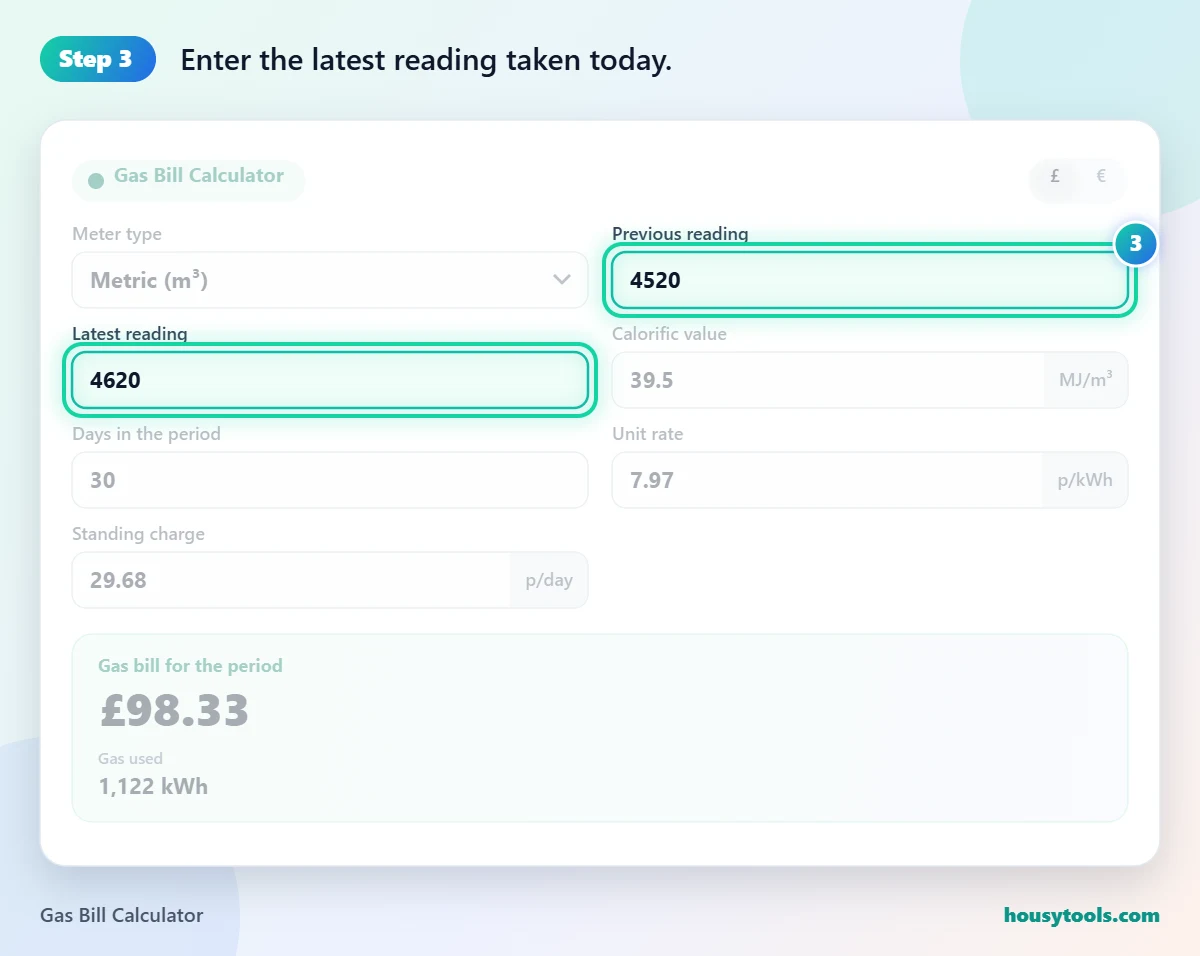
- Enter the latest reading taken today. The gas bill calculator warns you if it is lower than the previous one.
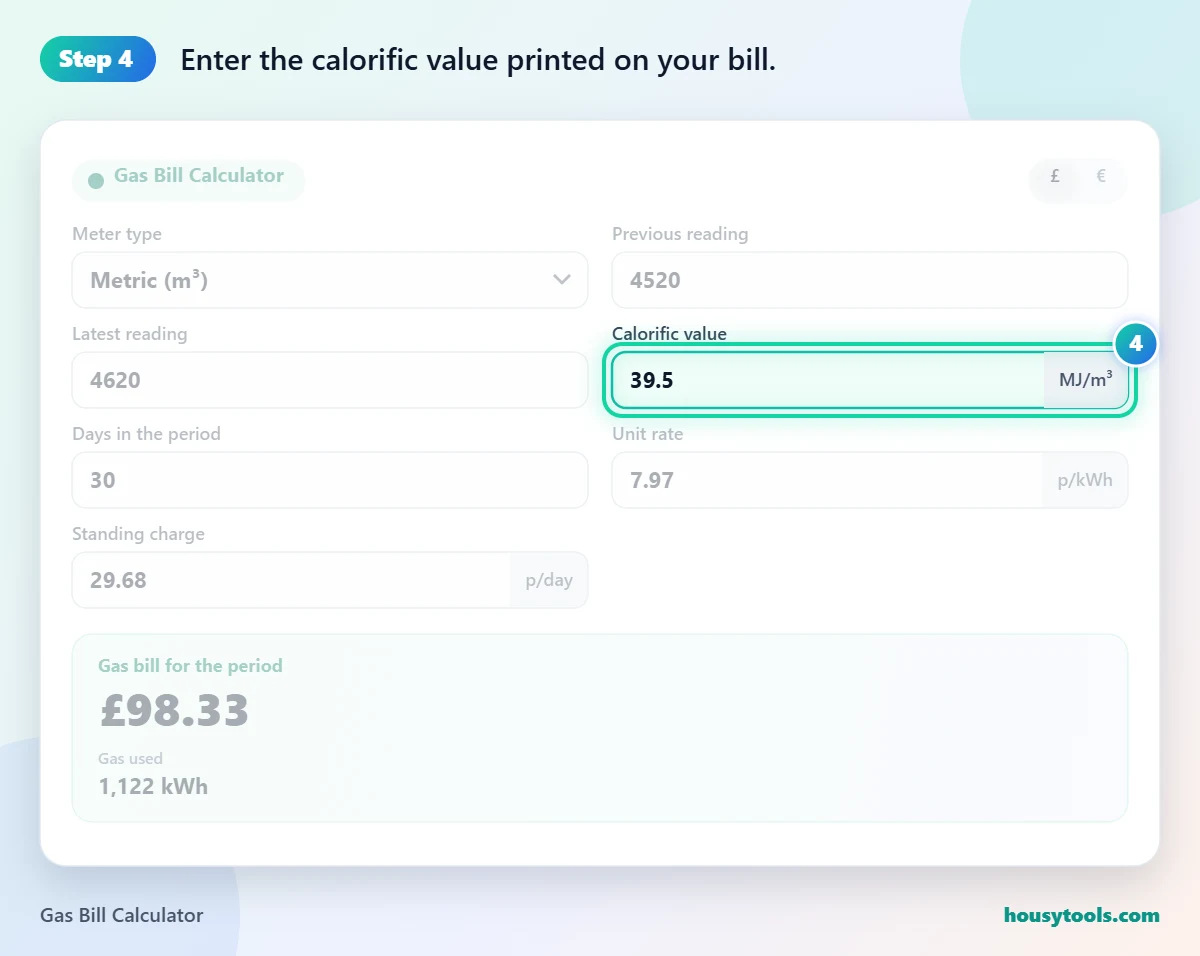
- Enter the calorific value printed on your bill. Leave the 39.5 MJ/m³ default if you do not have it.
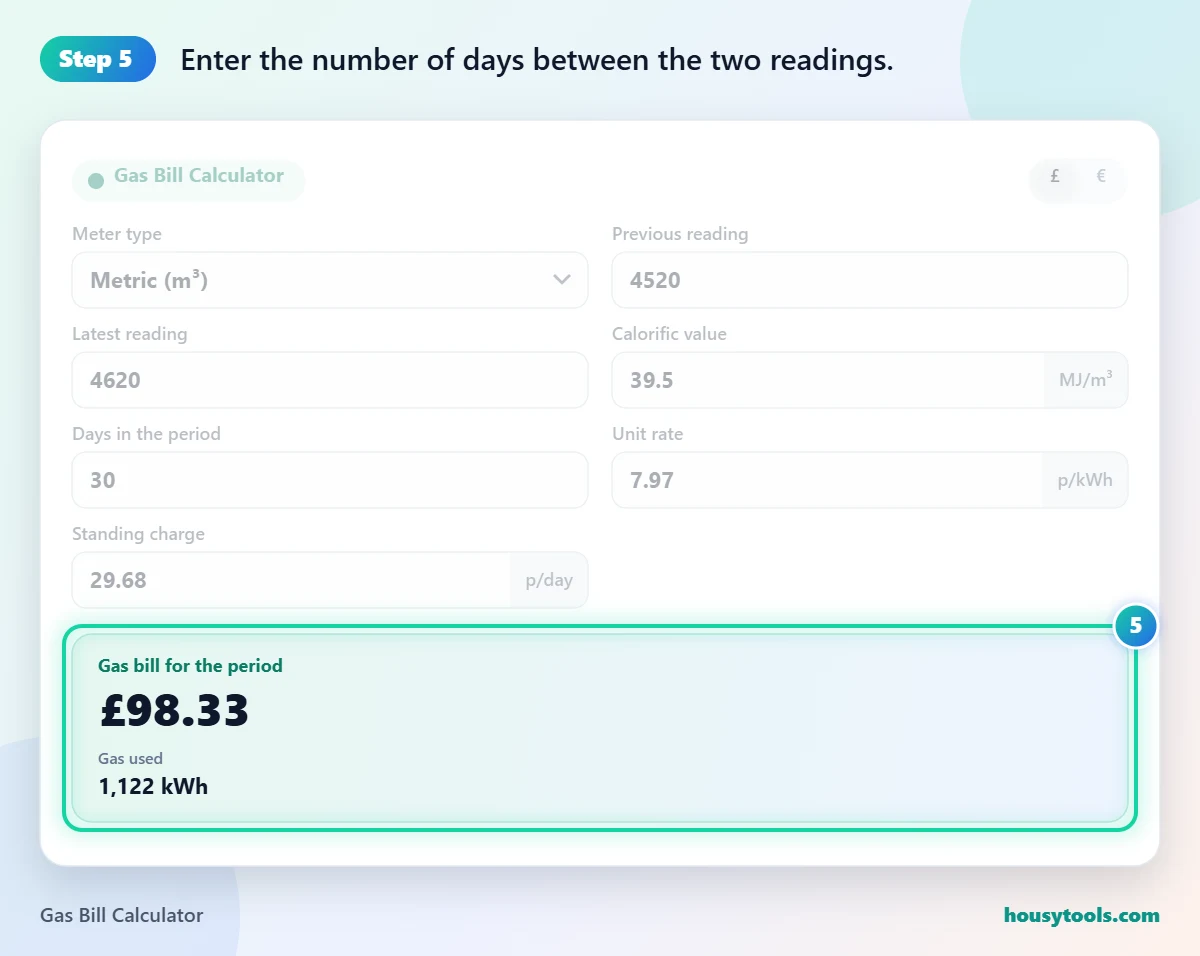
- Enter the number of days between the two readings.
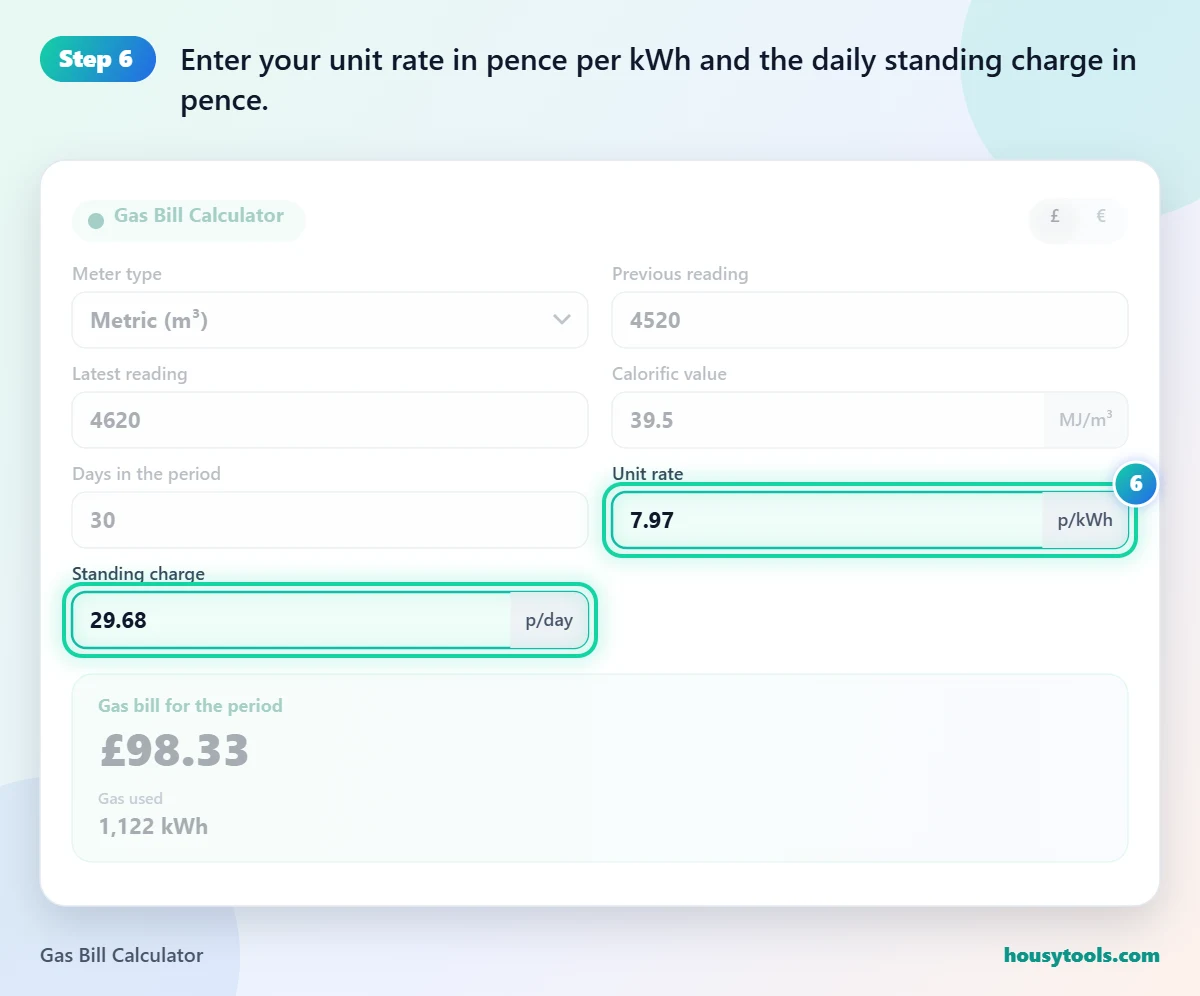
- Enter your unit rate in pence per kWh and the daily standing charge in pence. The defaults are the Ofgem cap for October to December 2026.
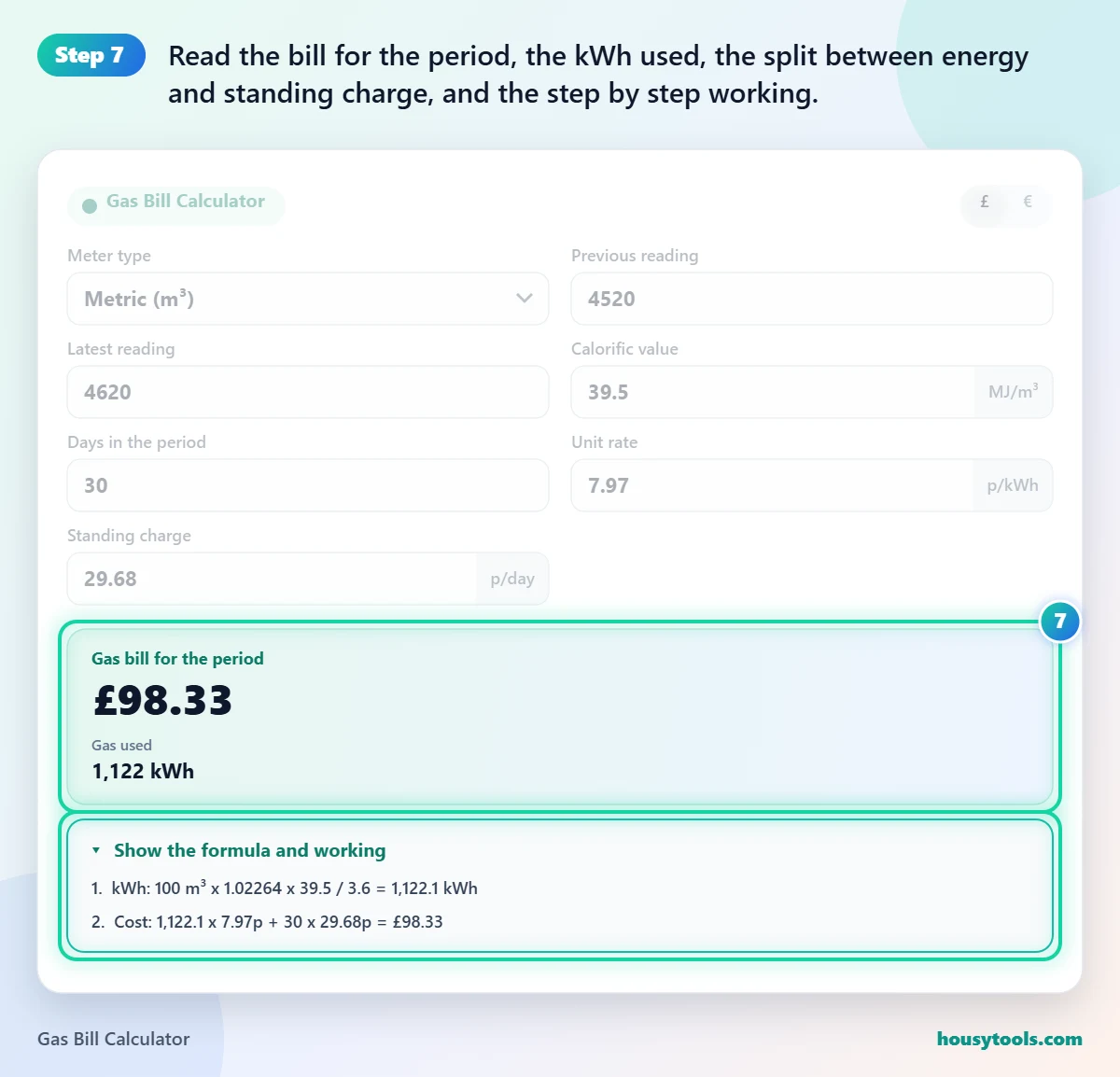
- Read the bill for the period, the kWh used, the split between energy and standing charge, and the step by step working.
How Much Is Gas per kWh in the UK Right Now?
Under the Ofgem price cap from 1 October to 31 December 2026, gas averages 7.97p per kWh plus a standing charge of 29.68p per day for direct debit customers in Great Britain. These figures include 5% VAT, so do not add VAT again when you use them in the gas bill calculator.
The cap limits the rates on standard variable tariffs, not your total bill, and the exact figures vary slightly by region and payment method. Ofgem lists every regional rate on its price cap unit rates page. If you are on a fixed tariff, type your own rates from your bill or online account instead of the defaults.
For context, Ofgem’s typical domestic consumption value for a medium gas user is 9,500 kWh a year from 1 July 2026, down from 11,500 kWh. At cap rates that is roughly £757 of energy plus £108 of standing charges over a year.
Why Is the Calorific Value on My Gas Bill Important?
The calorific value tells you how much energy each cubic metre of gas holds, and every 1 MJ/m³ change shifts your kWh by about 2.5%. Gas from the network usually sits between 38 and 41 MJ/m³, and suppliers use the average for your billing period.
Most UK bills print it near the meter readings, sometimes as “CV”, and the gas bill calculator lets you type it in to one decimal place. If you leave the default of 39.5, the gas bill calculator will be within a few per cent for most homes. For an exact check against a bill, always copy the value from that bill.
The 1.02264 factor is different: it is a fixed correction for temperature and pressure that applies to standard domestic meters, so you never need to change it.
How Many kWh Is 100 m³ of Gas?
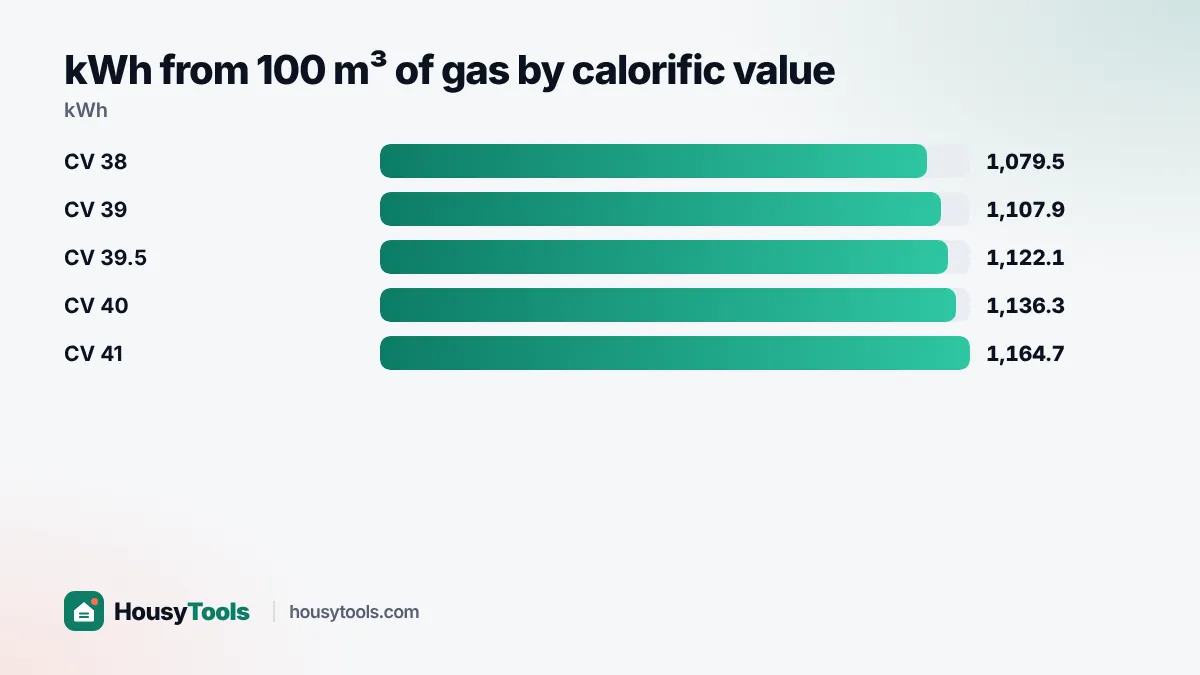
100 m³ of gas is about 1,122 kWh at a calorific value of 39.5 MJ/m³, and between roughly 1,080 and 1,165 kWh across the normal range. The table shows results from this gas bill calculator for 100 m³ over 30 days at the October 2026 cap rates.
| Calorific value (MJ/m³) | kWh from 100 m³ | Bill for 30 days |
|---|---|---|
| 38 | 1,079.5 | £94.94 |
| 39 | 1,107.9 | £97.20 |
| 39.5 | 1,122.1 | £98.33 |
| 40 | 1,136.3 | £99.46 |
| 41 | 1,164.7 | £101.73 |
How Do I Know if My Gas Meter Is Metric or Imperial?
A metric meter shows “m³” and usually five digits before a decimal point, while an imperial meter shows “ft³” or “cubic feet” and four digits. Older homes can still have imperial meters, so check the face of the meter rather than guessing.
Imperial units are hundreds of cubic feet, so each unit is 2.83 m³. A rise of 100 imperial units is 283 m³, which the gas bill calculator turns into about 3,175 kWh at a calorific value of 39.5. Picking the wrong meter type is the biggest single error people make: it changes the result by a factor of 2.83.
Worked Example: Priya’s Winter Gas Bill
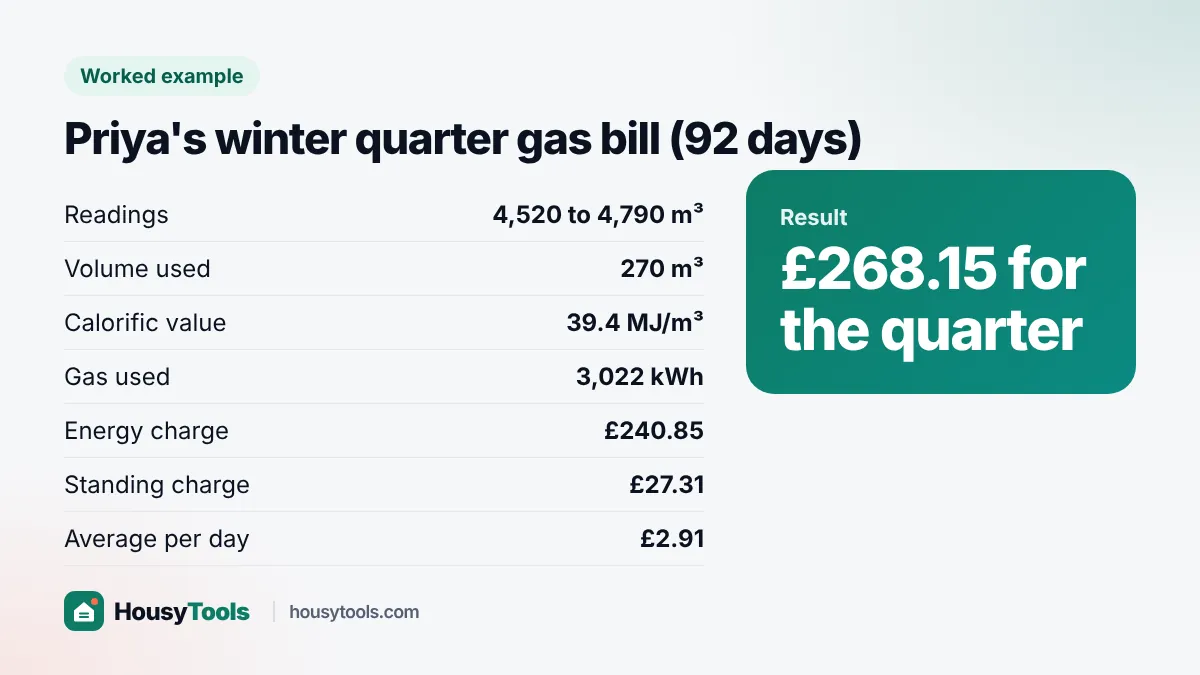
Priya lives in a three bedroom semi in Leicester with a metric meter. Her reading on 1 October was 4,520 and on 1 January it was 4,790, a period of 92 days. Her bill shows a calorific value of 39.4 MJ/m³ and she pays the price cap direct debit rates.
- Units used: 4,790 minus 4,520 = 270 m³
- kWh: 270 x 1.02264 x 39.4 / 3.6 = 3,021.9 kWh
- Energy charge: 3,021.9 x 7.97p = £240.85
- Standing charge: 92 x 29.68p = £27.31
- Total: £268.15, or £2.91 a day on average
Running the gas bill calculator for each quarter shows how much winter drives the total. Winter quarters are always the dearest, so Priya should not multiply this by four to estimate a year. If she wants to compare it with a heat pump, the heat pump running cost calculator takes her yearly gas kWh and boiler efficiency as a starting point.
Common Mistakes When Working Out a Gas Bill
- Including the red digits or digits after the decimal point. Use only the main black or white numbers.
- Choosing metric for an imperial meter, or the other way round.
- Adding 5% VAT on top of price cap rates that already include it.
- Comparing against an estimated bill. Look for an “E” next to the reading and send an actual reading instead.
- Forgetting the standing charge, which you pay every day even when the boiler is off.
- Using the wrong number of days. Count from the date of the previous reading to the date of the latest one.
If the gas bill calculator and the bill still differ, ask your supplier for the calorific value and readings they used. Never open, move or adjust a gas meter or appliance yourself: that work is for a Gas Safe registered engineer, and if you smell gas, call the National Gas Emergency Service on 0800 111 999.
Does the Gas Bill Calculator Work Outside the UK?
The gas bill calculator works in Europe too, if your bill gives a conversion factor and calorific value, because most European suppliers also convert cubic metres to kWh before charging. Set the calorific value from your bill and enter your local unit rate and standing charge in cents. Where a bill combines correction and calorific value into one factor, enter the volume and adjust the calorific value so the kWh match your bill once, then reuse it.
To plan your whole energy budget, pair this tool with the electricity bill calculator, or browse every tool in the energy and bills hub. You can read how we test each formula on our how our calculators work page.
Gas Bill Calculator FAQs
How do I convert gas units to kWh?
Multiply cubic metres by 1.02264 and by the calorific value, then divide by 3.6. For an imperial meter, multiply the units by 2.83 first. At a calorific value of 39.5, one cubic metre gives about 11.2 kWh.
How much gas does an average UK house use?
Ofgem’s typical domestic consumption value for a medium gas user is 9,500 kWh a year from 1 July 2026. Low users are around 6,000 kWh and high users around 14,000 kWh, depending on home size, insulation and heating habits.
Is VAT included in the gas price cap rates?
Yes. Ofgem’s gas cap rates of 7.97p per kWh and 29.68p per day for October to December 2026 already include 5% VAT. Leave VAT out of your sum when you use these figures, or you will overstate the bill.
Why is my gas bill higher than my calculation?
The usual reasons are an estimated reading, a different calorific value, extra days in the billing period or an older debt added to the account. Check the readings marked on the bill, then enter the exact figures into the gas bill calculator again.
What is the standing charge on a gas bill?
It is a fixed daily amount that covers the cost of supplying gas to your home, paid even when you use none. Under the October to December 2026 price cap it averages 29.68p a day, about £108 a year.
How often should I read my gas meter?
Submitting a reading at least once a month, and whenever your tariff or prices change, keeps your bills accurate. Smart meters send readings automatically, but it is still worth checking the display against your bill now and then.
Checked October 2026. Sources: GOV.UK gas meter readings and bill calculation, Ofgem energy price cap rates, Ofgem typical domestic consumption values decision 2026.