
Show the formula and working
This free water tank size calculator works out how many litres a rectangular, upright or horizontal tank holds, in litres, cubic metres and UK and US gallons, for loft cisterns, rainwater tanks and storage tanks in the UK, Ireland and Europe. It also gives the weight of the water and how many days of supply the tank holds at your daily use.
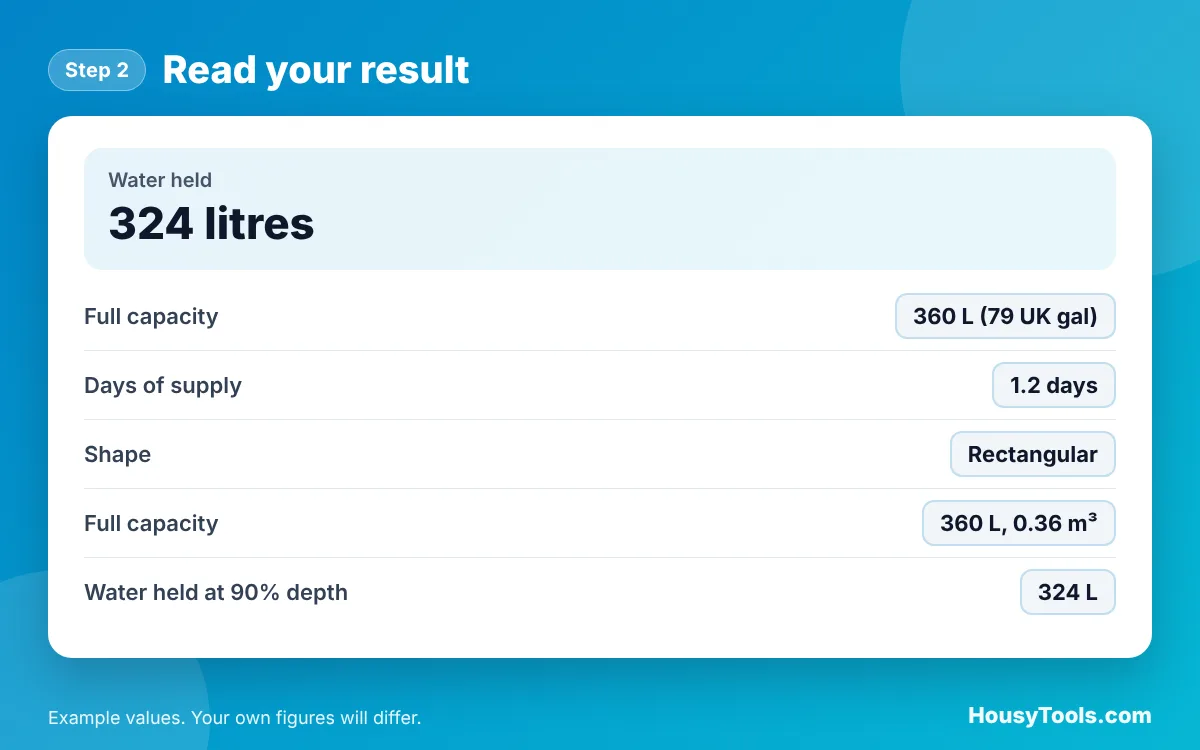
Quick answer: A water tank size calculator multiplies the inside length, width and height in centimetres and divides by 1,000 for litres. A 100 x 60 x 60 cm cistern holds 360 litres when full, or 324 litres at 90% depth, which weighs about 324 kg and lasts about 1.2 days for two people.
What Is a Water Tank Size Calculator?
A water tank size calculator is a tool that turns a tank’s inside measurements into the volume of water it holds, and shows the weight and how long that water lasts.
The formula in plain words: a rectangular tank holds length times width times height, and an upright cylinder holds 3.1416 times the radius squared times the height. In centimetres, divide by 1,000 for litres. A horizontal cylinder that is part full holds less than its depth suggests, because its curved sides narrow towards the bottom, so the calculator uses the area of a circular segment. Litres divided by 4.54609 give UK gallons.
How Do You Use the Water Tank Size Calculator?
- Choose the Tank shape.
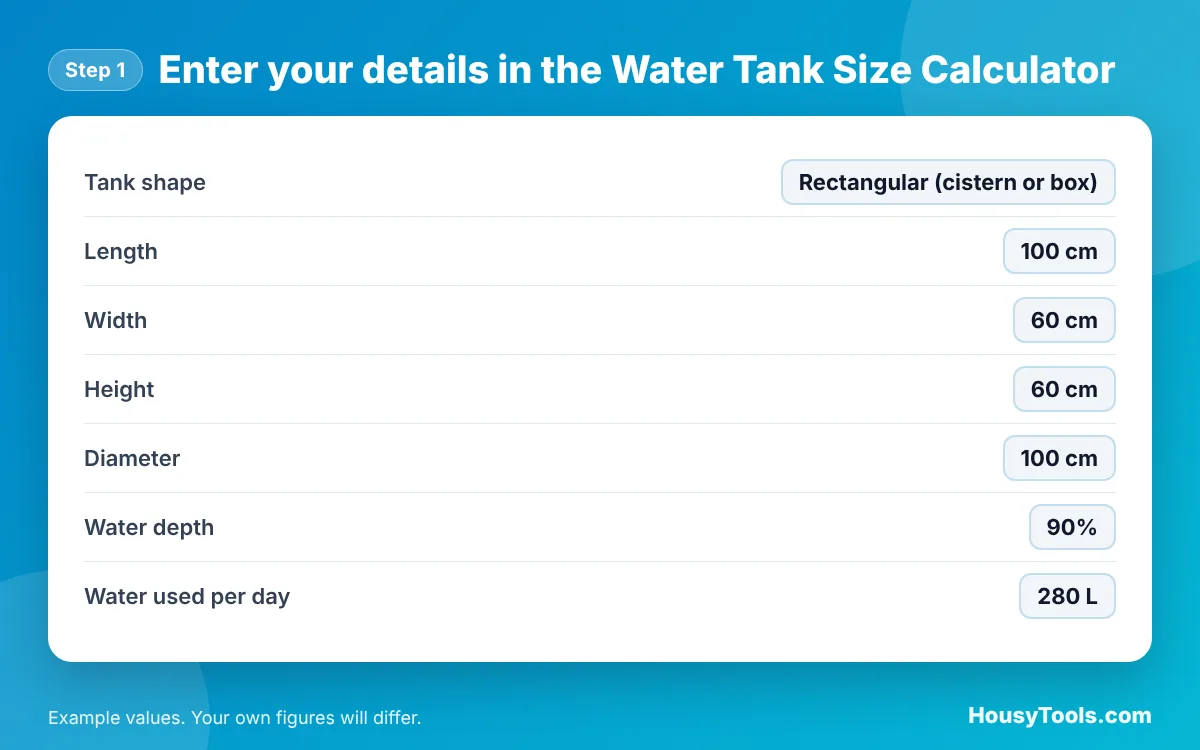
- Measure the inside of the tank and enter the Length, Width and Height, or the Diameter for a cylinder.
- Enter the Water depth as a percentage of the height, since most tanks never fill to the brim.
- Enter the Water used per day to see how many days the tank lasts.
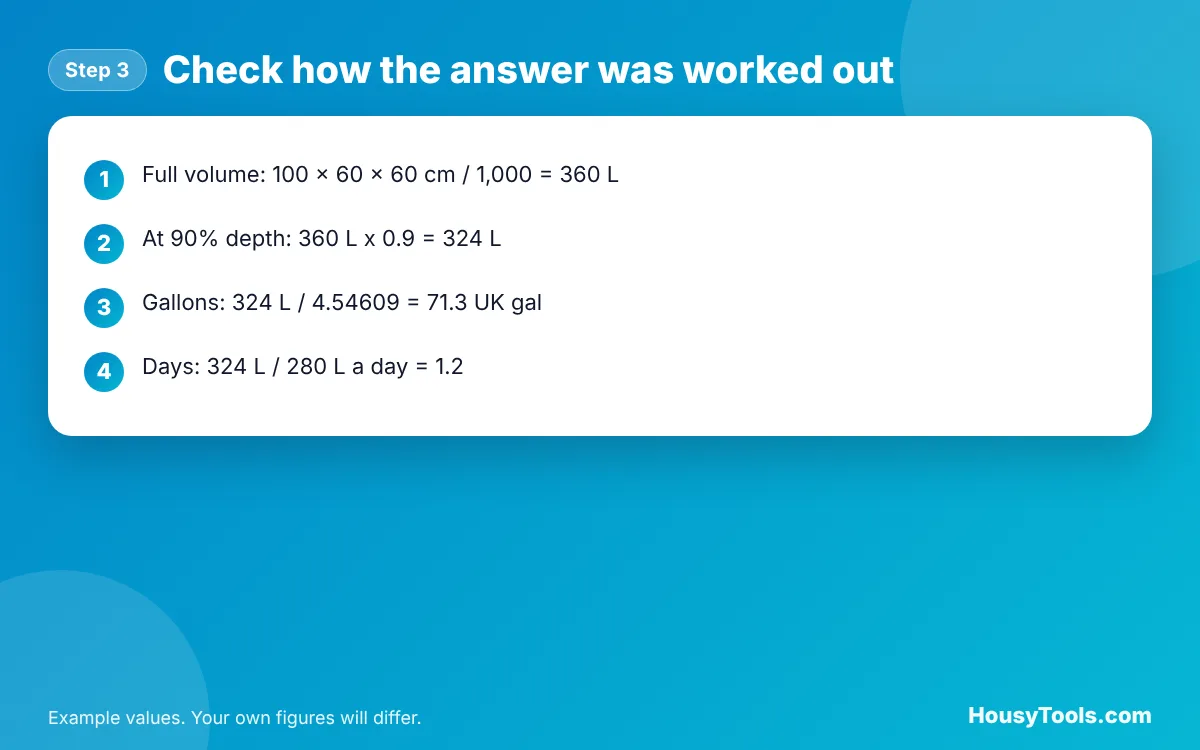
- Read the litres, gallons, weight and days of supply, then open “Show the formula and working” to see the sums.
How Do You Work Out Litres in a Tank?
Multiply the inside length, width and depth of water in centimetres and divide by 1,000, because one litre is 1,000 cubic centimetres, as defined on Wikipedia’s litre page. In metres, multiply the three sizes and then multiply by 1,000 instead. A tank 1 m by 1 m by 1 m holds 1,000 litres, or one cubic metre. Measure inside the walls, not outside, because plastic and steel tanks have thick sides.
How Many Gallons Is My Tank?
Divide the litres by 4.54609 for UK gallons or by 3.785411784 for US gallons, the exact definitions given on Wikipedia’s gallon page. A 360 litre cistern is about 79 UK gallons or 95 US gallons. Older UK loft tanks were often described in gallons, so the litres to gallons converter helps when replacing one.
How Much Does a Full Water Tank Weigh?
Water weighs about 1 kg per litre, so a tank holding 324 litres carries about 324 kg of water, plus the weight of the tank. That is why a loft cistern must sit on a strong, level platform that spreads the load across several joists, never on the ceiling boards. Large tanks on a floor, flat roof or stand may need a structural check before they are filled.
How Full Is a Horizontal Tank at a Given Depth?
A horizontal cylindrical tank holds less than its depth suggests near the bottom and top, and exactly half at half depth. At 25% depth it is only 19.6% full, and at 75% depth it is 80.4% full. The table below works for any horizontal cylinder with flat ends, such as many water and oil tanks; the heating oil tank calculator covers fuel tanks.
Horizontal Cylinder: Depth Against Volume
| Water depth (% of diameter) | Volume held (% of full) |
|---|---|
| 10% | 5.2% |
| 20% | 14.2% |
| 25% | 19.6% |
| 30% | 25.2% |
| 40% | 37.4% |
| 50% | 50.0% |
| 60% | 62.6% |
| 70% | 74.8% |
| 75% | 80.4% |
| 80% | 85.8% |
| 90% | 94.8% |
Worked Example: A Loft Cold Water Cistern
Example: a rectangular loft cistern measuring 100 cm long, 60 cm wide and 60 cm high inside, filled to 90% depth, in a home using 280 litres a day. These are the default inputs.
- Full capacity: 100 x 60 x 60 / 1,000 = 360 litres, or 79 UK gallons.
- At 90% depth: 360 x 0.9 = 324 litres, which is 71.3 UK gallons or 85.6 US gallons.
- Weight of the water: about 324 kg.
- Days of supply: 324 / 280 = 1.2 days.
The 280 litres a day is two people at the England average of about 140 litres each, according to Waterwise. For a horizontal tank 100 cm across and 100 cm long, choose Horizontal cylinder: it holds 785 litres full and 393 litres at half depth.
Water Tank Size Calculator FAQs
How many litres is a 1 m³ tank?
A 1 m³ tank holds 1,000 litres when full, which is about 220 UK gallons or 264 US gallons. Intermediate bulk containers sold for rainwater are often about this size, with a little extra above the nominal figure.
Why does my cistern not fill to the top?
A cold water cistern is set so the water stops below the overflow pipe, leaving an air gap. The float valve shuts off at that level, so the working volume is less than the full size. Measure the water depth for an accurate figure.
How do I measure a round tank?
Measure the inside diameter across the widest point, then the inside height for an upright tank or the inside length for a horizontal one. If you can only reach the outside, measure the circumference and divide by 3.1416 for the diameter, then subtract the wall thickness.
How big a water tank do I need?
Multiply your daily use by the days of storage you want. At about 140 litres per person a day, two people need about 280 litres for each day of supply. For rainwater storage, the rainwater harvesting method sizes a tank from roof area and demand instead.
Does the tank shape change the litres?
Yes. A cylinder holds about 78.5% of a box with the same width, depth and height, because its round sides leave the corners empty. Choose the right shape in the calculator for an accurate result.
Is a loft water tank drinkable?
In most UK homes the kitchen cold tap comes straight from the mains, while a loft cistern feeds other taps and the hot water. Water stored in a cistern is not usually treated as drinking water, so drink from the mains-fed kitchen tap.
For more volume tools, see the area and volume converters, including the cubic metre calculator.
Checked October 2026. Sources: Litre (Wikipedia), Gallon (Wikipedia), Save water (Waterwise).