
Show the formula and working
This topsoil calculator works out how much topsoil you need for a lawn, bed or border, in cubic metres, tonnes, small bags and bulk bags. Enter the length, width and depth in metres or feet, add a little for settling, and it shows the volume, an estimated weight and how many bags to order, plus the cost if you add a price.
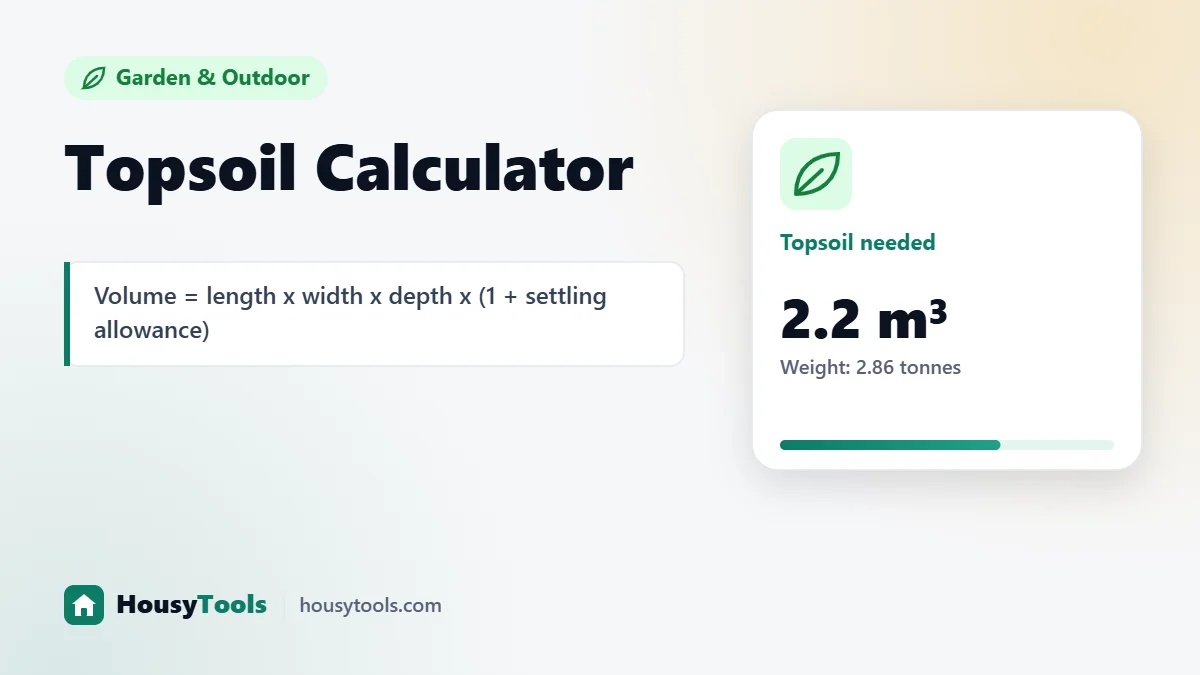
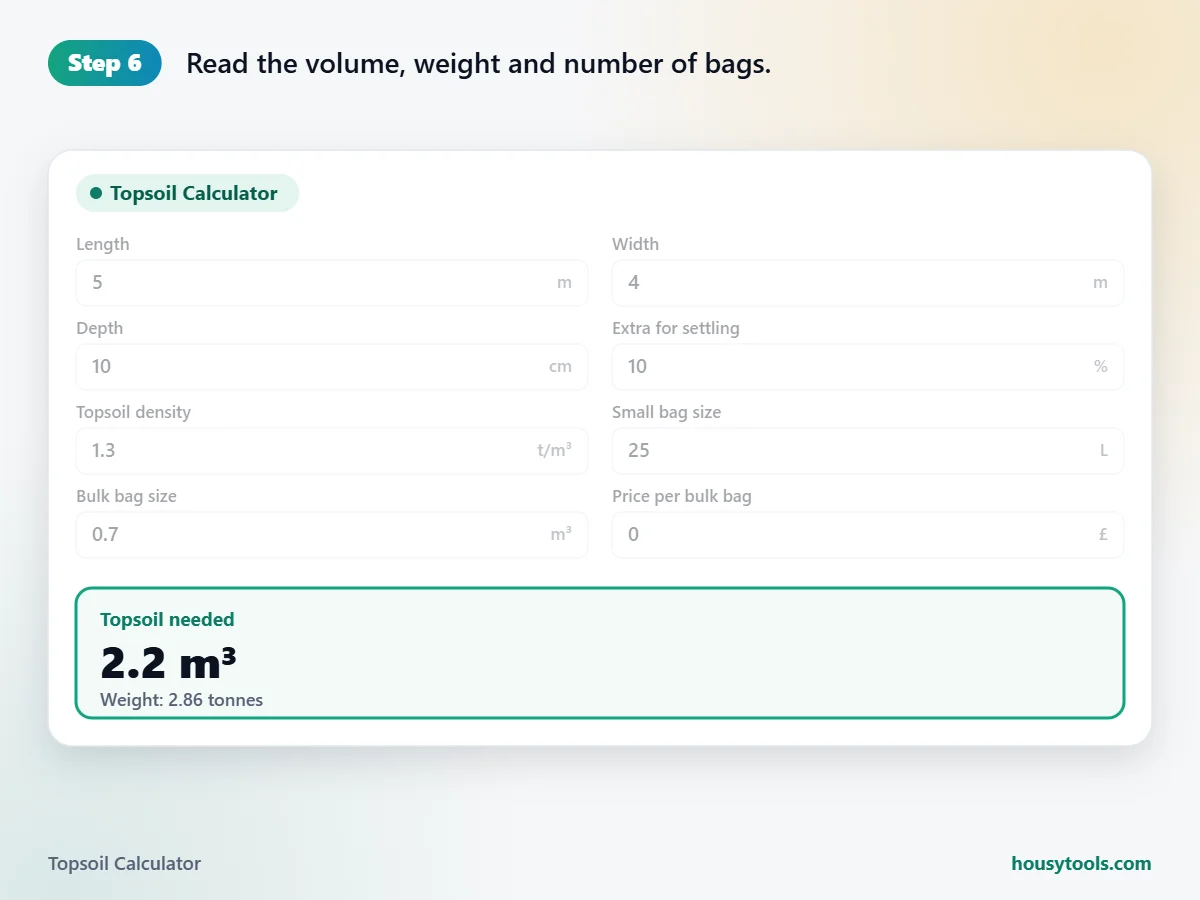
Quick answer: To work out how much topsoil you need, multiply length by width by depth in metres, then add about 10% for settling. A 5 m by 4 m area at 10 cm deep needs 2 m³, or about 2.2 m³ with settling. At an example density of 1.3 tonnes per m³ that weighs about 2.9 tonnes.
What Is a Topsoil Calculator?
A topsoil calculator is a tool that converts the size and depth of an area into the volume of topsoil to order, and estimates its weight and the number of bags.
The formula in plain words: area equals length times width. Volume equals area times depth, with the depth converted from centimetres to metres. Because loose soil sinks once it is spread, raked and watered, the calculator adds a settling allowance. Volume times density gives the weight in tonnes, and volume divided by the bag size, rounded up, gives the number of bags.
How Do You Use the Topsoil Calculator?
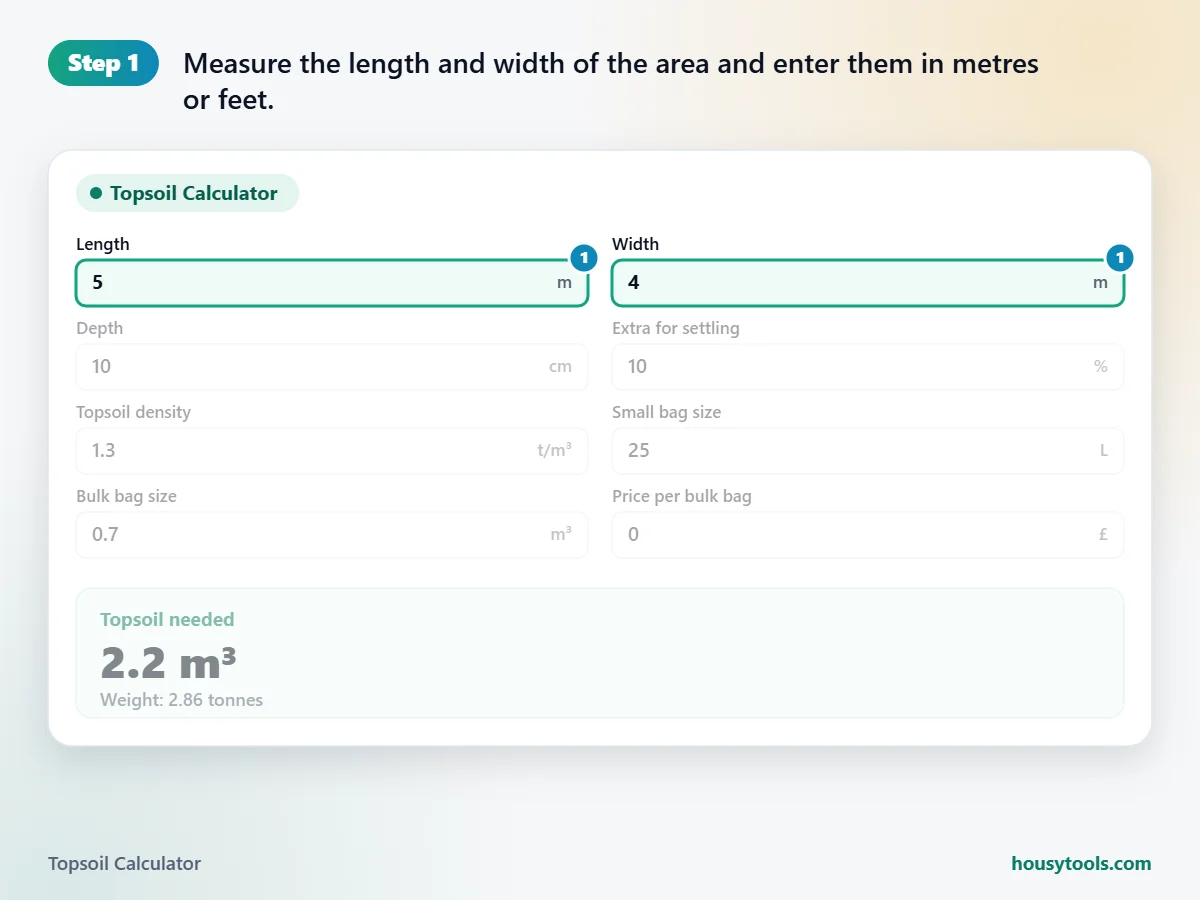
- Measure the length and width of the area and enter them in metres or feet.
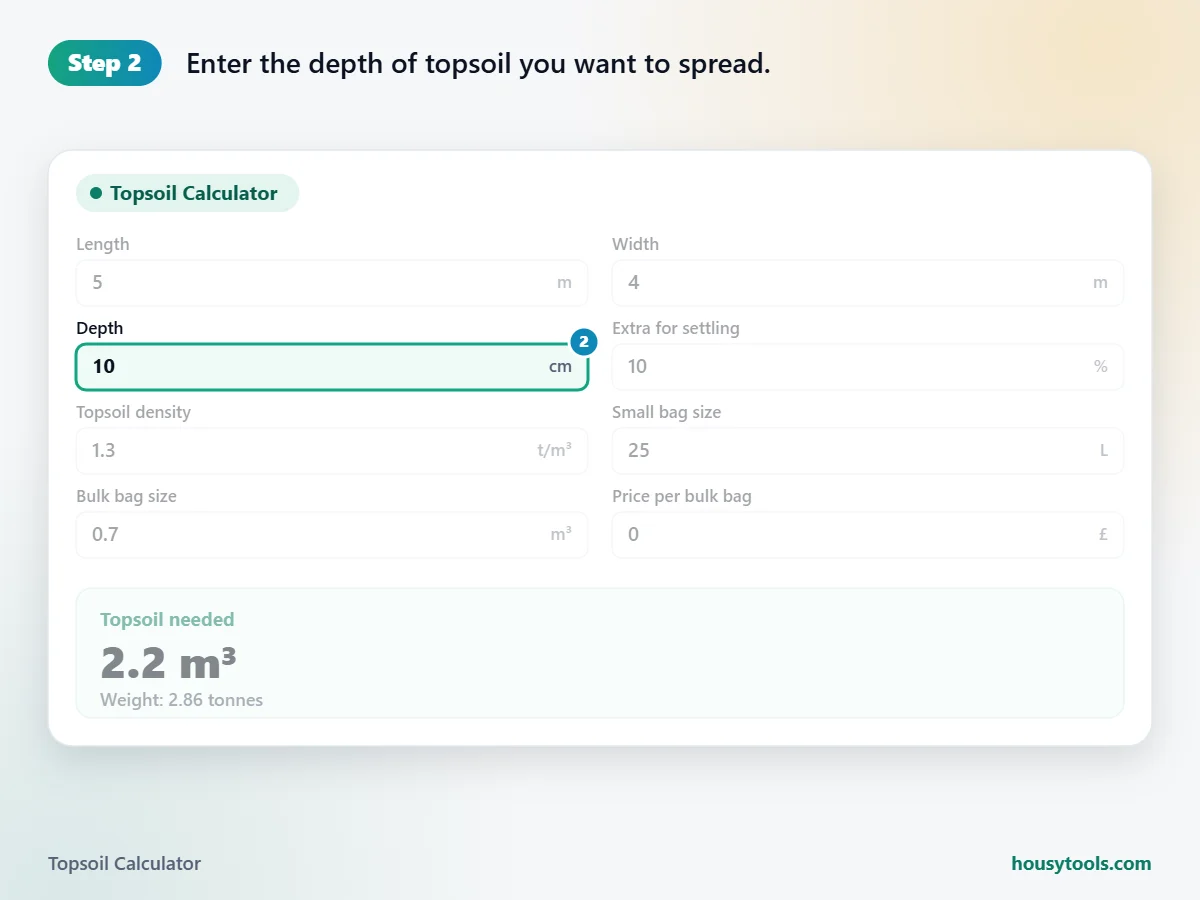
- Enter the depth of topsoil you want to spread.
- Set an extra allowance for settling.
- Enter the density from your supplier to see the weight.
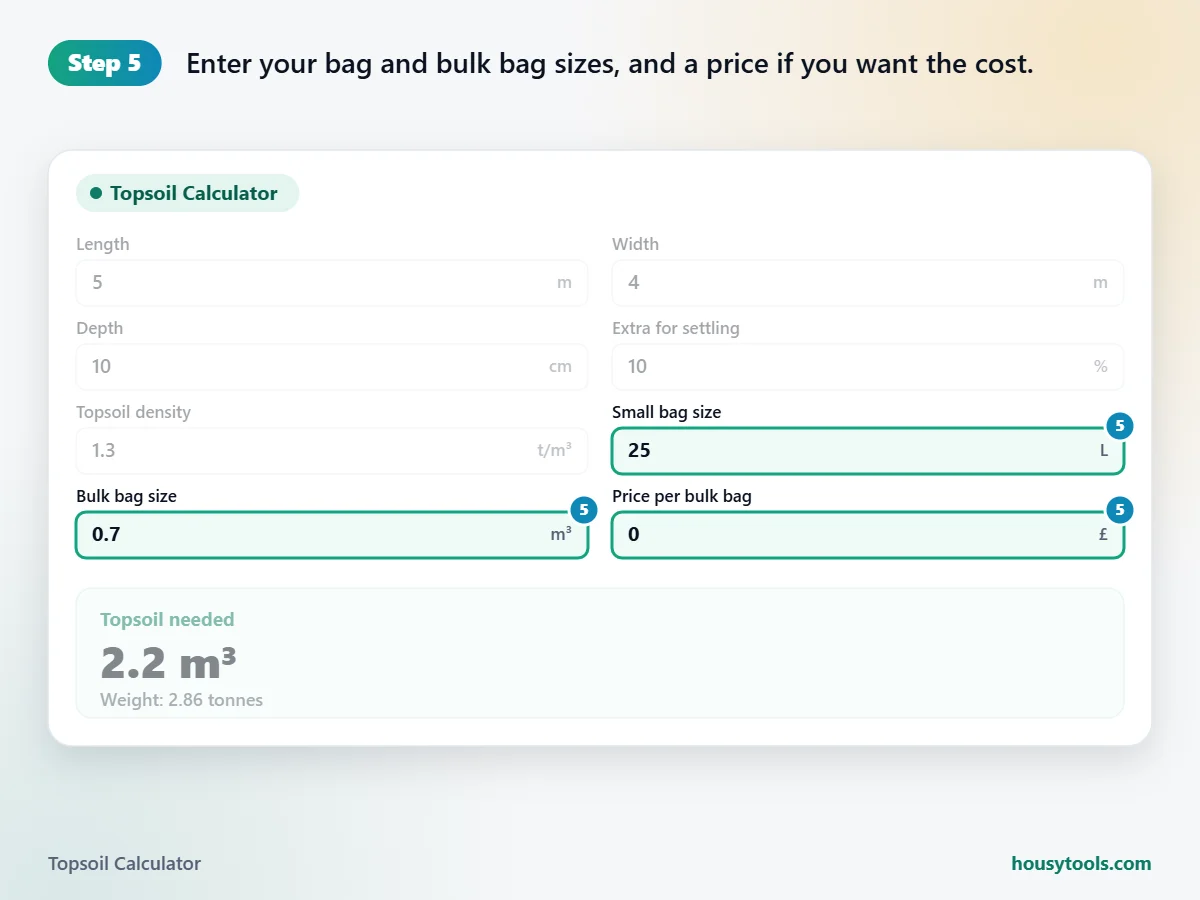
- Enter your bag and bulk bag sizes, and a price if you want the cost.
- Read the volume, weight and number of bags.


How Deep Should Topsoil Be?
For a new lawn, 10 to 15 cm of good topsoil is a common target, while flower beds and vegetable plots usually benefit from 20 to 30 cm or more.
Depth makes a big difference to the order. The same 20 m² area needs 1.1 m³ at 5 cm but 6.6 m³ at 30 cm, so decide the depth before you ask for quotes. If you are only levelling dips in an existing lawn, a few centimetres of a topsoil and sand mix is often enough, and you can work it out with the same tool.
| Depth | Volume with 10% settling | Weight at 1.3 t/m³ | 0.7 m³ bulk bags | 25 litre bags |
|---|---|---|---|---|
| 5 cm | 1.1 m³ | 1.43 t | 2 | 44 |
| 10 cm | 2.2 m³ | 2.86 t | 4 | 88 |
| 15 cm | 3.3 m³ | 4.29 t | 5 | 132 |
| 20 cm | 4.4 m³ | 5.72 t | 7 | 176 |
| 30 cm | 6.6 m³ | 8.58 t | 10 | 264 |
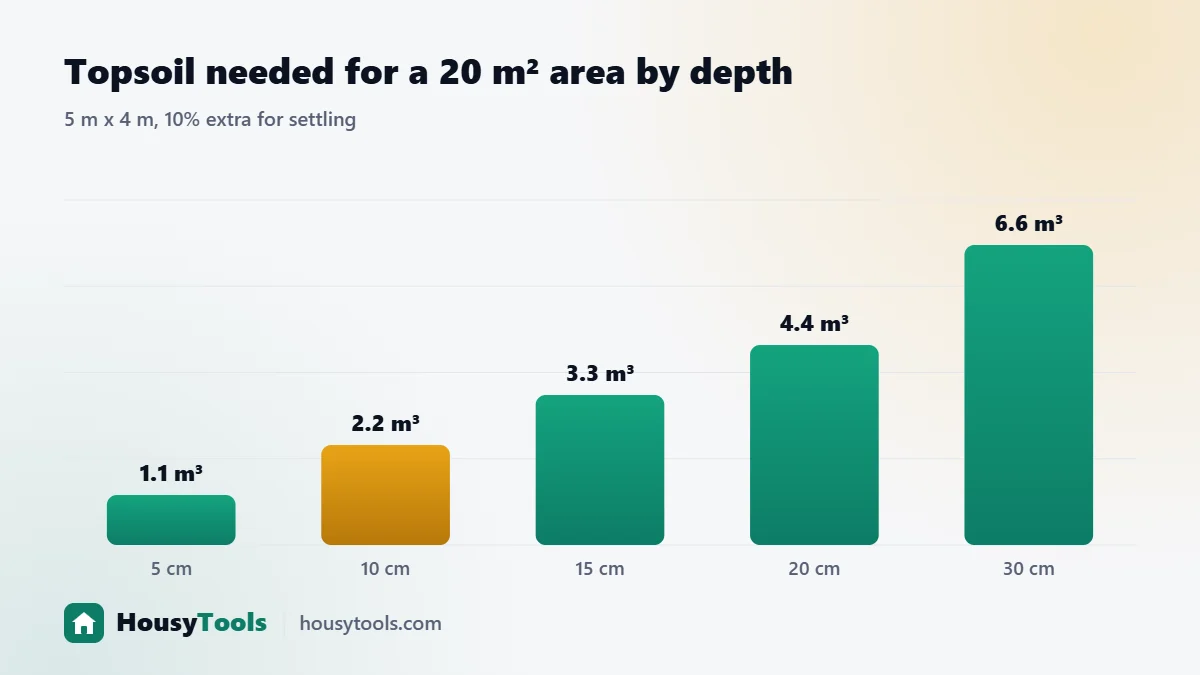
Notice how quickly small bags stop making sense: 88 bags of 25 litres is a lot of carrying, so for anything over about 1 m³ a bulk bag delivery is usually cheaper and far less work.
How Much Does a Tonne of Topsoil Cover?
At an example density of 1.3 tonnes per m³, one tonne of topsoil is about 0.77 m³, which covers about 7.7 m² at 10 cm deep or about 5.1 m² at 15 cm.
Density is the number that varies most. Dry, sandy topsoil is lighter than wet clay, and the same soil can weigh noticeably more after rain. That is why the density box is an example, not a fixed figure: suppliers that sell by the tonne should be able to tell you their own figure, and the Wikipedia article on topsoil explains why soils differ so much. If you are hiring a van or trailer, check its payload against the weight before loading.
Bulk Bags or Loose Delivery?
Bulk bags suit small and medium jobs because they can be left on a drive, while loose tipped loads suit large jobs where a lorry can reach the garden.
Bulk bags are sold in different sizes, so enter the size your supplier quotes rather than assuming. Ask whether the price includes delivery, whether the soil is screened (sieved to remove stones and roots), and whether it meets the British Standard for topsoil, BS 3882, which some suppliers quote on their product pages. For laying a lawn afterwards, the turf calculator and the grass seed calculator work from the same measurements.
Worked Example: A New Lawn of 12 m by 6 m
Example: a homeowner is replacing a worn lawn of 12 m by 6 m and wants 15 cm of new topsoil before laying turf. The supplier quotes 0.7 m³ bulk bags.
- Area: 12 x 6 = 72 m²
- Volume: 72 x 0.15 = 10.8 m³
- With 10% for settling: 11.88 m³
- Weight at an example 1.3 t/m³: about 15.4 tonnes
- Bulk bags: 11.88 / 0.7 = 16.97, so 17 bags
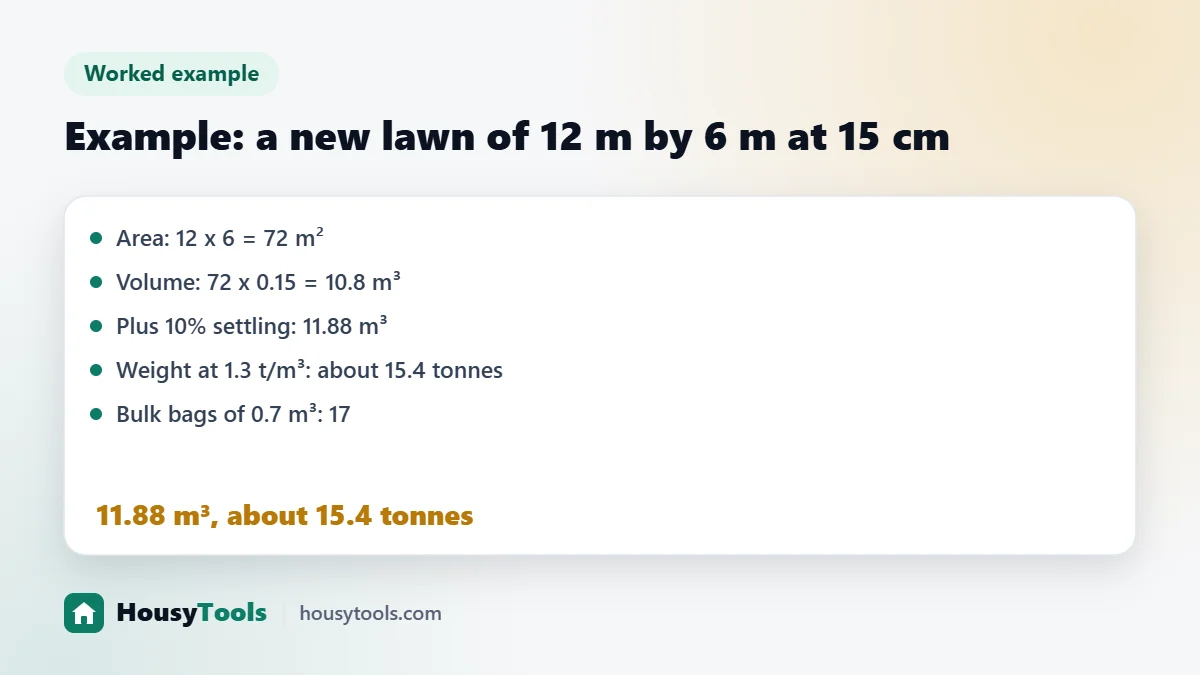
Seventeen bulk bags is a big delivery, so the homeowner asks for a loose tipped load instead and checks the price per cubic metre. A practical tip: spread it in two layers, firming each one with your feet, so the lawn settles evenly instead of sinking in patches.
Common Mistakes When Ordering Topsoil
The most common mistake is mixing up centimetres and metres for depth, which can make an order ten or a hundred times too big or small.
- Measuring depth in centimetres but entering it as metres.
- Forgetting settling, then running short when the soil sinks.
- Ordering small bags for a large job.
- Not checking whether a bulk bag is 0.7 m³, 0.8 m³ or 1 m³.
- Spreading topsoil over weeds instead of clearing them first.
Before any digging, check for buried pipes and cables, especially near the house.
Topsoil Calculator FAQs
How much topsoil do I need for a 10 m² lawn?
At 10 cm deep, 10 m² needs 1 m³, or about 1.1 m³ with 10% for settling. At 15 cm it needs about 1.65 m³. Enter your own depth in the calculator.
How many bags of topsoil are in a cubic metre?
One cubic metre is 1,000 litres, so it fills 40 bags of 25 litres or about 25 bags of 40 litres. Bulk bags hold far more, often 0.7 m³ or more.
How heavy is a cubic metre of topsoil?
It depends on the soil and how wet it is. This calculator uses an example of 1.3 tonnes per m³, but ask your supplier for their own figure.
Should I add extra topsoil for settling?
Yes. Loose soil sinks after it is spread, firmed and watered. Adding about 10% is a sensible starting point and saves a second delivery.
What depth of topsoil do I need for vegetables?
Vegetable beds usually benefit from at least 20 to 30 cm of good soil. Raised beds are often filled with a mix of topsoil and compost, which the raised bed soil calculator works out.
Can I use topsoil to level a lawn?
For small dips, yes. Spread a thin layer of a topsoil and sand mix a few centimetres deep and let the grass grow through, repeating if needed rather than burying it.
Checked October 2026. Sources: Wikipedia on topsoil, supplier product information for bag sizes and densities.