
Show the formula and working
This free solar battery size calculator tells homeowners in the UK, Ireland and northern Europe how many kilowatt hours of battery storage their solar panels can actually fill, and what that battery would save each year. It models the seasons month by month from EU PVGIS solar data, allows for battery losses and lost export income, and gives a simple payback in pounds or euros.
Quick answer: A solar battery size calculator matches usable capacity to the smaller of two numbers: the electricity you use after dark, and the spare solar an average summer day can store. A London home using 2,500 kWh a year, 60% after dark, with 4 kWp of panels needs about 4.5 kWh usable.
What Is a Solar Battery Size Calculator?
A solar battery size calculator is a tool that finds the battery capacity, in usable kWh, that your panels can charge and your home can empty on a typical day. A bigger battery only helps if there is both spare solar to fill it and evening use to drain it.
The formula in plain words: divide your yearly use by 365 to get daily use, then multiply by the share you use after the panels stop. Work out the daily solar output for each month, take away your daytime use, and multiply what is left by the round trip efficiency. The suggested size is the smaller of your after dark use and the average spare solar from April to September, rounded up to the next 0.5 kWh. The yearly saving is the energy the battery supplies multiplied by your unit rate, minus the export payments you no longer receive.
How Do You Use the Solar Battery Size Calculator?
- Enter your Annual electricity use in kWh from your bill or supplier app, and the Share used after the panels stop, meaning evening, night and early morning use.
- Enter your Solar panel size in kWp and choose the nearest Location. If your installer gave you a yearly estimate, choose “Custom yield” and enter it per kWp in Custom yield.
- Check the Round trip efficiency and Usable share of battery capacity against the battery’s data sheet.
- Enter your Electricity unit rate and Export rate in pence per kWh, then your Battery price from a quote.
- To test a particular model, enter its usable capacity in Battery size to check. Leave it at 0 to see the suggested size.
- Read the result and open “Show the formula and working” to see daily use, solar output, spare solar and the saving worked out step by step.


What Size Solar Battery Do I Need for a 4 kW System?
A 4 kWp system in the UK usually suits a battery of about 4 to 5 kWh usable for a home using 2,500 kWh a year, because that is roughly what the household uses after dark. The panels produce far more than that on a summer day, so the limit is your evening use, not the panels. A home with an electric car, heat pump or higher evening use can justify more, while a small flat may need less. Use the solar panel calculator first if you have not yet chosen the system size.
Why Does a Bigger Battery Not Always Save More?
A battery saves money only on energy it both stores and gives back, so once it covers your after dark use, extra capacity sits empty and saves nothing. In the worked example below, going from 4.5 kWh to 10 kWh adds no saving at all, yet would cost more. In winter the opposite problem appears: December output in London is under a third of June output according to EU PVGIS data, so even a small battery often cannot fill from solar alone.
| Usable battery size | Energy supplied a year | Yearly saving | Payback at £5,000 |
|---|---|---|---|
| 2 kWh | 730 kWh | £93.71 | 53.4 years |
| 3 kWh | 1,072 kWh | £137.65 | 36.3 years |
| 4 kWh | 1,353 kWh | £173.74 | 28.8 years |
| 4.5 kWh (suggested) | 1,383 kWh | £177.58 | 28.2 years |
| 6 kWh | 1,383 kWh | £177.58 | 28.2 years |
| 10 kWh | 1,383 kWh | £177.58 | 28.2 years |
The table uses the calculator’s default inputs: London, 4 kWp, 2,500 kWh a year with 60% after dark, 89% round trip efficiency, 26.32p unit rate and 12p export rate. The battery price is an example only.
Is a Solar Battery Worth It in the UK?
A battery charged only from solar rarely pays for itself quickly, because each stored kWh saves the unit rate but gives up the export payment, so the real gain per kWh is the gap between the two. At 26.32p to buy and 12p to export, that gap is about 12.9p per kWh once losses are counted. The Energy Saving Trust puts battery storage at around £5,000 to £8,000. Batteries make more sense when you can also charge them from cheap overnight electricity on a time of use tariff, which the Economy 7 calculator helps you compare, or when your export rate is low.
What Is the Difference Between Usable and Total Battery Capacity?
Usable capacity is the energy you can actually draw out, while total (nominal) capacity includes a reserve the battery keeps to protect its cells. A battery sold as 10 kWh total with a 90% depth of discharge gives 9 kWh usable. Many current home batteries quote usable capacity directly: the Tesla Powerwall 3 data sheet lists 13.5 kWh AC usable with 89% round trip efficiency. Size on usable capacity, and enter the depth of discharge in the calculator if only the total figure is given.
Worked Example: A Battery in London
Example: a London household uses 2,500 kWh of electricity a year and estimates that 60% of it is used after the panels stop. It has a 4 kWp system and a quote of £5,000 for a battery.
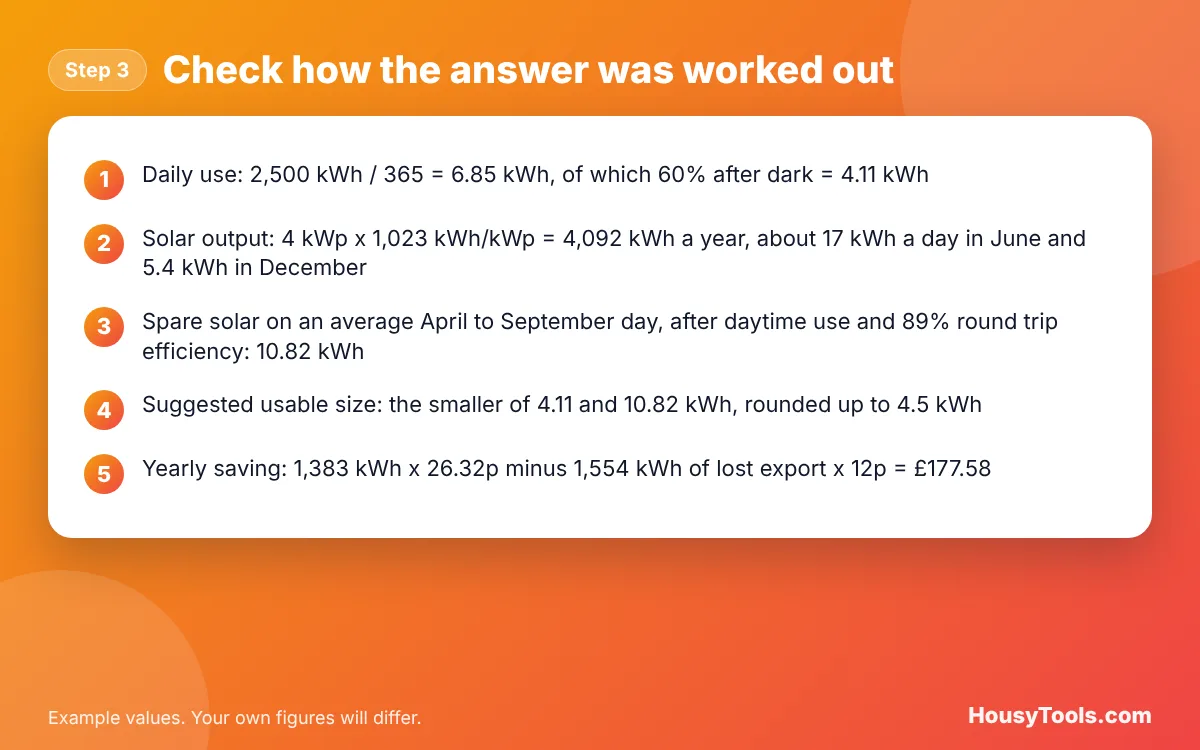
- Daily use: 2,500 / 365 = 6.85 kWh, of which 60% after dark = 4.11 kWh.
- Solar output: 4 kWp x 1,023 kWh per kWp = 4,092 kWh a year, about 17 kWh a day in June and 5.4 kWh in December.
- Spare solar on an average April to September day is well above 4.11 kWh, so the suggested usable size is 4.11 kWh rounded up to 4.5 kWh.
- Over a year the battery supplies 1,383 kWh, covering 92% of the after dark use, and the household gives up 1,554 kWh of export.
- Saving: 1,383 x 26.32p minus 1,554 x 12p = £177.58 a year, a simple payback of 28.2 years.
Entering 13.5 kWh in Battery size to check leaves the saving at £177.58, because the household does not use more than about 4.1 kWh after dark. Here, a cheap overnight tariff would matter more than extra capacity. You can explore other running costs in the energy bill calculators.
Solar Battery Size Calculator FAQs
How many kWh battery do I need for my house?
Most homes need a usable capacity close to the electricity they use between sunset and sunrise. For a typical UK home using 2,500 kWh a year with 60% after dark, that is about 4 to 5 kWh. Homes with an electric car or heat pump often need more.
Can a solar battery power my home all winter?
No. In northern Europe December solar output is a small fraction of June output, so panels often cannot cover daytime use, let alone fill a battery. A battery shifts solar from day to evening, not from summer to winter, so you will still buy electricity in winter.
How long does a solar battery take to pay back?
Charged from solar only, payback is often 20 years or more, because each stored kWh saves the unit rate but loses the export payment. With the default inputs it is 28.2 years at £5,000. Charging from a cheap overnight tariff as well can shorten it considerably.
What round trip efficiency should I use?
Use the figure on the battery’s data sheet, which is usually between about 85% and 95% for modern lithium batteries. The Tesla Powerwall 3 data sheet lists 89%, which is the calculator’s default. Lower efficiency means you get back less of each kWh you store.
Should I add a battery if my export rate is high?
A high export rate weakens the case for a battery, because every kWh you store is a kWh you no longer sell. If your export rate is close to your unit rate, the saving almost disappears. The calculator subtracts lost export so you can see the real gain.
Does the calculator account for cloudy days?
It uses average daily output for each month, so it does not model individual cloudy and sunny days. On dull days the battery will not fill, and on bright days some spare solar is still exported. Treat the result as a typical year estimate, not a guarantee.
Checked October 2026. Sources: EU Joint Research Centre PVGIS, Energy Saving Trust, Solar panels, Ofgem, Energy price cap unit rates and standing charges, Ofgem, Review of typical domestic consumption values: decision, Tesla Powerwall 3 data sheet.