
Show the formula and working
This artificial grass calculator works out how much artificial grass to buy for a lawn, balcony or play area, using the roll width your supplier sells. Because artificial grass comes off wide rolls and is cut to length, the amount you buy is usually more than the lawn area. The calculator tries both directions and picks the layout with the least waste, then shows the pieces, joins, joining tape and cost.
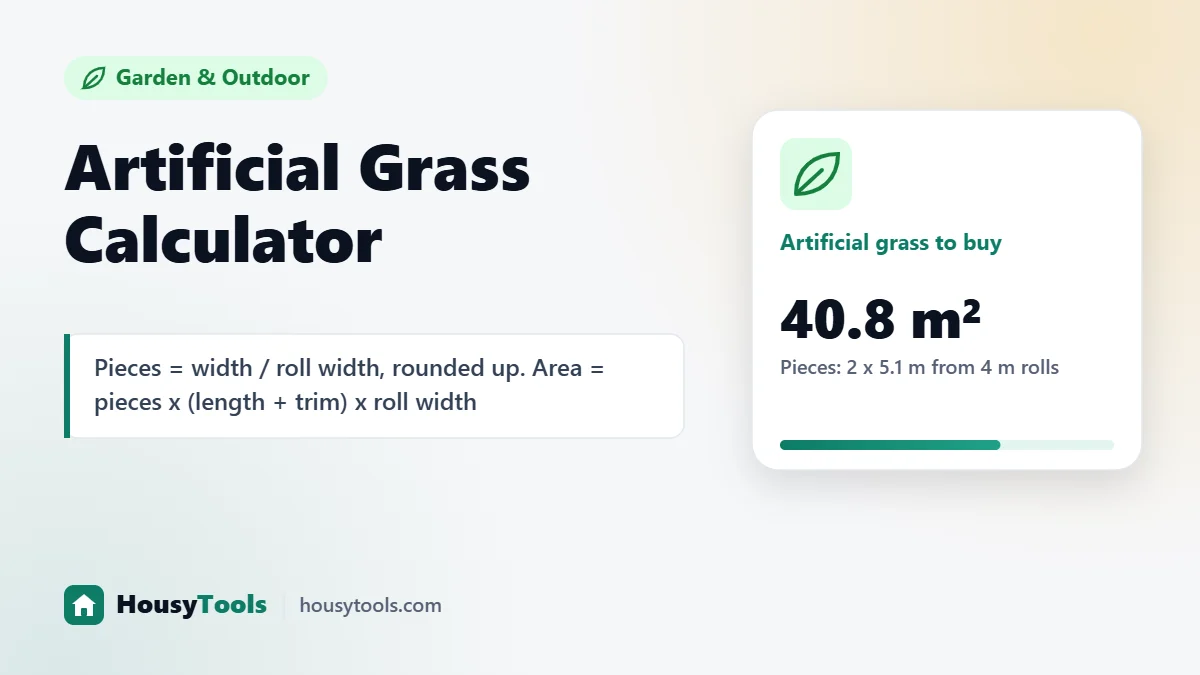
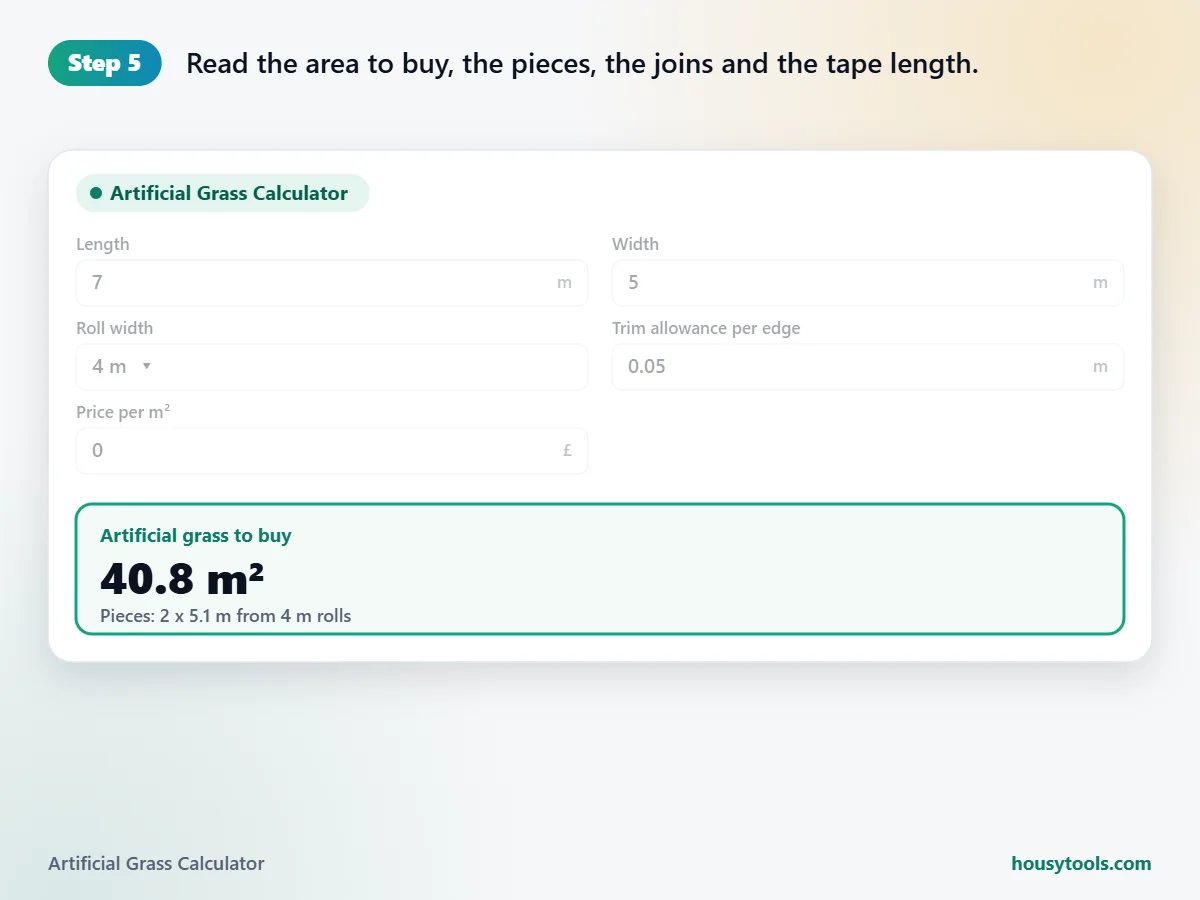
Quick answer: To work out how much artificial grass you need, divide the lawn width by the roll width and round up to get the number of pieces, then multiply by the length plus a trim allowance and by the roll width. A 7 m by 5 m lawn needs two 5.1 m pieces from 4 m rolls, so you buy 40.8 m² for a 35 m² lawn.
What Is an Artificial Grass Calculator?
An artificial grass calculator is a tool that converts a lawn’s size into the square metres of artificial grass to buy, based on the fixed width of the roll it is cut from.
The formula in plain words: the number of pieces equals the width the grass must cover divided by the roll width, rounded up. Each piece is cut to the length of the lawn plus a small trim allowance at each end. Pieces times piece length times roll width gives the area to buy. The calculator does this twice, once with the rolls running along the lawn and once across it, and picks the smaller order. Joins are the number of pieces minus one, and each join needs joining tape as long as the piece.
How Do You Use the Artificial Grass Calculator?
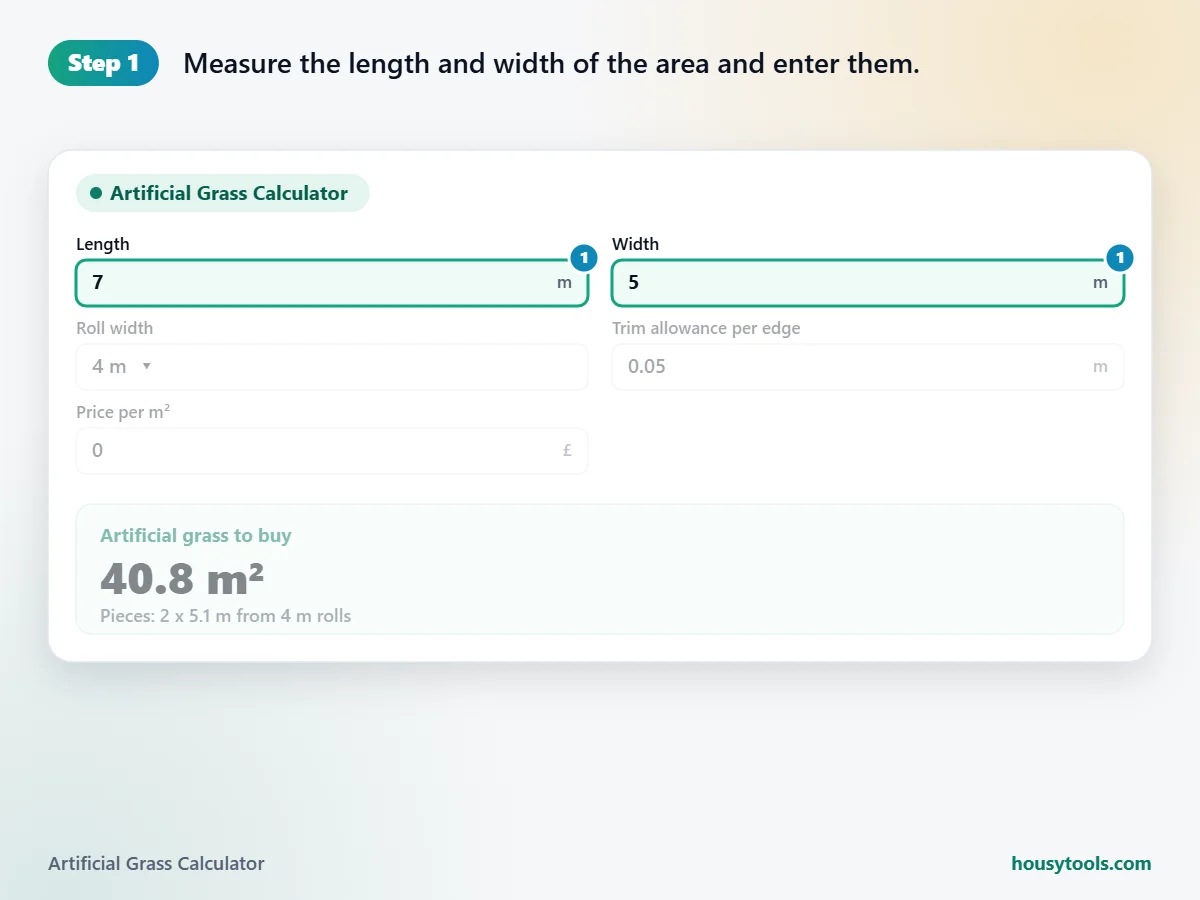
- Measure the length and width of the area and enter them.
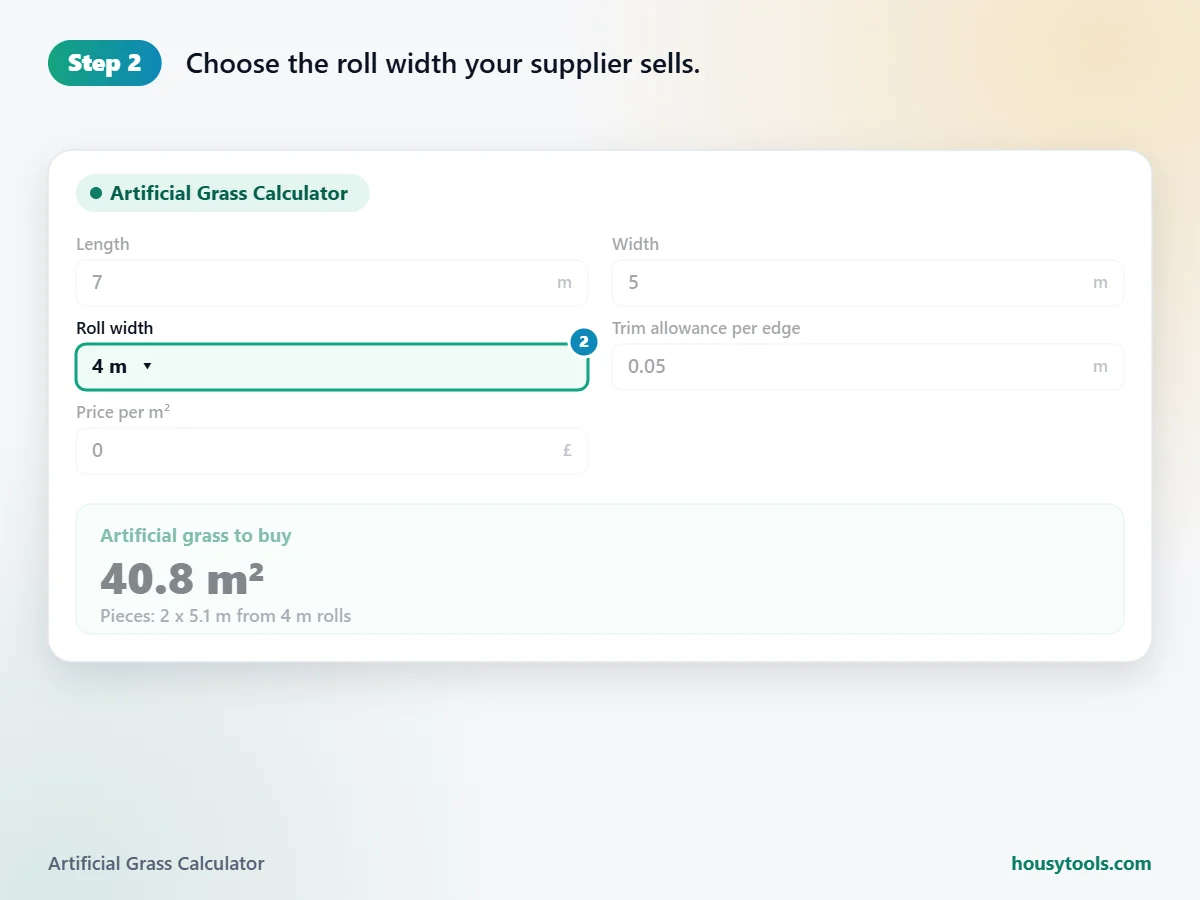
- Choose the roll width your supplier sells.
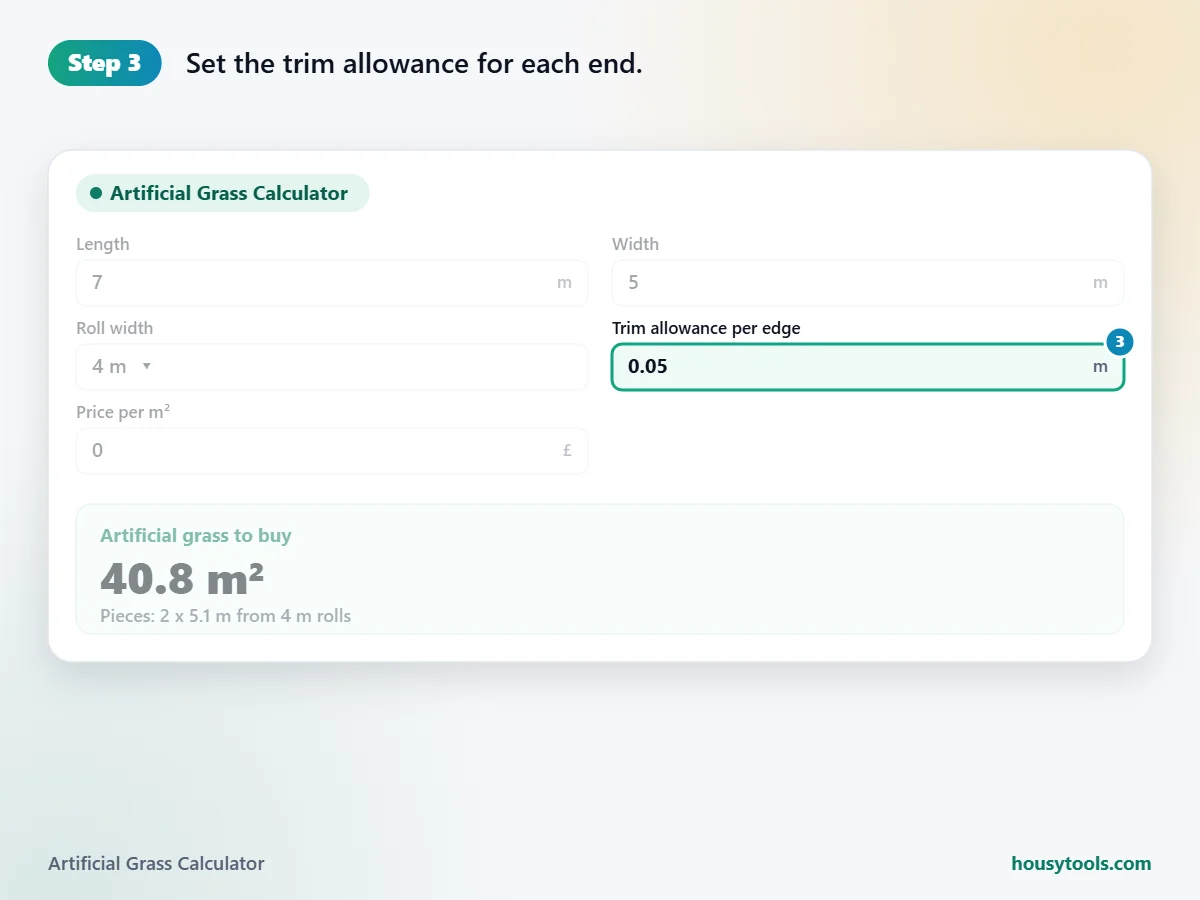
- Set the trim allowance for each end.
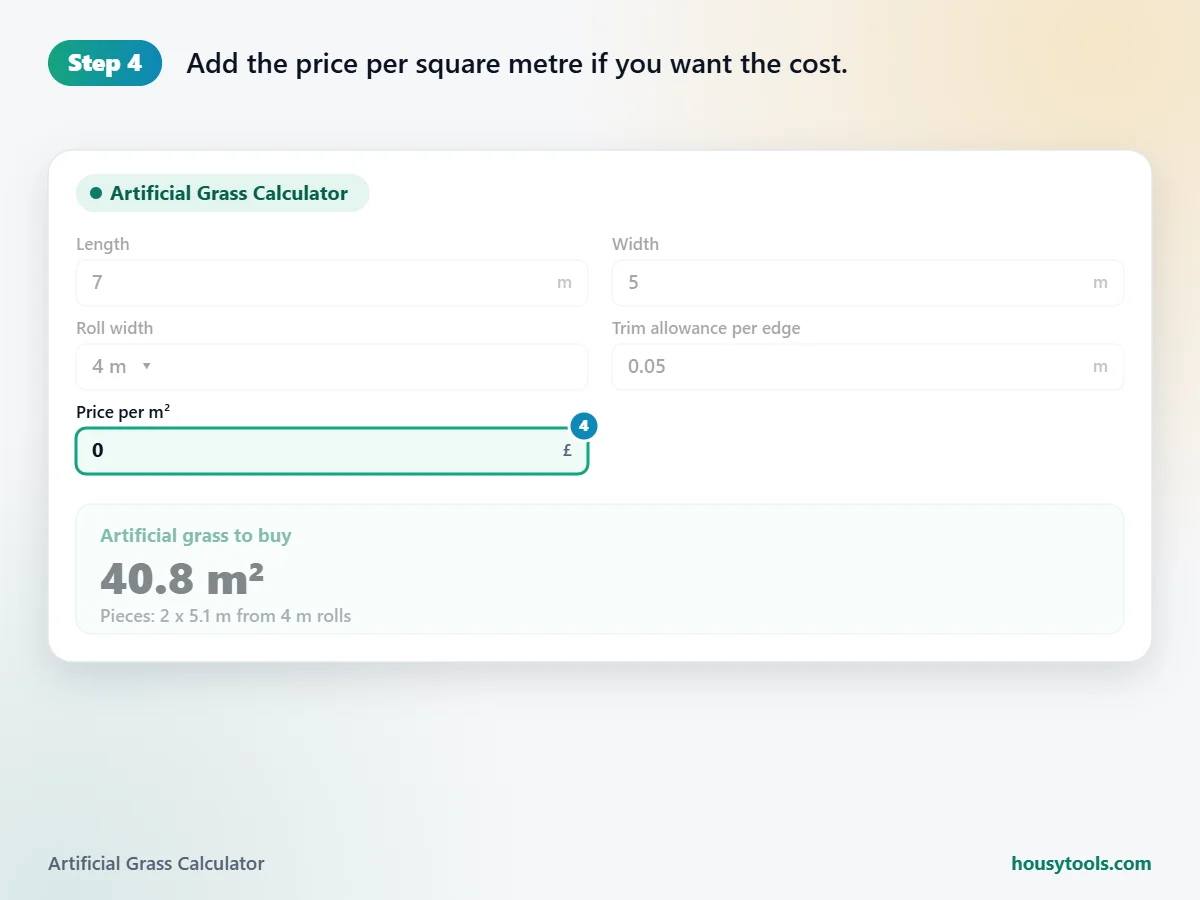
- Add the price per square metre if you want the cost.
- Read the area to buy, the pieces, the joins and the tape length.
Why Do You Buy More Artificial Grass Than Your Lawn Area?
You pay for the full roll width of every piece, so any width that is not a multiple of the roll width leaves an offcut strip that you buy but do not lay.
| Lawn size | Lawn area | Best order from 4 m rolls | Offcut waste |
|---|---|---|---|
| 4 m x 4 m | 16 m² | 16.4 m² | 2% |
| 5 m x 3 m | 15 m² | 20.4 m² | 26% |
| 7 m x 5 m | 35 m² | 40.8 m² | 14% |
| 8 m x 6 m | 48 m² | 48.8 m² | 2% |
| 10 m x 7 m | 70 m² | 80.8 m² | 13% |
Lawns that are close to a multiple of the roll width, such as 4 m or 8 m wide, waste very little. A 5 m by 3 m area wastes about a quarter of what you pay for, because a 3 m width still needs a full 4 m piece. In that case, ask whether the supplier sells a narrower roll.
2 m or 4 m Rolls: Which Is Better?
Narrower 2 m rolls can waste less grass on lawns of awkward widths, while 4 m rolls need fewer joins, which look better and take less work.
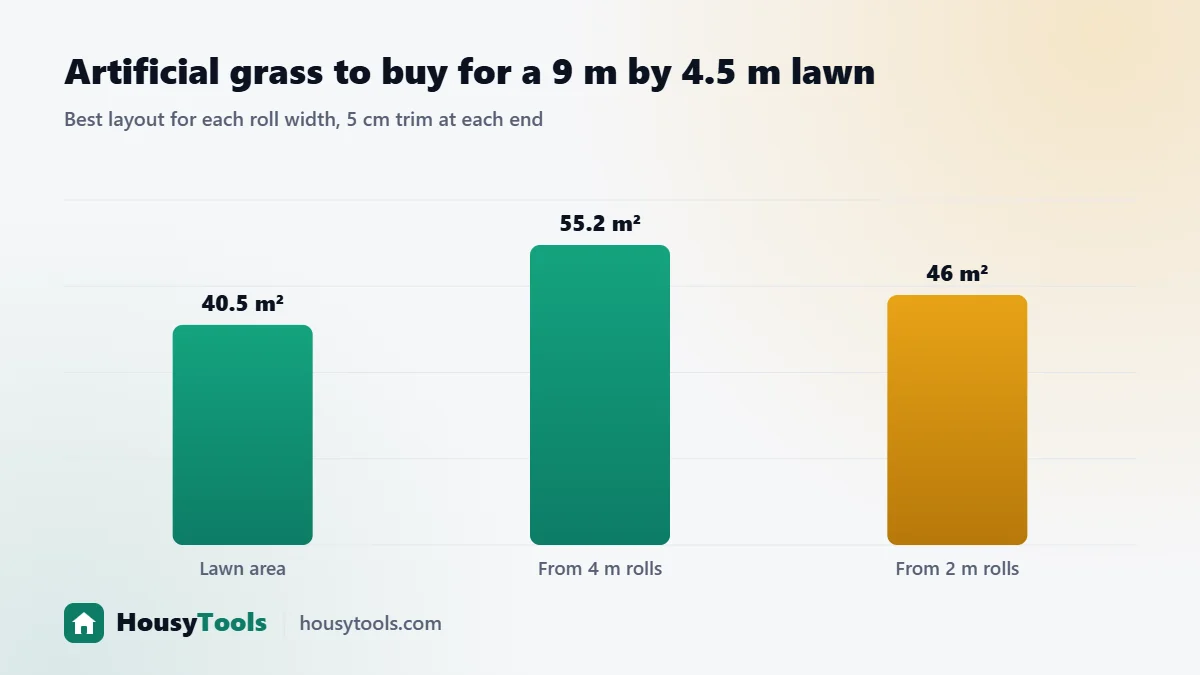
Run the calculator with each roll width. In our 9 m by 4.5 m example, 2 m rolls need 46 m² against 55.2 m² from 4 m rolls, saving over £200 at £22 per m², but they add three extra joins. For a lawn that children play on, fewer joins can be worth the extra cost. Also keep the pile running the same way on every piece, usually towards the house, so the colour looks even.
How Do You Prepare the Base for Artificial Grass?
A typical base is a compacted sub base of crushed stone with a finer layer of sharp sand or grano dust on top, laid over a weed membrane, so the grass sits flat and drains well.
The depth of each layer depends on your soil and the product, so follow the supplier’s fitting guide. The gravel calculator and sand calculator work out the base materials from the same length and width. If you choose real turf instead, the turf calculator shows how many rolls you need.
Worked Example: A 9 m by 4.5 m Lawn
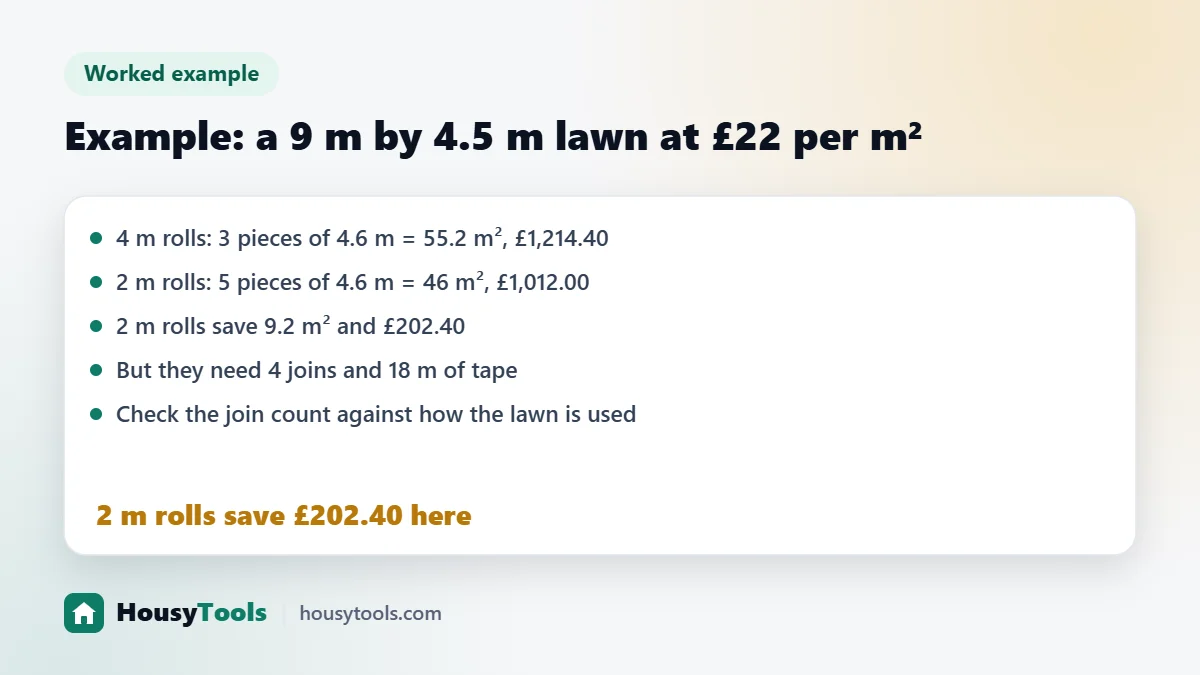
Example: a homeowner wants artificial grass on a 9 m by 4.5 m lawn and has a quote of £22 per m² (an example price), with both 2 m and 4 m rolls available.
- From 4 m rolls: 3 pieces of 4.6 m running across the lawn, 55.2 m², £1,214.40
- From 2 m rolls: 5 pieces of 4.6 m, 46 m², £1,012.00
- Saving with 2 m rolls: 9.2 m² of grass and £202.40
- Trade off: 4 joins and 18 m of joining tape instead of 2 joins and 9 m
The homeowner chooses 2 m rolls and plans the joins away from the main walkway. A practical tip: lay all the pieces out and let them relax in the sun for a few hours before trimming, because rolled grass shrinks back slightly as it flattens.
Artificial Grass vs Real Turf
Artificial grass costs more to buy but needs no mowing, feeding or watering, while real turf is cheaper and cooler underfoot but needs ongoing care.
Artificial grass can get hot in strong sun and is a plastic product, which matters to some households. Real lawns support insects and soak up rain. Many gardens use both: real grass in sunny open areas and artificial grass in shade where real grass struggles. The Royal Horticultural Society has practical advice on caring for real lawns.
Artificial Grass Calculator FAQs
How much artificial grass do I need for a 5 m by 4 m lawn?
With 4 m rolls you need one piece of 5.1 m, which is 20.4 m² for a 20 m² lawn. The calculator checks both directions to find the smallest order.
What widths does artificial grass come in?
Many suppliers sell artificial grass off 2 m and 4 m wide rolls, and some offer 5 m. Choose the width in the calculator and compare the results.
How much joining tape do I need?
You need tape for every join, as long as the pieces being joined. Two pieces 5 m long need one 5 m join.
Should artificial grass face towards the house?
Many installers lay the pile facing towards the main viewing point, often the house, so it looks fuller. The important thing is that every piece faces the same way.
How much extra should I allow for trimming?
A few centimetres at each end is usually enough for trimming to a straight edge. The calculator adds 5 cm at each end by default, and you can change it.
Can I lay artificial grass on concrete?
Yes, many products can be laid on concrete or patios with a foam underlay, as long as water can drain away. Follow the supplier’s fitting guide.
Checked October 2026. Sources: supplier product information for roll widths, RHS lawn advice.