
Show the formula and working
This free TV size and viewing distance calculator tells you the best screen size for the distance from your sofa to the wall, or the best seating distance for a TV you already own, for homes in the UK, Ireland and Europe. It uses the SMPTE and THX viewing angle guidelines and checks whether you will actually see the extra detail of Full HD, 4K or 8K at that distance.
Quick answer: A TV size and viewing distance calculator sizes the screen so it fills about 30 degrees of your view for everyday watching, or 40 degrees for a cinema feel. At 2.5 m that means a TV of about 61 to 82 inches. A 55 inch TV is best viewed from 1.67 to 2.27 m.
What Is a TV Size and Viewing Distance Calculator?
A TV size and viewing distance calculator is a tool that links screen size to seating distance using the angle the screen fills in your field of view.
The formula in plain words: the screen width equals twice the viewing distance multiplied by the tangent of half the viewing angle. For a 16:9 TV, the diagonal size equals that width multiplied by 1.147 (the square root of 337 divided by 16), then converted to inches. Working the other way, the distance equals half the screen width divided by the tangent of half the angle. For the detail check, the tool uses the 1 arcminute limit of normal vision: the distance at which you can just see every line equals the screen height divided by the number of lines multiplied by the tangent of 1 arcminute.
How Do You Use the TV Size and Viewing Distance Calculator?
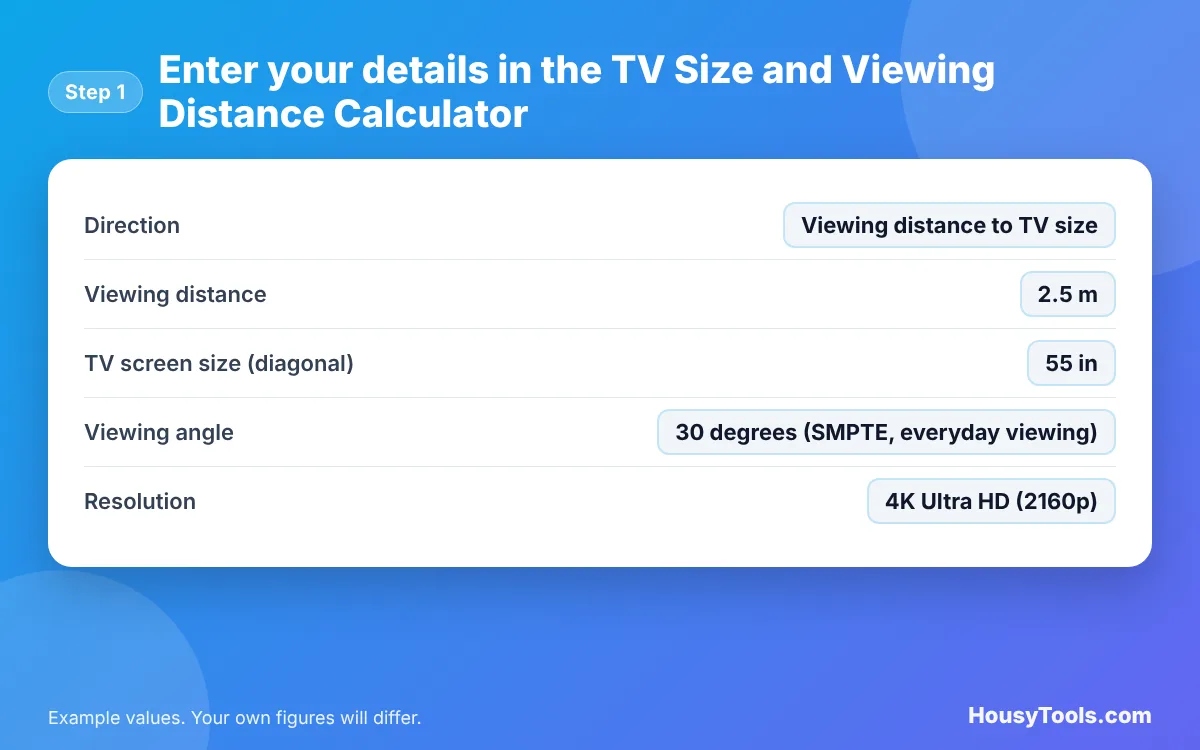
- Pick the Direction: “Viewing distance to TV size” when shopping for a new TV, or “TV size to viewing distance” to place your seating.
- Measure from your eyes in your usual seat to where the screen will be, and enter it as the Viewing distance.
- For the second direction, enter the TV screen size (diagonal) in inches.
- Choose the Viewing angle: 30 degrees for mixed everyday viewing, or 40 degrees for films and games.
- Choose the Resolution of the TV or the content you watch most.
- Read the recommended size or distance, then open “Show the formula and working” to see the angle and detail checks.
What Size TV Should I Get for My Viewing Distance?
Multiply your viewing distance in metres by about 24 to get the screen size in inches for a 30 degree view, or by about 33 for a 40 degree view. At 2.5 m, that gives roughly 61 to 82 inches, so a 65 inch TV is a sensible choice for most living rooms at that distance. At 2 m, a screen of about 48 to 66 inches suits; at 3 m, 73 to 99 inches. The SMPTE 30 degree recommendation is a good minimum for everyday watching, while THX recommends about 40 degrees for the most involving picture.
How Far Should You Sit From a 55 Inch TV?
Sit between 1.67 m and 2.27 m from a 55 inch TV: 2.27 m gives the SMPTE 30 degree view and 1.67 m gives the THX 40 degree view. A 65 inch TV suits 1.98 to 2.69 m, and a 75 inch TV suits 2.28 to 3.10 m. If your sofa is further away than the top of the range, the picture will feel small, and a bigger screen or moving the seating closer will help.
Does 4K Let You Sit Closer to the TV?
Yes: with 4K you can sit about half as far away as with Full HD before you notice the pixels, at about 1.6 screen heights instead of 3.2. Those figures match the ITU design viewing distances for UHD and HD television and come from the 1 arcminute limit of normal visual acuity. For a 55 inch screen, that is 1.09 m for 4K and 2.18 m for Full HD. The flip side is that from 2.5 m or more, many people cannot see all the extra detail of 4K on a 55 inch TV, and 8K adds even less at normal living room distances. A larger 4K screen is usually a better upgrade than 8K.
TV Size and Viewing Distance Chart
| Screen size | 40 degrees (THX) | 30 degrees (SMPTE) | Full HD full detail | 4K full detail |
|---|---|---|---|---|
| 43 in | 1.31 m | 1.78 m | 1.70 m | 0.85 m |
| 50 in | 1.52 m | 2.07 m | 1.98 m | 0.99 m |
| 55 in | 1.67 m | 2.27 m | 2.18 m | 1.09 m |
| 65 in | 1.98 m | 2.69 m | 2.58 m | 1.29 m |
| 75 in | 2.28 m | 3.10 m | 2.97 m | 1.49 m |
| 85 in | 2.59 m | 3.51 m | 3.37 m | 1.68 m |
The comfortable seating range for each size lies between the 40 degree and 30 degree columns. The detail columns show the distance at which a viewer with normal eyesight can just resolve every line of that resolution; sit further away and some detail is lost.
Worked Example: Choosing a New TV
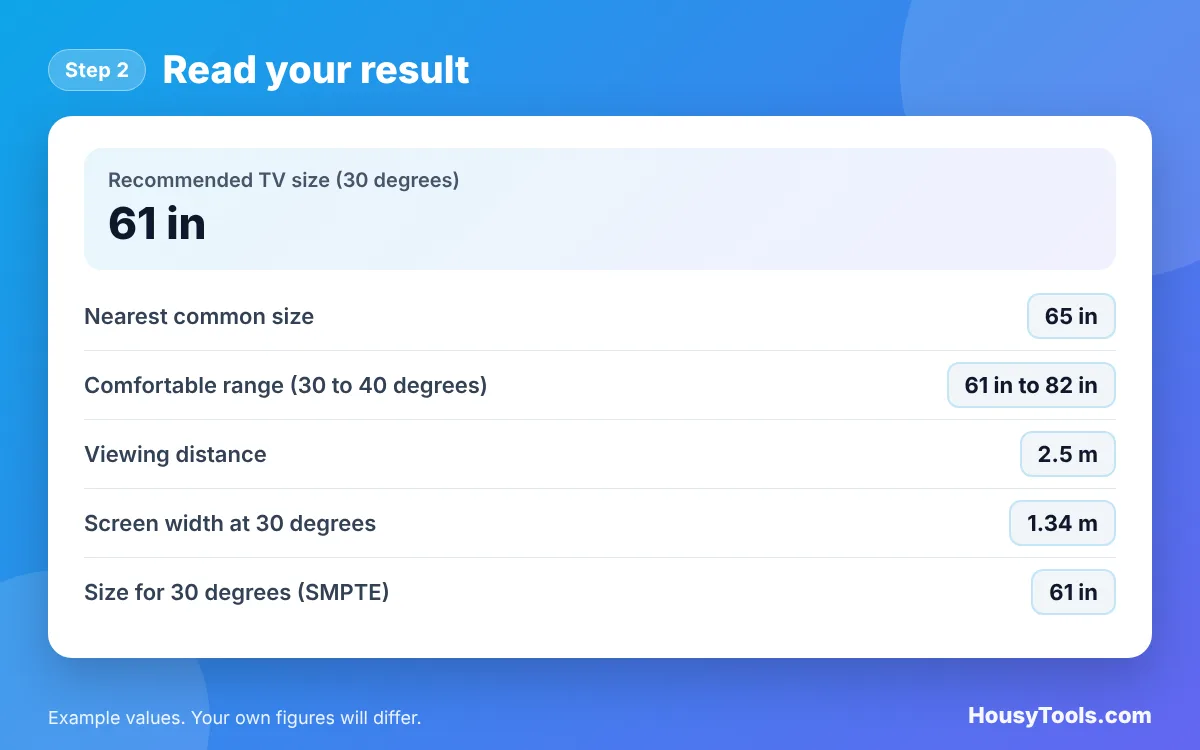
Example: a sofa is 2.5 m from the wall where the TV will hang, and the viewing is a mix of news, sport and films in 4K. Choose “Viewing distance to TV size”, enter 2.5 m, and keep the 30 degree angle and 4K resolution.
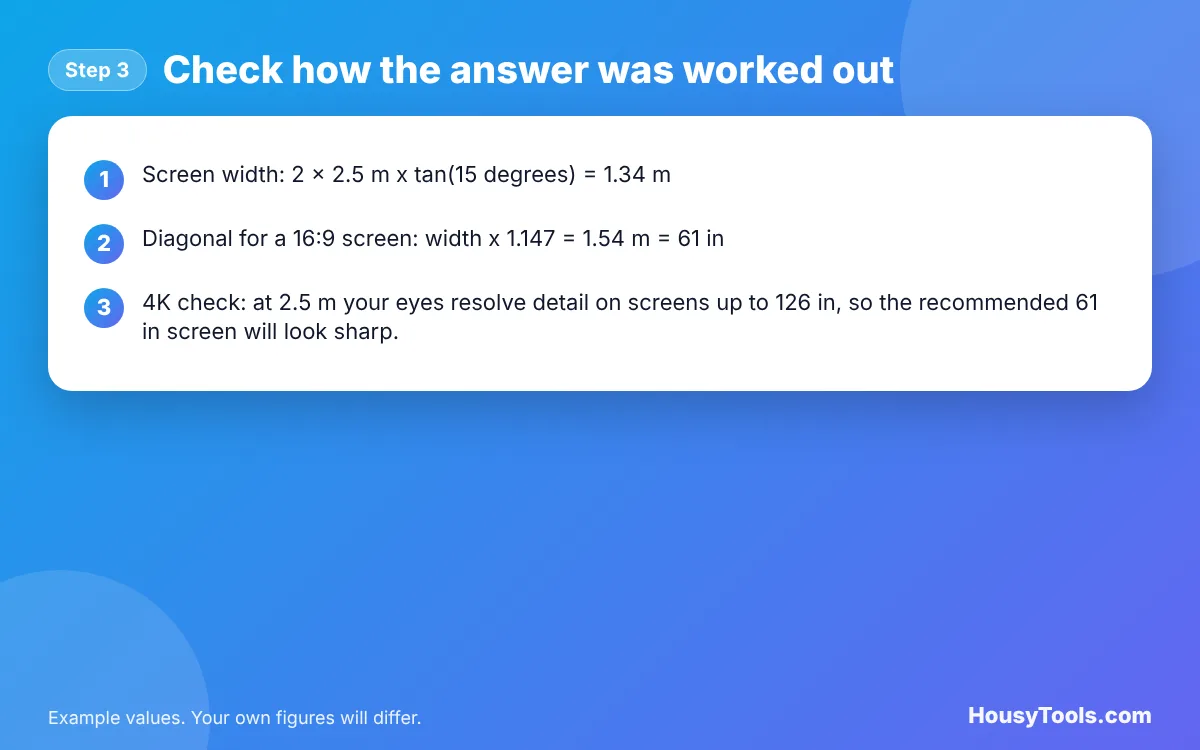
- Screen width: 2 x 2.5 m x tan(15 degrees) = 1.34 m.
- Diagonal: 1.34 m x 1.147 = 1.54 m, which is 61 inches.
- Nearest common size: 65 inches. The 30 to 40 degree range runs from 61 to 82 inches.
- 4K check: at 2.5 m the eye resolves detail on screens up to 126 inches, so a 65 inch 4K TV will look sharp.
A 65 inch TV is the choice here. A bigger screen uses more power, so check its running cost with the electricity cost calculator using the wattage on the energy label.
Height matters as much as size. For comfortable viewing, mount the TV so the centre of the screen is roughly at eye level when seated, which in most living rooms is lower than people expect. Mounting a large TV high above a fireplace forces you to look up and can strain your neck over a long film. Check the wall can take the weight of the TV and bracket, and use fixings rated for the wall type. For more ways to plan and run your home, see our energy bill calculators.
TV Size and Viewing Distance Calculator FAQs
How is TV size measured?
TV size is the diagonal of the visible screen in inches, from one corner to the opposite corner, not including the frame. A 55 inch TV has a 140 cm diagonal and, at 16:9, a screen about 122 cm wide and 68 cm tall.
Can a TV be too big for a room?
A TV is only too big if it fills much more than about 40 degrees of your view, so you have to turn your head to follow the action. For a 2.5 m distance, that point is around 82 inches, larger than most living rooms ever use.
What is the SMPTE viewing distance?
The SMPTE guideline places the viewer where the screen fills about 30 degrees of the field of view. For a 16:9 TV, that is about 1.63 times the screen diagonal, so 2.27 m for a 55 inch screen.
What is the THX viewing distance?
THX recommends a viewing angle of about 40 degrees for a cinema like experience, which works out at about 1.2 times the screen diagonal. For a 65 inch TV, that is a seating distance of about 1.98 m.
Is 8K worth it at normal viewing distances?
For most homes, no. To see all the detail of 8K on a 65 inch TV, you would need to sit within about 65 cm of the screen. At typical sofa distances of 2 to 3 m, 4K already shows more detail than the eye can resolve.
Does the calculator work for ultrawide or 4:3 screens?
The calculator assumes a 16:9 screen, which covers almost every TV sold today. Ultrawide monitors and older 4:3 sets have a different width for the same diagonal, so their ideal distances differ.
Checked October 2026. Sources: Wikipedia, Optimum HDTV viewing distance (SMPTE 30 degrees and 1.6264 x diagonal, THX 40 degrees and about 1.2 x diagonal, ITU 3.2 H, 1.6 H and 0.8 H, 1 arcminute acuity), Wikipedia, Visual acuity, Wikipedia, Inch (2.54 cm exactly).