
Show the formula and working
This tile adhesive calculator tells you how many kilograms and bags of tile adhesive to buy for a wall or floor, based on the area, the notched trowel you will use and whether you back-butter large tiles. It is set up for UK and European tiling, with 20 kg bags as the default and square feet available for imperial users.
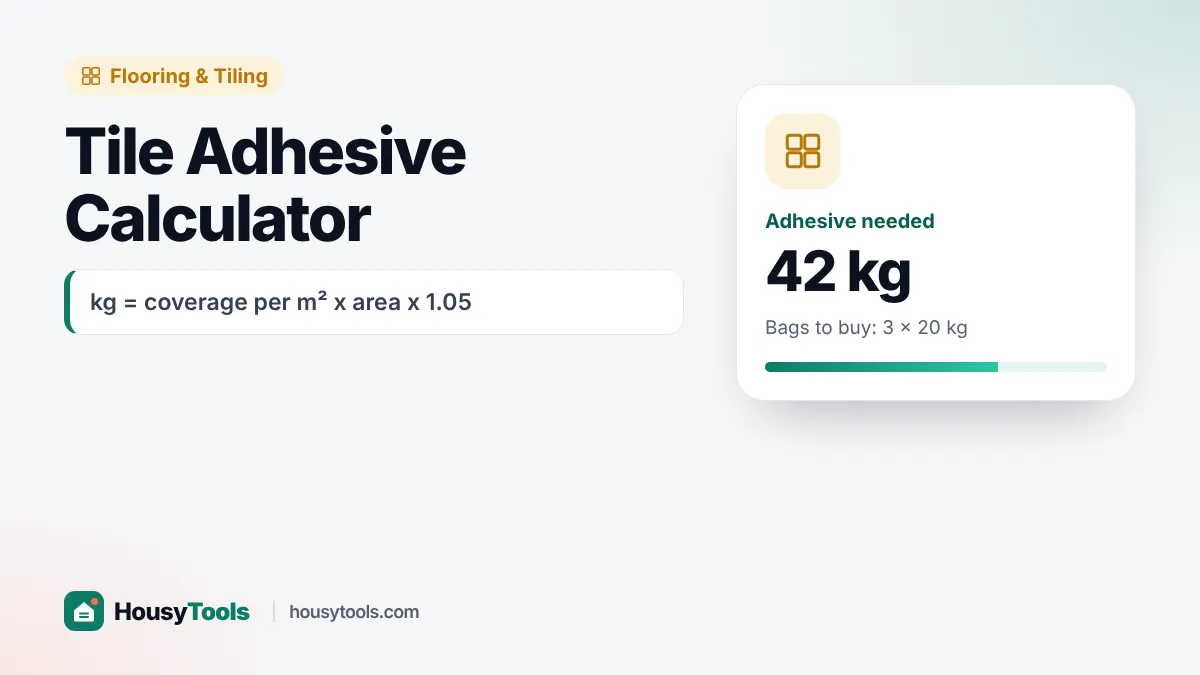
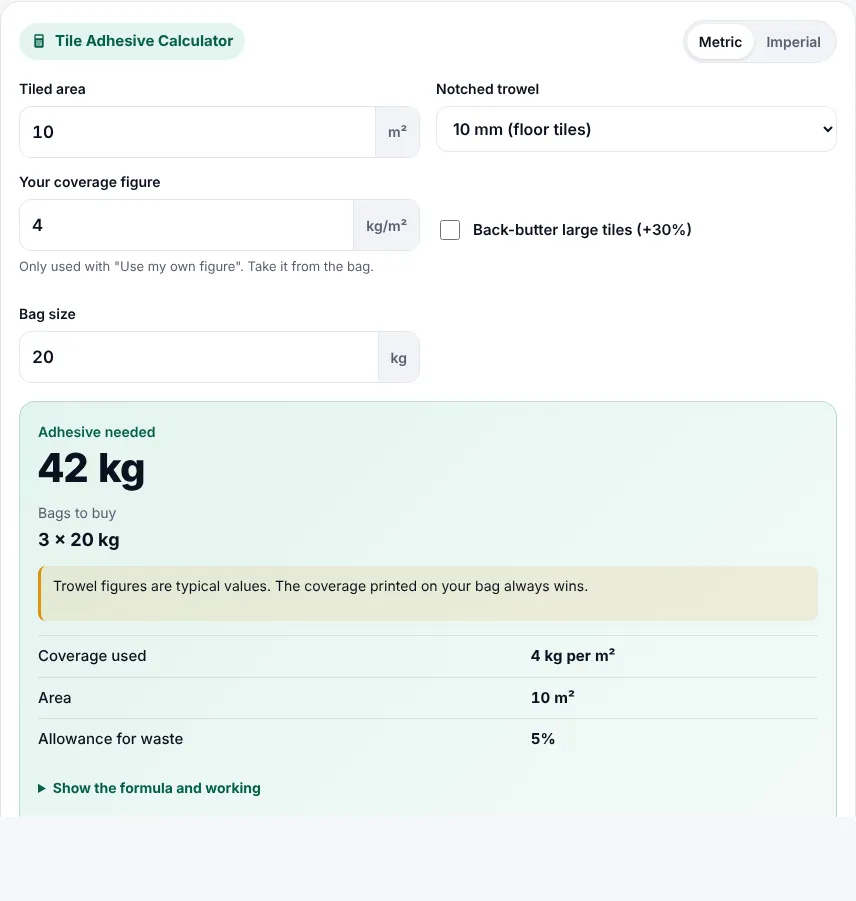
Quick answer: a tile adhesive calculator multiplies your area by a coverage rate set by the trowel notch, then adds 5% for waste. Typical rates are 2.5 kg per m² with a 6 mm notch for wall tiles and 4 kg per m² with a 10 mm notch for floors. Back-buttering large tiles adds about 30%.
What Is a Tile Adhesive Calculator?
A tile adhesive calculator is a tool that estimates how much powdered or ready mixed tile adhesive you need to fix tiles over a set area. It turns your area and trowel choice into kilograms, then into whole bags.
The formula is simple: coverage rate in kg per m² x area in m² x 1.05 for waste. If you tick back-buttering, the coverage rate is multiplied by 1.3 first. The total is divided by the bag size and rounded up, because you cannot buy part of a bag.
The coverage rate comes from the notched trowel. Bigger notches leave taller ridges of adhesive, so they use more per square metre. Cement based adhesive of this kind is also called thinset, which Wikipedia describes as a mortar of cement, fine sand and a water retaining agent.
How Do You Use the Tile Adhesive Calculator?
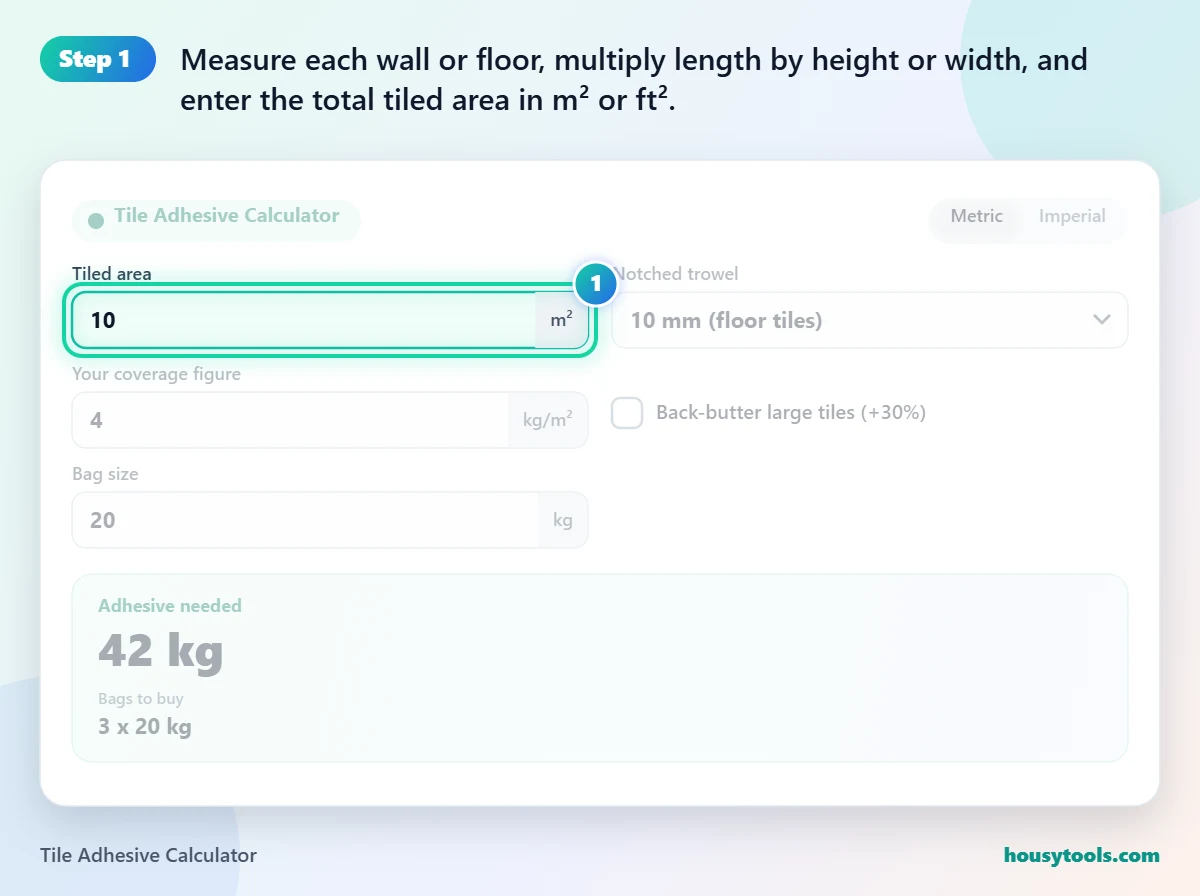
- Measure each wall or floor, multiply length by height or width, and enter the total tiled area in m² or ft².
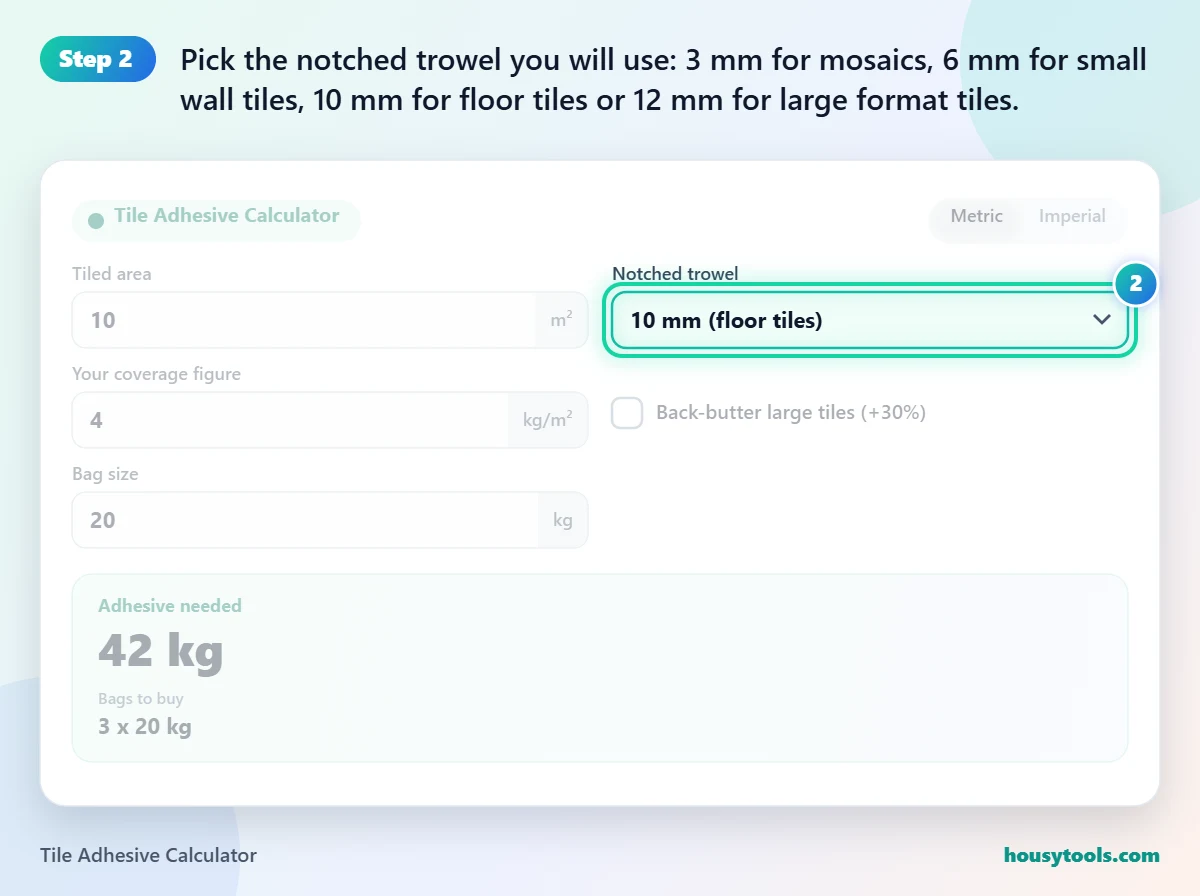
- Pick the notched trowel you will use: 3 mm for mosaics, 6 mm for small wall tiles, 10 mm for floor tiles or 12 mm for large format tiles.
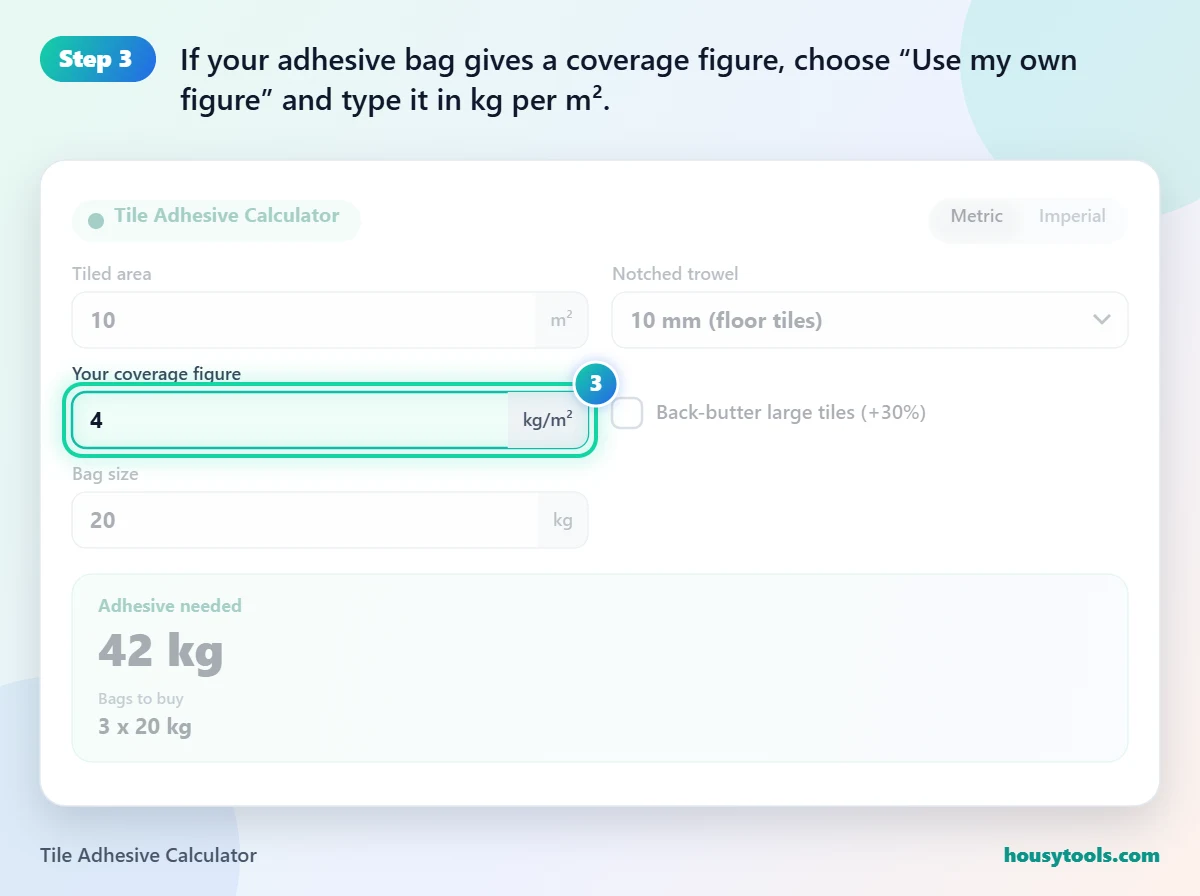
- If your adhesive bag gives a coverage figure, choose “Use my own figure” and type it in kg per m².
- Tick back-buttering if you will spread adhesive on the back of large tiles as well as the floor or wall.
- Enter the bag size you plan to buy. The default is 20 kg, the usual size for cement based adhesive.
- Read off the kilograms needed and bags to buy, and check the working shown under the result.
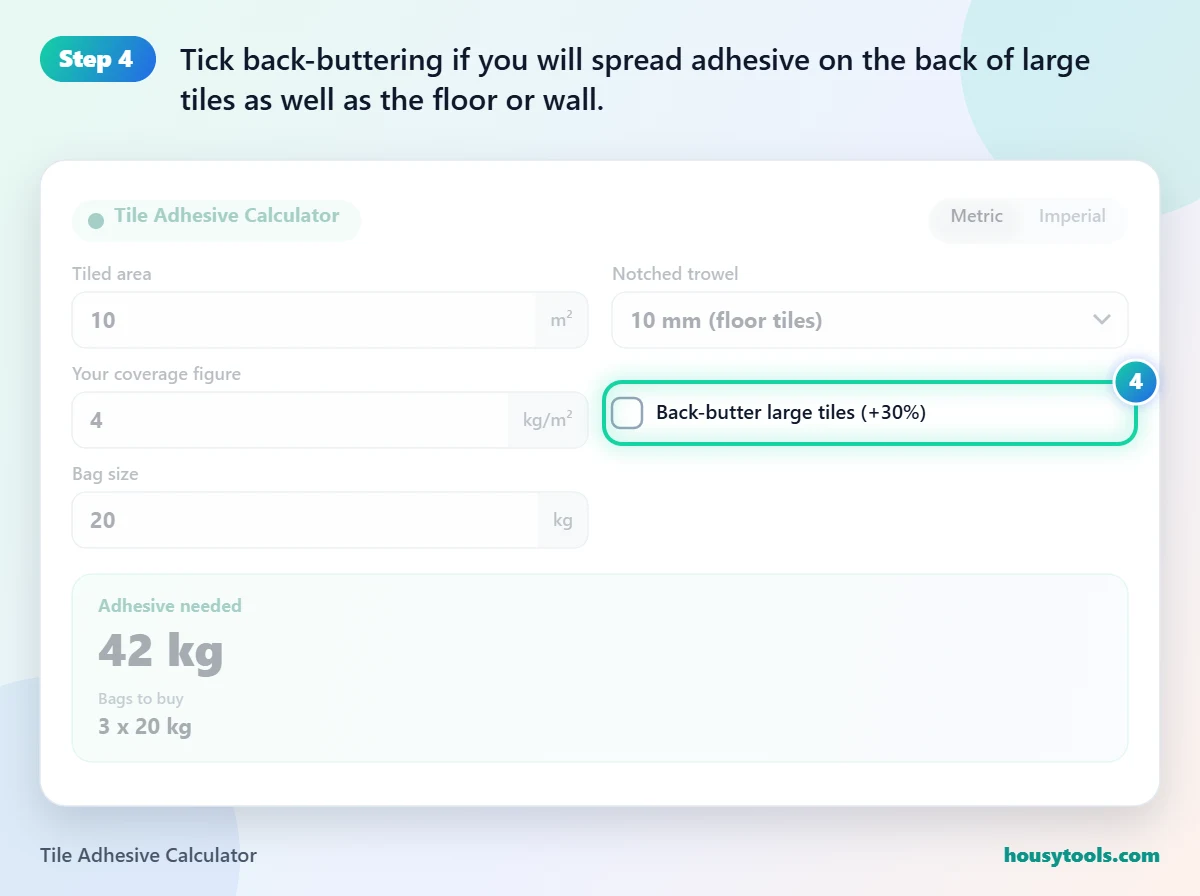
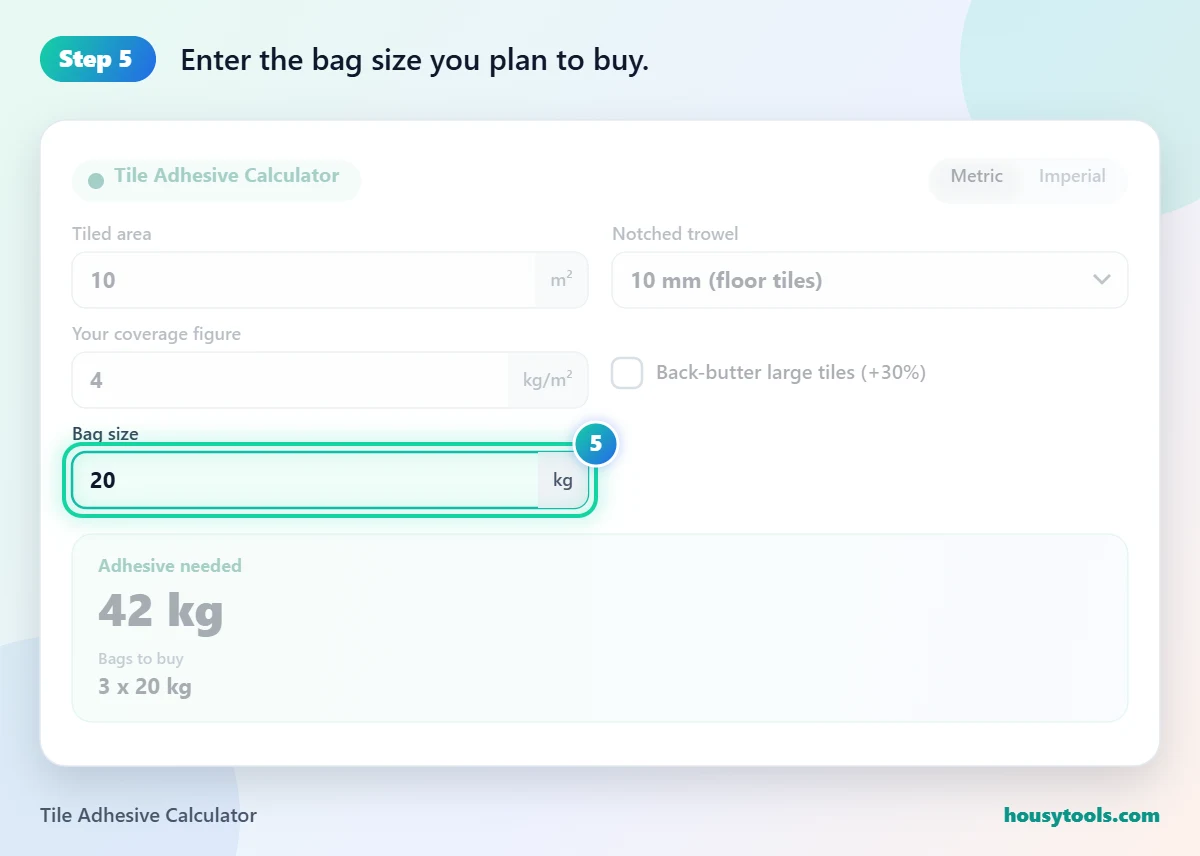
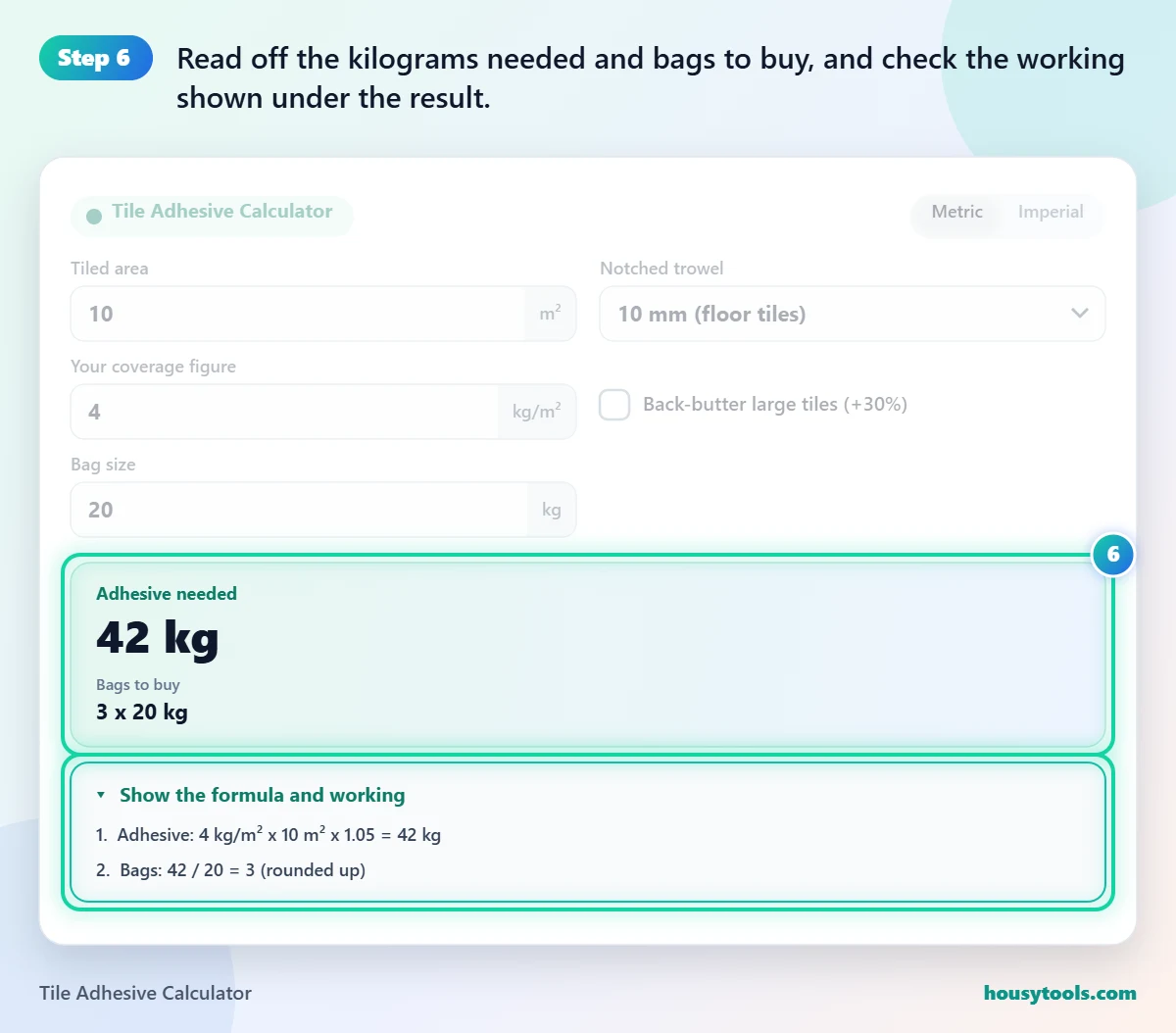
The tile adhesive calculator recalculates as you type, so you can compare trowel sizes before you go to the merchant.
How Much Tile Adhesive Do I Need per m²?
Most jobs need 1.5 to 5 kg of tile adhesive per m², with about 2.5 kg for small wall tiles and about 4 kg for floor tiles laid with a 10 mm notched trowel. Our tile adhesive calculator uses those typical figures as presets.
Real data sheets sit in the same range. BAL quotes its Flex One adhesive at 0.5 m² per kg for dry walls with a 6 mm notch and 0.26 m² per kg for floors with a 10 mm notch on a solid bed. That is 2.0 kg and 3.85 kg per m² once you divide 1 by the coverage.
Weber states 3.0 kg per m² for weberset rapid plus with a 6 x 6 mm notched trowel, and 4.5 kg per m² for a 3 mm solid bed. Products differ, which is why the coverage printed on your own bag should replace the preset.
Tile Adhesive Coverage by Trowel Size
| Notched trowel | Typical tiles | Adhesive (kg/m²) | Area per 20 kg bag |
|---|---|---|---|
| 3 mm | Mosaics | 1.5 | 13.3 m² |
| 6 mm | Small wall tiles | 2.5 | 8.0 m² |
| 10 mm | Floor tiles | 4.0 | 5.0 m² |
| 12 mm | Large format tiles | 5.0 | 4.0 m² |
| 10 mm + back-butter | Large floor tiles | 5.2 | 3.8 m² |
| 12 mm + back-butter | Very large or heavy tiles | 6.5 | 3.1 m² |
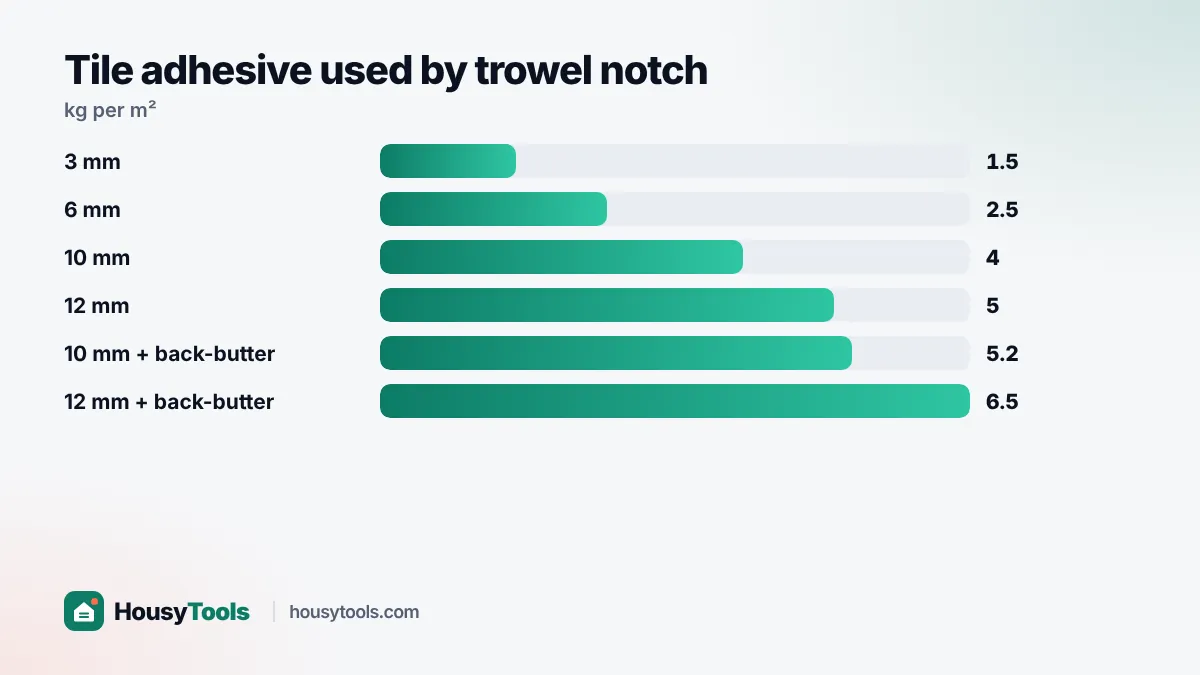
To turn a figure in m² per kg from a UK bag into kg per m², divide 1 by it. For example, 0.4 m² per kg equals 2.5 kg per m².
What Size Notched Trowel Should I Use?
As a rule of thumb, the larger the tile, the larger the notch: 3 to 4 mm for mosaics, 6 mm for wall tiles up to about 300 mm, and 10 to 12 mm for floor and large format tiles.
The aim is a full bed of adhesive under every tile, especially on floors and in wet areas such as showers, where BAL’s figures assume a solid bed. Lift a tile after bedding it now and then: if the back is not well covered, move up a notch size or back-butter.
A bigger notch also helps on slightly uneven walls, but it is not a fix for a bad floor. If the floor is out by several millimetres, level it first and work out the compound with our self levelling compound calculator.
Does Back-Buttering Tiles Use More Adhesive?
Yes, back-buttering usually adds about 30% to adhesive use, and the tile adhesive calculator applies exactly that when you tick the box. Back-buttering means spreading a thin skim coat on the back of each tile before pressing it into the ridged bed.
It is common with large format tiles, natural stone and tiles with deep keys on the back, because it helps achieve full contact. The 30% in the tile adhesive calculator is our estimate, so check your adhesive’s data sheet if it gives a separate figure for this method.
How Do You Measure an Area for Tile Adhesive?
Measure each surface in metres, multiply length by height (walls) or length by width (floors), and add the results together before entering them in the tile adhesive calculator. A bathroom with three tiled walls of 2.0 x 2.4 m, 1.7 x 2.4 m and 2.0 x 1.2 m comes to 11.28 m².
Take off large areas you will not tile, such as a bath panel or a window, but do not bother subtracting sockets or small cut outs. Treat walls and floors as separate runs in the tile adhesive calculator if they use different trowels, then add the bags together.
If you measure in feet, switch the tile adhesive calculator to imperial and enter square feet; the sum is done in metric behind the scenes, so the bag count is the same.
Worked Example: Tom’s Kitchen Floor
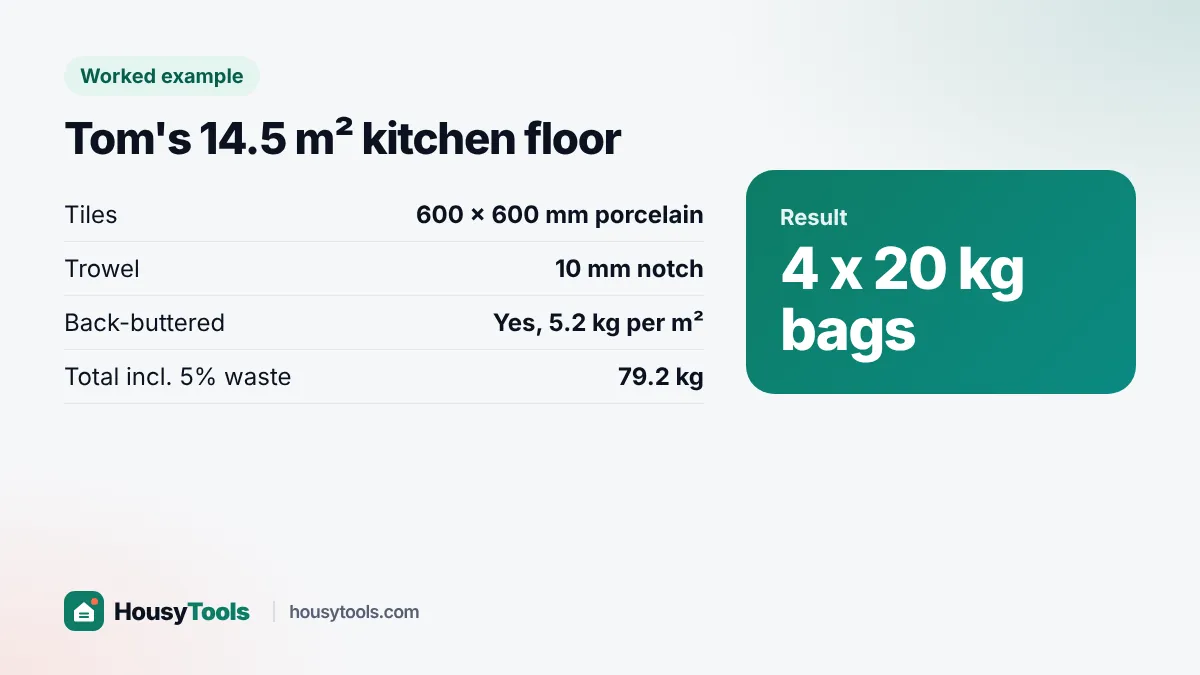
Tom in Bristol is laying 600 x 600 mm porcelain tiles on a 14.5 m² kitchen floor. He will use a 10 mm notched trowel and back-butter each tile, buying adhesive in 20 kg bags.
- Coverage: 4 kg per m² x 1.3 for back-buttering = 5.2 kg per m²
- Adhesive: 5.2 kg/m² x 14.5 m² x 1.05 = 79.17 kg, shown as 79.2 kg
- Bags: 79.17 / 20 = 4 bags (rounded up)
- Without back-buttering: 4 kg/m² x 14.5 m² x 1.05 = 60.9 kg, still 4 bags
Four bags cover both methods, so Tom can decide on site. He will grout with 3 mm joints, and runs the grout calculator next for the same floor.
Common Tile Adhesive Mistakes
- Spot fixing tiles with dabs of adhesive. It leaves voids that can crack floor tiles and trap water on walls.
- Mixing a whole bag at once. Mix only what you can use within the pot life on the bag, especially with rapid set adhesive.
- Using a wall trowel on a floor. Too little adhesive leaves hollow tiles that sound different when tapped.
- Ignoring the substrate. Plasterboard, timber and underfloor heating may need a flexible (S1) adhesive or primer, as the bag explains.
- Forgetting waste. Adhesive left on the trowel, in the bucket and in skins is lost, which is why we add 5%.
Every figure the tile adhesive calculator uses is listed on how our calculators work. For tiles, grout and levelling in one place, browse the flooring and tiling calculators.
Tile Adhesive Calculator FAQs
How many m² does a 20 kg bag of tile adhesive cover?
A 20 kg bag covers about 8 m² with a 6 mm notched trowel and about 5 m² with a 10 mm notch, before waste. Large format tiles that are back-buttered drop that to roughly 3 to 4 m² per bag.
Is ready mixed tile adhesive the same coverage as powder?
Not always. Ready mixed tubs are usually for small wall tiles in dry areas and their coverage is printed in m² per tub. Choose “Use my own figure” in the tile adhesive calculator and enter the tub’s kg per m² rate.
How thick should tile adhesive be?
Once tiles are pressed in, a square notched trowel leaves a bed of roughly half the notch depth, so about 3 mm from a 6 mm notch and 5 mm from a 10 mm notch. Check the maximum bed depth on your bag; BAL Flex One allows up to 15 mm.
Do I need flexible tile adhesive?
Flexible adhesives (classed S1 or S2) are recommended on timber, plasterboard, underfloor heating and for large format tiles that move with temperature. The manufacturer’s data sheet lists suitable substrates, so check it before buying.
Should I add extra tile adhesive for waste?
Yes. The tile adhesive calculator adds 5% for adhesive left in the bucket and on the trowel. On uneven walls or floors you may use more, so keep the receipt and one spare bag if your merchant accepts returns.
Can I use tile adhesive to level a floor?
Only for small dips within the product’s maximum bed depth. For floors that are out by more than a few millimetres, use a levelling compound first. It gives a flat base and usually costs less than filling with adhesive.
Checked October 2026. Sources: BAL Flex One data, Weber weberset rapid plus specification (NBS Source), Wikipedia.