
Show the formula and working
This free parquet flooring calculator works out how many packs of parquet blocks you need for a room, with an allowance for cuts and waste, plus the number of blocks, the adhesive and the length of edge beading, for homeowners and fitters in the UK, Ireland and Europe. It suits herringbone, chevron and straight laid parquet, solid or engineered.
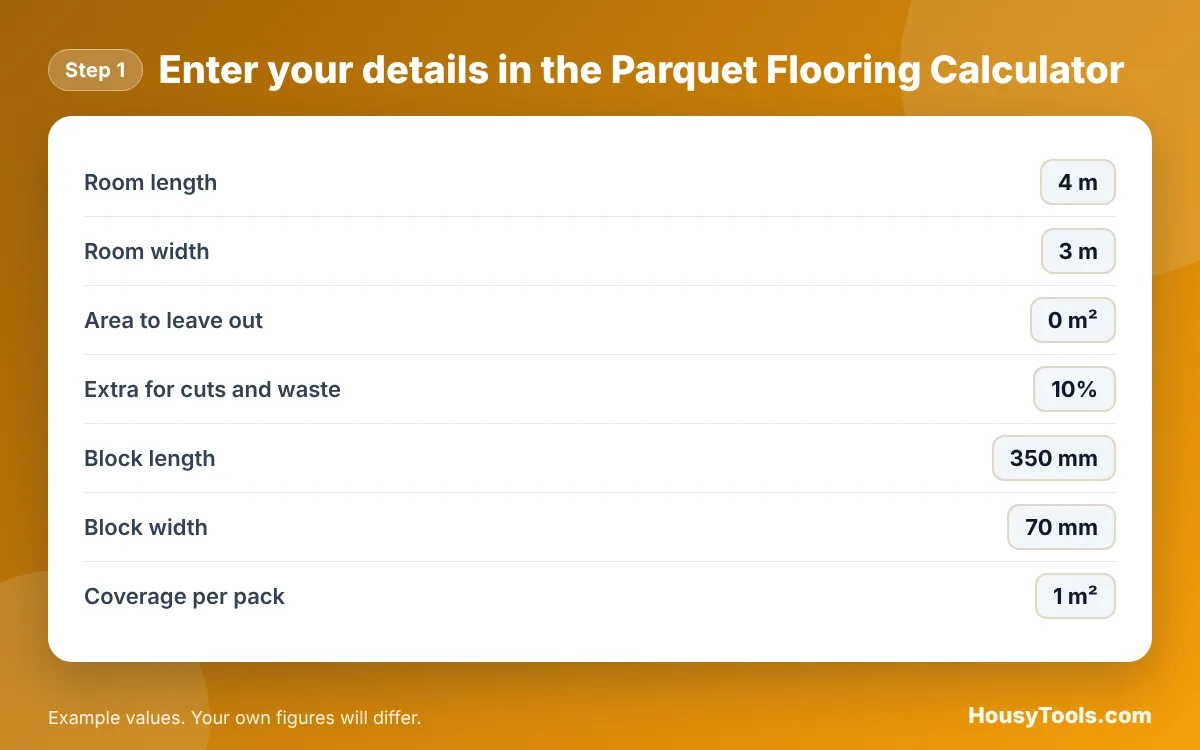
Quick answer: Multiply the room length by its width, add about 10% for cuts, then divide by the coverage of one pack and round up. A 4 m by 3 m room is 12 m², or 13.2 m² with 10% extra, so a parquet flooring calculator shows 14 packs of 1 m², about 539 blocks of 350 x 70 mm.
What Is a Parquet Flooring Calculator?
A parquet flooring calculator is a tool that turns a room’s floor area into packs and blocks of parquet, the small wooden blocks laid in patterns such as herringbone and chevron. In plain words: floor area = length x width – areas left out; area to buy = floor area x (1 + waste %); packs = area to buy / coverage per pack, rounded up; blocks = area to buy / (block length x block width). Adhesive = floor area x spread rate, and beading = room perimeter – doorways.
The pack coverage, block size and adhesive spread rate start at example figures because they vary by product. Copy the real figures from the pack and the adhesive tub, and the result updates.
How Do You Use the Parquet Flooring Calculator?
- Enter the Room length, Room width and any Area to leave out.
- Set the Extra for cuts and waste: about 10%, or more for herringbone or chevron.
- Enter the Block length, Block width and Coverage per pack from the pack.
- Enter the Adhesive spread rate from the tub, or 0 for a floating floor, and the total width of Doorways.
- Read the packs, blocks, adhesive and beading, then open “Show the formula and working” to see each step.


How Much Extra Parquet Should I Order?
Order about 10% extra for cuts and waste on most parquet floors, and more for herringbone, chevron or rooms with many corners, bays and doorways. Every row of a herringbone floor ends in an angled cut at the walls, so offcuts add up. It also helps to keep a few spare blocks for future repairs, because later batches may differ in colour. The table shows packs of an example 1 m² at 10% and 15%.
| Room size | Floor area | With 10% extra | 1 m² packs at 10% | With 15% extra | 1 m² packs at 15% |
|---|---|---|---|---|---|
| 3 x 3 m | 9 m² | 9.90 m² | 10 | 10.35 m² | 11 |
| 4 x 3 m | 12 m² | 13.20 m² | 14 | 13.80 m² | 14 |
| 4 x 4 m | 16 m² | 17.60 m² | 18 | 18.40 m² | 19 |
| 5 x 4 m | 20 m² | 22.00 m² | 22 | 23.00 m² | 23 |
| 6 x 4 m | 24 m² | 26.40 m² | 27 | 27.60 m² | 28 |
| 6 x 5 m | 30 m² | 33.00 m² | 33 | 34.50 m² | 35 |
How Many Parquet Blocks Are in a Square Metre?
Divide one square metre by the area of one block: 350 x 70 mm blocks give 40.8 blocks per m², 280 x 70 mm give 51.0, 450 x 90 mm give 24.7, 500 x 100 mm give 20.0 and 600 x 120 mm give 13.9. Smaller blocks mean more pieces to lay and more cuts, so labour and waste rise. Patterned floors often look best when the block length is a whole multiple of its width, such as 5 to 1.
What Subfloor Does Parquet Need?
Glued parquet needs a flat, dry, sound subfloor, so check concrete for moisture and level any dips before fitting. A self levelling compound calculator works out how much compound an uneven screed needs. Leave an expansion gap around the edges as the maker specifies, and cover it with beading, scotia or skirting; the skirting board calculator helps if you are replacing the skirting.
Worked Example: Parquet for a 4 m by 3 m Room
Example: a 4 m by 3 m dining room with one 0.9 m doorway, laid in 350 x 70 mm blocks sold in packs covering 1 m², with 10% extra and adhesive at an example 1 kg per m². The floor area is 4 x 3 = 12 m², and with 10% extra the area to buy is 13.2 m². That is 13.2 / 1 = 13.2 packs, rounded up to 14 packs. Each block covers 0.0245 m², so 13.2 / 0.0245 = 539 blocks, of which about 490 are laid.
Adhesive is 12 x 1 = 12 kg, and the beading runs 2 x (4 + 3) – 0.9 = 13.1 m. For a herringbone pattern in tiles rather than wood, use the herringbone tile calculator, and see more tools on the flooring calculators page.
Parquet Flooring Calculator FAQs
How do I calculate how much parquet I need?
Multiply the room’s length by its width in metres, subtract areas you will not cover, add about 10% for cuts, and divide by the coverage of one pack. Round up to whole packs, and check all packs come from the same batch.
Does herringbone parquet need more wastage?
Usually yes, because every row ends in an angled cut at the wall. Many fitters allow 10% to 15% or more for herringbone and chevron, depending on the room shape. Ask your fitter for their figure and enter it in the calculator.
How much adhesive does parquet need?
It depends on the adhesive and the trowel notch, so use the spread rate on the tub in kg per m². Multiply it by the floor area. The calculator uses 1 kg per m² only as an example to replace with the real figure.
What is the difference between solid and engineered parquet?
Solid parquet blocks are timber all the way through, while engineered blocks have a hardwood top layer on a stable core. Engineered parquet moves less with humidity and suits underfloor heating more often. The quantity calculation is the same for both.
How long should parquet acclimatise before fitting?
Follow the maker’s instructions, which usually say to leave the packs in the room where they will be laid for a set time at normal temperature and humidity. This lets the wood settle and reduces gaps or lifting after fitting.
Do I need beading around a parquet floor?
You need something to hide the expansion gap at the walls: beading, scotia or skirting fitted after the floor. The calculator works out the beading length as the room perimeter minus doorways, where thresholds are used instead.
Checked October 2026. Sources: Parquetry (Wikipedia), Engineered wood (Wikipedia).