
Show the formula and working
This free staircase paint calculator works out how much paint you need to paint a staircase, counting the treads, risers, stringers, spindles, handrail and newel posts separately, for homeowners and decorators in the UK, Ireland and Europe. It turns your measurements into square metres, litres and tins, so you can buy the right amount of trim paint and floor paint.
Quick answer: Add up the area of every part you will paint, multiply by the coats and divide by the coverage per litre. A 13 step staircase 0.86 m wide with treads, risers, one stringer, 26 spindles, a handrail and two newels is about 10.78 m², so a staircase paint calculator shows 1.8 litres for two coats.
What Is a Staircase Paint Calculator?
A staircase paint calculator is a tool that measures each part of a staircase as a surface area and converts the total into paint. In plain words: treads = steps x stair width x tread depth; risers = steps x width x riser height; stringer = steps x the diagonal of one step x the visible board height; spindles = number x 4 faces x width x height; handrail = length x girth. Paint = total area x coats / coverage per litre.
The default coverage of 12 m² per litre is the figure on the Dulux Trade Quick Dry Satinwood product page, a common choice for stair woodwork. Treads take a lot of wear, so many people use a dedicated floor or stair paint on them, or leave them for a runner. The breakdown shows the treads separately so you can buy each product.
How Do You Use the Staircase Paint Calculator?
- Count the risers and enter the Number of steps, then measure the Stair width, Tread depth and Riser height.
- Tick Paint the treads and Paint the risers as needed.
- Choose the Stringers to paint and measure the Visible stringer height.
- Enter the Number of spindles, Spindle width and Spindle height, then the Handrail length, Handrail girth and Newel posts.
- Enter the Coats, the Paint coverage from your tin and the Tin size.
- Read the litres and tins, then open “Show the formula and working” to see the area of every part.
How Much Paint Do I Need for a Staircase?
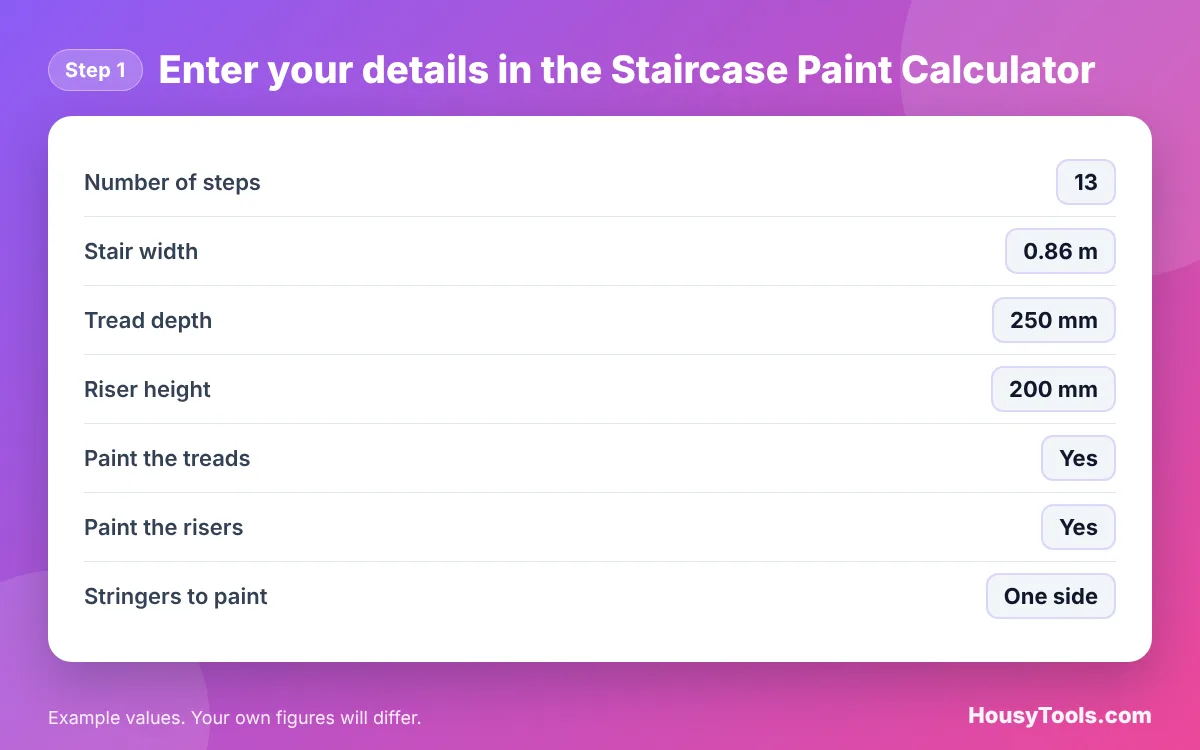
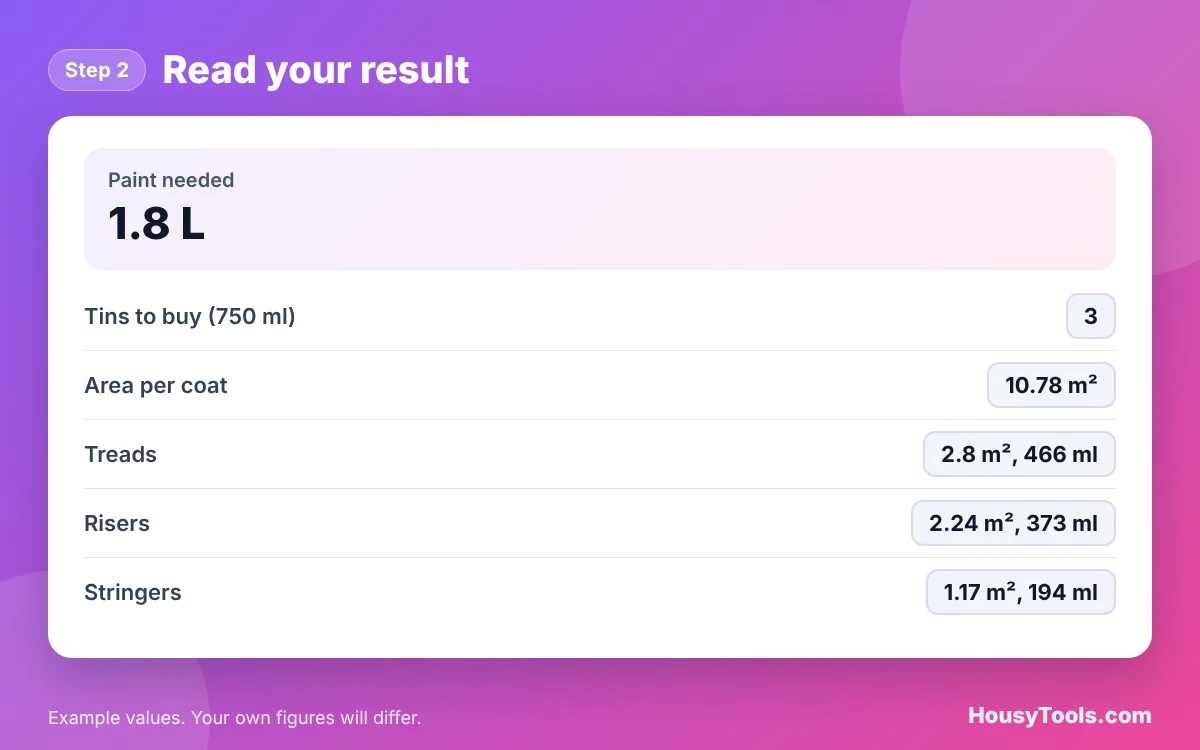
A straight 13 step staircase with spindles, like the example below, needs about 1.8 litres for two coats at 12 m² per litre. Spindles are the surprise: 26 square spindles take slightly more paint than all 13 treads, because each has four faces. Painted treads and risers alone on a 13 step flight need about 840 ml for two coats.
| Part | How it is measured | Example area | Two coats at 12 m²/L |
|---|---|---|---|
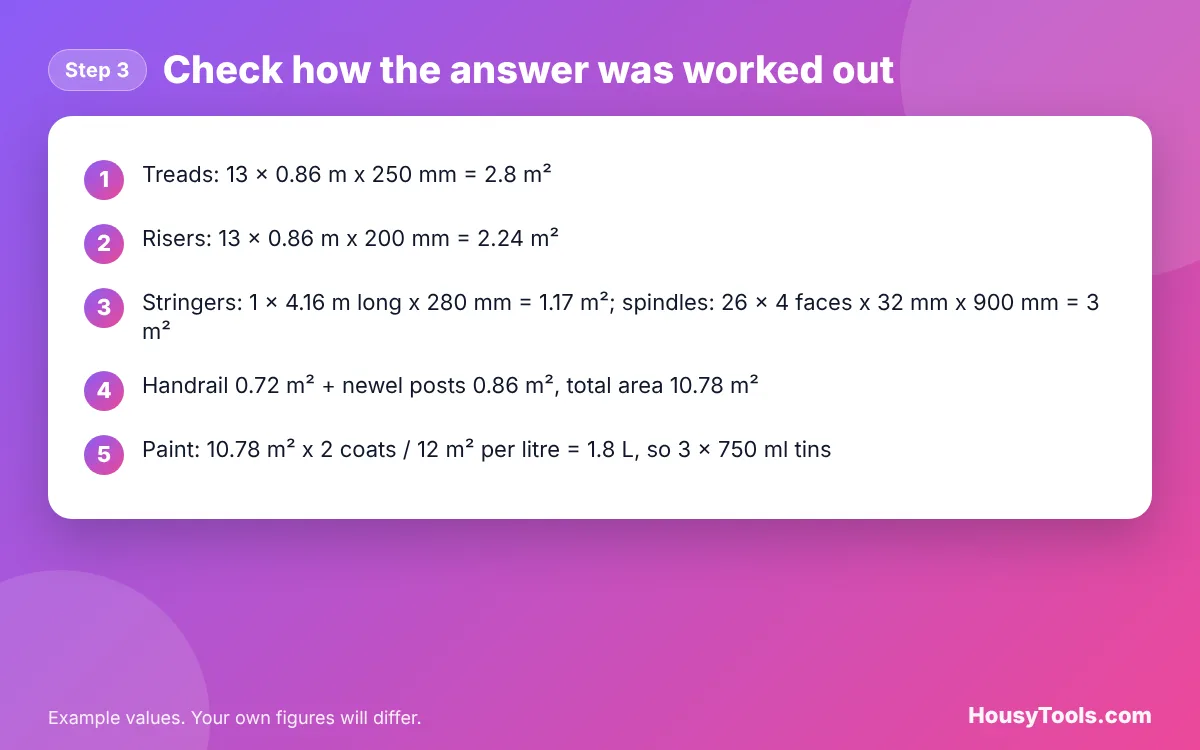
| Treads | 13 x 0.86 m x 250 mm | 2.80 m² | 466 ml |
| Risers | 13 x 0.86 m x 200 mm | 2.24 m² | 373 ml |
| One stringer | 4.16 m long x 280 mm | 1.17 m² | 194 ml |
| Spindles | 26 x 4 faces x 32 mm x 900 mm | 3.00 m² | 499 ml |
| Handrail | 3.6 m x 200 mm girth | 0.72 m² | 120 ml |
| Two newel posts | 2 x 4 faces x 90 mm x 1.2 m | 0.86 m² | 144 ml |
| Total | 10.78 m² | 1.8 L |
What Paint Should I Use on Stairs?
Use a hard wearing floor or stair paint on the treads and a satinwood, eggshell or gloss trim paint on the risers, stringers, spindles and handrail. Treads take constant foot traffic, so a product made for floors lasts much longer than ordinary woodwork paint; the floor paint calculator covers that side. Choose a finish that is not slippery, and let it harden fully before heavy use.
How Do I Paint Stairs When I Still Need to Use Them?
Paint every other tread, let them dry, then paint the rest, so you can always step on dry treads. Start at the top and work down so you never paint yourself in. Do spindles and the handrail first, then stringers and risers, and treads last. If you would rather fit a runner on the treads, the stair carpet calculator works out its length.
The riser height check in the calculator follows the Approved Document K limit of 220 mm for a private stair in England, which helps you spot a mismeasured step.
Worked Example: Painting a 13 Step Staircase
Example: a straight staircase with 13 steps, 0.86 m wide, 250 mm treads and 200 mm risers, one 280 mm stringer, 26 spindles 32 mm square and 900 mm high, a 3.6 m handrail with a 200 mm girth and two newel posts, painted with two coats at 12 m² per litre. The parts add up to 2.80 + 2.24 + 1.17 + 3.00 + 0.72 + 0.86 = 10.78 m². Paint = 10.78 x 2 / 12 = 1.8 litres, which is three 750 ml tins.
If the treads get floor paint instead, the woodwork needs 1.33 litres and the treads 466 ml at the same coverage. More decorating tools are on the paint and decorating calculators page.
Staircase Paint Calculator FAQs
How many tins of paint do I need for stairs?
Most straight staircases need two or three 750 ml tins for two coats, depending on the spindles and coverage. The example 13 step staircase needs 1.8 litres, so three 750 ml tins or one 2.5 litre tin.
How do I measure stair spindles for paint?
Count the spindles, measure the width of one face and its height between the handrail and the base rail. A square spindle has four faces, so each one is 4 x width x height. Turned spindles have a similar area to square ones of the same size.
How many coats of paint do stairs need?
Two coats is the usual rule for stair woodwork, after a primer or undercoat on bare or dark wood. Treads may need the number of coats the floor paint maker gives for heavy traffic, so follow the tin.
Can I paint stairs with ordinary gloss?
Gloss suits spindles, handrails and stringers, but on treads it can be slippery and wears through quickly. Use a floor or stair paint for treads, ideally one with a low sheen or anti slip finish.
How long before I can walk on painted stairs?
Follow the drying and hardening times on the tin, which are usually longer than the recoat time. Use alternate treads while they dry, and avoid heavy traffic or furniture moves until the paint has fully hardened.
Do I need to sand stairs before painting?
Yes. Lightly sand sound paint or varnish to give the new coat a key, then vacuum and wipe away dust. In homes built before 1960, old paint may contain lead, so do not dry sand it; use a lead test kit first.
Checked October 2026. Sources: Dulux Trade Quick Dry Satinwood (product page), Approved Document K (GOV.UK).