
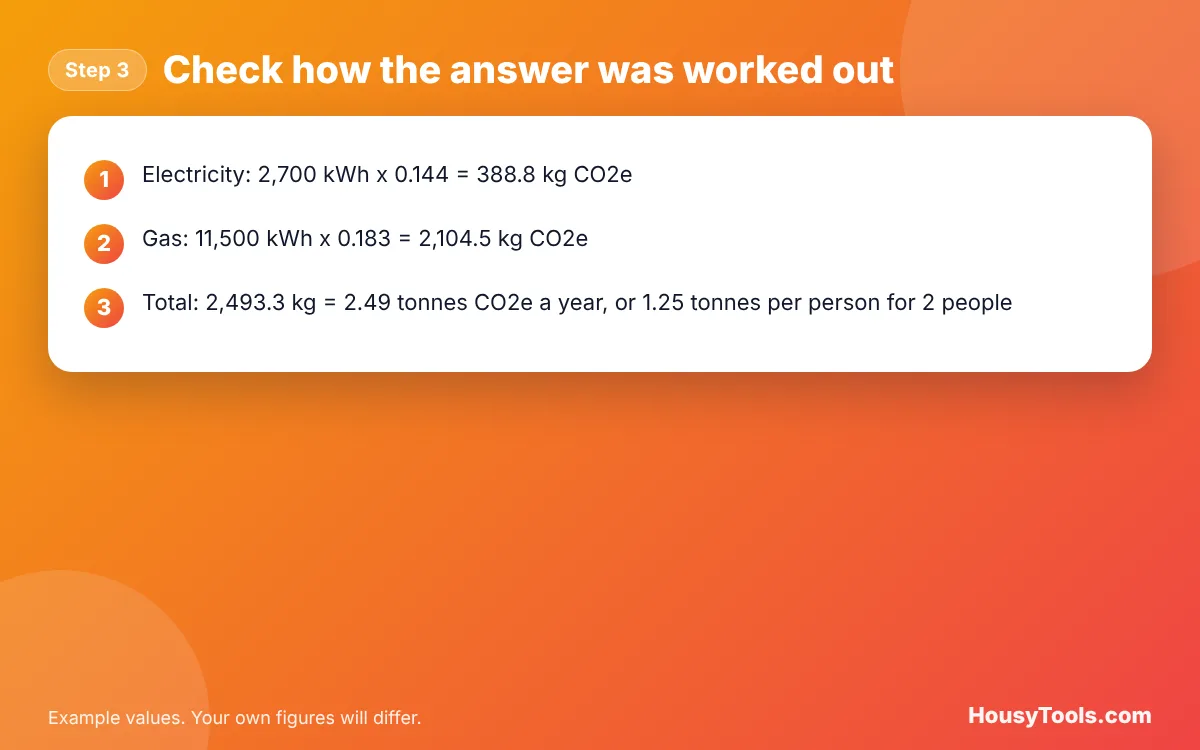
Show the formula and working
This free home carbon footprint calculator works out the greenhouse gas emissions from the energy your home uses each year, for households in the UK, Ireland and Europe who want a clear figure for electricity, gas, heating oil and LPG. It uses the UK government’s 2026 conversion factors by default, shows which fuel causes most of your footprint, and lets you change every factor for another country or a newer table.
Quick answer: A home carbon footprint calculator multiplies each fuel you use by its emission factor. A UK home using 2,700 kWh of electricity at 0.144 kg and 11,500 kWh of gas at 0.183 kg produces about 2.49 tonnes CO2e a year, and gas causes 84% of it.

What Is a Home Carbon Footprint Calculator?
A home carbon footprint calculator is a tool that converts your yearly household energy use into kilograms or tonnes of carbon dioxide equivalent (CO2e), the standard unit that counts all greenhouse gases as if they were CO2.
The formula in plain words: for each fuel, multiply the amount used by its emission factor, then add the results together. Electricity and gas are in kWh, heating oil and LPG are in litres. Divide the total by 1,000 for tonnes and by the number of people for a per person figure. The default factors come from the government’s greenhouse gas reporting conversion factors 2026, which put UK electricity at 0.13096 kg CO2e per kWh generated plus 0.01299 kg for grid losses, so 0.144 kg per kWh used at home.
How Do You Use the Home Carbon Footprint Calculator?
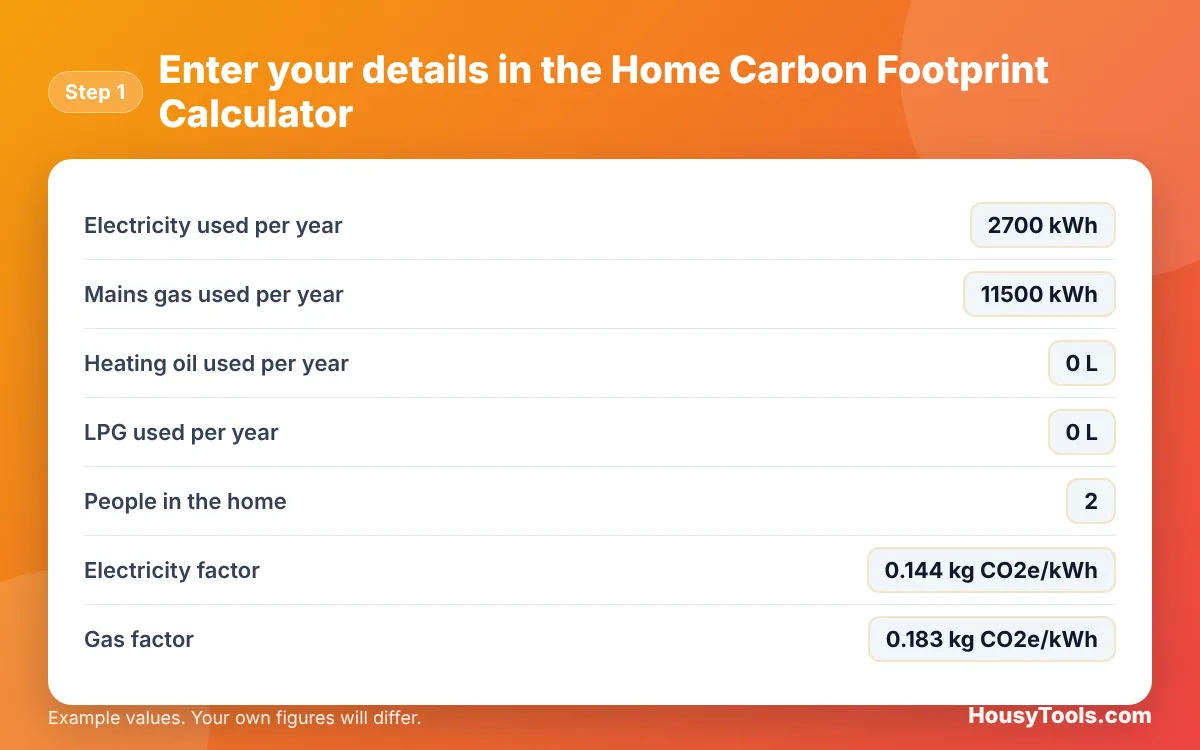
- Enter Electricity used per year in kWh from your annual statement or smart meter app.
- Enter Mains gas used per year in kWh. If your bill shows cubic metres, convert them first.
- If you heat with oil or LPG, enter Heating oil used per year or LPG used per year in litres from your delivery invoices.
- Set People in the home to see the footprint per person.
- Keep the Electricity factor, Gas factor, Heating oil factor and LPG factor, or replace them with your country’s figures.
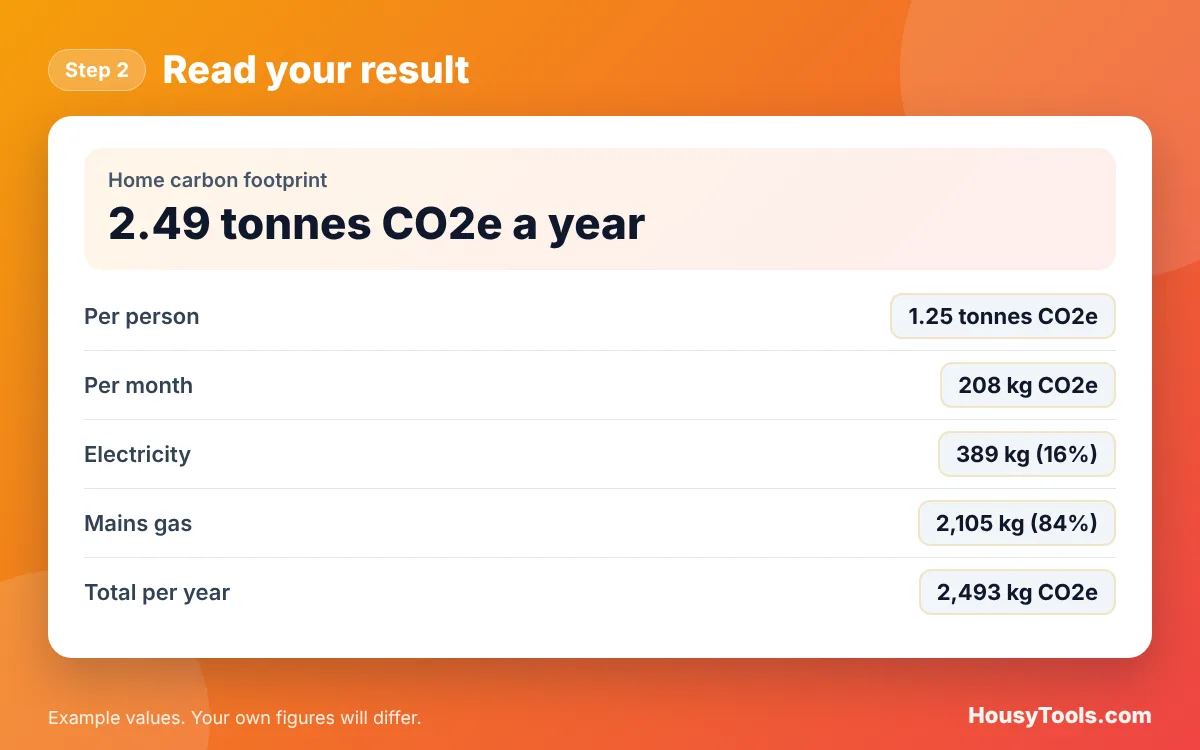
- Read the result and open “Show the formula and working” to see each fuel’s share and the sum.
What Is the Average Carbon Footprint of a UK Home?
A UK home with typical medium energy use produces about 2.5 tonnes CO2e a year from electricity and gas, using Ofgem’s typical figures of 2,700 kWh of electricity and 11,500 kWh of gas. Ofgem explains these benchmarks on its average gas and electricity use page. Low and high users differ a lot, as the table shows.
| Home | Electricity | Gas | Electricity CO2e | Gas CO2e | Total a year |
|---|---|---|---|---|---|
| Low use | 1,800 kWh | 7,500 kWh | 259 kg | 1,373 kg | 1.63 t |
| Medium use | 2,700 kWh | 11,500 kWh | 389 kg | 2,105 kg | 2.49 t |
| High use | 4,100 kWh | 17,000 kWh | 590 kg | 3,111 kg | 3.70 t |
| Medium use, heat pump instead of gas (illustration below) | 6,150 kWh | 0 kWh | 886 kg | 0 kg | 0.89 t |
Factors used: 0.144 kg CO2e per kWh of electricity and 0.183 kg per kWh of gas.
Does Electricity or Gas Have a Bigger Carbon Footprint?
In the UK in 2026, a kWh of gas burned at home gives more CO2e than a kWh of electricity: about 0.183 kg against 0.144 kg. The electricity factor fell by around 26% in the 2026 tables as the grid used less fossil fuel, while the gas factor barely changes from year to year. Because most homes use far more gas than electricity, heating is usually the largest part of the footprint.
How Much Carbon Does a Heat Pump Save?
Switching from a gas boiler to a heat pump can cut heating emissions by well over half at 2026 UK factors. As an illustration, 11,500 kWh of gas in a 90% efficient boiler delivers about 10,350 kWh of heat. A heat pump with a seasonal efficiency of 3 would need about 3,450 kWh of electricity for the same heat, which is about 497 kg CO2e instead of 2,105 kg. Your own result depends on the heat pump’s real efficiency, so compare running costs too with the heat pump vs gas boiler cost calculator.
Do Green Electricity Tariffs Make My Footprint Zero?
Not in the standard method: the government factors measure the average grid, so a green tariff does not change the location based figure this calculator shows. Some reporting methods allow a lower market based figure for certified renewable supply, but that needs your supplier’s own fuel mix data. Reducing the kWh you use always lowers the result, which you can check against cost with the electricity bill calculator.
Worked Example: A Typical Gas Heated Home
Example: a home with 2 people uses 2,700 kWh of electricity and 11,500 kWh of gas a year, with no oil or LPG. These are the tool’s default inputs.
- Electricity: 2,700 kWh x 0.144 = 388.8 kg CO2e (16%).
- Gas: 11,500 kWh x 0.183 = 2,104.5 kg CO2e (84%).
- Total: 2,493.3 kg, or 2.49 tonnes CO2e a year, about 208 kg a month.
- Per person: 2.49 / 2 = 1.25 tonnes CO2e.
Home Carbon Footprint Calculator FAQs
How do I calculate my home’s carbon footprint?
Multiply each fuel by its emission factor and add them up. For example, 2,700 kWh of electricity x 0.144 plus 11,500 kWh of gas x 0.183 gives about 2,493 kg CO2e a year. Take the kWh figures from your annual energy statements.
What is the UK electricity carbon factor for 2026?
The UK government’s 2026 factor is 0.13096 kg CO2e per kWh generated, plus 0.01299 kg for transmission and distribution losses, which makes 0.14396 kg for each kWh used at home. The calculator rounds this to 0.144.
What does CO2e mean?
CO2e, or carbon dioxide equivalent, adds methane, nitrous oxide and other greenhouse gases to carbon dioxide, weighting each by how strongly it warms the climate compared with CO2. It lets different fuels be compared on one scale.
How do I convert gas cubic metres to kWh?
Multiply the cubic metres by the volume correction factor and the calorific value from your bill, then divide by 3.6. Many UK bills already show the kWh figure. Our gas m³ to kWh converter does the sum for you before you use this calculator.
Can I use this calculator outside the UK?
Yes. Replace the electricity factor with your country’s published grid figure, because grids differ a lot across Europe. Gas, oil and LPG factors are similar between countries, since they depend mainly on the fuel itself.
Does the calculator include solar panels?
Enter only the electricity you import from the grid. Solar power you generate and use yourself reduces that import figure, so it lowers the result automatically. Exported solar power is not subtracted in this simple method.
Checked October 2026. Sources: GOV.UK, Greenhouse gas reporting: conversion factors 2026 (methodology report, Table 9, for the electricity factor), Ofgem, Average gas and electricity usage.