
Show the formula and working
This dew point calculator works out the temperature at which water vapour in the air starts to condense, from the air temperature and relative humidity, for homeowners and renters in the UK, Ireland and the rest of Europe dealing with condensation and mould. Add the temperature of a window, wall or pipe, and it tells you whether condensation will form there and whether the surface is damp enough for mould.
Quick answer: A dew point calculator uses the Magnus formula on air temperature and relative humidity. Air at 20 °C and 60% humidity has a dew point of 12 °C, so any surface at 12 °C or colder gets wet. A wall at 14 °C stays dry but sits at about 88% surface humidity, enough for mould over time.
What Is a Dew Point Calculator?
A dew point calculator is a tool that finds the temperature at which air becomes saturated and water starts to condense, using the air temperature and relative humidity. In plain words: take the natural log of the humidity as a fraction, add 17.625 x T / (243.04 + T), and call that gamma. The dew point is 243.04 x gamma / (17.625 minus gamma), with T in °C. This is the Magnus formula with the constants of Alduchov and Eskridge, accurate to a few tenths of a degree from -40 °C to 50 °C.
When warm, moist room air touches a surface colder than its dew point, the air next to it cools and drops water as condensation. That is why windows, outside wall corners and cold water pipes are often wet on winter mornings. The dew point article on Wikipedia explains the physics and the formula in more depth.
How Do You Use the Dew Point Calculator?
- Choose the Temperature unit, °C or °F.
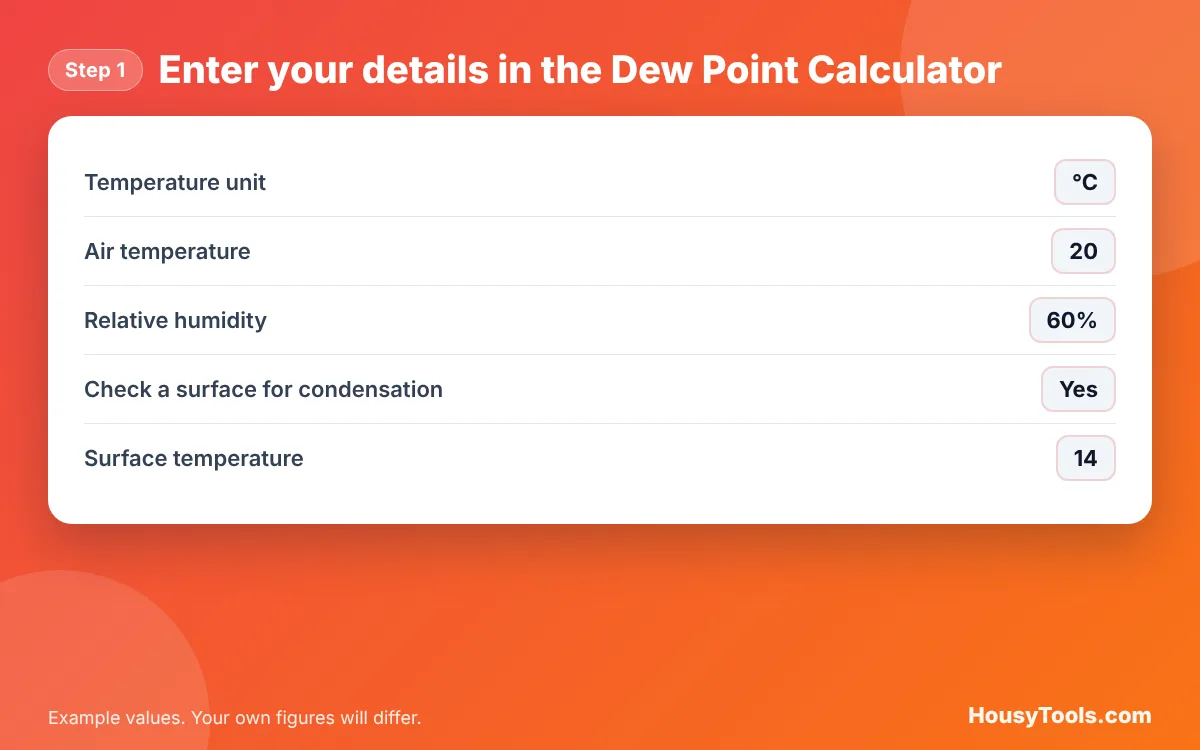
- Enter the Air temperature and the Relative humidity from a thermometer and hygrometer in the room.
- Leave Check a surface for condensation ticked to test a window, wall or pipe.
- Enter the Surface temperature, ideally measured with an infrared thermometer.
- Read the dew point, the absolute humidity and the surface check, then open “Show the formula and working” to see each step.


Why Do I Get Condensation on My Windows?
Windows get condensation when the glass is colder than the dew point of the room air. At 20 °C and 60% humidity the dew point is 12 °C, and single glazing or old double glazing is often colder than that on a cold night. You can stop it by warming the surface, with better glazing or insulation, or by lowering the dew point, with extractor fans, trickle vents, opening windows briefly and a dehumidifier.
Can Mould Grow Without Visible Condensation?
Yes, mould can grow when the humidity right at a surface stays at about 80% or more for long periods, even if no water droplets appear. That 80% surface humidity limit is the criterion used for mould risk in the European standard for building condensation, BS EN ISO 13788. The calculator works out the humidity at the surface from its temperature, so a cold wall corner at 14 °C in a 20 °C room at 60% shows about 88%, which is a mould risk. The NHS explains how damp and mould affect health.
What Is a Comfortable Dew Point Indoors?
In a heated home in winter, a dew point of roughly 4 to 13 °C is usual, which matches about 40 to 60% humidity at 18 to 21 °C. The lower the dew point, the colder a surface can be before it gets wet. Keeping humidity near 40 to 50% in cold weather lowers the dew point to about 6 to 9 °C at 20 °C and greatly cuts condensation on cold surfaces.
Dew Point Chart by Temperature and Humidity
Dew point in °C, worked out with the same formula as the calculator.
| Air temperature | 40% RH | 50% RH | 60% RH | 70% RH | 80% RH |
|---|---|---|---|---|---|
| 10 °C | -3.0 | 0.0 | 2.6 | 4.8 | 6.7 |
| 15 °C | 1.5 | 4.7 | 7.3 | 9.6 | 11.6 |
| 18 °C | 4.2 | 7.4 | 10.1 | 12.4 | 14.5 |
| 20 °C | 6.0 | 9.3 | 12.0 | 14.4 | 16.4 |
| 22 °C | 7.8 | 11.1 | 13.9 | 16.3 | 18.4 |
| 25 °C | 10.5 | 13.9 | 16.7 | 19.1 | 21.3 |
Worked Example: A Cold Bedroom Wall Corner
Example: a bedroom is at 20 °C and 60% relative humidity, and the outside wall corner measures 14 °C. Gamma is ln(0.6) + 17.625 x 20 / 263.04 = 0.8292, so the dew point is 243.04 x 0.8292 / (17.625 minus 0.8292) = 12.0 °C. The wall is 2 °C above the dew point, so no droplets form. But the vapour pressure in the room, 14.0 hPa, is about 88% of the saturation pressure at 14 °C, so the corner sits at about 88% surface humidity, a mould risk. These are the default inputs, so the calculator shows the same result.
Lowering the room humidity to 50% drops the dew point to 9.3 °C and the surface humidity to about 73%, out of the mould risk zone. A cold corner often points to missing insulation, so check heat loss through the wall with the U-value calculator, and see what drying the air costs with the dehumidifier running cost calculator.
Dew Point Calculator FAQs
What is the difference between dew point and humidity?
Relative humidity is how full the air is of water vapour compared with the most it can hold at that temperature, so it changes when the air warms or cools. The dew point measures the actual amount of moisture and only changes when water is added or removed.
What is the dew point at 20 °C and 50% humidity?
The dew point at 20 °C and 50% relative humidity is about 9.3 °C. Any surface colder than that, such as single glazing on a winter night, will collect condensation. At 60% humidity the dew point rises to 12 °C.
How do I measure a wall or window temperature?
An infrared thermometer pointed at the surface from close range gives a quick reading. Measure early in the morning on a cold day, when surfaces are coldest. A contact thermometer taped to the surface for a few minutes is more accurate on shiny glass.
Does heating the house reduce condensation?
Steady low heating warms walls and windows so they stay above the dew point, which helps. Heating alone does not remove moisture, though, so combine it with ventilation and extractor fans in kitchens and bathrooms to bring the dew point down.
What is absolute humidity?
Absolute humidity is the mass of water vapour in a cubic metre of air, in grams. Air at 20 °C and 60% relative humidity holds about 10.3 g per m³ by this calculation. It shows the real moisture load, which a dehumidifier lowers.
Why does the bathroom mirror steam up?
A hot shower pushes the humidity close to 100%, so the dew point rises almost to the room temperature. The mirror is cooler than the air, so it falls below the dew point and condensation forms. A running extractor fan clears it faster.
Checked October 2026. Sources: Dew point, Magnus formula (Wikipedia), Can damp and mould affect my health? (NHS), BS EN ISO 13788 (BSI), 80% surface humidity mould criterion.