
These free energy unit converters turn kWh into BTU, therms into kWh, gas meter readings into kWh, heating oil litres into kWh and watts into amps, using the exact legal and scientific conversion factors.
Quick answer: Pick the converter for the unit on your bill, appliance label or quote, enter the number and read the result. Each converter shows the factor it used and the working, so you can compare boilers, heat pumps, air conditioners and fuels on the same kWh basis.
Why Convert Everything to kWh?
UK and EU energy bills charge per kWh, so converting gas, oil and BTU ratings to kWh lets you compare fuels and appliances fairly. One kWh equals 3,412 BTU and 3.6 MJ.
How Do Gas Meter Readings Become kWh?
Suppliers multiply cubic metres by a volume correction of 1.02264 and the calorific value in MJ per m³, then divide by 3.6. The gas converter shows each step with your own calorific value from your bill.
Which Energy Unit Converters Do You Need?
Find the unit that appears on your bill, meter, appliance label or quote, then choose the energy unit converter below that turns it into kWh, the unit UK and EU suppliers charge for.
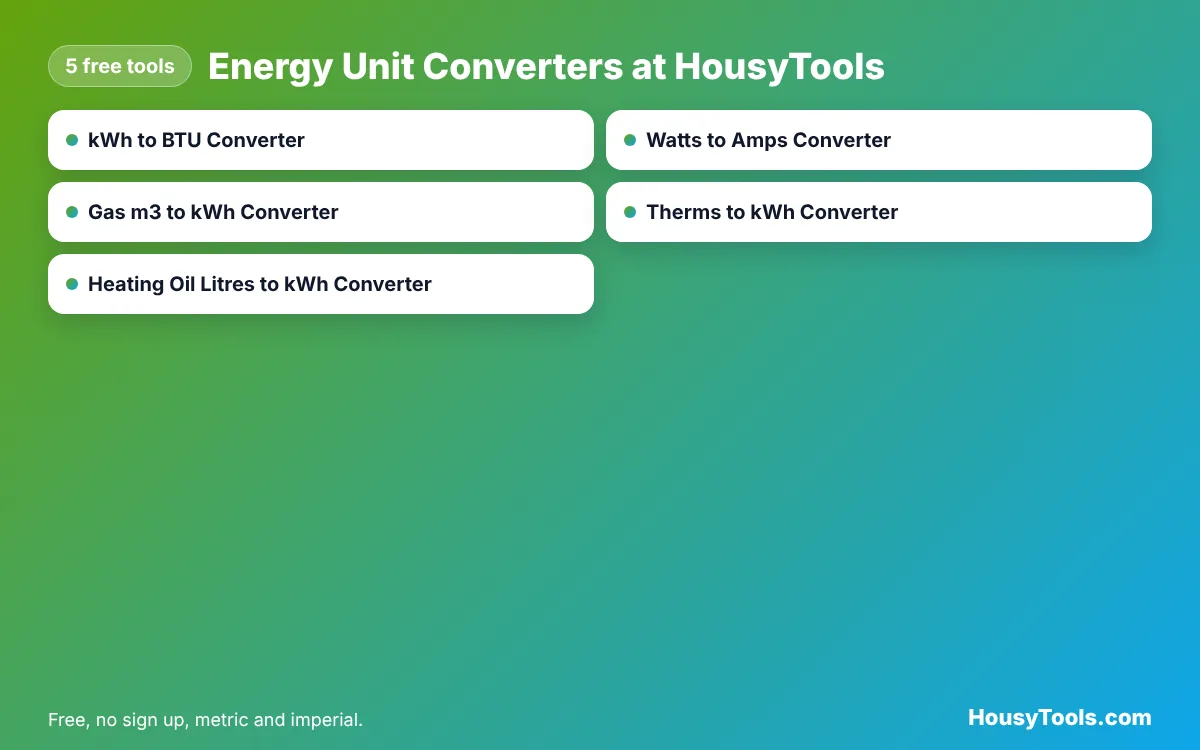
| Tool | What it works out |
|---|---|
| kWh to BTU Converter | Converts kWh to BTU and back, plus kW to BTU per hour for air conditioners. |
| Watts to Amps Converter | Converts watts to amps, or amps to watts, for single phase, three phase and DC circuits. |
| Gas m3 to kWh Converter | Converts gas meter units in cubic metres or cubic feet to kWh, and back. |
| Therms to kWh Converter | Converts UK, EU or US therms to kilowatt hours, or kilowatt hours back to therms. |
| Heating Oil Litres to kWh Converter | Converts heating oil litres to kWh or back, with useful heat and cost per kWh. |
How Our Energy Unit Converters Work
Converting everything to kWh lets you compare a gas boiler, an oil boiler, a heat pump and an air conditioner on the same basis. Each converter shows the factor it used and the working, step by step.
Price cap rates come from Ofgem, and unit definitions follow the Weights and Measures Act 1985. Gas conversions use the calorific value printed on your own bill.
Tips for Accurate Results With Our Energy Unit Converters
- Use the calorific value from your own gas bill. It changes slightly from month to month.
- Check whether your gas meter reads in cubic metres or cubic feet before converting.
- Compare fuels in pence per kWh of useful heat, after boiler or heat pump efficiency.
- Remember that kW is power and kWh is energy. A 2 kW heater running for 3 hours uses 6 kWh.
- Use 230 V for UK and EU single phase calculations unless your appliance states otherwise.
Common Mistakes to Avoid
- Confusing BTU with BTU per hour. Air conditioners are rated in BTU per hour.
- Mixing UK, EU and US therms, which differ slightly.
- Using gross and net heating oil values interchangeably. The energy unit converters show both.
- Forgetting the 1.02264 volume correction factor when turning gas units into kWh.
Energy Unit Converters FAQs
Is a UK therm the same as a US therm?
They are very close but not identical: a UK therm is about 105.506 MJ and a US therm about 105.480 MJ. Both are roughly 29.3 kWh, and the therms converter lets you pick which one you need.
How many amps does a 3 kW heater draw?
At 230 V a 3,000 W heater draws about 13 A, which is the limit of a UK 13 A plug. The watts to amps converter shows the current and the plug fuse to use.
How much energy is in a litre of heating oil?
A litre of kerosene holds roughly 10 kWh, depending on whether the gross or net value is used. The heating oil converter shows both and lets you enter your supplier figure.
To turn those kWh into money, use the electricity cost calculator or the gas bill calculator.