
Show the formula and working
This free BTU calculator works out how much heat a room needs on a cold day, in BTU per hour and in watts, for homeowners and renters in the UK, Ireland and northern Europe choosing a radiator, electric heater or heat pump emitter. Instead of a single rule of thumb, it adds up the heat lost through outside walls, windows, a loft ceiling, a ground floor and draughts, using the room temperatures and outdoor design temperatures that MCS heat pump designers use.
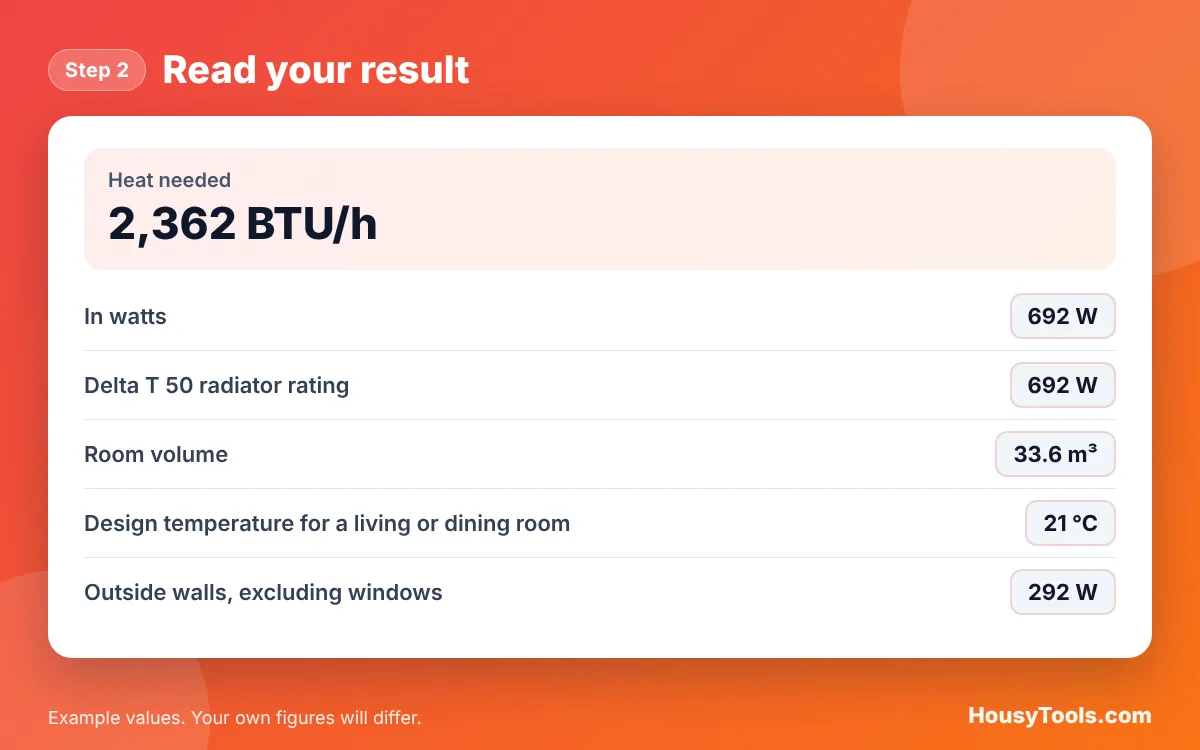
Quick answer: A BTU calculator adds up the heat a room loses, then multiplies watts by 3.412 to get BTU per hour. A 4 m by 3.5 m living room with one unfilled cavity outside wall, 2 m² of older double glazing and a heated room above needs about 692 W, or 2,362 BTU/h, at -3 °C outside.
What Is a BTU Calculator?
A BTU calculator is a tool that estimates the heat output, in British thermal units per hour, needed to keep a room at a comfortable temperature on a cold winter day. One watt equals about 3.412 BTU per hour, according to the definition of the British thermal unit, so the same figure can be read in either unit.
The formula in plain words: for each outside surface, multiply its area by its U-value and by the difference between the room temperature and the outside design temperature. Do the same for the windows, for a ceiling under a loft and for a ground floor (using 10 °C for the ground). Then add the air heat loss: 0.33 times the air changes per hour times the room volume times the temperature difference. Add everything up for watts and multiply by 3.412 for BTU per hour.
How Do You Use the BTU Calculator?
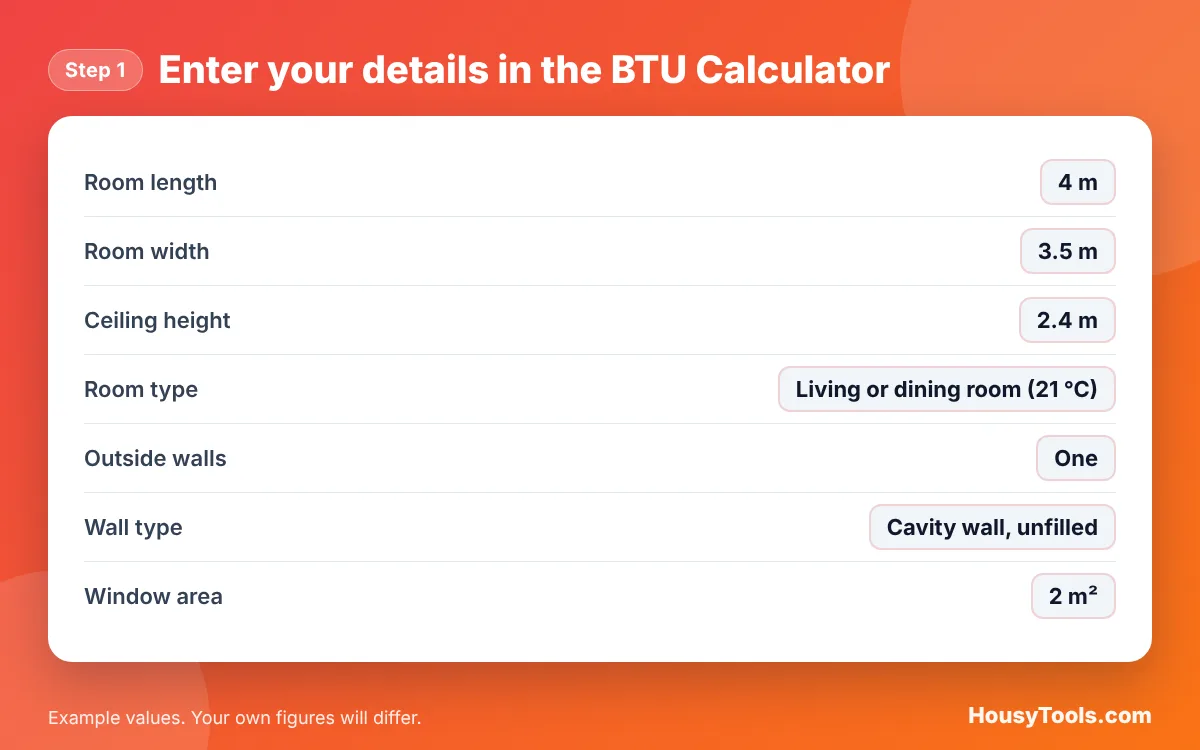
- Enter the Room length, Room width and Ceiling height. Turn on the imperial switch if you measured in feet.
- Choose the Room type, which sets the design temperature, and the number of Outside walls.
- Choose the Wall type, enter the Window area and pick the Glazing.
- Set what is Above the room and Below the room.
- Check the Outside design temperature for your area and the Air changes per hour.
- Pick the Radiator Delta T your system runs at, so the tool can give the catalogue rating to buy.
- Read the result and open “Show the formula and working” to see the heat lost through each part of the room.

How Many BTUs Do I Need for My Room?
Typical UK rooms need roughly 750 to 6,200 BTU/h (about 220 to 1,820 W), and the figure depends far more on insulation and outside walls than on floor area. A small insulated bedroom can need under 1,000 BTU/h, while a large solid brick living room with single glazing can need over 6,000. The table shows results from this calculator at -3 °C outside with 1 air change per hour.
| Room | Construction | Watts | BTU/h |
|---|---|---|---|
| Small bedroom, 3 x 2.5 m | One outside wall, filled cavity, modern double glazing 1.2 m² | 223 W | 761 |
| Bathroom, 2.5 x 2 m | One outside wall, unfilled cavity, older double glazing 0.6 m² | 357 W | 1,218 |
| Bedroom, 4 x 3.5 m, under insulated loft | One outside wall, unfilled cavity, older double glazing 2 m² | 653 W | 2,228 |
| Living room, 4 x 3.5 m | One outside wall, unfilled cavity, older double glazing 2 m² | 692 W | 2,362 |
| Bedroom, 4 x 3.5 m, under poorly insulated loft | One outside wall, unfilled cavity, older double glazing 2 m² | 812 W | 2,769 |
| Corner bedroom, 4 x 3.5 m | Two outside walls, unfilled cavity, older double glazing 2 m² | 888 W | 3,030 |
| Living room, 5 x 4 m, ground floor | Two outside walls, solid brick, single glazing 3 m², uninsulated floor | 1,817 W | 6,201 |
Why Do Simple BTU Rules of Thumb Get It Wrong?
Simple rules that multiply room volume by a fixed factor ignore insulation, so they can be out by half or more for the same size room. In this calculator, the same 4 m by 3.5 m living room needs 784 W with solid brick walls, 692 W with an unfilled cavity, 492 W with a filled cavity and 388 W with modern walls and glazing. That is a two to one spread with identical dimensions. The heat per cubic metre row in the results shows the factor that suits your room, which you can compare with any rule you have seen.
What Temperatures Should a BTU Calculation Use?
Use 21 °C for living rooms, 18 °C for bedrooms, kitchens and halls, and 22 °C for bathrooms, with an outside temperature of about -3 °C in London and lower further north. These room temperatures come from the CIBSE Domestic Heating Design Guide, as listed in the MCS heat load calculator design conditions, which give UK outdoor design temperatures from -1.5 °C to -5.6 °C. Manchester is about -4.5 °C and Edinburgh about -5.4 °C. A colder design temperature gives a bigger, safer answer.
How Do I Turn BTUs Into a Radiator Size?
Radiators are sold by their output at Delta T 50, so divide the heat needed by the correction factor for your system: 1.0 at Delta T 50, 0.747 at Delta T 40 and 0.513 at Delta T 30, from the Stelrad correction factor table. A heat pump running at Delta T 30 therefore needs a radiator rated almost twice the room’s heat loss. The calculator does this for you, and the radiator size calculator and radiator output calculator help you choose and check a specific radiator.
Worked Example: A Corner Bedroom
Example: a corner bedroom in a 1970s house measures 4 m by 3.5 m with a 2.4 m ceiling. It has two outside cavity walls that were never filled, 2 m² of older double glazing and heated rooms above and below. The house is near London, so the calculation uses -3 °C outside.
- Temperature difference: 18 °C minus -3 °C = 21 °C.
- Walls: (4 + 3.5) x 2.4 = 18 m², minus 2 m² of window = 16 m² x 1.6 x 21 = 538 W.
- Windows: 2 m² x 2.8 x 21 = 118 W.
- Air: 0.33 x 1 x 33.6 m³ x 21 = 233 W.
- Total: 888 W x 3.412 = 3,030 BTU/h.
With a gas boiler at Delta T 50, the room needs a radiator rated about 888 W. With a switch to a heat pump running at Delta T 30, the catalogue rating rises to 1,731 W, or 5,907 BTU/h. Filling the cavity would cut the wall loss from 538 W to 168 W. More heating tools are in the heating calculators section.
BTU Calculator FAQs
How do you convert watts to BTU?
Multiply watts by 3.412 to get BTU per hour, and divide BTU per hour by 3.412 to get watts. A 1,000 W radiator gives about 3,412 BTU/h. A kW is 1,000 W, so 1 kW is about 3,412 BTU/h.
How many BTU per square metre do I need?
There is no single correct figure, because insulation, windows and outside walls matter more than floor area. In the examples on this page, a 14 m² room needs from about 95 to 215 BTU/h per square metre depending on construction. Enter your room’s details for a figure that fits it.
Should I round my BTU result up?
Yes, choose the next radiator size up rather than down. A slightly larger radiator with a thermostatic valve simply reaches temperature faster, while an undersized one cannot keep the room warm on the coldest days.
Does the calculator include heat from neighbouring rooms?
It assumes rooms next to, above and below are heated to a similar temperature, so no heat is lost through internal walls. If a neighbouring space is unheated, such as a garage, treat that wall as an outside wall for a safer answer.
What air change rate should I use?
The default of 1 air change per hour suits a typical room. Use a higher figure for a draughty room with an open chimney or gappy floorboards, and a lower one for a new, airtight home with mechanical ventilation.
Is a BTU calculator good enough to size a heat pump?
It is a good first estimate, but MCS rules require a room by room heat loss calculation to BS EN 12831 by the installer, using measured U-values and local design temperatures. Use this result to check a quote, not to replace the survey.
Checked October 2026. Sources: Wikipedia, British thermal unit, MCS heat load calculator, Design conditions, Stelrad correction factor table, MCS MIS 3005-D, Wikipedia, Density of air.