
Show the formula and working
This free shower water usage calculator works out how many litres each shower uses and what it costs in water and heating, for homes in the UK, Ireland and Europe. It works for electric showers from their kW rating, for mixer and power showers from their flow rate, or from a simple bucket test, and compares the result with a bath.
Quick answer: A shower water usage calculator multiplies the flow rate by the minutes. An 8 minute shower at 10 litres a minute uses 80 litres, as much as a typical bath, and costs about 57p with gas heating and an example 4.00 per m³ water price. A 9.5 kW electric shower uses about 36 litres in that time.

What Is a Shower Water Usage Calculator?
A shower water usage calculator is a tool that estimates the litres of water a shower uses and the cost of the water and the energy to heat it, per shower and per year.
The formula in plain words: litres per shower equal the flow rate in litres a minute times the minutes. For an electric shower, the flow equals the kW rating times 60, divided by 4.18 times the temperature rise. The heating energy in kWh equals the litres times 4.18 times the temperature rise, divided by 3,600, and divided by the heater’s efficiency for gas or a heat pump. The cost adds the energy times its unit rate to the cubic metres times the water price.
How Do You Use the Shower Water Usage Calculator?
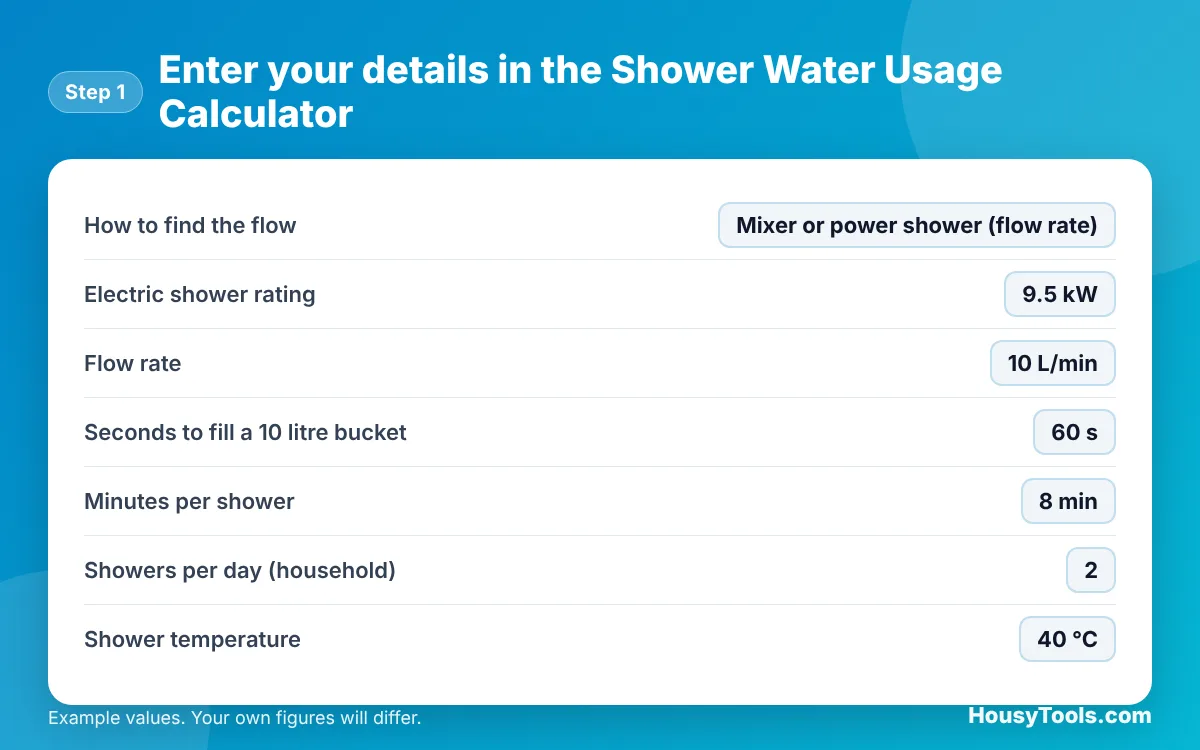
- Choose How to find the flow: electric shower, mixer or power shower, or bucket test.
- Enter the Electric shower rating, the Flow rate or the Seconds to fill a 10 litre bucket to match your choice.
- Enter the Minutes per shower and Showers per day (household), and check the Shower temperature and Cold water temperature.
- Enter the Hot water fuel unit rate and Water heater efficiency for a mixer, or the Electricity unit rate for an electric shower, and your Water and sewerage price per m³.
- Read the litres and cost per shower and per year, then open “Show the formula and working” to see each step.


How Much Water Does a Shower Use per Minute?
A shower uses anything from a few litres a minute to well over 10, depending on the type, the shower head and the water pressure. An electric shower’s flow is limited by its power: a 9.5 kW shower warming water by 30 °C can deliver only about 4.5 litres a minute, while mixer showers on a combi boiler or unvented cylinder often run much faster, and pumped power showers faster still. The bucket test gives your own figure in a minute.
Is a Shower Cheaper Than a Bath?
A short shower is cheaper than a bath, but a long or powerful one may not be. Waterwise puts a typical bath at around 80 litres and says a power shower can use more than a bath. At 10 litres a minute, an 8 minute shower already matches it. The electric shower cost calculator looks at the energy side of electric showers in more detail.
Why Does an Electric Shower Use Less Water?
An electric shower heats water as it flows, so it can only run as fast as its element can warm the water. Heating water takes 4.18 kJ per litre for each degree, as listed on Wikipedia’s specific heat capacity page. A 9.5 kW element therefore manages about 4.5 litres a minute with a 30 °C rise, and less in winter when the mains is colder. Less water does not mean cheap, though, because electricity costs more per kWh than gas.
How Much Does a Shower Cost?
An 8 minute mixer shower at 10 litres a minute costs about 57p: 24.68p for the gas to heat it at 7.97p per kWh with a 90% boiler, and 32p of water and sewerage at the example price. A 9.5 kW electric shower for 8 minutes costs about 48p: 33.34p of electricity at 26.32p per kWh and 14.55p of water. Both unit rates are the Ofgem cap for October to December 2026.
Shower Water and Cost by Flow Rate
An 8 minute shower at 40 °C from 10 °C mains, heated by a 90% gas boiler at 7.97p per kWh, with water and sewerage at an example 4.00 per m³.
| Flow rate | Litres per shower | Gas heating | Water and sewerage | Total per shower |
|---|---|---|---|---|
| 4.5 L/min | 36 | 11.10p | 14.40p | 25.50p |
| 6 L/min | 48 | 14.81p | 19.20p | 34.01p |
| 8 L/min | 64 | 19.74p | 25.60p | 45.34p |
| 10 L/min | 80 | 24.68p | 32.00p | 56.68p |
| 12 L/min | 96 | 29.61p | 38.40p | 68.01p |
| 15 L/min | 120 | 37.02p | 48.00p | 85.02p |
Worked Example: A Mixer Shower on a Gas Boiler
Example: a mixer shower running at 10 litres a minute for 8 minutes, twice a day, at 40 °C from 10 °C mains water, heated by a 90% gas boiler at 7.97p per kWh, with an example water and sewerage price of 4.00 per m³. These are the default inputs.
- Water: 10 x 8 = 80 litres per shower.
- Heat: 80 x 4.18 x 30 / 3,600 = 2.79 kWh, / 0.9 = 3.10 kWh of gas, costing 24.68p.
- Water and sewerage: 0.08 m³ x 4.00 = 32p.
- Per shower: 56.68p. Per year at 2 a day: 58.4 m³ and £413.75.
Cutting each shower to 4 minutes halves both the water and the cost. If your hot water comes from an immersion heater instead, enter 26.32 in Hot water fuel unit rate and 100 in Water heater efficiency; the immersion heater cost calculator covers heating the whole cylinder.
Shower Water Usage Calculator FAQs
How many litres does a 10 minute shower use?
A 10 minute shower uses 10 times its flow rate: about 45 litres from a 9.5 kW electric shower, 100 litres from a 10 litre a minute mixer and more from a power shower. Do a bucket test to find your own flow.
How do I do a shower bucket test?
Mark 10 litres on a bucket, run the shower at your usual setting, and time how many seconds it takes to fill to the mark. Enter the seconds in the calculator. 60 seconds means 10 litres a minute, and 120 seconds means 5.
Do aerated or eco shower heads save water?
Yes. Aerated and flow limited shower heads lower the litres per minute while keeping the spray feeling full, which cuts both water and heating costs on mixer showers. They should not be fitted to electric showers unless the shower maker approves them.
Is an electric shower cheaper than a gas heated shower?
Not always. An electric shower uses less water, but electricity costs over three times as much per kWh as gas under the October 2026 cap. In the examples above, 8 minutes costs about 48p electric against 57p for a faster mixer.
Does shower water cost money without a meter?
Without a water meter your water bill is fixed, so shorter showers do not cut it, but they still save the energy to heat the water. Set Water and sewerage price per m³ to 0 to see the energy cost alone.
How hot is a normal shower?
Most people shower at around 38 to 42 °C, so the calculator uses 40 °C as an example. A hotter shower needs more energy for every litre, and a thermostatic mixer helps keep the temperature steady and safe.
For more home running costs, see the home calculators.
Checked October 2026. Sources: Save water (Waterwise), Specific heat capacity (Wikipedia), Energy price cap unit rates (Ofgem).