
Show the formula and working
This free dilution ratio calculator works out exactly how much concentrate and how much water to mix for any ratio printed on a cleaning product, garden feed or other concentrate, for households in the UK, Ireland and Europe and anywhere else that measures in millilitres. It handles both ways labels write ratios, works from the total you want to make or from the concentrate you have, and can show the strength of the final mix.
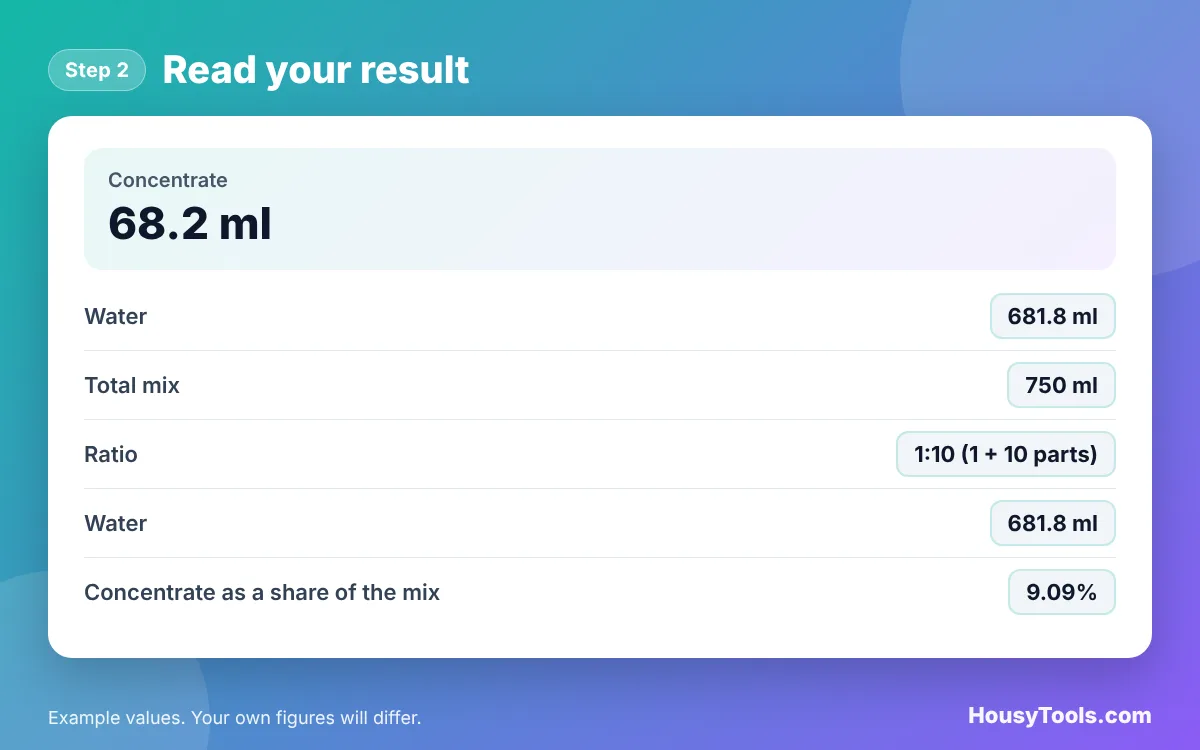
Quick answer: A dilution ratio calculator divides the total mix by the number of parts. A 1:10 ratio usually means 1 part concentrate plus 10 parts water, 11 parts in all, so a 750 ml spray bottle needs 68.2 ml of concentrate and 681.8 ml of water. Read as 1 in 10, it is 75 ml.
What Is a Dilution Ratio Calculator?
A dilution ratio calculator is a tool that turns a ratio such as 1:10 or 1:50 into real amounts of concentrate and water for the container you are filling.
The formula in plain words: work out the total number of parts. If the label means 1 part concentrate plus X parts water, there are 1 + X parts. If it means 1 part in X parts in total, there are X parts. Divide the total volume by the number of parts to get the concentrate, and take that away from the total for the water. Working the other way, multiply the concentrate by the number of parts for the total. A ratio compares quantities, so any unit works as long as both parts use the same one.
How Do You Use the Dilution Ratio Calculator?
- Choose What do you know?: “The total amount I want to make” or “How much concentrate I will use”.
- Enter the second number of the ratio in Ratio: 1 part concentrate to, for example 10 for 1:10.
- Choose How the label counts the ratio. If the label says “1 part to 10 parts water”, choose the first option.
- Enter the Total amount to make or the Concentrate you will use in ml.
- Optionally enter the Active ingredient in the concentrate to see the final strength.
- Read the result and open “Show the formula and working” to see the parts, concentrate and water.


What Does a 1:10 Dilution Ratio Mean?
On most cleaning products, 1:10 means 1 part concentrate mixed with 10 parts water, so the concentrate is 1 of 11 parts in the finished mix. Some labels, and many science and medical uses, mean 1 part in 10 parts in total instead. The difference is small at high ratios but matters at low ones: at 1:4 it is 150 ml against 187.5 ml in a 750 ml bottle. The tool always shows the other reading too, so check the label’s wording.
| Ratio | Concentrate in 750 ml (1 + X parts) | Concentrate in 5 L bucket (1 + X parts) | Concentrate in 750 ml (1 in X) |
|---|---|---|---|
| 1:1 | 375 ml | 2,500 ml | Neat |
| 1:4 | 150 ml | 1,000 ml | 187.5 ml |
| 1:5 | 125 ml | 833.3 ml | 150 ml |
| 1:10 | 68.2 ml | 454.5 ml | 75 ml |
| 1:20 | 35.7 ml | 238.1 ml | 37.5 ml |
| 1:32 | 22.7 ml | 151.5 ml | 23.4 ml |
| 1:50 | 14.7 ml | 98 ml | 15 ml |
| 1:100 | 7.4 ml | 49.5 ml | 7.5 ml |
How Do You Measure Small Amounts of Concentrate?
Use a measuring jug or syringe marked in millilitres for accuracy, or metric spoons: a teaspoon is 5 ml and a tablespoon is 15 ml. The calculator shows the concentrate in tablespoons too, so 68.2 ml is about 4.5 tablespoons. If you only have a kitchen scale, the ml to grams converter explains how density affects the weight, and the litres to gallons converter helps with large containers.
Is It Safe to Mix Cleaning Products?
Never mix different cleaning products, and above all never mix bleach with ammonia, vinegar or other acids, because the mixtures release toxic gases. Dilute each product only with water, in a clean labelled container, following the label’s dilution and safety instructions. Wear gloves where the label says so, ventilate the room, and keep mixes away from children. The HSE guidance on hazardous substances explains why labels and safety data sheets matter.
Worked Example: Filling a 750 ml Spray Bottle at 1:10
Example: a concentrated cleaner says to dilute 1:10 with water, meaning 1 part product plus 10 parts water, and you want to fill a 750 ml spray bottle. These are the tool’s default inputs.
- Parts: 1 + 10 = 11.
- Concentrate: 750 / 11 = 68.2 ml, about 4.5 tablespoons.
- Water: 750 minus 68.2 = 681.8 ml.
- If the label had meant 1 in 10: 75 ml concentrate and 675 ml water.
Put the water in the bottle first, then add the concentrate, to reduce foaming and splashes, and label the bottle with the product name and date.
Dilution Ratio Calculator FAQs
How do I calculate a dilution ratio?
Add the parts together, divide the total volume by that number for the concentrate, and make up the rest with water. For 1:4 in a 1 litre bottle, 1 + 4 = 5 parts, so use 200 ml of concentrate and 800 ml of water.
What does 1:50 mean in ml?
1:50 usually means 1 ml of concentrate for every 50 ml of water. To make 5 litres, use 5,000 / 51 = 98 ml of concentrate and 4,902 ml of water. Read as 1 in 50, it would be 100 ml.
Is 1:10 the same as 10%?
Only if the label means 1 part in 10 parts total. If it means 1 part plus 10 parts water, the concentrate is 1 in 11, about 9.09% of the mix. The calculator shows the share of concentrate for either reading.
Should I add water to concentrate or concentrate to water?
For household cleaners, putting the water in first and adding the concentrate reduces foaming and splashing. Always follow any order the label gives, as some products state a specific method.
Does a stronger mix clean better?
Not necessarily. Using more concentrate than the label says wastes product, can leave sticky residue and may damage surfaces or irritate skin. The maker’s dilution is chosen to work for the stated job.
How long does a diluted cleaner last?
It depends on the product. Some diluted solutions lose strength within a day, so the label may say to make a fresh mix each time. Mix only what you need and label the container with the date.
Checked October 2026. Sources: HSE, COSHH: hazardous substances, Wikipedia, Bleach, Wikipedia, Ratio.