
Show the formula and working
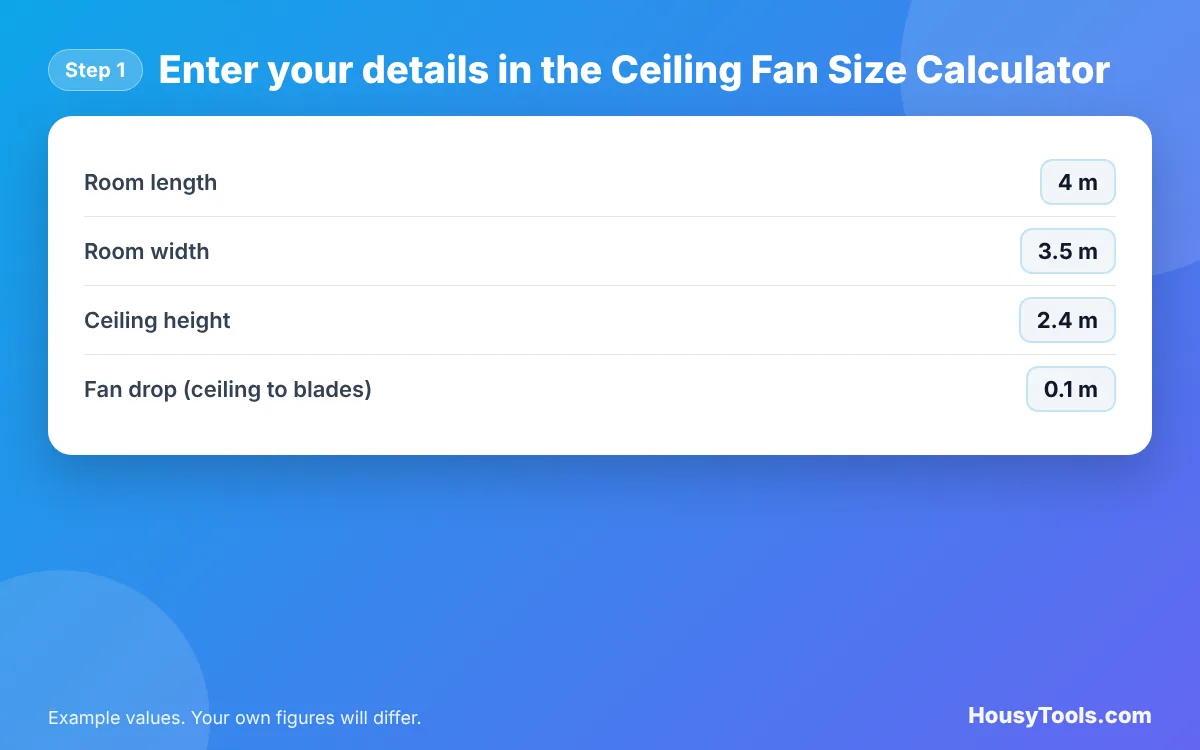
This free ceiling fan size calculator works out the blade span a ceiling fan should have for your room and checks that the blades will hang at a safe height, for homeowners and renters in the UK, Ireland and Europe, where ceilings are often lower than in the US homes most fan guides are written for. Enter the room size, ceiling height and the fan’s drop, in metres or feet.
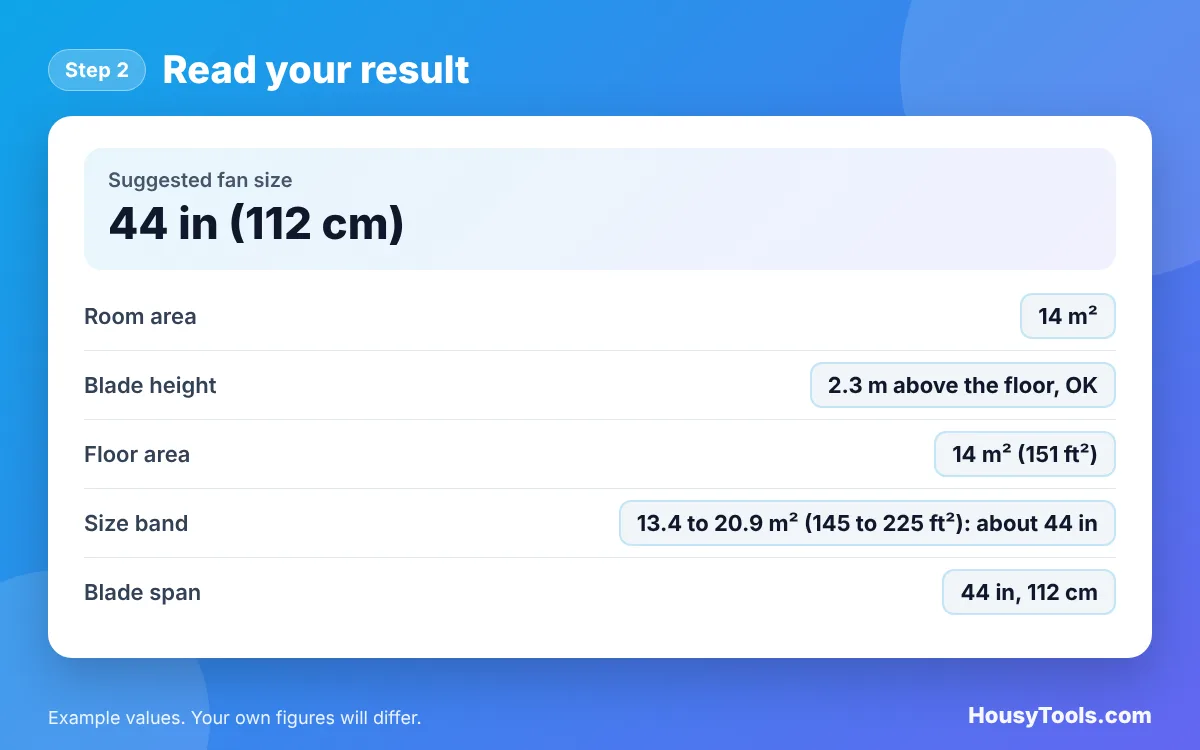
Quick answer: A ceiling fan size calculator matches blade span to floor area. A 4 m by 3.5 m room of 14 m² (151 ft²) suits a fan of about 44 in (112 cm). With a 2.4 m ceiling, choose a fan whose blades hang no more than 0.1 m down, keeping them 2.3 m above the floor.

What Is a Ceiling Fan Size Calculator?
A ceiling fan size calculator is a tool that recommends a fan’s blade span, the tip to tip diameter, from the room’s floor area, and checks the blade height above the floor.
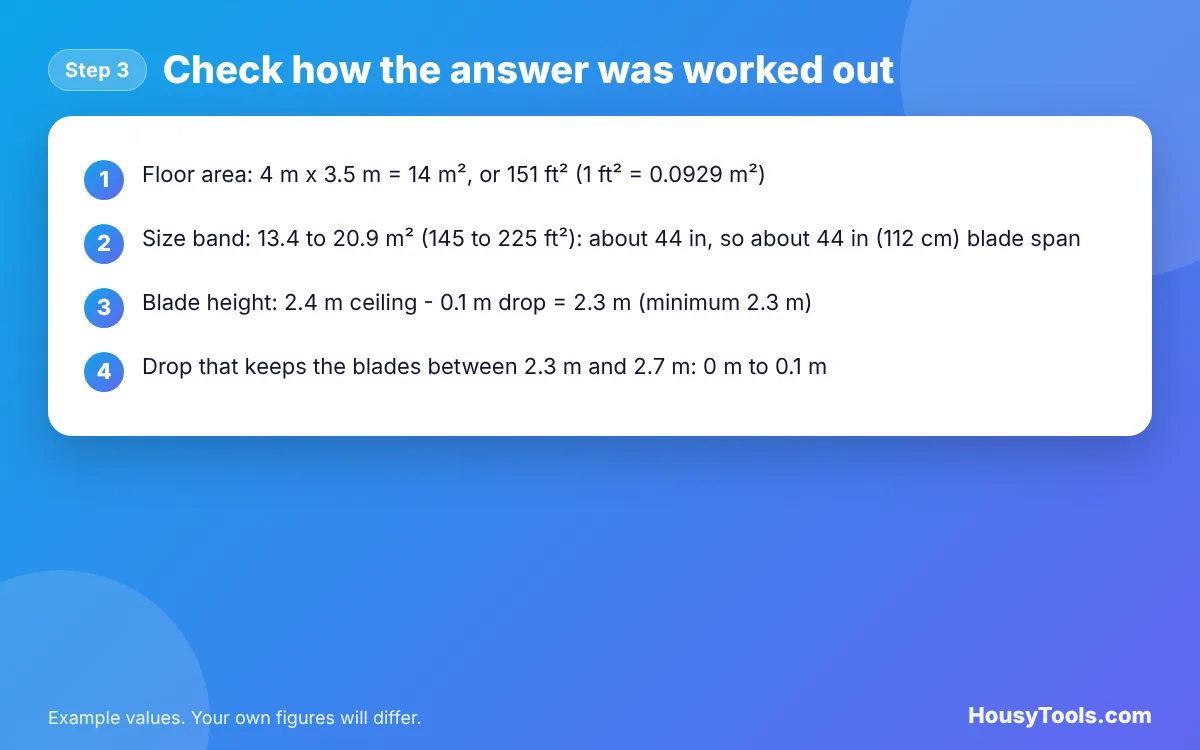
The formula in plain words: multiply length by width for the floor area, convert it to square feet because fan sizes are sold in inches, and pick the size band it falls in. Then take the fan’s drop away from the ceiling height to get the blade height. The US Department of Energy’s Energy Saver guide to fans says a 36 or 44 inch fan suits rooms up to 225 ft², about 20.9 m², and a fan of 52 inches or more suits larger rooms. European fan manuals, following EN 60335-2-80, require the blades to be at least 2.3 m above the floor.
How Do You Use the Ceiling Fan Size Calculator?
- Enter the Room length and Room width. Use the imperial switch if you measured in feet.
- Enter the Ceiling height from floor to ceiling.
- Enter the Fan drop (ceiling to blades) from the data sheet of the fan you are considering, including any downrod.
- Read the result and open “Show the formula and working” to see the area, size band, blade height and the drop range that suits your ceiling.
What Size Ceiling Fan Do I Need for My Room?
Most bedrooms of 7 to 13 m² suit a fan of about 36 inches, rooms of 13 to 21 m² about 44 inches, and larger living spaces 52 inches or more. The two bands from the Department of Energy are split further in the table using a common rule of thumb.
| Floor area | Square feet | Fan blade span | Example room |
|---|---|---|---|
| Up to 7 m² | Up to 75 ft² | Up to 36 in (91 cm) | Box room, 2.5 x 2.5 m |
| 7 to 13.4 m² | 76 to 144 ft² | About 36 in (91 cm) | Single bedroom, 3.5 x 3 m |
| 13.4 to 20.9 m² | 145 to 225 ft² | About 44 in (112 cm) | Double bedroom, 4 x 3.5 m |
| 20.9 to 37.2 m² | 226 to 400 ft² | 52 in (132 cm) or more | Living room, 6 x 4 m |
| Over 37.2 m² | Over 400 ft² | 56 in (142 cm) or more, or two fans | Open plan, 8 x 5 m |
How High Should Ceiling Fan Blades Be?
In the UK and EU, ceiling fan blades must be at least 2.3 m above the floor, a figure that appears in fan installation manuals. The Department of Energy adds that fans work best with blades 7 to 9 feet (about 2.1 to 2.7 m) above the floor and 10 to 12 inches below the ceiling. In a home with a 2.4 m ceiling, the 2.3 m rule wins, so the blades can drop only 0.1 m. That means a flush mount or low profile fan, which moves a little less air than one hung lower.
Can You Fit a Ceiling Fan With a Low Ceiling?
You can fit a ceiling fan only if the blades will still be at least 2.3 m above the floor, so a ceiling of 2.3 m or less is too low for one. Between about 2.35 and 2.5 m, look for flush or “hugger” models with a short drop and check the drop figure on the data sheet. If no fan fits, a pedestal or tower fan is the safer choice. The calculator flags the largest drop your ceiling allows.
How Much Does a Ceiling Fan Cost to Run?
Ceiling fans use far less power than air conditioning, so running costs are usually small. Take the wattage from the fan’s label, multiply by the hours you run it, and divide by 1,000 for kWh. The electricity cost calculator does this with your own unit rate. For the room’s volume, which matters for air purifiers and dehumidifiers, use the room volume calculator.
Worked Example: A Ceiling Fan for a UK Double Bedroom
Example: a double bedroom 4 m by 3.5 m with a 2.4 m ceiling, looking at a low profile fan with a 0.1 m drop. These are the tool’s default inputs.
- Floor area: 4 x 3.5 = 14 m², which is 151 ft².
- Size band: 145 to 225 ft², so a fan of about 44 in (112 cm).
- Blade height: 2.4 m minus 0.1 m = 2.3 m, which meets the 2.3 m minimum.
- Largest drop allowed: 0.1 m, so a fan with a downrod would be too low here.
A ceiling fan needs a secure fixing into a joist or a rated support and a suitable electrical supply. Have it installed by a qualified electrician, and see Electrical Safety First for guidance on electrical work at home.
Ceiling Fan Size Calculator FAQs
What size ceiling fan for a 12 foot by 12 foot room?
A 12 by 12 foot room is 144 ft², about 13.4 m², which sits at the top of the 36 inch band. A 36 to 44 inch fan suits it, and the larger size gives gentler airflow at lower speed.
How do I measure a ceiling fan’s size?
Fan size is the blade span: the diameter of the circle the blade tips make. For an even number of blades, measure tip to opposite tip. For an odd number, measure from the centre to one tip and double it.
What is the minimum ceiling height for a ceiling fan?
The blades must be at least 2.3 m above the floor in the UK and EU, so the ceiling must be 2.3 m plus the fan’s drop. A flush fan with a 0.1 m drop needs a ceiling of at least 2.4 m.
Is a bigger ceiling fan better?
A fan sized for the room moves enough air at a lower, quieter speed. Too small a fan has to run fast to be felt, and too large a fan in a small room can feel draughty and crowd the ceiling. Match the size band to the floor area.
Should I use two fans in a long room?
If the room is more than about twice as long as it is wide, two smaller fans spaced along it usually spread air more evenly than one large fan in the middle. The calculator flags long rooms automatically.
Can I install a ceiling fan myself?
Fitting a ceiling fan involves fixed wiring and a load bearing fixing, so use a qualified electrician. In England and Wales, some electrical work must also meet Part P of the Building Regulations, which a registered electrician can self certify.
Checked October 2026. Sources: US Department of Energy, Energy Saver: Fans for cooling, EU ceiling fan installation manuals citing a 2.3 m minimum blade height (EN 60335-2-80), Electrical Safety First.