
Show the formula and working
This off grid solar calculator sizes the solar panels and battery bank for a cabin, van, boat, workshop or outbuilding with no grid connection, using solar data for UK, Irish and northern European locations. Enter your daily use, location and the month you design for, plus battery details, and it shows the array size, the number of panels and the battery capacity in kWh and amp hours.
Quick answer: An off grid solar array needs enough kWp to cover daily use, after losses, on the worst day you design for. For 3 kWh a day in London in December, at 1.23 kWh per kWp a day and 85% efficiency, you need about 2.88 kWp, and a battery of about 8.8 kWh for two sunless days at 80% depth of discharge.
What Is an Off Grid Solar Calculator?
An off grid solar calculator is a tool that sizes a stand alone solar system, panels plus batteries, so that it can meet a daily electricity load without a grid connection.
The formula in plain words: the energy the panels must make each day is your daily use divided by the system efficiency, which covers battery and inverter losses. Divide that by the daily output of 1 kWp in your design month to get the array size in kWp. The battery must hold your daily use times the days of autonomy, divided by the usable depth of discharge and the efficiency. Divide the battery’s watt hours by its voltage to get amp hours.
How Do You Use the Off Grid Solar Calculator?
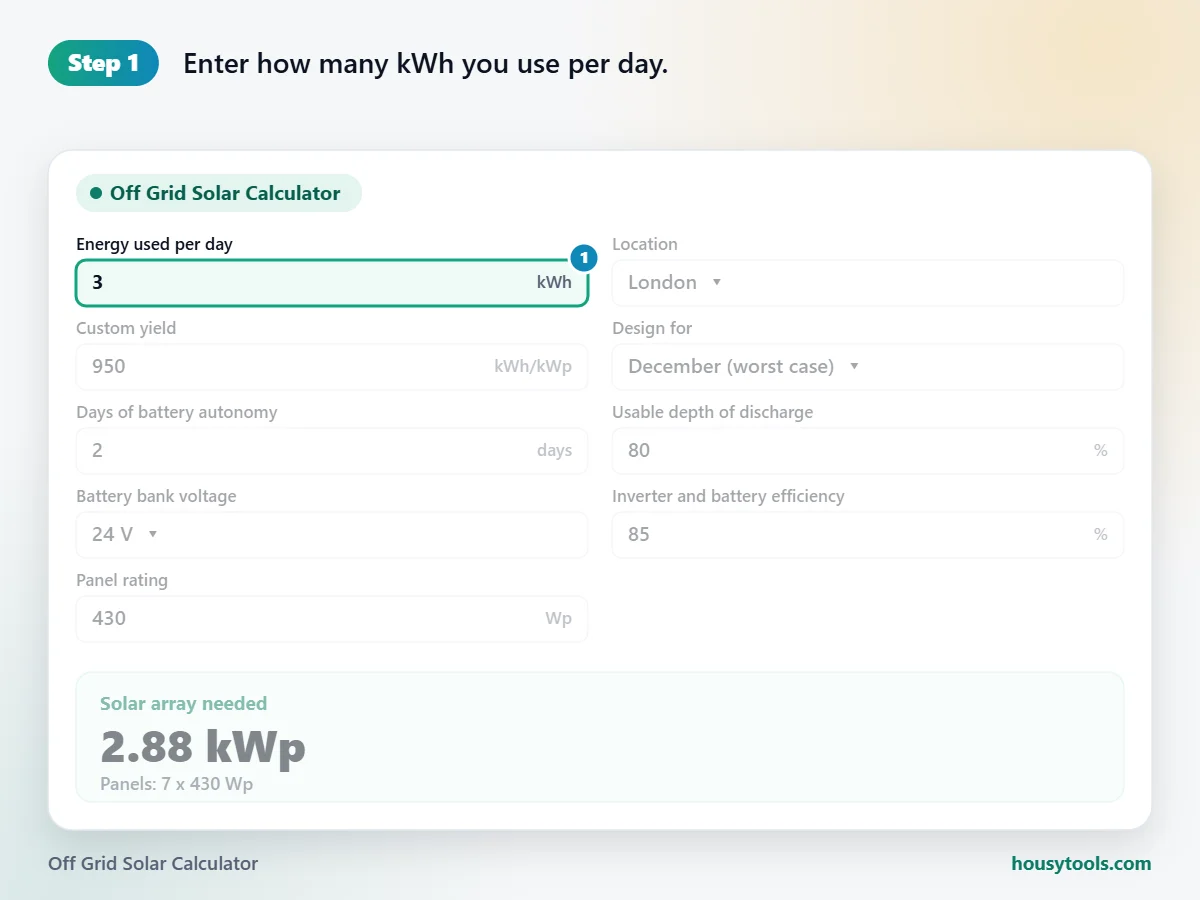
- Enter how many kWh you use per day.
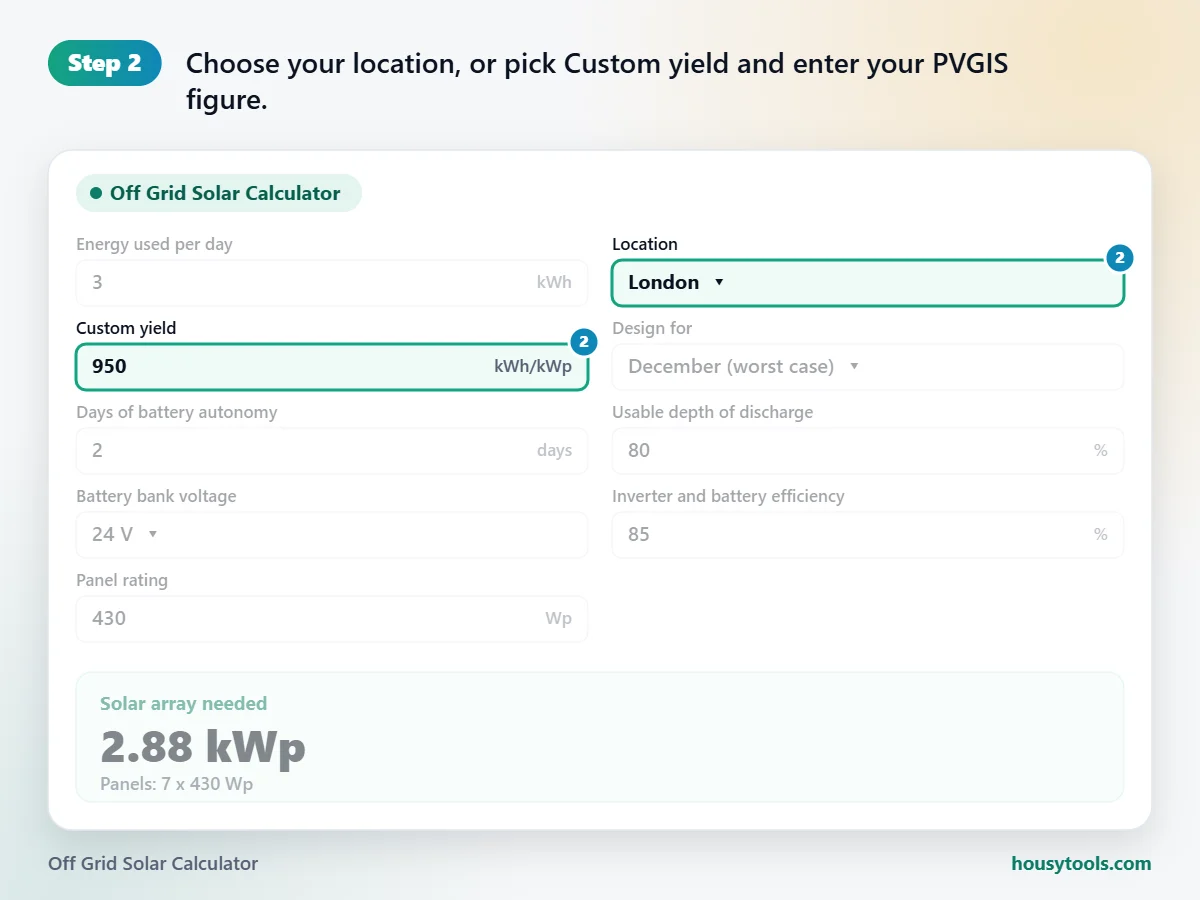
- Choose your location, or pick Custom yield and enter your PVGIS figure.
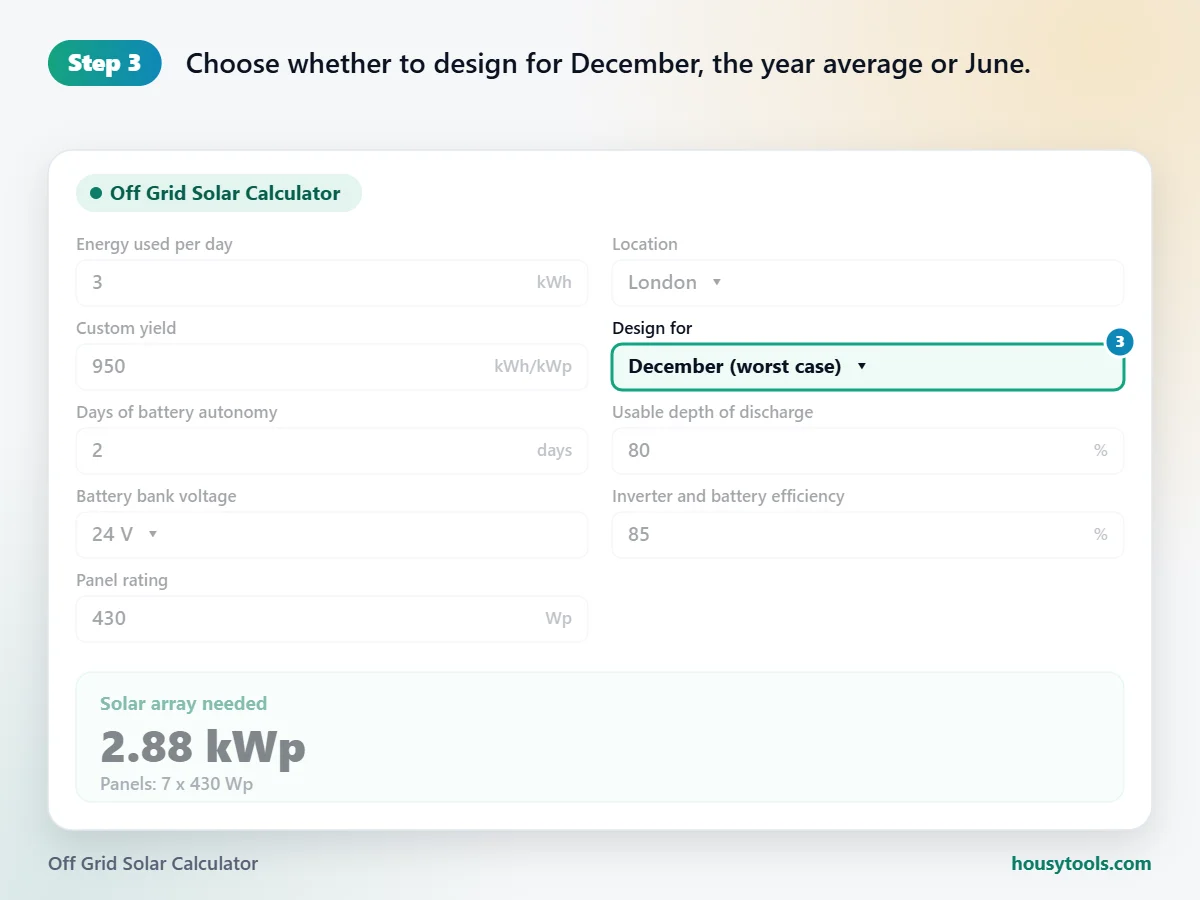
- Choose whether to design for December, the year average or June.
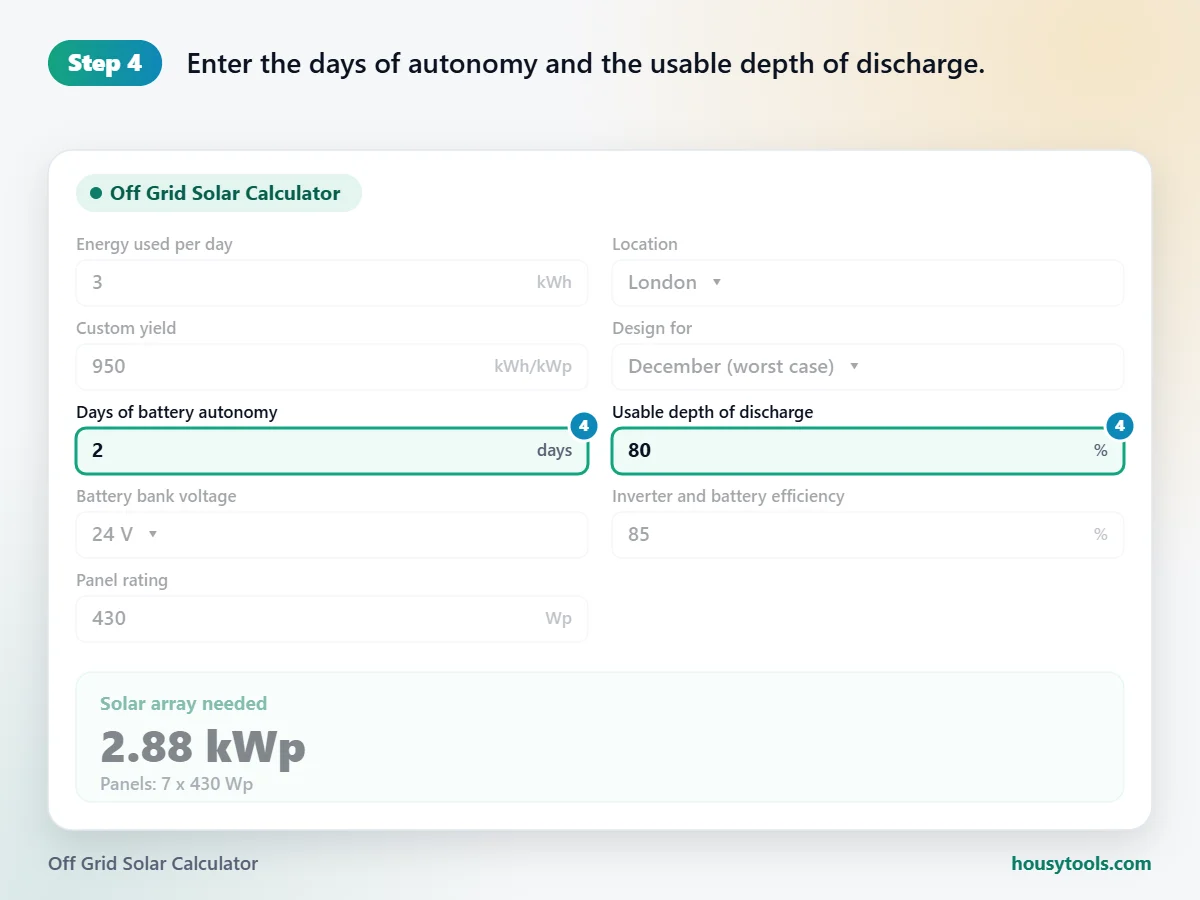
- Enter the days of autonomy and the usable depth of discharge.
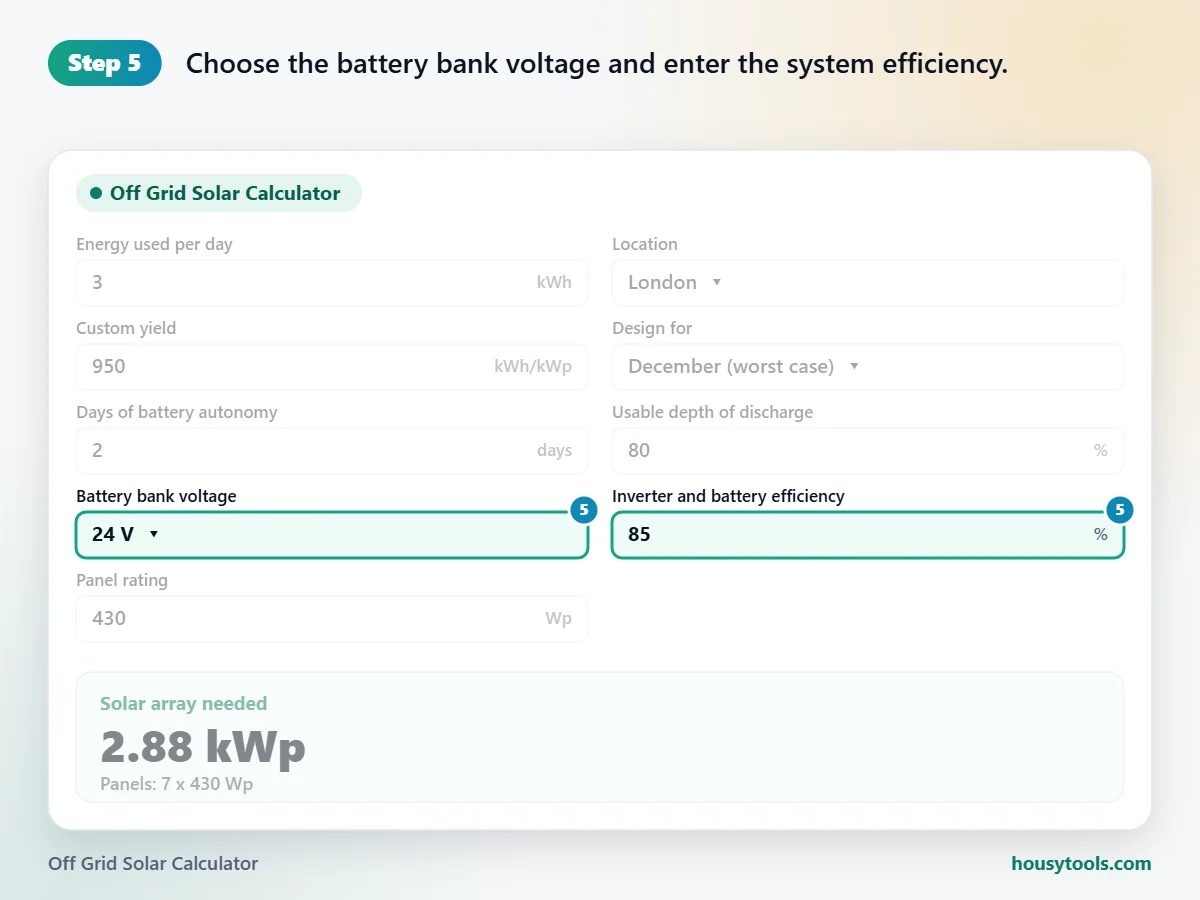
- Choose the battery bank voltage and enter the system efficiency.
- Enter the panel rating, then read the array size, panel count and battery bank.

How Big Should an Off Grid Solar System Be?
Size it for the month you need it most: in London, covering 3 kWh a day in December needs more than three times the array that June needs, because each kWp makes about 1.23 kWh a day in December against 4.0 kWh in June.
| Daily use | June array | Year average array | December array | Battery for 2 days |
|---|---|---|---|---|
| 0.5 kWh | 0.15 kWp | 0.21 kWp | 0.48 kWp | 1.5 kWh |
| 1 kWh | 0.29 kWp | 0.42 kWp | 0.96 kWp | 2.9 kWh |
| 2 kWh | 0.59 kWp | 0.84 kWp | 1.92 kWp | 5.9 kWh |
| 3 kWh | 0.88 kWp | 1.26 kWp | 2.88 kWp | 8.8 kWh |
| 5 kWh | 1.47 kWp | 2.10 kWp | 4.80 kWp | 14.7 kWh |
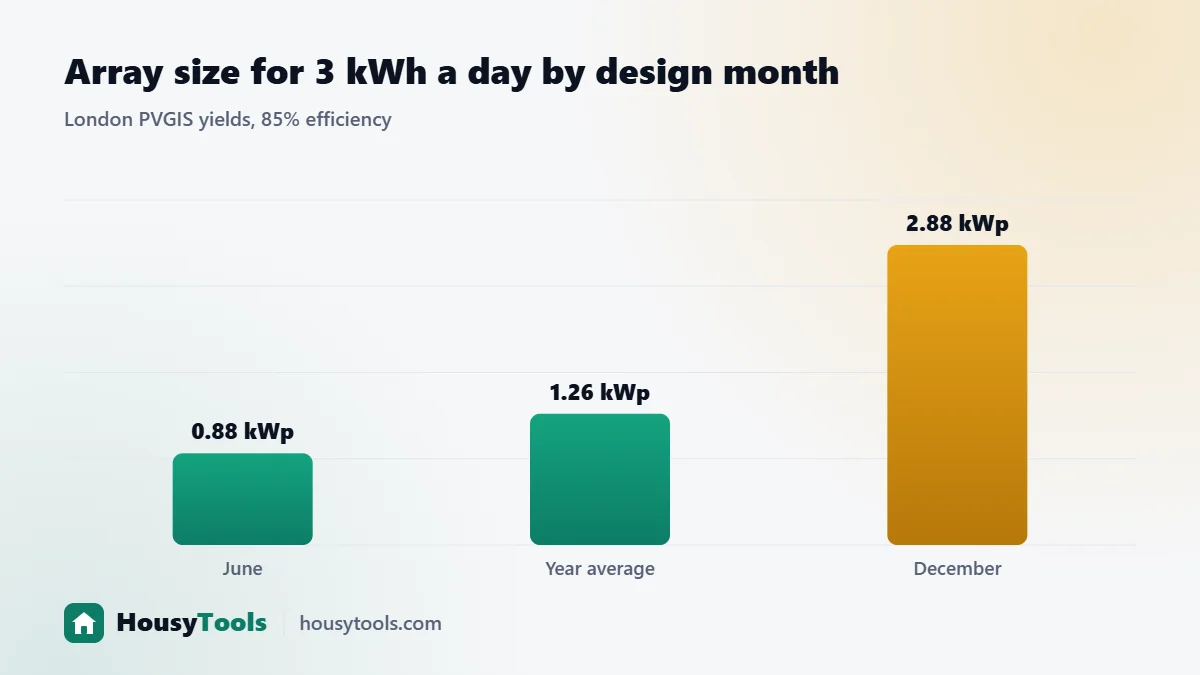
The figures come from the PVGIS tool from the EU Joint Research Centre, which also has an off grid mode for your exact address. Many off grid homes in northern Europe do not try to cover December with solar alone. They size for spring to autumn and add a small generator or wind turbine for the darkest weeks, which costs far less than a huge array that sits mostly unused in summer.
How Do You Work Out Daily Energy Use?
Add up watts times hours of use for every appliance, then divide by 1,000 to get kWh per day.
For example, a 40 W fridge running about a third of the time uses about 0.32 kWh a day, five 6 W LED lights for 5 hours use 0.15 kWh, and a 60 W laptop for 4 hours uses 0.24 kWh. Our appliance wattage calculator helps with the totals, and the inverter size calculator sizes the inverter for the largest loads you run at once. Avoid electric heating and cooking off grid where possible, because they use far more than lights and electronics.
What Battery Do You Need for Off Grid Solar?
The battery bank must hold your daily use for the number of sunless days you want to cover, divided by how deeply the battery can be discharged and by its losses.
Lithium iron phosphate (LiFePO4) batteries are often used at around 80% depth of discharge, while lead acid batteries last longer if they are discharged to about 50%, which nearly doubles the bank you need. Higher system voltages, 24 V or 48 V, keep currents and cable sizes down for larger systems. The solar charge controller calculator sizes the controller that sits between the panels and the battery.
Worked Example: A Summer Cabin Using 1.2 kWh a Day
Example: a cabin used from spring to autumn needs 1.2 kWh a day for lights, a small fridge and phone charging. The owner designs for June in a London climate, wants two days of autonomy and uses a 12 V lithium bank at 80% depth of discharge with 200 Wp panels.
- Panels must make: 1.2 / 0.85 = 1.41 kWh a day
- Array: 1.41 / 4.0 kWh per kWp = 0.35 kWp, so two 200 Wp panels
- Battery: 1.2 x 2 / 0.8 / 0.85 = 3.5 kWh
- At 12 V: 3,529 Wh / 12 V = 294 Ah
- In December the same panels make only about 0.5 kWh a day
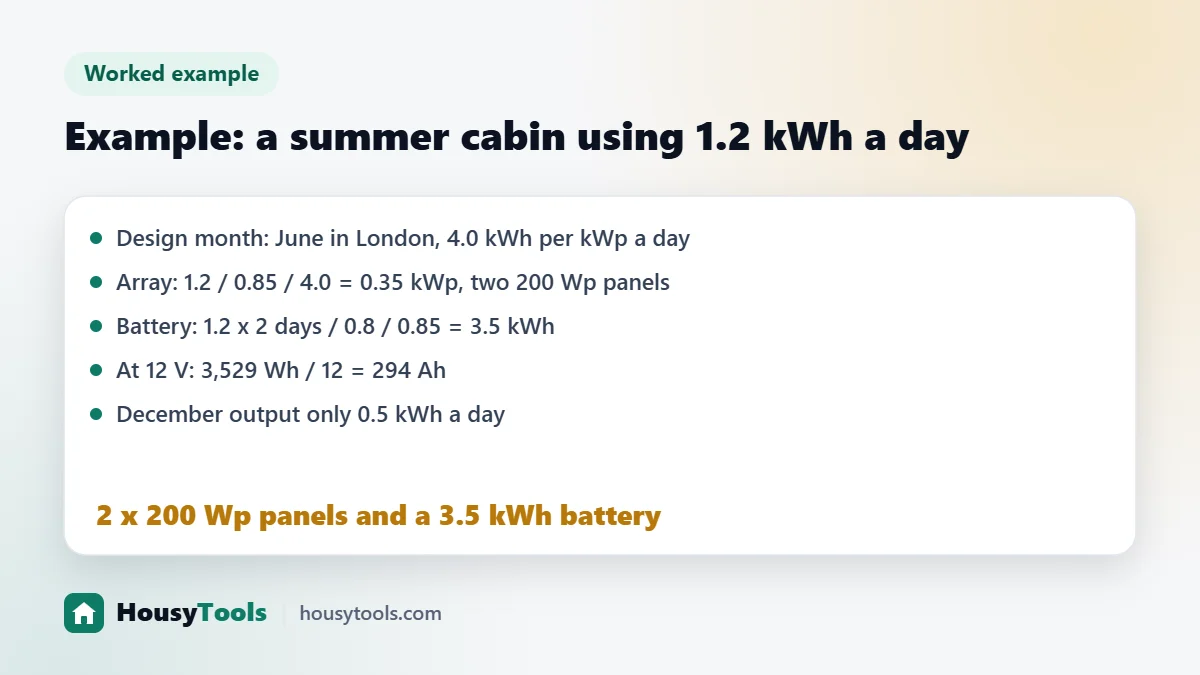
The design works for summer use but not for winter. To use the cabin in December, the owner would need about 0.96 kWp of panels or a backup charging source.
Off Grid Solar Safety
Off grid systems still carry dangerous DC currents and, with an inverter, mains voltage, so they need correct fuses, isolators, cable sizes and earthing.
Batteries must be installed in a ventilated, protected space, following the maker’s instructions. Unless you are competent and qualified, have the system designed and installed by a qualified electrician or solar installer. In the UK, electrical work in homes falls under Part P of the Building Regulations in England and Wales.
Off Grid Solar Calculator FAQs
How many solar panels do I need to run a house off grid?
A house using 8 kWh a day needs about 2.4 kWp in June but about 7.7 kWp in a London December. Most off grid houses in northern Europe add a generator for winter rather than fitting a huge array.
How many batteries do I need for off grid solar?
Multiply daily use by days of autonomy, then divide by depth of discharge and efficiency. For 3 kWh a day and two days at 80% and 85%, that is about 8.8 kWh, or 368 Ah at 24 V.
What are peak sun hours?
Peak sun hours are the daily solar energy expressed as hours of full 1,000 W per m² sunlight. One kWp makes roughly that many kWh a day, which is how this calculator uses PVGIS figures.
Can solar power a cabin all year in the UK?
For small loads such as lights and phones, yes, with a winter sized array and battery. For a fridge, laptop and water pump all year, most cabins also need a generator or other backup.
Should I use 12 V, 24 V or 48 V?
Use 12 V for small systems such as vans, and 24 V or 48 V for larger ones. Higher voltages halve or quarter the current for the same power, allowing thinner cables and smaller controllers.
How long do off grid batteries last?
It depends on chemistry, depth of discharge and temperature. Lithium iron phosphate batteries usually last many more cycles than lead acid. Check the cycle rating on the data sheet.
Checked October 2026. Sources: EU Joint Research Centre PVGIS 5.3.