
Show the formula and working
This stair carpet calculator works out how much carpet you need for a staircase, for homeowners and renters in the UK, Ireland and the rest of Europe: the area to cover, the length to buy off a 4 m or 5 m roll, the underlay area and the cost. It counts how many stair strips fit across the roll, which is the step most simple area calculators leave out, and it has a feet switch and a pound or euro switch.
Quick answer: Add tread depth, riser height and about 2.5 cm for the nosing, multiply by the number of steps and the stair width, then add 10% for wastage. Thirteen steps of 25 cm by 20 cm, 0.9 m wide, cover 6.11 m² with wastage. The stair carpet calculator shows this needs 2.1 m off a 4 m roll.
What Is a Stair Carpet Calculator?
A stair carpet calculator is a tool that turns your step measurements into the carpet area and the roll length to order. In plain words: carpet per step = tread depth + riser height + nosing allowance. Area = carpet per step x number of steps x stair width, plus any landing, plus a wastage percentage.
Carpet is sold off rolls of a fixed width, so the area alone does not tell you what to order. The calculator works out how many strips of your stair width fit side by side across the roll, shares the steps between those strips, and gives the roll length to cut. Joins between strips sit at the back of a tread, where the carpet folds and nobody sees them.
How Do You Use the Stair Carpet Calculator?
- Count the steps and enter them in Number of steps. Count each riser that will be carpeted.
- Measure one step and enter Tread depth and Riser height in centimetres. Measure the tread to the front edge of the nosing.
- Leave Nosing allowance per step at 2.5 cm, or increase it for a deep or rounded nosing.
- Enter Stair width at the widest point and choose your Carpet roll width.
- If the landing is being carpeted in the same carpet, enter Landing length and Landing width.
- Check Wastage and type your retailer’s price into Carpet price per m² (example).
- Read the length to buy, the area bought and the cost, then open “Show the formula and working” to see each step of the sum.
How Much Carpet Do You Need for 13 Stairs?
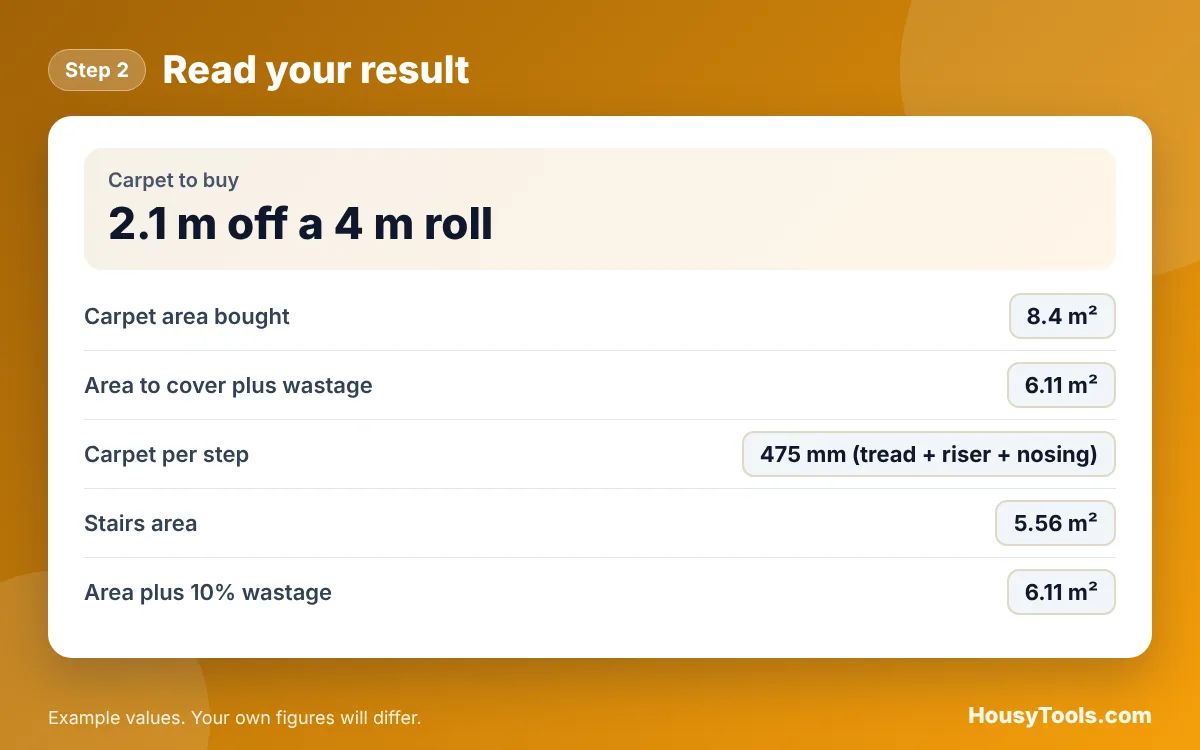
Thirteen typical UK steps, 0.9 m wide with 25 cm treads and 20 cm risers, need about 6.1 m² of carpet including 10% wastage, which is a 2.1 m length off a 4 m roll or a 1.6 m length off a 5 m roll. Thirteen is a common count for a straight flight between two floors in a house, but always count your own steps.
The area you buy is usually larger than the area you cover, because the roll width rarely divides exactly by the stair width. A 4 m roll fits four strips of 0.9 m with 0.4 m left over at the side. That offcut is often useful for a small landing or a cupboard floor.
How Do You Measure Stairs for Carpet?
Measure the depth of one tread from the back to the front edge of the nosing, the height of one riser, and the width of the stair at its widest point, then add about 2.5 cm per step to wrap the nosing. Measure two or three steps, because older stairs vary, and use the largest figures.
For new stairs in England, Approved Document K of the Building Regulations sets private stair risers between 150 mm and 220 mm and goings between 220 mm and 300 mm, so most home steps fall in that range. If your figures sit far outside it, measure again. Winders and kite steps are wider at one end: enter them as separate steps using the deepest tread, or ask your fitter to measure them on site.
How Much Wastage Should You Add for Stair Carpet?
Add 10% to the roll length for trimming and small measuring errors, and more, around 15% to 20%, for patterned or striped carpet that has to line up from step to step. The calculator applies the percentage to the roll length and then rounds up to the next 0.1 m.
The pile should run down the stairs, which means each strip runs along the length of the roll. That is why the strips sit side by side across the roll width rather than end to end. For the rooms at the top and bottom of the stairs, the carpet calculator works out room carpet the same way.
Do You Need Underlay on Stairs?
Yes, most fitted stair carpet goes over underlay on each tread and over the nosing, but not on the risers, so the underlay area is smaller than the carpet area. For the default 13 steps the calculator gives 3.22 m² of underlay, against 5.56 m² of carpet on the stairs themselves.
Stair Carpet Needed by Number of Steps
These figures come from the calculator with 0.9 m wide stairs, 25 cm treads, 20 cm risers, a 2.5 cm nosing allowance and 10% wastage, and no landing.
| Steps | Area plus 10% | Length off a 4 m roll | Length off a 5 m roll |
|---|---|---|---|
| 10 | 4.7 m² | 1.6 m (6.4 m²) | 1.1 m (5.5 m²) |
| 12 | 5.64 m² | 1.6 m (6.4 m²) | 1.6 m (8 m²) |
| 13 | 6.11 m² | 2.1 m (8.4 m²) | 1.6 m (8 m²) |
| 14 | 6.58 m² | 2.1 m (8.4 m²) | 1.6 m (8 m²) |
| 16 | 7.52 m² | 2.1 m (8.4 m²) | 2.1 m (10.5 m²) |
Notice that 12 steps cost the same on a 4 m roll as 10 steps, and 14 or 16 steps the same as 13. Strips are cut in whole steps, so the length to buy jumps in steps, not smoothly.
Worked Example: A Staircase
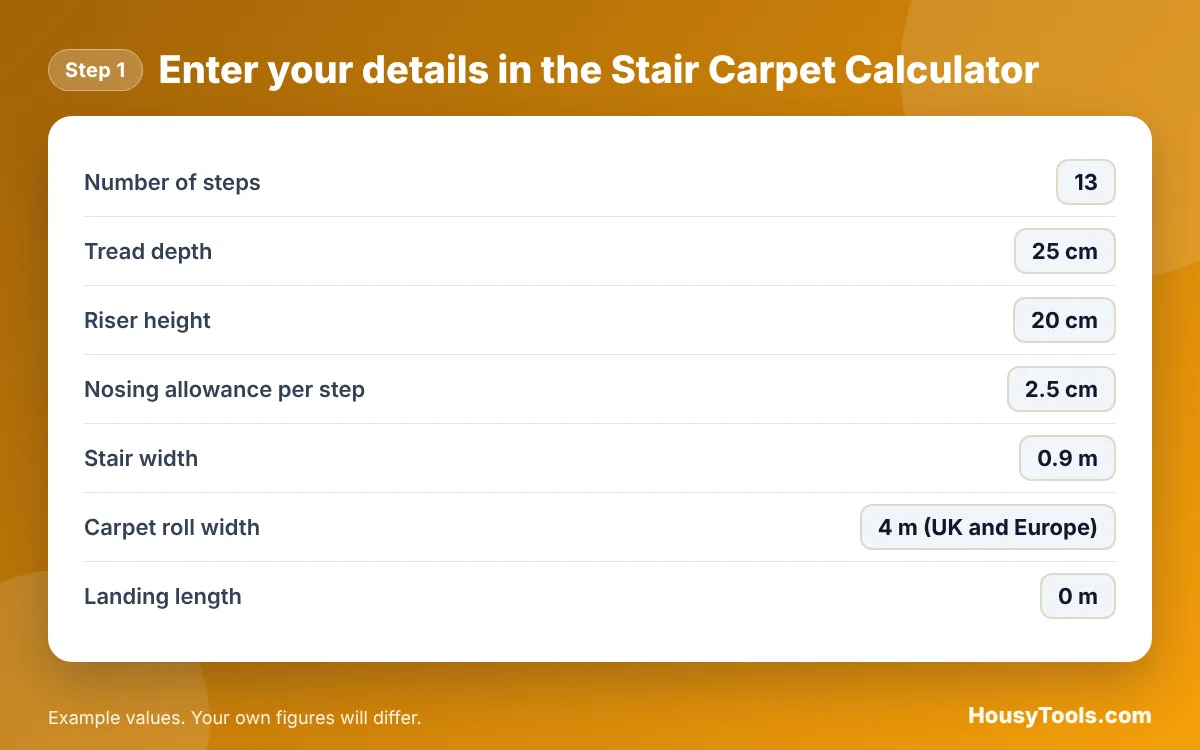
Example: a straight staircase has 13 steps. Each tread is 25 cm deep and each riser is 20 cm high, and the stairs are 0.9 m wide. Keep the 2.5 cm nosing allowance and 10% wastage, choose a 4 m roll and enter an example price of £20 per m².
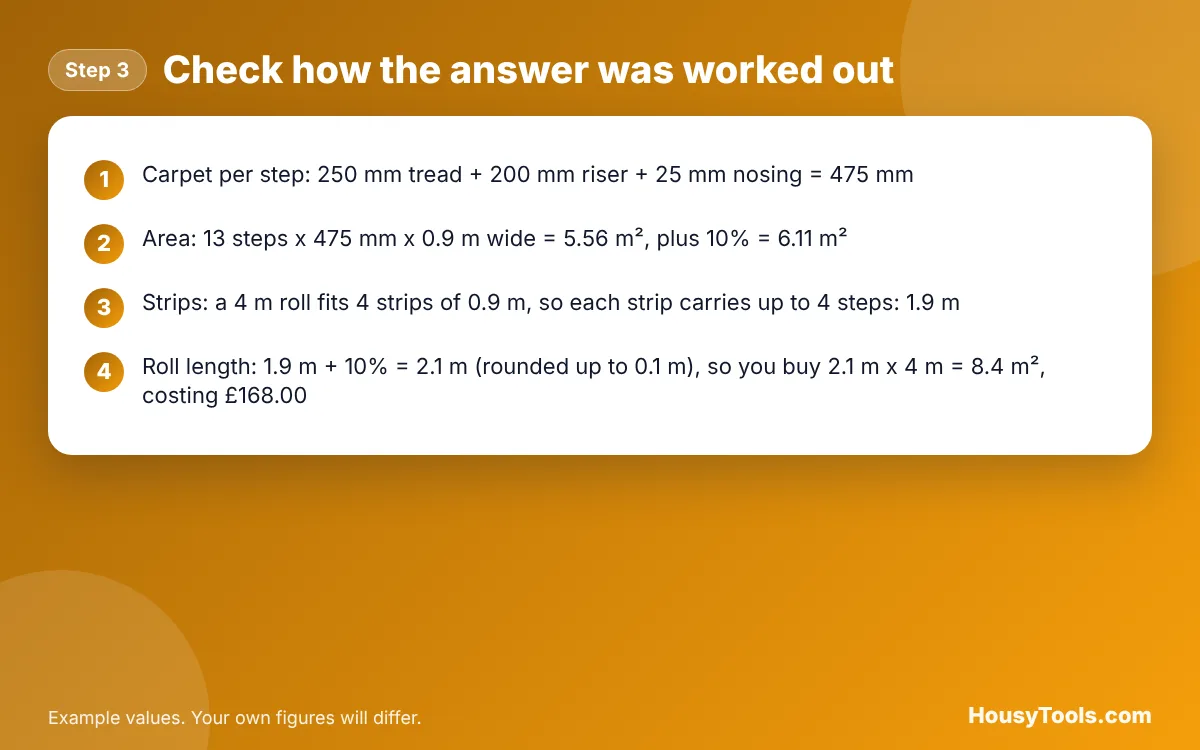
- Carpet per step: 25 + 20 + 2.5 = 47.5 cm.
- Area: 13 x 0.475 m x 0.9 m = 5.56 m², or 6.11 m² with 10% wastage.
- Strips: four 0.9 m strips fit across 4 m, so each strip carries up to 4 steps, which is 4 x 0.475 m = 1.9 m.
- Roll length: 1.9 m + 10% = 2.09 m, rounded up to 2.1 m. You buy 2.1 m x 4 m = 8.4 m² for £168.00, plus 3.22 m² of underlay.
If you add a 1.8 m by 0.9 m landing, the calculator lays the landing piece across the roll, adds 0.9 m of length and gives 3.1 m off the 4 m roll. More flooring tools are on the flooring calculators page.
Stair Carpet Calculator FAQs
How many square metres of carpet do I need for stairs?
A typical step needs about 0.43 m² of carpet when the stairs are 0.9 m wide, so 13 steps need about 5.6 m², or 6.1 m² with 10% wastage. Because of the roll width, the area you actually buy is often 8 m² or more.
What width do carpet rolls come in?
In the UK and Europe, carpet is usually made in 4 m and 5 m widths, while in the United States the common widths are 12 ft and 15 ft. Check with your retailer, because some ranges come in only one width.
Can I carpet stairs from one roll width?
Yes. Fitters cut the roll into strips the width of the stairs and join them at the back of a tread, where the join is hidden in the fold. A 4 m roll gives four strips for stairs up to 1 m wide.
How much extra should I allow for the nosing?
Allow about 2.5 cm, or one inch, per step for the carpet to wrap round the front edge of each tread. A deep, rounded or bullnose step needs more, so measure over the nosing with a flexible tape and enter your own figure.
Does a stair runner use less carpet?
Yes, a runner covers only the middle of each step, so enter the runner width as the stair width. Many runners are sold by the linear metre in a fixed width, in which case the roll length the calculator gives is the length to order.
Should the landing be carpeted in the same piece?
The landing is normally a separate piece cut from the same roll, joined at the top step or the doorway. Enter its length and width and the calculator adds the shortest roll length that fits it, laying it across the roll where possible.
Checked October 2026. Sources: GOV.UK: Approved Document K, protection from falling, collision and impact, Wikipedia: Carpet (roll widths).